
Key takeaways
Automating debt collection with AI contact center software helps agencies and lenders recover more debt while staying compliant with regulations like the FDCPA, TCPA, and TILA
AI virtual agents and agent assist tools reduce manual dialing and scripting errors, letting human agents focus on higher-value, hardship-sensitive conversations.
Propensity-to-pay scoring and conversation analytics help collections teams prioritize accounts most likely to result in successful recovery
Platforms like Level AI, NICE CXone, and Genesys each take a different approach to collections automation, from compliance monitoring to omnichannel outreach
Choosing the right AI contact center depends on your existing tech stack, compliance requirements, and how much of the collections workflow you want to automate versus keep human-led
Introduction
Digital and AI-driven debt collection strategies can improve recovery rates by 20 to 30 percent compared to traditional collection methods, according to industry research on collections technology adoption. That gap matters more than ever. Credit card debt in the United States has climbed past $930 billion, with delinquency rates edging closer to 5 percent as inflation and living costs squeeze household budgets. Collections teams are being asked to recover more, faster, while staying inside an increasingly tight regulatory box built around the FDCPA, TCPA, and state-level consumer protection laws.
That combination, more accounts, tighter margins, and stricter compliance, is exactly why contact centers are turning to AI. Automating debt collection isn't just about dialing faster. It's about giving agents real-time guidance during sensitive conversations, scoring which accounts are worth prioritizing, and catching compliance risks before they turn into fines or lawsuits. In this guide, we'll walk through how AI contact centers actually automate collections workflows, compare the top platforms built for this use case, and show how Level AI approaches the problem differently from the rest of the market.
How AI contact centers automate debt collection
Modern AI-powered collections solutions touch nearly every stage of the recovery workflow, not just the outbound call itself. Here's how that automation typically plays out across a collections operation:
Predictive and propensity-to-pay scoring: AI models analyze payment history, account status, and past interactions to rank which accounts are most likely to pay, so agents spend their time where it counts instead of working lists in order.
Real-time agent assist: During live calls, AI surfaces required disclosures, suggested responses, and next-best-action prompts based on what the customer says, reducing the chance an agent misses a mandated statement or mishandles a hardship claim.
Automated compliance monitoring: Every call is transcribed and scored against FDCPA, TCPA, and internal scripting requirements automatically, flagging risky language (threats, misrepresentation, contact-time violations) for review instead of relying on manual spot-checks.
AI virtual agents for routine outreach: Voice and chat-based virtual agents handle balance inquiries, payment reminders, and simple negotiation flows around the clock, freeing human agents for complex or emotionally sensitive accounts.
Voice and sentiment analysis: Natural language understanding detects frustration, financial hardship signals, or willingness to negotiate in real time, helping supervisors intervene or route calls appropriately.
Personalized payment plans: By combining credit data, customer profile, and conversation history, AI can recommend flexible payment plans or hardship programs tailored to the individual, improving both recovery rates and customer experience.
Together, these capabilities shift collections from a volume-driven dialing exercise into a more targeted, compliant, and customer-aware operation.
Compare the top AI contact centers for debt collection?
Platform | Best For | Debt Collection AI Capability | Compliance & Risk Monitoring | Ideal For |
Level AI | Compliance-first collections automation | Real-time agent guidance, propensity-to-pay scoring, conversation intelligence | Built-in FDCPA, TILA, SCRA monitoring with real-time alerts | Financial services, BPOs, and in-house collections teams |
NICE CXone | Large enterprise CCaaS with workforce tools | Predictive dialing, interaction analytics | Compliance recording and scripted disclosure tracking | Large, multi-site collections operations |
Genesys | Omnichannel orchestration at scale | AI-based routing and outbound campaign management | Compliance rules engine within Genesys Cloud | Enterprises running collections across many channels |
Five9 | Cloud dialer-led collections | Predictive/progressive dialing with AI-assisted scripting | Call recording with configurable compliance rules | Mid-market to enterprise collections agencies |
Dialpad | Lightweight, AI-native voice platform | Real-time transcription and coaching prompts | Basic call monitoring and sentiment flags | Smaller collections teams wanting fast AI adoption |
Talkdesk | Flexible CCaaS with prebuilt collections apps | Talkdesk Financial Services Experience Cloud modules | Configurable compliance workflows | Fintechs and banks building custom collections flows |
Verint | Deep workforce engagement and analytics | Speech analytics for collections QA | Strong regulatory analytics and audit trails | Enterprises prioritizing analytics-led compliance |
Oriserve | Conversational AI bots for outreach | Multilingual voicebots/chatbots for reminders and negotiation | Script-level compliance guardrails | Collections teams focused on high-volume digital outreach |
Now, let's compare the top AI contact centers for debt collection in detail
1. Level AI
Level AI is a conversational intelligence and AI contact center platform purpose-built to help collections and financial services teams recover more debt without stepping outside regulatory lines. The platform layers real-time agent assistance, automated quality assurance, and voice-of-the-customer analytics on top of a contact center's existing telephony and CRM stack. Rather than replacing collections agents, Level AI equips them with in-the-moment guidance, so disclosures get made correctly and hardship situations are handled with the right tone. It continuously monitors calls against FDCPA, TILA, and SCRA requirements as well as relevant state consumer protection laws, flagging risk before it becomes a compliance incident.
Level AI also unifies data from credit systems, customer profiles, call logs, and transcripts into a single view, which powers more accurate propensity-to-pay scoring. The result is a collections operation that recovers more while generating a defensible compliance record.
Key Features for Debt Collection:
Real-time compliance alerts that prompt agents with required disclosures and suggested language mid-call
Propensity-to-pay scoring built from historical payment data and account behavior
Conversation intelligence that surfaces which agent behaviors correlate with successful recoveries
Automated QA scoring across 100 percent of collections calls, not just a sampled subset
Voice and sentiment analysis to detect hardship signals and negotiation openings in real time
Auto-generated coaching and training recommendations based on actual call patterns
Best for: Level AI is best suited for collections teams that need to balance aggressive recovery targets with strict regulatory exposure, particularly in financial services, banking, and BPOs handling third-party collections. Because compliance monitoring runs on every interaction automatically, it removes the manual burden of sampling calls for FDCPA and TCPA risk. Teams managing hardship-sensitive portfolios (medical debt, retail credit, auto loans) benefit from the platform's ability to flag emotional and financial distress signals in real time.
Integrations: Level AI connects with major contact center platforms including Five9 and Genesys, along with common CRM and dialer systems, so collections teams can add AI capabilities without ripping out their existing telephony infrastructure.
: Mid-size to enterprise collections operations, financial institutions, and BPOs that need to scale recovery volume while keeping every call audit-ready. It's also a strong fit for organizations that have been burned by manual QA sampling missing compliance issues before they escalate.
2. NICE CXone
NICE CXone is one of the largest cloud contact center platforms on the market, combining omnichannel routing, workforce management, and AI-driven analytics under one roof. For collections, it brings predictive dialing and interaction analytics that help agencies manage high call volumes efficiently. Its scale makes it a common choice for large financial institutions and collections agencies running thousands of seats.
Key Features for Debt Collection:
Predictive and progressive dialing modes tuned for collections campaigns
Interaction analytics that scan calls for scripted disclosure compliance
Workforce management tools to forecast staffing against delinquency volume
AI-assisted quality management for supervisor review
Best For: NICE CXone works well for large, established collections operations that already rely on NICE's broader workforce engagement suite and want collections-specific dialing layered on top of it.
Integrations: NICE CXone integrates with a wide range of CRM, WFM, and telephony systems through its open cloud platform and marketplace of prebuilt connectors.
Who Should Use It: Enterprise-scale collections agencies and financial institutions with dedicated IT resources to manage a large, feature-dense platform.
3. Genesys
Genesys Cloud is an omnichannel orchestration platform known for its routing engine and AI-powered experience orchestration. In collections contexts, it's typically used to manage outbound campaigns across voice, SMS, and email while applying consistent compliance rules across channels. Genesys's strength lies in coordinating complex, multi-channel outreach at enterprise scale.
Key Features for Debt Collection:
AI-based outbound campaign management across voice and digital channels
Compliance rules engine to manage contact frequency and time-of-day restrictions
Predictive engagement scoring to prioritize outreach
Built-in workforce engagement management
Best For: Genesys suits enterprises that need to coordinate collections outreach across many channels and business units simultaneously, not just voice-first operations.
Integrations: Genesys Cloud offers a large AppFoundry marketplace with prebuilt integrations to CRM, payment, and compliance tools.
Who Should Use It: Large, multi-brand organizations that need centralized orchestration across a complex collections tech stack.
4. Five9
Five9 is a cloud contact center platform built around predictive dialing, making it a long-standing favorite in outbound-heavy industries like collections. Its dialer technology is designed to maximize agent talk time while respecting contact rules. Five9 layers AI-assisted scripting and virtual agent capabilities on top of its core dialing engine.
Key Features for Debt Collection:
Predictive and progressive dialing optimized for right-party contact rates
AI-assisted scripting to guide agents through disclosures
Call recording with configurable compliance rule sets
Virtual agent options for routine payment reminder calls
Best For: Five9 is a strong fit for collections agencies where dialer efficiency and right-party contact rates are the top priority.
Integrations: Five9 integrates with popular CRMs and offers APIs for custom collections workflow builds.
Who Should Use It: Mid-market to enterprise collections agencies that run high-volume outbound campaigns and want proven dialer technology.
5. Dialpad
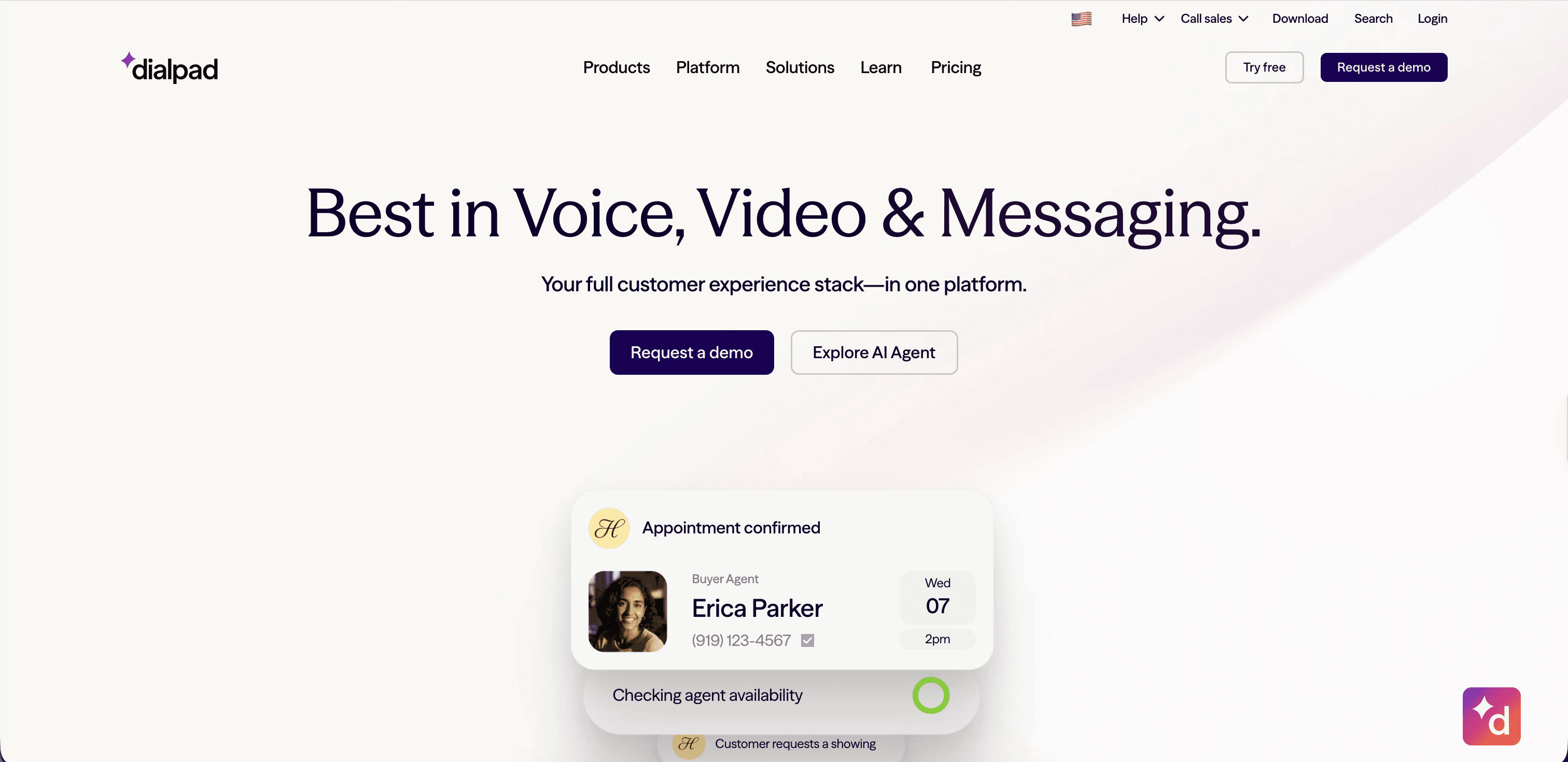
Dialpad is an AI-native business communications platform that has expanded into contact center use cases with built-in real-time transcription and coaching. It's a lighter-weight option compared to legacy CCaaS platforms, appealing to teams that want AI features without a lengthy implementation. For collections, Dialpad's real-time transcription can support basic compliance monitoring.
Key Features for Debt Collection:
Real-time call transcription and live coaching prompts
Sentiment detection during collections conversations
AI-generated call summaries for faster wrap-up
Simple deployment compared to larger CCaaS suites
Best For: Dialpad works well for smaller collections teams or in-house recovery units that want AI assistance without adopting a full enterprise contact center suite.
Integrations: Dialpad connects with common CRMs and business tools through its API and app marketplace.
Who Should Use It: Small to mid-size teams prioritizing fast AI adoption over deep collections-specific customization.
6. Talkdesk
Talkdesk is a flexible CCaaS platform that has built out industry-specific offerings, including a Financial Services Experience Cloud with modules relevant to collections. It emphasizes low-code customization, letting collections teams configure workflows without heavy engineering support. Talkdesk's AI capabilities extend to virtual agents and quality management.
Key Features for Debt Collection:
Prebuilt financial services and collections workflow templates
AI virtual agents for payment reminders and basic negotiation
Configurable compliance workflows by state or product line
Quality management with AI-assisted scoring
Best For: Talkdesk suits fintechs and banks that want to build tailored collections flows without a long, custom development cycle.
Integrations: Talkdesk offers a large AppConnect marketplace with integrations across CRM, payments, and compliance systems.
Who Should Use It: Fintech lenders and banks that need industry-specific templates and rapid configurability.
7. Verint

Verint is best known for its deep workforce engagement management and speech analytics capabilities, which many large collections operations use primarily for quality assurance rather than dialing. Its analytics engine can process large volumes of recorded calls to detect compliance risk patterns and agent performance trends. Teams evaluating Level AI against Verint often do so specifically around how much of the QA process can run automatically versus requiring analyst-led review.
Key Features for Debt Collection:
Speech and text analytics for large-scale collections call review
Workforce engagement management and forecasting
Compliance and audit trail reporting
Desktop and process analytics for agent behavior tracking
Best For: Verint fits enterprises that already prioritize analytics-led compliance and want deep reporting across a large agent workforce.
Integrations: Verint integrates with major telephony and CRM systems, typically as an analytics layer on top of an existing contact center platform.
Who Should Use It: Large enterprises with dedicated analytics teams that want granular reporting on agent and compliance performance.
8. Oriserve
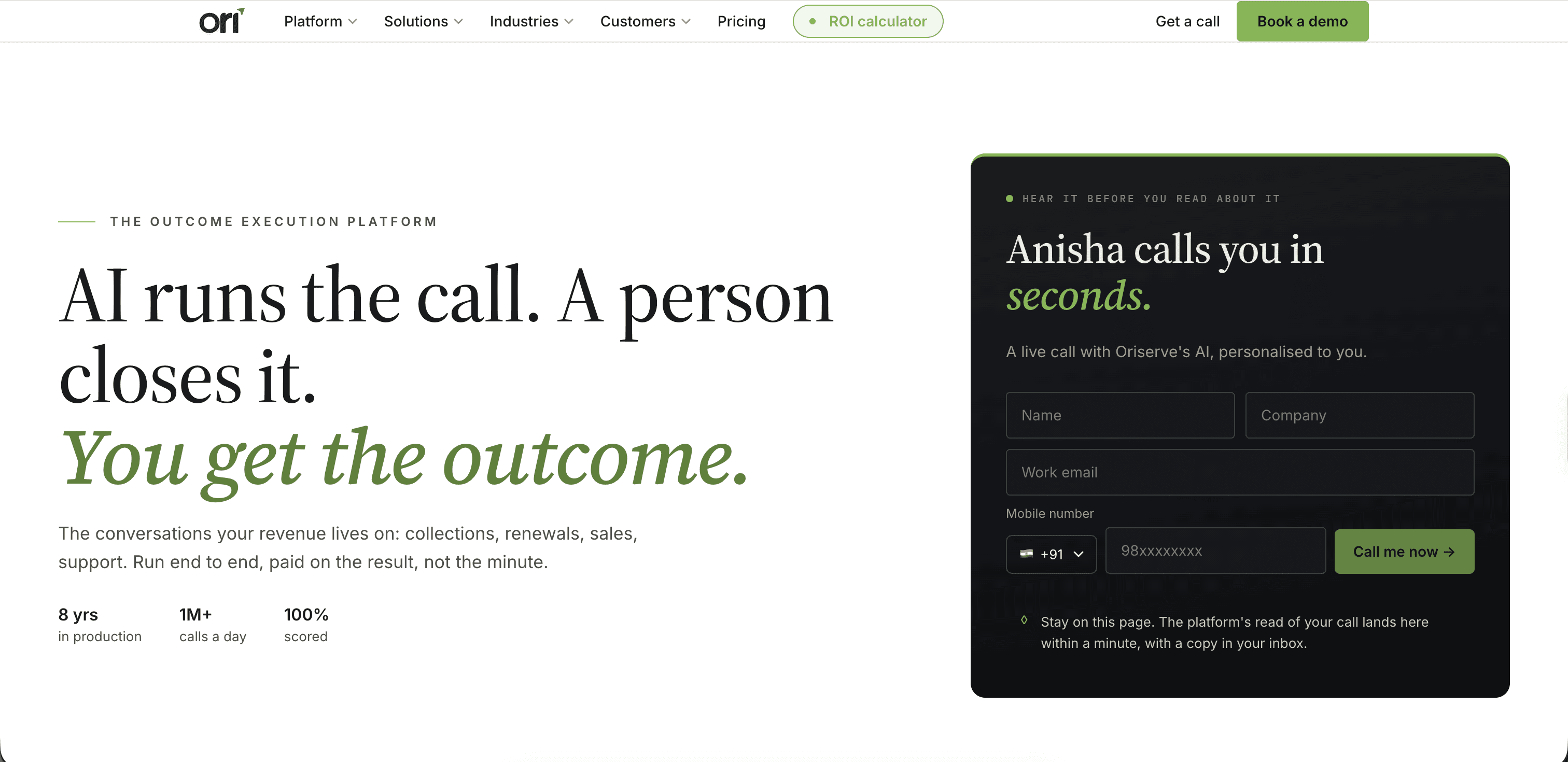
Oriserve is a conversational AI platform focused on voicebots and chatbots for customer engagement, including collections-style outreach like payment reminders and basic negotiation flows. It's positioned more toward high-volume, digital-first outreach than full contact center infrastructure. Oriserve supports multilingual conversations, which can matter for collections teams serving diverse customer bases.
Key Features for Debt Collection:
Multilingual voicebots and chatbots for payment reminders
Script-level compliance guardrails for automated conversations
Basic negotiation flows for routine, low-risk accounts
Analytics dashboards for bot-led conversation outcomes
Best For: Oriserve is best for collections teams that want to automate the simplest, most routine outreach (reminders, low-balance accounts) through bots before escalating to human agents.
Integrations: Oriserve offers API-based integrations with CRM and communication platforms.
Who Should Use It: Teams looking to offload high-volume, low-complexity outreach to bots while keeping complex accounts with human agents.
How to Automate Your Debt Collection with Level AI?
Getting started with Level AI for collections typically begins with connecting your existing telephony and CRM stack, since Level AI is designed to layer AI capabilities on top of platforms you already use rather than requiring a rip-and-replace. From there, the platform starts analyzing historical call data, credit information, and customer profiles to build propensity-to-pay scores, giving supervisors a clear view of which accounts are worth prioritizing first.
As covered in Level AI's guide to debt collections and credit recovery, the goal is balancing aggressive recovery with empathy and regulatory discipline, not choosing one over the other.
Once live, every collections call is monitored in real time against FDCPA, TILA, and SCRA requirements, with agents receiving prompts for required disclosures and suggested responses based on what the customer says. Voice analysis picks up on hardship signals and shifts in tone, helping agents (and their supervisors) know when to offer a payment plan or route the conversation to a specialist. Behind the scenes, conversation intelligence continuously identifies which agent behaviors and phrases correlate with successful outcomes, feeding that back into training programs automatically rather than waiting for a quarterly QA review.
For teams also managing broader FDCPA compliance in collections calls, Level AI's automated, 100 percent call coverage replaces manual sampling, meaning compliance risk gets caught on the call it happens, not weeks later in a random audit. Combined with insights drawn from proven AI-powered debt recovery strategies, this turns collections from a reactive, volume-driven process into a measurable, defensible, and more human one.
" transform="translate(85.643 10.143)" width="23.725855670103115px"/><path d="M 71.828 0 L 0 50.702" fill="transparent" height="50.70235051546392px" id="TnJFUMH9b" stroke-dasharray="" stroke-linecap="butt" stroke-linejoin="miter" stroke-miterlimit="10" stroke-width="0.68" stroke="rgb(254, 250, 241)" transform="translate(85.508 75.029)" width="71.82828865979384px"/><path d="M 81.579 0 L 0 52.003" fill="transparent" height="52.00280412371134px" id="ccJzhVTGI" stroke-dasharray="" stroke-linecap="butt" stroke-linejoin="miter" stroke-miterlimit="10" stroke-width="0.68" stroke="rgb(254, 250, 241)" transform="translate(85.495 73.738)" width="81.57921649484533px"/><path d="M 65.653 0 L 0 32.827" fill="transparent" height="32.826556701030924px" id="X0Vp_q8HG" stroke-dasharray="" stroke-linecap="butt" stroke-linejoin="miter" stroke-miterlimit="10" stroke-width="0.68" stroke="rgb(254, 250, 241)" transform="translate(85.462 92.931)" width="65.65311340206183px"/><path d="M 88.08 14.951 L 0 0" fill="transparent" height="14.950762886597914px" id="JM_UgSiJ_" stroke-dasharray="" stroke-linecap="butt" stroke-linejoin="miter" stroke-miterlimit="10" stroke-width="0.68" stroke="rgb(254, 250, 241)" transform="translate(86.233 125.789)" width="88.07950515463914px"/><path d="M 83.204 72.803 L 0 0" fill="transparent" height="72.80313402061856px" id="KlyUUjlMK" stroke-dasharray="" stroke-linecap="butt" stroke-linejoin="miter" stroke-miterlimit="10" stroke-width="0.68" stroke="rgb(254, 250, 241)" transform="translate(85.089 125.71)" width="83.20379381443304px"/><path d="M 7.8 114.081 L 0 0" fill="transparent" height="114.08065979381445px" id="kAiUvduBR" stroke-dasharray="" stroke-linecap="butt" stroke-linejoin="miter" stroke-miterlimit="10" stroke-width="0.68" stroke="rgb(254, 250, 241)" transform="translate(85.95 125.478)" width="7.800247422680428px"/><path d="M 0 93.604 L 9.75 0" fill="transparent" height="93.60445360824741px" id="FsgTAQB0n" stroke-dasharray="" stroke-linecap="butt" stroke-linejoin="miter" stroke-miterlimit="10" stroke-width="0.68" stroke="rgb(254, 250, 241)" transform="translate(76.2 125.421)" width="9.750432989690694px"/><path d="M 0 76.379 L 76.703 0" fill="transparent" height="76.37888659793816px" id="NxOhHvPJ5" stroke-dasharray="" stroke-linecap="butt" stroke-linejoin="miter" stroke-miterlimit="10" stroke-width="0.68" stroke="rgb(254, 250, 241)" transform="translate(9.343 125.217)" width="76.7034556701031px"/><path d="M 0 26.651 L 39.002 0" fill="transparent" height="26.651381443298988px" id="QETNKJ3L6" stroke-dasharray="" stroke-linecap="butt" stroke-linejoin="miter" stroke-miterlimit="10" stroke-width="0.68" stroke="rgb(254, 250, 241)" transform="translate(47.096 125.177)" width="39.0017319587629px"/><path d="M 0 16.901 L 85.154 0" fill="transparent" height="16.900948453608265px" id="BL63wDICD" stroke-dasharray="" stroke-linecap="butt" stroke-linejoin="miter" stroke-miterlimit="10" stroke-width="0.68" stroke="rgb(254, 250, 241)" transform="translate(0.094 125.125)" width="85.15396503092786px"/><path d="M 0 0 L 78.004 17.876" fill="transparent" height="17.875793814432996px" id="PIX70Vlqf" stroke-dasharray="" stroke-linecap="butt" stroke-linejoin="miter" stroke-miterlimit="10" stroke-width="0.68" stroke="rgb(254, 250, 241)" transform="translate(8.362 107.251)" width="78.00376082474227px"/><path d="M 0 0 L 67.928 52.327" fill="transparent" height="52.32742268041238px" id="u_syqWqWD" stroke-dasharray="" stroke-linecap="butt" stroke-linejoin="miter" stroke-miterlimit="10" stroke-width="0.68" stroke="rgb(254, 250, 241)" transform="translate(17.593 72.861)" width="67.92826391752578px"/><path d="M 0 0 L 77.029 70.528" fill="transparent" height="70.52832989690722px" id="DmW_aE2A0" stroke-dasharray="" stroke-linecap="butt" stroke-linejoin="miter" stroke-miterlimit="10" stroke-width="0.68" stroke="rgb(254, 250, 241)" transform="translate(9.489 54.678)" width="77.02866804123713px"/><path d="M 0 0 L 27.301 126.431" fill="transparent" height="126.43109443298971px" id="JrLaRUubC" stroke-dasharray="" stroke-linecap="butt" stroke-linejoin="miter" stroke-miterlimit="10" stroke-width="0.68" stroke="rgb(254, 250, 241)" transform="translate(58.341 -0.071)" width="27.30111340206188px"/><path d="M 0 4.012 C 0 1.796 1.796 0 4.012 0 C 6.228 0 8.025 1.796 8.025 4.012 C 8.025 6.228 6.228 8.025 4.012 8.025 C 1.796 8.025 0 6.228 0 4.012 Z" fill="rgb(254, 80, 0)" height="8.024669690721652px" id="Nh5qrPJs_" transform="translate(81.396 121.369)" width="8.024669690721623px"/></svg>)
1. Is it legal to use AI for debt collection calls?
Customer intelligence (CI) refers to the process of collecting, analyzing, and interpreting data about your customers to gain insights into their needs, preferences, and behaviors. This information can be used to improve various aspects of your business, such as marketing, product development, and customer service.
2. What is the best AI software for debt collection agencies?
The best platform depends on your priorities. Level AI is a strong fit for agencies that need built-in compliance monitoring and real-time agent guidance, while platforms like Five9 or NICE CXone may suit teams that prioritize high-volume predictive dialing above all else
3. Can AI virtual agents actually collect payments over the phone?
Not when it's implemented well. AI-driven personalization, like tailored payment plans and hardship detection, can actually improve customer experience by matching outreach to a customer's real financial situation rather than using a one-size-fits-all script
4. How does AI help with FDCPA compliance in collections?
AI monitors calls in real time (or shortly after) for required disclosures, prohibited language, and contact-time violations, flagging risks automatically instead of relying on manual, sampled call reviews that can miss violations
5. Does automating debt collection hurt the customer experience?
Customer intelligence (CI) refers to the process of collecting, analyzing, and interpreting data about your customers to gain insights into their needs, preferences, and behaviors. This information can be used to improve various aspects of your business, such as marketing, product development, and customer service.