
By Ashish Nagar, Founder and CEO, Level AI
A single customer conversation is rarely about one thing. A support call can carry a billing issue, a delivery failure, a policy dispute, a compliance risk, a coaching opportunity, and a product insight at once. The customer may never say "this was a high-effort experience." They say they have already called twice, the refund still has not arrived, the agent gave them a different answer last week, and they are tired of explaining the problem again.
Behind every conversation like that sits a set of questions. Was the issue resolved? Did the agent follow the right process? Was there a compliance risk? Did the customer signal churn? Should the system score it, summarize it, escalate it, coach on it, route it, or log it as Voice of Customer?
Contact center, QA, operations, and CX leaders answer these questions every day, and most of them are answered on a sample. The rest go ungraded, unmined, and ungoverned.
Why general-purpose models don't fit customer experience workflows
Serious AI companies are moving closer to the specific work their customers do. Cursor built Composer for software engineering. Harvey has published work on legal-specific models. Why the convergence in multiple enterprise verticals? Because production workloads at scale have taught lessons that won't show up in a pilot. Production judges AI on reliability inside real workflows, with real data, at real volume, under the security, latency, cost, and quality requirements of the business. We've found this out and built towards this operating model for the past 3 years, to optimize performance, privacy, and costs around the needs of our customers.
Customer experience is one of the most critical and complex business functions. It is a system of conversations, policies, exceptions, compliance rules, agent behaviors, and business outcomes, carried in messy data: accents, interruptions, hold music, transfers, frustrated customers, and long stretches where the real issue may be implied rather than stated. A general-purpose model can transcribe that. Telling you what it means in context, without delay, and in a secure & cost-effective environment requires models intelligently routed for specific tasks.
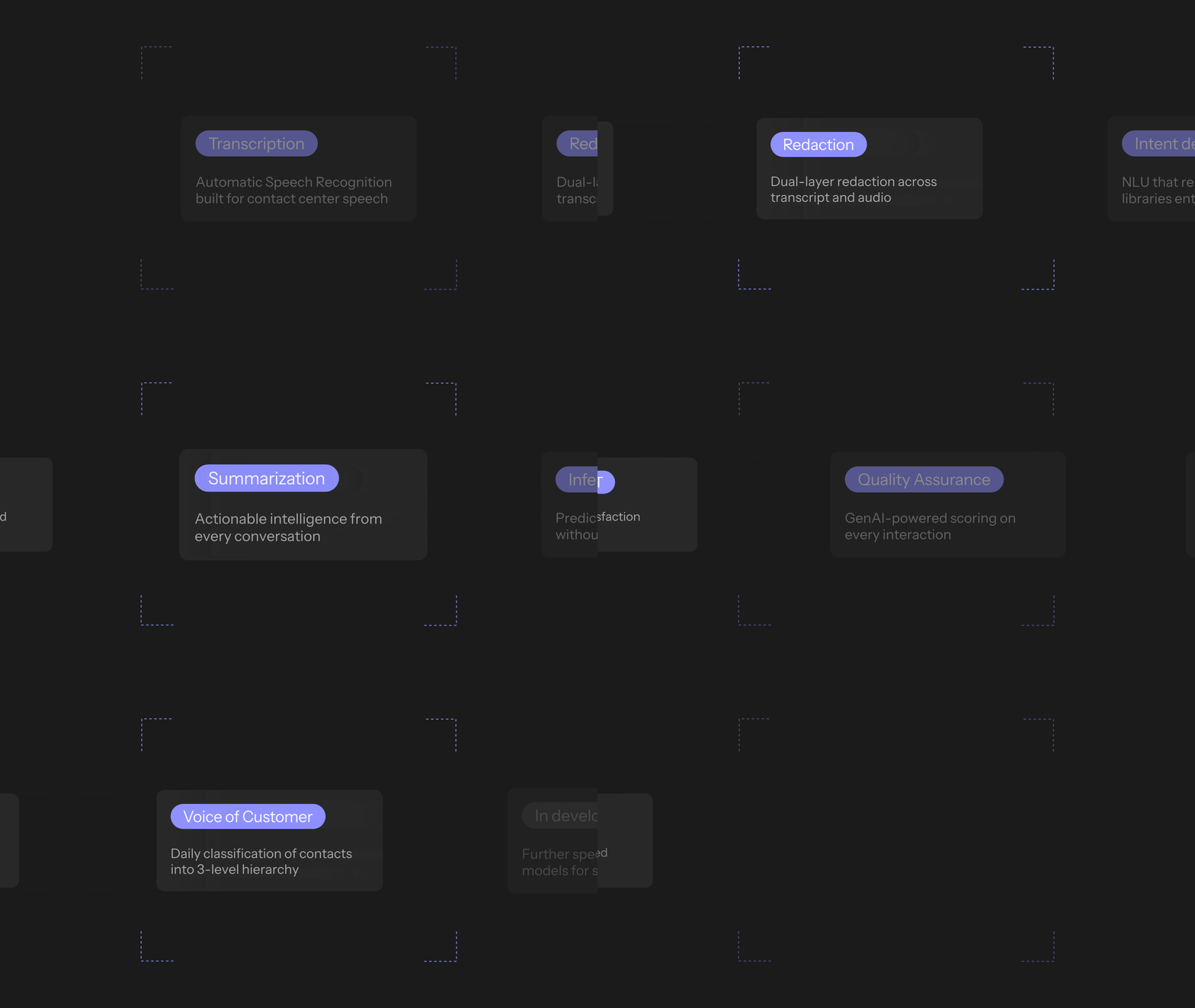
Seven models for the core jobs of CX
Today Level AI is introducing Level AI Latitude, our family of CX-specific models trained over the past 3 years on more than 1 billion customer interactions. Latitude powers the Level AI platform with seven proprietary, fine-tuned models built for the language, workflows, and quality standards of customer experience:
Transcription built for contact center speech, processing more than 7 million hours of live customer audio each month.
Redaction that identifies and removes sensitive data across transcripts and audio, with 96% accuracy on key entities.
Intent Detection that uses NLU instead of keyword libraries, delivering 400x more coverage as customers describe problems in their own words.
Summarization that turns long, messy customer conversations into structured summaries of what happened, what was done, how the issue ended, and what needs to happen next.
Inferred CSAT across 100% of conversations, including customers who never answer a survey.
Quality Assurance that scores every interaction against the company’s own rubric, with evidence attached to every score.
Voice of Customer classification into a three-level hierarchy, turning individual conversations into patterns leaders can act on.
Why seven models instead of one? Each job carries its own accuracy bar, latency budget, data sensitivity, and failure mode. Transcription is judged word by word in noisy audio. Redaction is judged by what it catches before data leaves the boundary. QA is judged by whether a supervisor can trace a score to evidence. The right architecture gives each job the right model.
The results run against the hardest benchmark we have, our own production. Compared with frontier LLMs (GPT, Gemini, Claude) on live CX workloads, Latitude delivers up to 49x lower cost to serve, up to 3.5x higher throughput, 4x lower latency, and accuracy at par. Every model runs on Level AI's own dedicated VPC GPU clusters; customer data never reaches an external model provider and never trains someone else's model.
full-stack control vs. third party llm
up to 49x
lower cost to serve
up to 3.5x
higher throughput
4x
lower latency
Accuracy at par
with frontier LLMs
Part of a fully governed stack
In powering the Level AI platform, Latitude has processed a run-rate of 4 trillion tokens, 97% of those on our own models, recalibrated against human QA leads monthly. CX quality is a moving target. Policies change, products change, regulators update expectations, so the intelligence layer has to keep learning from the feedback.
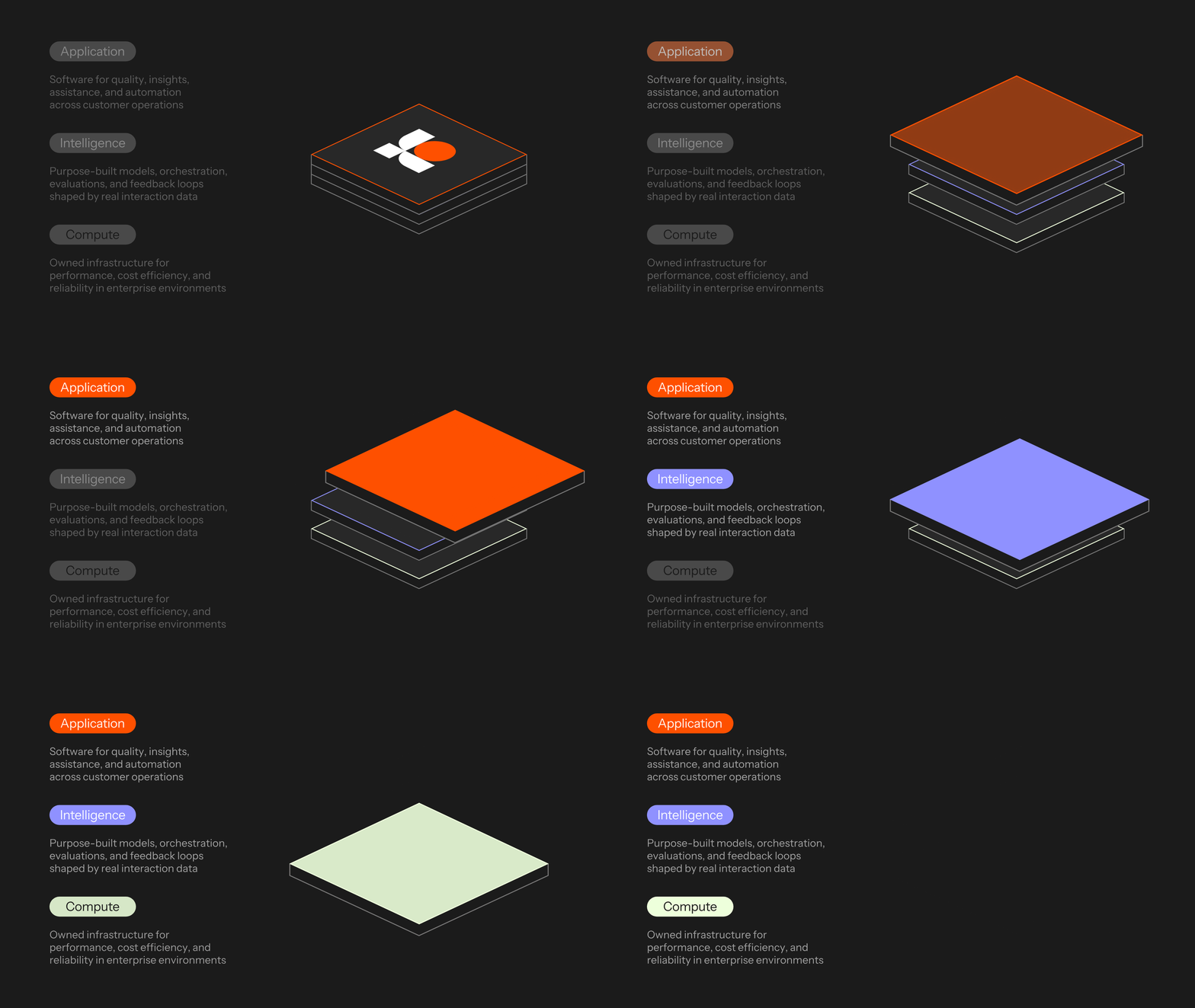
And a model family becomes useful in production when the stack around it is built for governance. A quality assurance model needs evidence. A redaction model needs governance. An intent model needs routing logic. A virtual agent needs guardrails, latency control, and fallback paths. That is why Level AI owns the full stack:
Application is where the Level AI platform turns intelligence into work across AI Workers, Virtual Agents, QA, Conversation Intelligence, Voice of Customer, Agent Assist, and Coaching
Intelligence is where Latitude runs on a governed harness for routing, guardrails, evidence, calibration, feedback loops, permissions, and tenant isolation
Compute is Level AI's owned GPU infrastructure, optimized app-to-metal for runtime performance, cost efficiency, and reliability
A model can generate an answer. A production system has to make that answer usable, governed, explainable, and improvable.
Why model ownership matters now
AI is becoming more capable and more operationally exposed at the same time. Model access, pricing, rate limits, and data policies can all change, and for customer-facing AI those are business risks. If a single upstream model sits behind a virtual agent, QA process, or compliance workflow, losing access to it creates gaps, brand impact, and customer churn.
In my view, this does not mean every enterprise should build every model from scratch. It means vendors need a clear position on what they own, what they route, what they fine-tune, what they govern, and how their systems behave when the model market shifts. Latitude is that position for Level AI.
The varying ownership of an enterprise's stack, from API wrapper to full-stack ownership, is their risk profile. That framework, the architecture behind Latitude, and the evaluation questions every buyer should bring to procurement are in our whitepaper, The Operating Standard for Enterprise AI.
That is the standard we are building toward, and the one we invite the market to measure us on.