
Key takeaways
A VoC program is much more than surveys. Modern Voice of the Customer (VoC) programs combine calls, chats, tickets, reviews, CRM data, and operational signals to capture the complete customer experience instead of relying on a small sample of survey responses
Most enterprise VoC programs fail because insights never become action. Siloed data, manual analysis, overreliance on NPS, and the lack of executive ownership prevent organizations from turning customer feedback into measurable business outcomes
AI enables analysis of 100% of customer interactions. Instead of manually reviewing a fraction of conversations, AI identifies emerging trends, churn risks, compliance issues, and recurring customer problems across every interaction in near real time
A successful VoC program requires a closed-loop process. Collecting feedback is only the first step. The real value comes from routing insights to Product, Engineering, Support, Marketing, and Leadership so issues are fixed and outcomes are measured
Business outcomes should drive the program—not dashboards. The best enterprise VoC programs measure retention, churn, CSAT, FCR, revenue impact, and time-to-action rather than simply reporting survey scores or interaction volumes
According to this report by Mckinsey, Sixty-three percent of business leaders cite customer feedback as a top source of growth ideas, yet only 15 percent say they consistently incorporate that feedback into their decisions. That gap is the story of most enterprise VoC programs today: organizations are drowning in customer feedback and still can’t act on it fast enough to matter.
Enterprise contact centers sit on more customer signal than any other part of the business: calls, chats, tickets, surveys, and reviews. Yet, most of it never reaches the people who could actually do something with it. A well-designed Voice of the Customer program closes that gap. It transforms scattered feedback into Voice of the Customer insights that reveal what customers actually need and routes those insights to the teams built to act on them.
This guide walks through how to build one from the ground up: what a modern VoC program looks like, why most enterprise efforts fail despite significant investment, and how contact center analytics is changing what’s possible. It’s written for contact center leaders, CX executives, operations leaders, and IT buyers evaluating how to modernize customer intelligence at scale.
What Is a Voice of the Customer (VoC) Program?
A Voice of the Customer program is the structured, ongoing process of capturing, analyzing, and acting on customer feedback across every channel where customers interact with a business. It is not a single survey or a quarterly report. It is a continuous operating process that feeds customer insight into product decisions, support operations, and executive strategy.
For enterprise contact centers specifically, VoC matters because the contact center is where customer sentiment surfaces first, often weeks or months before it shows up in churn numbers or revenue reports. A well-run VoC program catches a product issue, a policy confusion, or a competitive threat while there is still time to fix it.
The distinction between traditional and modern VoC programs comes down to coverage and speed. Traditional programs rely on post-interaction surveys and periodic NPS studies, capturing a small, self-selected sample of customer opinion after the fact. Modern programs analyze the interactions themselves- calls, chats, tickets- in as close to real time as possible, using conversation intelligence to surface patterns across 100 percent of customer interactions rather than the fraction who bother to fill out a survey.
Read: 5 best practices for voice of the customer programs
Why Do Most Enterprise Voice of the Customer Programs Fail?
Despite significant budget and executive attention, most enterprise VoC programs never deliver the business impact they were built for. Four failure patterns show up repeatedly.
Siloed customer data across teams is the most common. Support tickets sit in one system, call transcripts in another, CRM records in a third, and no one owns pulling them together. One enterprise leader described this exact problem in blunt terms: data from the phone system, “other CRM data, pulling it all together into one set of insights for your end user, that’s the goal here.” Without that consolidation, no team has the full picture of what customers are actually experiencing.
Overreliance on surveys and NPS is the second failure point. Surveys capture the opinions of customers motivated enough to respond, typically the most satisfied or the most frustrated, missing the quieter majority in between. NPS alone also tells you sentiment moved, not why, which limits how actionable the insight actually is.
Manual analysis that doesn’t scale compounds the problem. A team manually reviewing calls or tagging tickets can realistically cover a small percentage of total volume, which means most enterprise VoC programs are making decisions based on a sample, not the whole picture. And lack of executive ownership ties it together: without a named executive stakeholder accountable for acting on VoC findings, insights pile up in dashboards that no one is required to respond to.
How Do You Build a Voice of the Customer Program Around Business Outcomes?
The single biggest shift enterprise leaders can make is designing the VoC program around business outcomes first, and feedback collection second.
1. Align VoC Goals with Business Objectives
Before collecting a single data point, define what the program needs to influence: reducing churn, improving first contact resolution, informing product roadmap, or catching compliance risks earlier. A VoC program without a defined business objective becomes a reporting exercise rather than a decision-making tool.
2. Identify Executive Stakeholders
Every enterprise VoC program needs a named executive owner, typically in CX, operations, or product, who is accountable for turning insights into action. Without this, findings get acknowledged in meetings and forgotten by the next one.
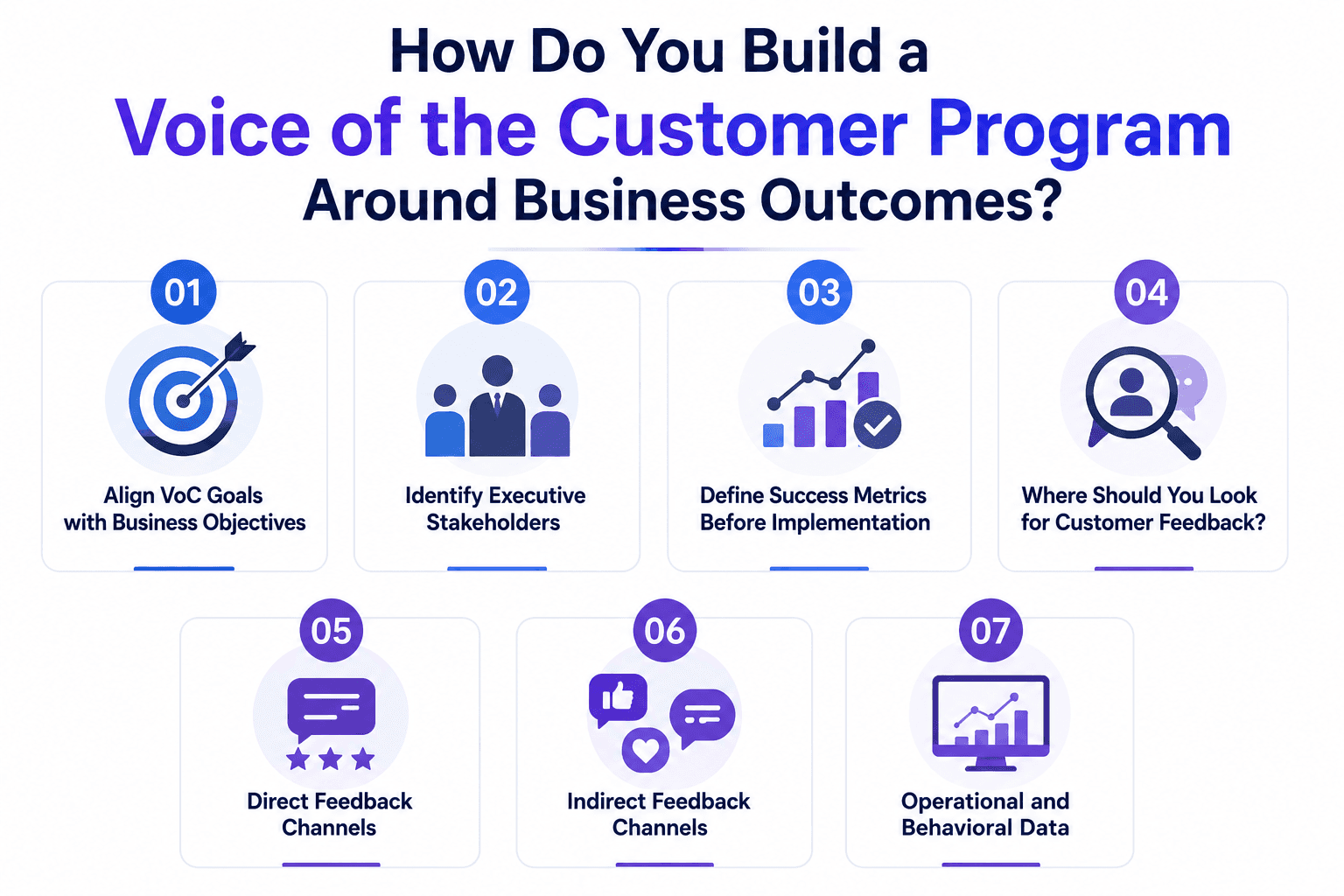
3. Define Success Metrics Before Implementation
Decide upfront how you will measure whether the program is working: faster issue detection, higher CSAT, reduced repeat contacts, or measurable revenue protection. Defining these metrics before rollout prevents the program from becoming an open-ended data collection effort with no clear finish line.
4. Where Should You Look for Customer Feedback?
An enterprise VoC program needs to pull from every place customer signal actually lives, not just the channels that are easiest to measure.
5. Direct Feedback Channels
These are the channels customers use intentionally to share an opinion: CSAT scores, NPS surveys, customer effort score (CES), and structured customer surveys. They are valuable but represent a small, self-selected slice of the overall customer base.
6. Indirect Feedback Channels
This is where the real volume lives: contact center calls, chat conversations, emails, support tickets, and public customer reviews. As one enterprise leader put it while evaluating tools for this exact challenge, they needed “a tool that would help us transcribe calls,” because “reading a phone call is a much faster review than having to listen to” one. That single comment captures why indirect channels, especially voice, have historically been the hardest source of feedback to analyze at scale, and why they matter most.
7. Operational and Behavioral Data
Beyond direct commentary, operational data tells its own story: CRM records, product usage patterns, QA evaluations, escalations, and repeat contact patterns. A customer who calls back three times about the same issue is giving you feedback just as clearly as one who fills out a survey, arguably more reliably.
Ready to see how consolidating these sources works in practice? Request a demo to see how a unified customer intelligence platform pulls direct, indirect, and operational signals into one view.
How Do You Design an Enterprise VoC Framework?
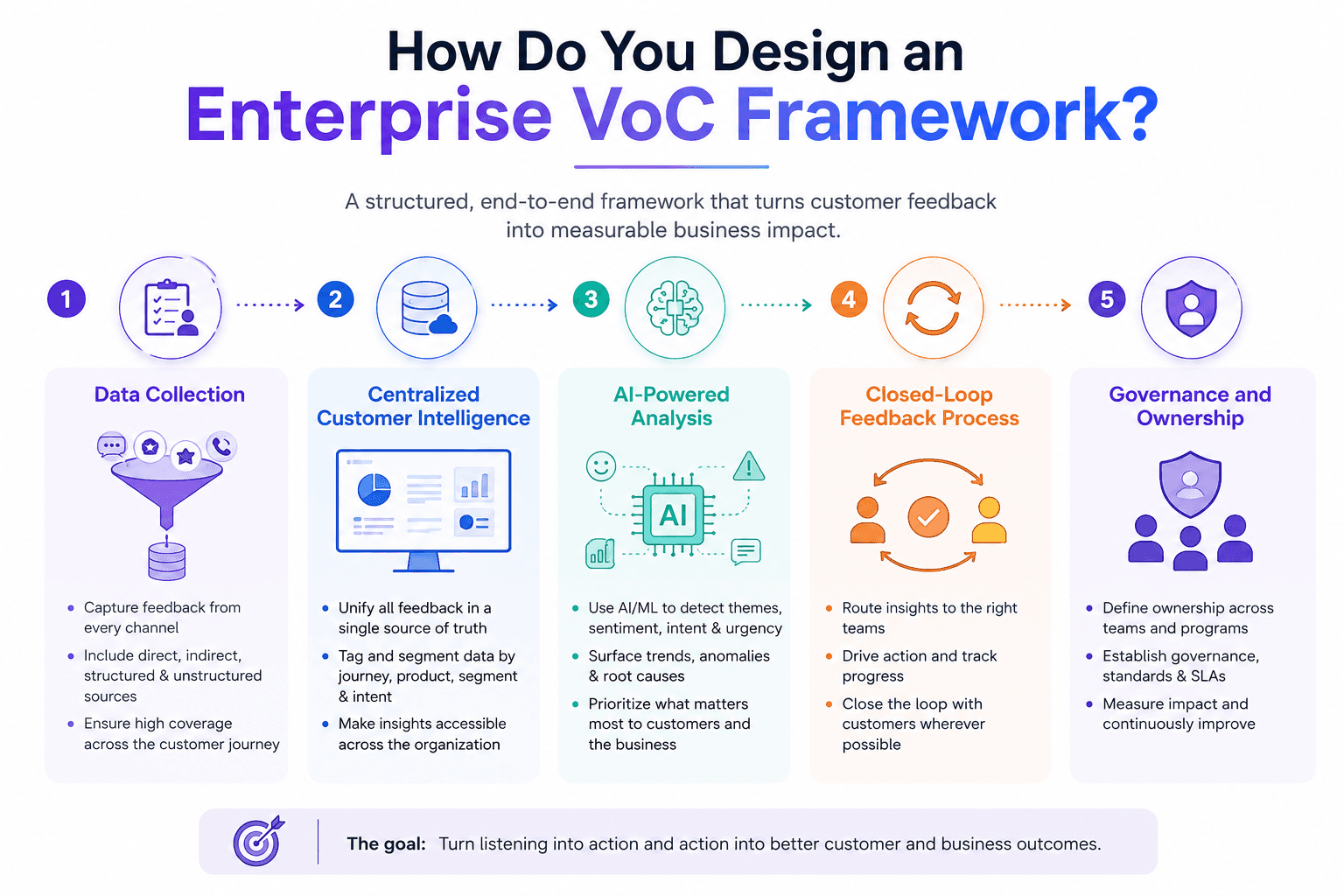
Once sources are identified, the framework determines whether feedback actually becomes action.
1. Data Collection
Establish consistent, automated capture across every channel so no source is left as a manual, occasional export.
2. Centralized Customer Intelligence
All feedback, direct and indirect, needs to live in a single system of record. This is the step most enterprise programs skip, and it’s the one that determines whether insights are trustworthy or contradictory across teams.
3. AI-Powered Analysis
Manual review cannot cover full conversation volume. AI-powered analytics can process every call, chat, and ticket, surfacing patterns a sampling-based process would miss entirely.
4. Closed-Loop Feedback Process
Insights need a defined path back to the team that can act on them, with a mechanism to confirm the action was taken and the issue resolved. Without this loop, VoC becomes a one-way broadcast rather than a business process.
5. Governance and Ownership
Someone needs to own the taxonomy, the escalation rules, and the reporting cadence. Without clear governance, different teams end up building their own competing versions of “what customers are saying.”
How Do You Turn Customer Conversations into Actionable Insights?
Collecting feedback is the easy part. Turning conversations into decisions requires a specific process.
Detecting recurring customer issues starts with pattern recognition across volume, not individual call review. When the same complaint surfaces across hundreds of interactions in a week, that is a signal worth escalating immediately, not something to wait for in a monthly report.
Identifying root causes goes a level deeper than the symptom. A spike in billing complaints might trace back to a single confusing line item on an invoice, a finding that only surfaces when you can analyze the actual language customers use, not just the ticket category they were filed under.
Prioritizing issues by business impact matters because not every recurring theme deserves the same urgency. A minor UI complaint from a small customer segment ranks differently than a checkout failure affecting high-value accounts, and the VoC program needs a way to weigh both financial exposure and volume.
Routing insights to the right teams closes the loop. An issue traced to a product bug needs to reach engineering, not just live in a CX dashboard. This is where most programs quietly fail: insight generation without a distribution mechanism just produces more reports nobody reads.
How Do You Create Cross-Functional VoC Workflows?
A Voice of the Customer program only creates value once insights reach the teams that can act on them, which means building workflows across departments, not just within CX.
Customer Support needs real-time visibility into emerging issues so agents are prepared before a spike in a specific complaint reaches them. Product Management needs a steady feed of validated customer pain points to inform roadmap prioritization, backed by volume and business impact data rather than anecdote. Engineering needs technical issues routed directly, with enough detail to reproduce and fix the underlying problem, not a vague summary of “customers are unhappy.”
Marketing benefits from understanding which messaging themes resonate or backfire in actual customer language. Customer Success needs early churn signals long before a renewal conversation, ideally weeks or months ahead. And Executive Leadership needs a distilled, business-language view of how customer sentiment connects to revenue, retention, and cost, not a raw feed of every ticket filed that week.
How Do You Measure the Success of Your Voice of the Customer Program?
A VoC program needs its own scorecard, tracked across four categories.
Customer experience metrics are the most familiar: CSAT, NPS, and CES tell you how customers rate individual interactions and their overall relationship with your brand. One enterprise leader summarized the core goal in exactly these terms: “our main goal is to continuously improve on our CSAT, right, and be able to highlight areas where we’re not hitting customer expectation.”
Contact center metrics connect VoC directly to operational performance: first contact resolution (FCR), average handle time (AHT), escalation rate, and repeat contact rate. A rising repeat contact rate, for example, is often one of the clearest early signals that a VoC program is catching a real, unresolved issue.
Business impact metrics are what ultimately justify the program to the executive team: customer retention, churn, revenue impact, and customer lifetime value. These are lagging indicators, but they are the ones that prove the program’s ROI over time.
AI and operational metrics measure the program’s own effectiveness: conversation coverage (what percentage of interactions are actually being analyzed), insight accuracy, trend detection speed, and time to action from insight to resolution. A program analyzing 100 percent of conversations with fast trend detection will consistently outperform one still working from a manual sample.
What Mistakes Should You Avoid When Building a VoC Program?
Several patterns show up repeatedly in enterprise VoC programs that never reach their potential.
Relying only on surveys misses the much larger, unsolicited feedback volume sitting in every call and ticket. Sampling a small percentage of interactions means most of your customer signal is simply invisible to the program, no matter how well the sample is analyzed. Working with disconnected systems forces teams to reconcile conflicting views of the same customer, which erodes trust in the data itself.
Focusing on dashboards instead of action is one of the most common traps: a beautifully designed dashboard that no one is accountable for acting on delivers zero business value. Not closing the feedback loop means customers (and internal teams) never see evidence that their input changed anything, which quietly kills engagement with the program over time. And measuring activity instead of outcomes, tracking how many surveys went out rather than what changed because of them, keeps VoC programs stuck as a reporting function instead of a growth driver.
How Is AI Transforming Enterprise VoC Programs?
AI has changed what is realistically possible for enterprise VoC programs, primarily by removing the sampling constraint that has limited these programs for decades.
Modern platforms can analyze 100 percent of customer interactions, not a manually selected slice, which means no significant issue goes undetected simply because it happened on a call nobody happened to review. This also means AI can automatically identify emerging trends days or weeks before they would surface in a quarterly report, giving teams a real window to act before an issue becomes a wider pattern. One customer described the shift plainly: the voice of the customer insights capability was “above and beyond where we are with the current dashboard that we’re using for the call center.”
AI-powered analysis can also detect churn risks and compliance issues buried in conversational language long before they appear in a CRM flag or a formal complaint. It can deliver real-time recommendations to agents and supervisors in the moment rather than after the fact, and it enables proactive decision-making by giving leaders a live view of customer sentiment instead of a retrospective one. As one enterprise customer noted about the visibility gap AI closed for them, “we currently don’t have any mechanism for quality checking our voice AI agent, and so that’s something we’re really excited to add.” The same principle applies across every channel a VoC program touches: you cannot improve what you cannot see, and AI is what makes seeing everything possible.
What Should Be on Your Enterprise VoC Program Implementation Checklist?
Before rolling out or overhauling a VoC program, confirm the following are in place:
Define clear business objectives for the program
Identify and confirm executive stakeholders
Consolidate data sources into a single customer intelligence view
Deploy AI-driven analytics capable of covering full interaction volume
Build reporting workflows tailored to each stakeholder team
Establish governance for taxonomy, escalation, and ownership
Measure outcomes continuously, not just at launch
Wrapping Up: Build a Voice of the Customer Program That Delivers Results
Building an enterprise Voice of the Customer program comes down to a few consistent steps: define the business outcomes you’re solving for, identify every source of feedback, especially the indirect channels most programs underuse, design a framework that closes the loop rather than just reporting findings, and hold specific teams accountable for acting on what the data shows.
The core lesson from the enterprises that get this right is that VoC is not a survey initiative or a quarterly report. It is a continuous business process, and one that lives or dies on whether insights actually reach the people who can act on them. AI-powered conversation intelligence has made it realistic for the first time to analyze the full volume of customer interactions rather than a sample, which is what makes operationalizing VoC at enterprise scale finally achievable.
" transform="translate(85.643 10.143)" width="23.725855670103115px"/><path d="M 71.828 0 L 0 50.702" fill="transparent" height="50.70235051546392px" id="TnJFUMH9b" stroke-dasharray="" stroke-linecap="butt" stroke-linejoin="miter" stroke-miterlimit="10" stroke-width="0.68" stroke="rgb(254, 250, 241)" transform="translate(85.508 75.029)" width="71.82828865979384px"/><path d="M 81.579 0 L 0 52.003" fill="transparent" height="52.00280412371134px" id="ccJzhVTGI" stroke-dasharray="" stroke-linecap="butt" stroke-linejoin="miter" stroke-miterlimit="10" stroke-width="0.68" stroke="rgb(254, 250, 241)" transform="translate(85.495 73.738)" width="81.57921649484533px"/><path d="M 65.653 0 L 0 32.827" fill="transparent" height="32.826556701030924px" id="X0Vp_q8HG" stroke-dasharray="" stroke-linecap="butt" stroke-linejoin="miter" stroke-miterlimit="10" stroke-width="0.68" stroke="rgb(254, 250, 241)" transform="translate(85.462 92.931)" width="65.65311340206183px"/><path d="M 88.08 14.951 L 0 0" fill="transparent" height="14.950762886597914px" id="JM_UgSiJ_" stroke-dasharray="" stroke-linecap="butt" stroke-linejoin="miter" stroke-miterlimit="10" stroke-width="0.68" stroke="rgb(254, 250, 241)" transform="translate(86.233 125.789)" width="88.07950515463914px"/><path d="M 83.204 72.803 L 0 0" fill="transparent" height="72.80313402061856px" id="KlyUUjlMK" stroke-dasharray="" stroke-linecap="butt" stroke-linejoin="miter" stroke-miterlimit="10" stroke-width="0.68" stroke="rgb(254, 250, 241)" transform="translate(85.089 125.71)" width="83.20379381443304px"/><path d="M 7.8 114.081 L 0 0" fill="transparent" height="114.08065979381445px" id="kAiUvduBR" stroke-dasharray="" stroke-linecap="butt" stroke-linejoin="miter" stroke-miterlimit="10" stroke-width="0.68" stroke="rgb(254, 250, 241)" transform="translate(85.95 125.478)" width="7.800247422680428px"/><path d="M 0 93.604 L 9.75 0" fill="transparent" height="93.60445360824741px" id="FsgTAQB0n" stroke-dasharray="" stroke-linecap="butt" stroke-linejoin="miter" stroke-miterlimit="10" stroke-width="0.68" stroke="rgb(254, 250, 241)" transform="translate(76.2 125.421)" width="9.750432989690694px"/><path d="M 0 76.379 L 76.703 0" fill="transparent" height="76.37888659793816px" id="NxOhHvPJ5" stroke-dasharray="" stroke-linecap="butt" stroke-linejoin="miter" stroke-miterlimit="10" stroke-width="0.68" stroke="rgb(254, 250, 241)" transform="translate(9.343 125.217)" width="76.7034556701031px"/><path d="M 0 26.651 L 39.002 0" fill="transparent" height="26.651381443298988px" id="QETNKJ3L6" stroke-dasharray="" stroke-linecap="butt" stroke-linejoin="miter" stroke-miterlimit="10" stroke-width="0.68" stroke="rgb(254, 250, 241)" transform="translate(47.096 125.177)" width="39.0017319587629px"/><path d="M 0 16.901 L 85.154 0" fill="transparent" height="16.900948453608265px" id="BL63wDICD" stroke-dasharray="" stroke-linecap="butt" stroke-linejoin="miter" stroke-miterlimit="10" stroke-width="0.68" stroke="rgb(254, 250, 241)" transform="translate(0.094 125.125)" width="85.15396503092786px"/><path d="M 0 0 L 78.004 17.876" fill="transparent" height="17.875793814432996px" id="PIX70Vlqf" stroke-dasharray="" stroke-linecap="butt" stroke-linejoin="miter" stroke-miterlimit="10" stroke-width="0.68" stroke="rgb(254, 250, 241)" transform="translate(8.362 107.251)" width="78.00376082474227px"/><path d="M 0 0 L 67.928 52.327" fill="transparent" height="52.32742268041238px" id="u_syqWqWD" stroke-dasharray="" stroke-linecap="butt" stroke-linejoin="miter" stroke-miterlimit="10" stroke-width="0.68" stroke="rgb(254, 250, 241)" transform="translate(17.593 72.861)" width="67.92826391752578px"/><path d="M 0 0 L 77.029 70.528" fill="transparent" height="70.52832989690722px" id="DmW_aE2A0" stroke-dasharray="" stroke-linecap="butt" stroke-linejoin="miter" stroke-miterlimit="10" stroke-width="0.68" stroke="rgb(254, 250, 241)" transform="translate(9.489 54.678)" width="77.02866804123713px"/><path d="M 0 0 L 27.301 126.431" fill="transparent" height="126.43109443298971px" id="JrLaRUubC" stroke-dasharray="" stroke-linecap="butt" stroke-linejoin="miter" stroke-miterlimit="10" stroke-width="0.68" stroke="rgb(254, 250, 241)" transform="translate(58.341 -0.071)" width="27.30111340206188px"/><path d="M 0 4.012 C 0 1.796 1.796 0 4.012 0 C 6.228 0 8.025 1.796 8.025 4.012 C 8.025 6.228 6.228 8.025 4.012 8.025 C 1.796 8.025 0 6.228 0 4.012 Z" fill="rgb(254, 80, 0)" height="8.024669690721652px" id="Nh5qrPJs_" transform="translate(81.396 121.369)" width="8.024669690721623px"/></svg>)
Frequently Asked Questions
What is a Voice of the Customer (VoC) program?
A Voice of the Customer program is the ongoing process of capturing, analyzing, and acting on customer feedback across every channel, direct and indirect, to inform business decisions
How do you build a VoC program?
Start by aligning the program with specific business objectives, identify every source of customer feedback across direct, indirect, and operational data, then build a framework for collection, analysis, and closed-loop action, with clear governance and executive ownership
What data should an enterprise VoC program collect?
A complete program pulls from direct feedback (surveys, CSAT, NPS, CES), indirect feedback (calls, chats, tickets, reviews), and operational data (CRM records, QA evaluations, escalations, repeat contacts)
Which KPIs should you track?
Track customer experience metrics (CSAT, NPS, CES), contact center metrics (FCR, AHT, escalation rate, repeat contact rate), business impact metrics (retention, churn, revenue, CLV), and program-specific metrics like conversation coverage and time to action
How does AI improve VoC programs?
AI allows programs to analyze 100 percent of customer interactions instead of a manual sample, detect emerging trends faster, and surface churn or compliance risks that would otherwise go unnoticed until they show up in lagging business metrics