Key takeaways
Contact center needs are evolving beyond traditional QA and WFM.
Many teams are looking for platforms that provide deeper insights, automation, and real-time support alongside quality management and workforce planning.
AI-powered conversation intelligence is becoming increasingly important.
Modern solutions can analyze customer interactions at scale, helping teams uncover trends, improve agent performance, and identify coaching opportunities.
Level AI stands out for organizations prioritizing AI-driven quality management.
With automated QA, conversation intelligence, and real-time agent assistance, Level AI helps contact centers gain deeper visibility into customer interactions while reducing manual review efforts.
The best Playvox alternative depends on your operational priorities.
Whether your focus is workforce management, quality assurance, analytics, or agent coaching, choosing a platform that aligns with your team's goals will deliver the strongest results.
If you’re looking for a Playvox alternative, you’re not alone. The contact center software space has seen major shifts recently, and Playvox by NICE is no longer the independent, mid-market-friendly platform it used to be. Whether you’re evaluating options for quality assurance, workforce management, or full-suite contact center performance, this guide covers the best Playvox competitors across both categories, with a close look at why Level AI stands out as the top replacement.
What Is Playvox?
Playvox is a cloud-based workforce engagement management (WEM) platform built primarily for digital-first, omnichannel contact centers. It offers tools across quality assurance (QA), workforce management (WFM), agent coaching, performance management, learning, and gamification. Designed with SMBs and mid-market teams in mind, Playvox became popular for its clean interface and native integrations with platforms like Salesforce and Zendesk. It allowed QA teams to score interactions, run calibrations, coach agents, and track KPIs, all from one centralized platform. Before its acquisition, Playvox was widely recognized as one of the more agile and affordable WEM options on the market, particularly for growing contact centers that needed solid QA and scheduling capabilities without the complexity of enterprise-grade giants like NICE or Verint.
Playvox Acquisition by NICE
In October 2024, Playvox confirmed it had been acquired by NICE, rebranding itself to Playvox by NICE. The deal effectively eliminated one of NICE’s three main workforce engagement management competitors, consolidating market power in the hands of an enterprise-focused vendor. For existing Playvox customers, the acquisition has raised serious concerns. NICE already offers all of Playvox’s core capabilities through its own CXone Mpower platform, which means the risk of feature deprecation, redundant product overlap, and forced migrations is very real.
How to Choose the Right Playvox Alternative?
With dozens of Playvox competitors on the market, it is easy to get overwhelmed. Here are eight key criteria to guide your evaluation.
1. Coverage of Interactions
Legacy QA tools sample only 1 to 5 percent of customer conversations. Any platform you consider should be capable of evaluating 100 percent of interactions across voice, chat, email, and social, using automated scoring rather than manual spot-checks.
2. QA vs. WFM vs. Full Suite
Playvox served both QA and workforce management needs. Before you search for a replacement, decide whether you need a dedicated QA tool, a standalone WFM solution, or a full-suite platform that handles both. Mixing best-in-class tools often delivers better results than a bundled platform that does both adequately.
3. Real-Time vs. Post-Call Analysis
Some platforms only analyze conversations after they end. Others offer real-time agent guidance, supervisor monitoring, and live coaching during calls. If your team deals with high-stakes or compliance-sensitive interactions, real-time capabilities are critical.
4. Native Integrations with Your Tech Stack
Check whether the platform integrates natively with your CRM (Salesforce, Zendesk, HubSpot), your telephony platform (Five9, Talkdesk, Genesys), and your ticketing system. Forced workarounds through custom APIs add implementation time and technical debt.
5. Ease of Setup and Time to Value
Enterprise WEM deployments can take months and require dedicated IT resources. Mid-market teams generally need platforms that can be operational in days or weeks. Ask vendors for typical onboarding timelines and whether implementation requires professional services.
6. Coaching and Agent Development Tools
QA is only useful if the insights it surfaces lead to action. Evaluate how each platform connects scores to coaching workflows, whether it supports calibration sessions, and whether agents can view their own performance. Platforms with closed-loop coaching deliver better outcomes.
7. Pricing Transparency and Total Cost
Playvox’s pricing changed significantly post-acquisition. Prioritize vendors who offer clear, predictable per-agent pricing with no large upfront onboarding fees. Factor in the total cost of ownership, including implementation, training, and integration costs, not just the monthly license.
8. Vendor Independence and Roadmap Stability
One of the key lessons from the Playvox-NICE situation is that vendor independence matters. Before committing, research the vendor’s ownership structure, funding history, and product roadmap to assess the risk of acquisition-driven disruption.
Ready to see what a modern Playvox alternative looks like in action? Book a demo with Level AI today.
Top 10 Playvox Alternatives and Competitors
The tools below have been organized into two groups based on their primary strength: Quality Assurance and Conversation Intelligence platforms, and Workforce Management platforms. Many tools on this list overlap into both categories.
Tool | Best For | QA | WFM | Real-Time | Standout |
Level AI | QA + conversation intelligence | ✅ 100% coverage | ❌ | ✅ | Semantic understanding across all channels |
Scorebuddy | Compliance-heavy QA teams | ✅ | ❌ | ❌ | Built-in LMS tied to QA scores |
Kalus by Zendesk | Zendesk-native teams | ✅ | ❌ | ❌ | AutoQA inside Zendesk ecosystem |
MaestroQA | Enterprise QA programs | ✅ | ❌ | ❌ | Screen capture + configurable rubrics |
Calabrio | Full WEM replacement | ✅ | ✅ | ⚠️ | Closest like-for-like Playvox swap |
Assembled | Modern WFM only | ❌ | ✅ | ✅ | Fastest WFM implementation |
Talkdesk | Mid-market all-in-one | ✅ | ✅ | ✅ | QA + routing in one contract |
Genesys | Large enterprise CCaaS | ✅ | ✅ | ✅ | Broadest platform coverage |
Zendesk | Consolidating CX + QA | ⚠️ | ❌ | ❌ | One vendor for support + QA |
✅ Strong ⚠️ Limited ❌ Not included
1. Level AI (Best Overall Playvox Alternative for QA and Conversation Intelligence)
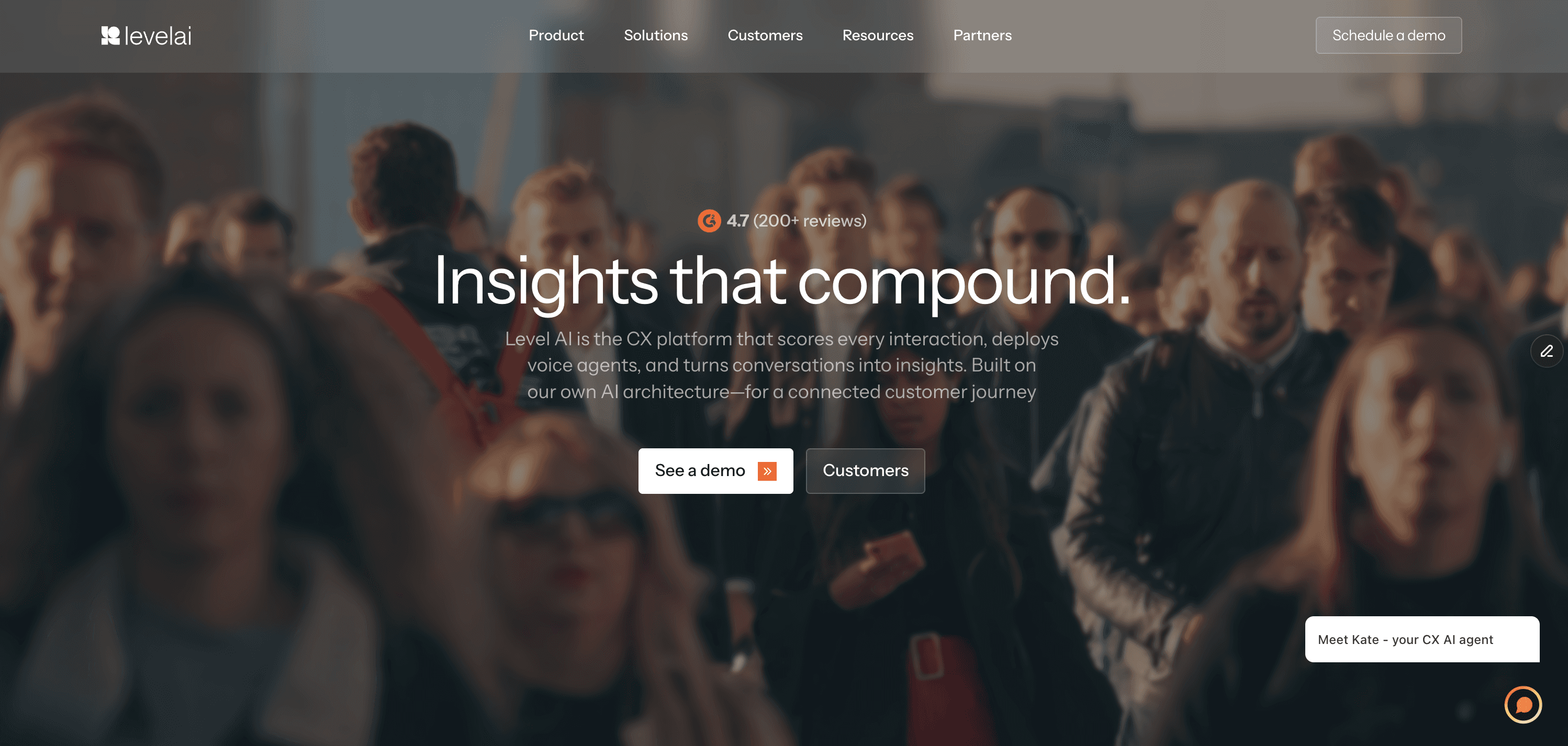
Level AI is a contact center intelligence platform built specifically to help quality assurance teams, operations leaders, and CX managers get real insight out of every customer conversation. Unlike traditional QA tools that rely on keyword matching or manual scorecard reviews, Level AI uses semantic understanding to analyze what customers and agents are actually saying, not just the words they use. This means the platform can detect intent, sentiment, and context across voice, chat, email, and messaging channels, at 100 percent coverage.
What sets Level AI apart from most Playvox alternatives is the combination of automated scoring, real-time agent guidance, and a unified analytics layer that makes data usable for multiple teams simultaneously. QA managers get auto-scored interactions with customizable rubrics through the InstaScore system. Supervisors get real-time dashboards that surface the most important conversations without needing to dig through call queues. Operations leaders get trend data that answers not just how agents are performing, but why customers are reaching out and where gaps in process or training exist. The platform integrates with leading CRMs, helpdesks, and telephony platforms, and is designed to get teams up and running quickly.
Key Features:
InstaScore: automated, rubric-based scoring across 100% of interactions
Real-time agent assists with live in-call guidance and knowledge surfacing
Semantic intelligence that understands customer intent beyond keywords
Omnichannel support across voice, chat, email, and messaging
Customizable QA rubrics through the Rubric Builder
Smart tagging and conversation intelligence for operations and product teams
Real-time supervisor dashboards with call whisper and intervention tools
Scenario Engine for tracking specific interaction types or compliance triggers
Best For:
Level AI is the strongest choice for contact centers that need to go beyond manual QA sampling and want real, automated visibility into every customer interaction. It is particularly well-suited for mid-market and enterprise teams running omnichannel support who want a platform that serves both QA and operations intelligence goals without requiring two separate tools.
Strengths:
Industry-leading accuracy in semantic analysis, with customers reporting over 2x better tagging accuracy compared to keyword-based systems
Real-time and post-call capabilities in a single platform, covering both live coaching and historical QA
Fast time to value with straightforward onboarding compared to legacy enterprise WEM tools
Purpose-built for contact centers, not a bolted-on QA module in a broader suite
Serves multiple stakeholder groups: QA teams, supervisors, operations, and product management
Strong track record as a recognized leader by G2, Forrester, and CMP Research in conversation intelligence and QA software
" transform="translate(85.643 10.143)" width="23.725855670103115px"/><path d="M 71.828 0 L 0 50.702" fill="transparent" height="50.70235051546392px" id="TnJFUMH9b" stroke-dasharray="" stroke-linecap="butt" stroke-linejoin="miter" stroke-miterlimit="10" stroke-width="0.68" stroke="rgb(254, 250, 241)" transform="translate(85.508 75.029)" width="71.82828865979384px"/><path d="M 81.579 0 L 0 52.003" fill="transparent" height="52.00280412371134px" id="ccJzhVTGI" stroke-dasharray="" stroke-linecap="butt" stroke-linejoin="miter" stroke-miterlimit="10" stroke-width="0.68" stroke="rgb(254, 250, 241)" transform="translate(85.495 73.738)" width="81.57921649484533px"/><path d="M 65.653 0 L 0 32.827" fill="transparent" height="32.826556701030924px" id="X0Vp_q8HG" stroke-dasharray="" stroke-linecap="butt" stroke-linejoin="miter" stroke-miterlimit="10" stroke-width="0.68" stroke="rgb(254, 250, 241)" transform="translate(85.462 92.931)" width="65.65311340206183px"/><path d="M 88.08 14.951 L 0 0" fill="transparent" height="14.950762886597914px" id="JM_UgSiJ_" stroke-dasharray="" stroke-linecap="butt" stroke-linejoin="miter" stroke-miterlimit="10" stroke-width="0.68" stroke="rgb(254, 250, 241)" transform="translate(86.233 125.789)" width="88.07950515463914px"/><path d="M 83.204 72.803 L 0 0" fill="transparent" height="72.80313402061856px" id="KlyUUjlMK" stroke-dasharray="" stroke-linecap="butt" stroke-linejoin="miter" stroke-miterlimit="10" stroke-width="0.68" stroke="rgb(254, 250, 241)" transform="translate(85.089 125.71)" width="83.20379381443304px"/><path d="M 7.8 114.081 L 0 0" fill="transparent" height="114.08065979381445px" id="kAiUvduBR" stroke-dasharray="" stroke-linecap="butt" stroke-linejoin="miter" stroke-miterlimit="10" stroke-width="0.68" stroke="rgb(254, 250, 241)" transform="translate(85.95 125.478)" width="7.800247422680428px"/><path d="M 0 93.604 L 9.75 0" fill="transparent" height="93.60445360824741px" id="FsgTAQB0n" stroke-dasharray="" stroke-linecap="butt" stroke-linejoin="miter" stroke-miterlimit="10" stroke-width="0.68" stroke="rgb(254, 250, 241)" transform="translate(76.2 125.421)" width="9.750432989690694px"/><path d="M 0 76.379 L 76.703 0" fill="transparent" height="76.37888659793816px" id="NxOhHvPJ5" stroke-dasharray="" stroke-linecap="butt" stroke-linejoin="miter" stroke-miterlimit="10" stroke-width="0.68" stroke="rgb(254, 250, 241)" transform="translate(9.343 125.217)" width="76.7034556701031px"/><path d="M 0 26.651 L 39.002 0" fill="transparent" height="26.651381443298988px" id="QETNKJ3L6" stroke-dasharray="" stroke-linecap="butt" stroke-linejoin="miter" stroke-miterlimit="10" stroke-width="0.68" stroke="rgb(254, 250, 241)" transform="translate(47.096 125.177)" width="39.0017319587629px"/><path d="M 0 16.901 L 85.154 0" fill="transparent" height="16.900948453608265px" id="BL63wDICD" stroke-dasharray="" stroke-linecap="butt" stroke-linejoin="miter" stroke-miterlimit="10" stroke-width="0.68" stroke="rgb(254, 250, 241)" transform="translate(0.094 125.125)" width="85.15396503092786px"/><path d="M 0 0 L 78.004 17.876" fill="transparent" height="17.875793814432996px" id="PIX70Vlqf" stroke-dasharray="" stroke-linecap="butt" stroke-linejoin="miter" stroke-miterlimit="10" stroke-width="0.68" stroke="rgb(254, 250, 241)" transform="translate(8.362 107.251)" width="78.00376082474227px"/><path d="M 0 0 L 67.928 52.327" fill="transparent" height="52.32742268041238px" id="u_syqWqWD" stroke-dasharray="" stroke-linecap="butt" stroke-linejoin="miter" stroke-miterlimit="10" stroke-width="0.68" stroke="rgb(254, 250, 241)" transform="translate(17.593 72.861)" width="67.92826391752578px"/><path d="M 0 0 L 77.029 70.528" fill="transparent" height="70.52832989690722px" id="DmW_aE2A0" stroke-dasharray="" stroke-linecap="butt" stroke-linejoin="miter" stroke-miterlimit="10" stroke-width="0.68" stroke="rgb(254, 250, 241)" transform="translate(9.489 54.678)" width="77.02866804123713px"/><path d="M 0 0 L 27.301 126.431" fill="transparent" height="126.43109443298971px" id="JrLaRUubC" stroke-dasharray="" stroke-linecap="butt" stroke-linejoin="miter" stroke-miterlimit="10" stroke-width="0.68" stroke="rgb(254, 250, 241)" transform="translate(58.341 -0.071)" width="27.30111340206188px"/><path d="M 0 4.012 C 0 1.796 1.796 0 4.012 0 C 6.228 0 8.025 1.796 8.025 4.012 C 8.025 6.228 6.228 8.025 4.012 8.025 C 1.796 8.025 0 6.228 0 4.012 Z" fill="rgb(254, 80, 0)" height="8.024669690721652px" id="Nh5qrPJs_" transform="translate(81.396 121.369)" width="8.024669690721623px"/></svg>)
2. Scorebuddy (Best for Scalable QA with Built-In Learning)
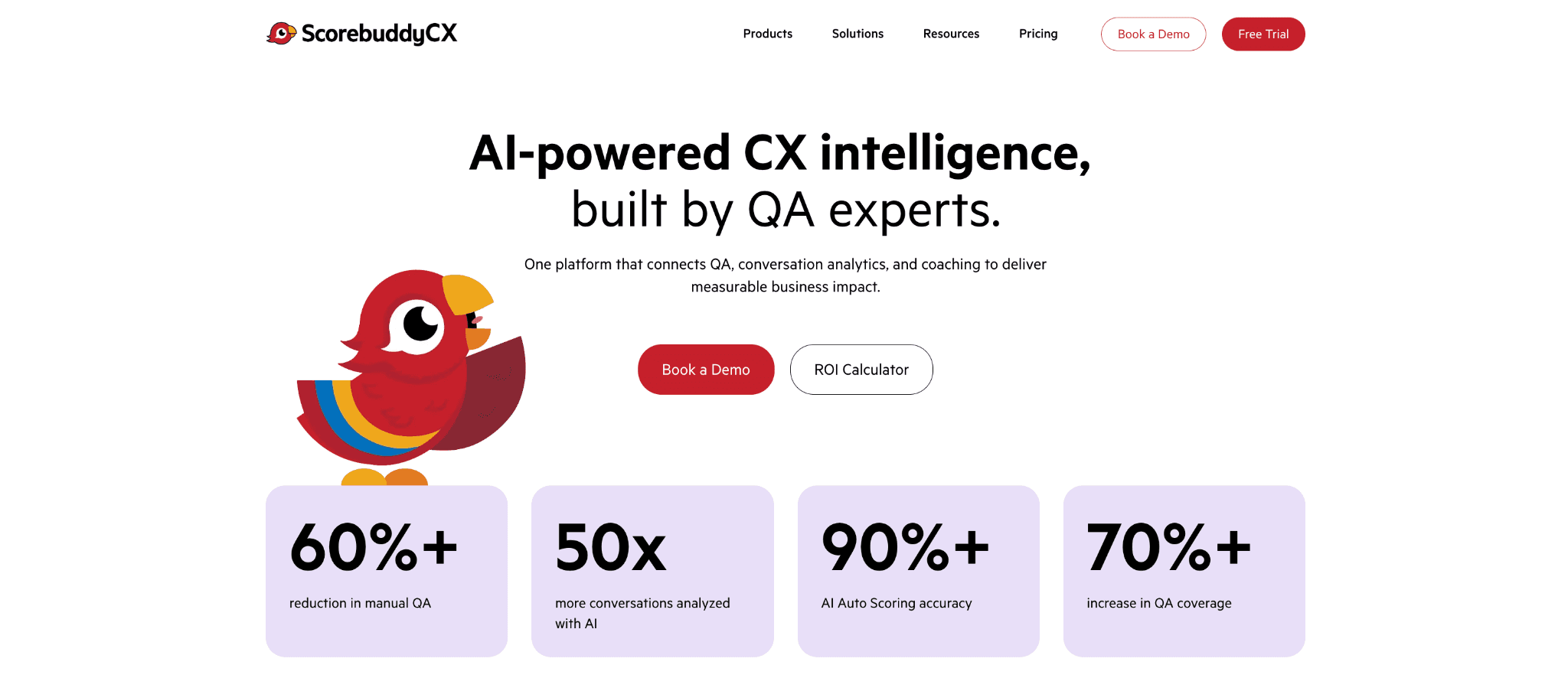
Scorebuddy is a purpose-built quality assurance platform with over 50,000 agents and 300-plus contact centers on its platform. It combines AI-powered auto-scoring, highly configurable scorecards, and a built-in learning management system (LMS) that connects QA findings directly to agent training. The platform supports native integrations with Salesforce, Zendesk, Genesys, Five9, Amazon Connect, and Talkdesk.
Key Features:
GenAI auto-scoring with up to 100% interaction coverage
Configurable scorecards mapped to compliance and CX criteria
Integrated LMS for training and development linked to QA scores
BI-grade reporting and data export for all stakeholders
ISO 27001 and SOC 2 Type 1 and Type 2 certification
Evaluator workflow automation and intelligent sampling rules
Multi-client BPO support with full data segregation
Best For:
Scorebuddy is a strong fit for teams transitioning from spreadsheet-based QA to a structured platform. It is particularly well-regarded by BPOs and enterprise contact centers with complex organizational structures and high compliance requirements.
Strengths:
Dedicated QA focus without the overhead of a broader WEM suite
Built-in LMS that connects evaluations to coaching and training in one loop
Strong compliance credentials including SOC 2 certification
Highly configurable scorecards that accommodate complex multi-channel QA programs
Solid integration ecosystem with most major contact center platforms
Weaknesses:
Some users report slow loading during high-volume periods when pulling large data exports
Reporting interface has a steeper learning curve than simpler QA tools
Does not include workforce management features; QA-only solution
3. Zendesk QA (Formerly Klaus)
Klaus was acquired by Zendesk in 2022 and has since been rebranded as Zendesk QA. The platform retains much of what made Klaus popular, including AI-driven conversation reviews, AutoQA features, and a clean interface built by support professionals for support teams. Its AutoQA system analyzes every interaction, including AI agent conversations, and automatically assigns quality scores based on predefined or custom criteria.
Key Features:
AutoQA for 100% automated conversation scoring
Native integration within Zendesk Suite
Support for human and AI agent interaction monitoring
Calibration workflows for consistent scoring
Performance dashboards and trend tracking
Best For:
Zendesk QA is the natural choice for teams already fully embedded in the Zendesk ecosystem. It is a strong option for smaller to mid-sized support teams that prioritize ease of use and don’t need complex multi-channel QA workflows.
Strengths:
Deep native integration with Zendesk that reduces tool-switching for QA reviewers
Solid AutoQA capabilities that extend coverage beyond manual sampling
Strong brand and platform stability under Zendesk’s ownership
Relatively fast to implement for teams already on Zendesk
Weaknesses:
Locked to the Zendesk ecosystem; unsuitable for teams using other helpdesks
Some users report regression in scorecard functionality since the acquisition
Limited organizational flexibility for large multi-team or BPO-scale operations
Lacks workforce management capabilities
4. MaestroQA (Now Rebranded as Rippit)
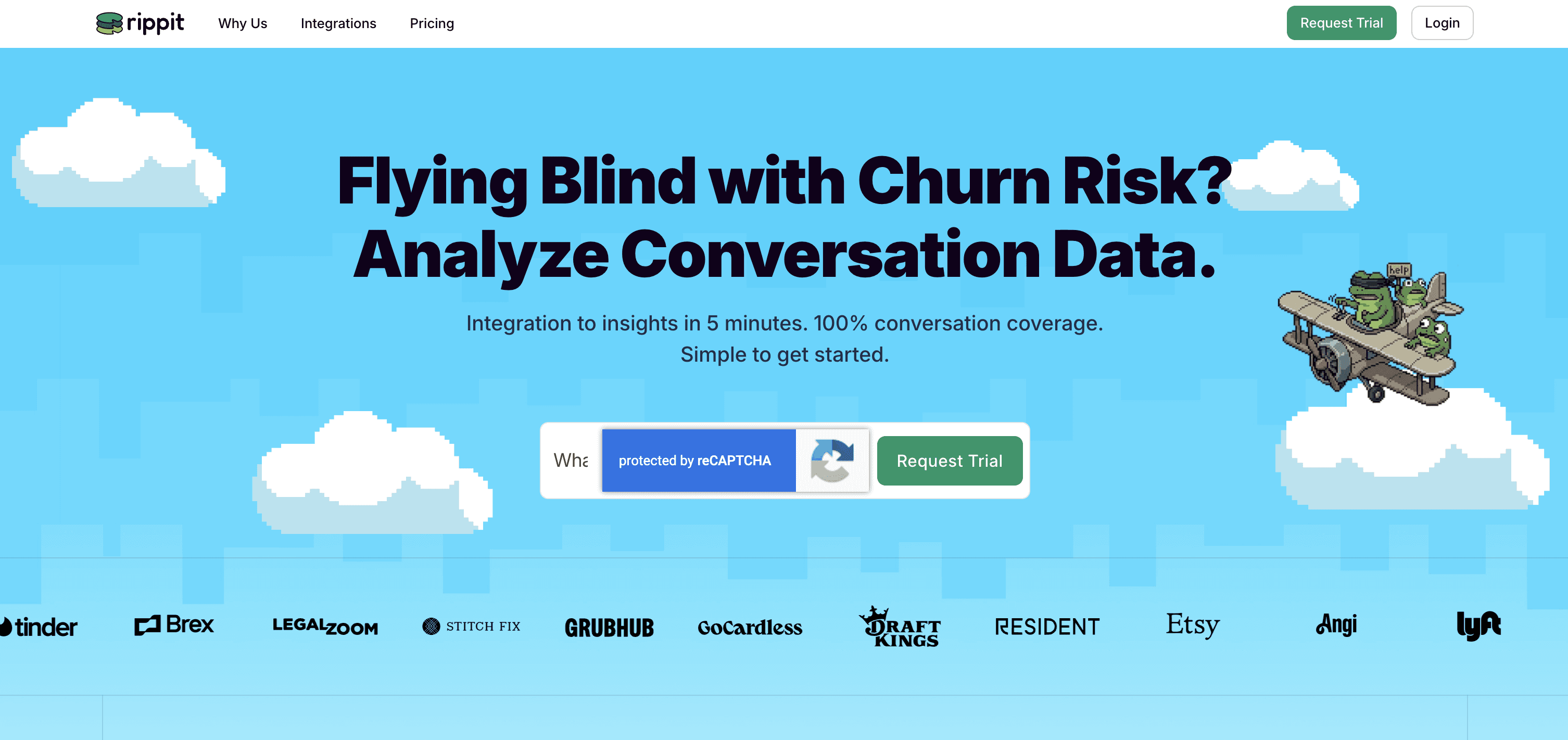
MaestroQA, recently rebranded to Rippit, is a QA platform designed for teams that want more than a checklist approach to quality management. It offers configurable scorecards that can be customized by channel type, interaction complexity, and team role. Screen capture provides a full interaction context for reviewers, and AI-powered conversation analytics are layered over manual workflows to help teams scale coverage without fully replacing human judgment.
Key Features:
Configurable scorecards with criteria mapped by channel type and interaction complexity
Screen capture for full interaction context beyond transcript review
AI-powered conversation analytics layered over manual QA workflows
Calibration tools and automated workflow routing
Deep integrations with CRM platforms including Salesforce and Zendesk
Coaching tools and agent performance tracking
Best For:
MaestroQA suits contact centers with dedicated QA teams that need to run structured, data-driven quality programs at scale. It is particularly strong for enterprise teams and BPOs where different interaction types require distinct evaluation criteria.
Strengths:
Deep customization options for scorecards and evaluation workflows
Strong track record in enterprise and analyst-led QA environments
Screen capture provides context that pure conversation analytics can miss
Solid integration ecosystem across CRM and helpdesk platforms
Well-regarded coaching and calibration tools
Weaknesses:
Relies more on manual-first QA workflows than fully automated coverage
Interface can be complex and requires a learning curve for new users
Product updates have occasionally disrupted existing workflows
Does not include workforce management features
5. Calabrio ONE (Now part of the Verint CX platform)
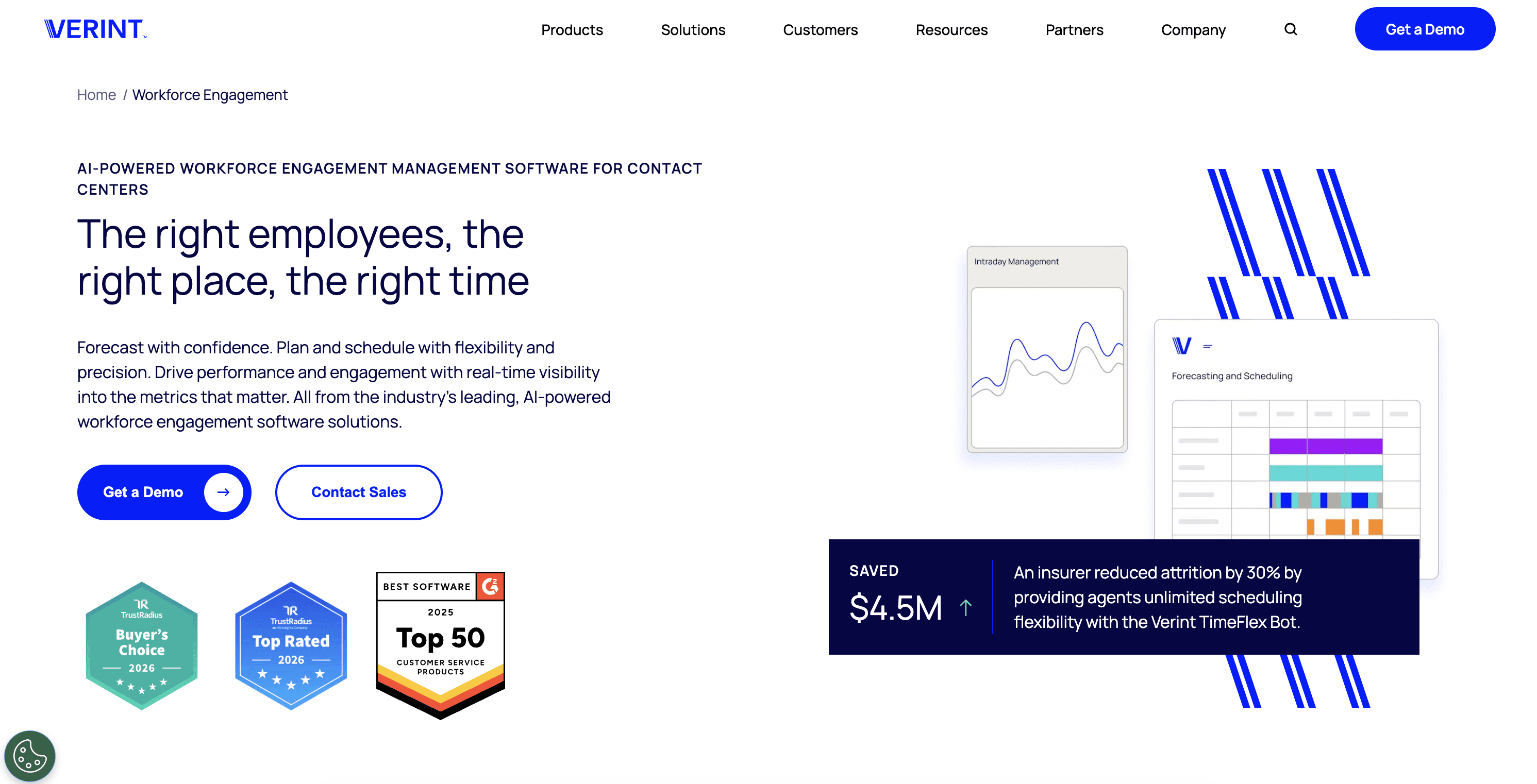
Calabrio ONE is one of the most direct full-suite alternatives to Playvox, covering workforce management, quality assurance, analytics, and agent performance in a single cloud-native platform. It is built for mid-market to large contact centers with 200 to 1,000-plus agents. Its forecasting module uses machine learning to automate demand predictions up to 60 days in advance, while its quality management module supports interaction scoring, coaching workflows, and compliance tracking.
Key Features:
AI-driven forecasting and scheduling up to 60 days out
Quality assurance with interaction scoring and calibration tools
Agent performance dashboards and coaching workflows
Analytics with customer journey insights
Remote-friendly mobile scheduling via the My Time app
Compliance features built into the core platform
Best For:
Calabrio is the strongest match for mid-to-large contact centers that need a complete WEM replacement for Playvox, including scheduling, QA, and analytics in one place.
Strengths:
Genuine full-suite WEM coverage that matches Playvox’s breadth
Cloud-native architecture designed for modern contact centers
Strong compliance features are built in by default
Mobile-friendly design works well for distributed and hybrid teams
Solid mid-market positioning with enterprise-grade capabilities
Weaknesses:
Implementation can require significant professional services investment
The total cost of ownership is higher than standalone QA tools
Users accustomed to Playvox’s lighter interface may find a learning curve
6. Zendesk Suite
The full Zendesk Suite is worth considering as a broader Playvox alternative for teams looking to consolidate their customer service platform and QA tooling into a single vendor relationship. The Suite includes ticketing, live chat, voice, and reporting, with Zendesk QA available as an add-on.
Key Features:
Omnichannel support across voice, chat, email, and social
Built-in QA with AutoQA features as an add-on
Agent performance reporting and dashboards
Workflow automation and extensive third-party app marketplace
SOC 2 and GDPR compliance
Best For:
Teams that want to consolidate their customer service platform and QA into a single Zendesk relationship, particularly if they are currently using multiple disconnected tools for interactions, ticketing, and quality monitoring.
Strengths:
One-stop platform that covers CX and QA without multiple vendor contracts
Extensive app marketplace for adding functionality
Well-established platform with strong global support resources
Weaknesses:
QA capabilities are not as deep as standalone QA platforms
Voice capabilities have historically lagged behind purpose-built telephony platforms
Enterprise pricing can escalate quickly with add-ons
7. Assembled (Best Standalone WFM Alternative)
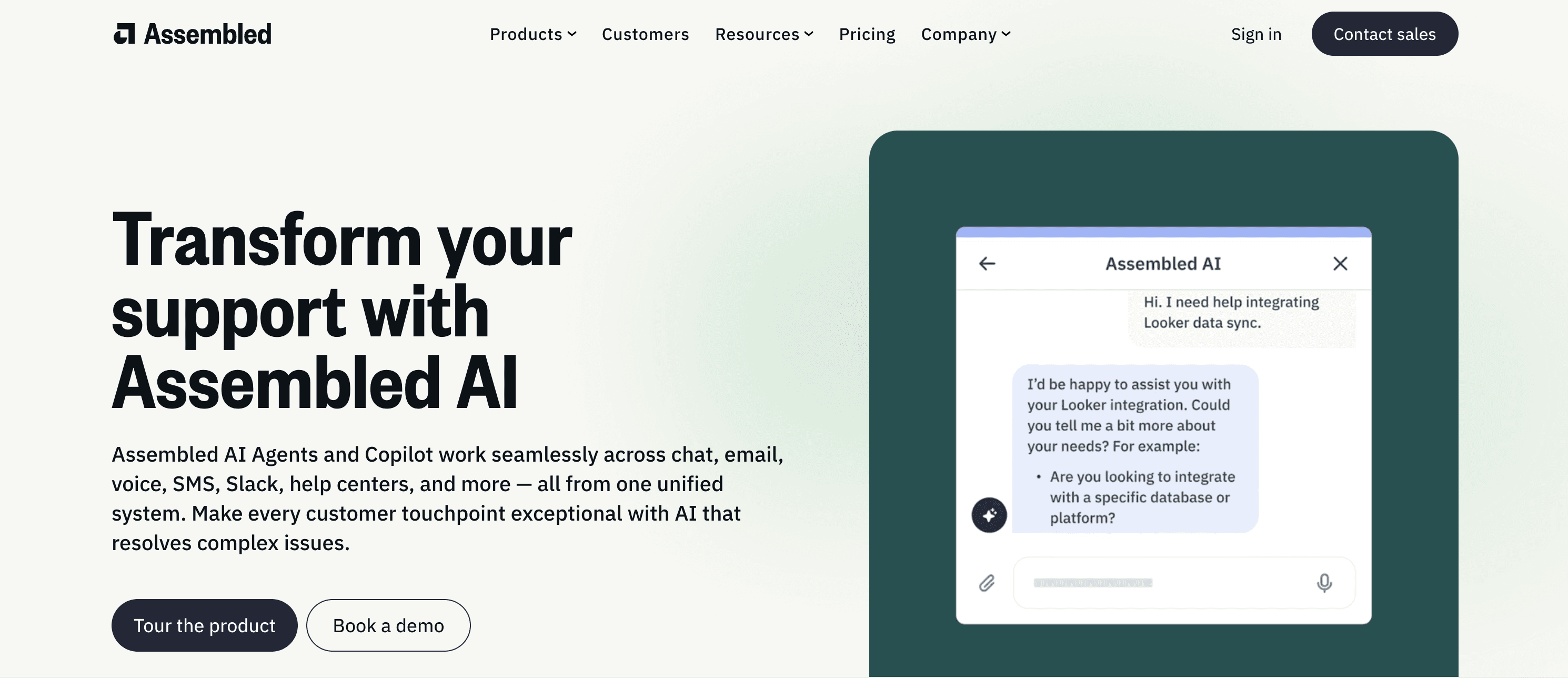
Assembled is one of the most innovative standalone workforce management platforms on the market. It covers the full WFM stack, including forecasting, scheduling, intraday management, and performance analytics. It recently became the first WFM platform to launch a Model Context Protocol (MCP) server, enabling teams to query live workforce data through natural language. Assembled is the top-ranked WFM alternative to Playvox on G2.
Key Features:
AI-driven demand forecasting and scheduling
Intraday management and real-time adherence tracking
Staffing scenario simulations and what-if planning
MCP server for natural language access to live WFM data
SOC 2, GDPR, and HIPAA compliance
Native integrations with Salesforce, Zendesk, and leading contact center platforms
Best For:
Growing support teams and tech companies that need modern, fast-to-implement workforce management without the complexity of legacy enterprise WFM platforms. An excellent replacement for Playvox WFM, specifically.
Strengths:
Modern, intuitive interface that reduces the learning curve vs. legacy WFM tools
MCP integration is a genuine innovation for accessing operational data in existing workflows
Fast implementation timelines compared to enterprise alternatives
Strong focus on digital-first and hybrid workforces
SOC 2 certified with a strong security posture
Weaknesses:
Does not include quality assurance features; teams replacing Playvox’s full WEM suite need a separate QA tool
Less suited for very large enterprise contact centers with complex multi-country scheduling
Reporting depth is not as extensive as legacy enterprise WFM platforms
8. Talkdesk
Talkdesk is a cloud-based contact center platform that goes beyond QA and WFM to cover the full contact center stack, including omnichannel routing, IVR, AI agent assist, quality management, and workforce engagement. Its Quality Management module includes AI-powered automated scoring, voice and screen recording, customizable evaluation forms, coaching workflows, and gamification.
Key Features:
Omnichannel contact center with voice, chat, email, and social
AI-powered Quality Management with automated scoring
Voice and screen recording with customizable evaluation forms
Agent coaching and gamification tools
Real-time monitoring and reporting dashboards
Best For:
Mid to large contact centers looking for a unified CCaaS platform that includes solid built-in quality management, rather than a standalone QA tool.
Strengths:
Full contact center platform that reduces vendor fragmentation
Quality management features are genuinely integrated, not bolted on
Strong AI capabilities across routing, agent assist, and QA
Good mid-market reputation with broad industry coverage
Weaknesses:
QA capabilities are not as deep as dedicated QA platforms like Level AI or Scorebuddy
Customizing reports and complex workflows often requires technical support
Requires signing up for the full Talkdesk platform rather than purchasing QA as a standalone module
Occasional instabilities and slower support response times noted in user reviews
9. Genesys Cloud CX
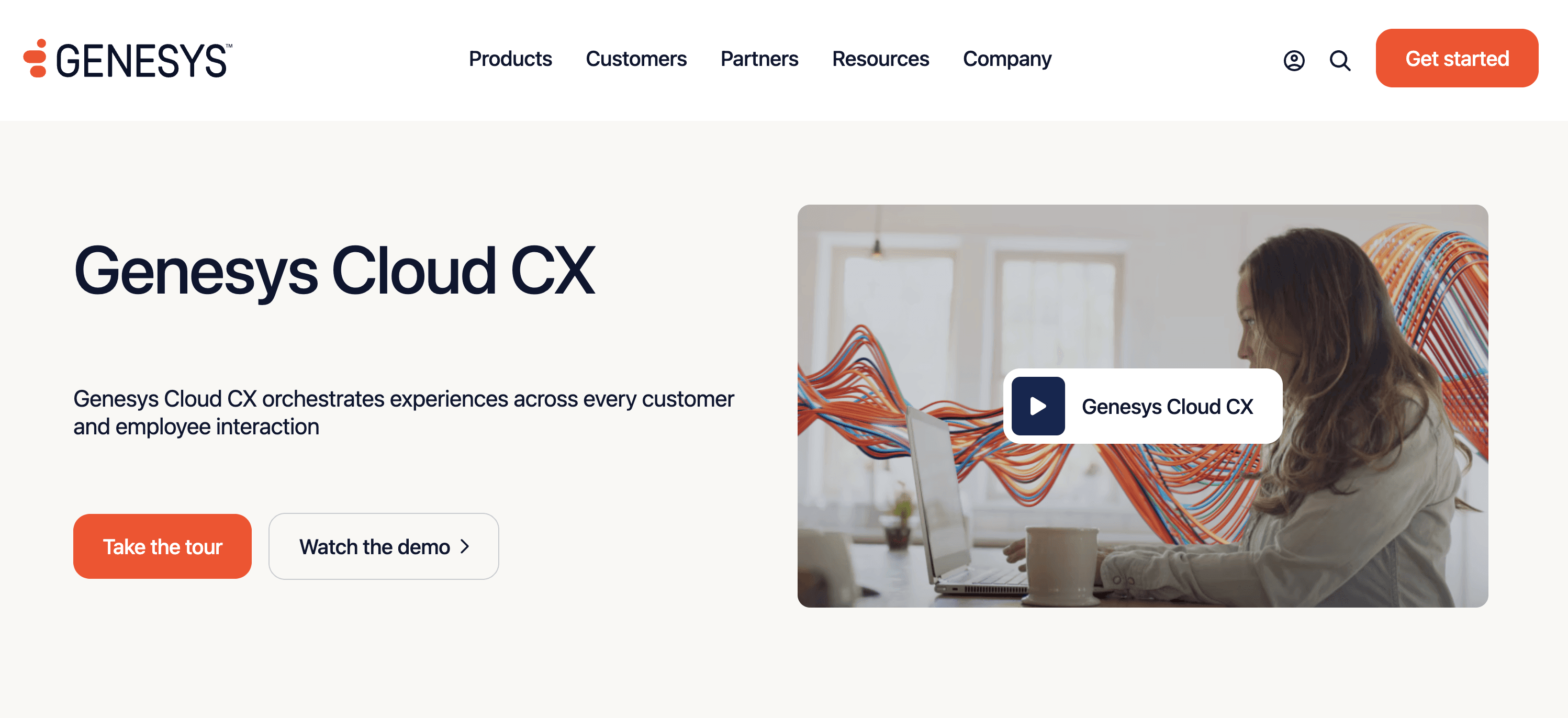
Genesys Cloud CX is one of the most widely deployed cloud contact center platforms globally, trusted by thousands of organizations across enterprise and mid-market segments. It covers the full spectrum of contact center operations, including omnichannel routing, IVR, AI-driven agent assist, workforce management, quality management, and customer analytics.
Key Features:
Omnichannel contact center across voice, chat, email, social, and messaging
AI-powered workforce engagement management
Quality management with automated scoring and coaching
Real-time analytics and performance dashboards
Open API architecture with an extensive integration marketplace
Enterprise-grade security and compliance
Best For:
Large and enterprise contact centers looking for a comprehensive all-in-one CCaaS platform that covers routing, WFM, QA, and analytics without requiring multiple vendor relationships.
Strengths:
Broad platform coverage that includes every major contact center function
Enterprise-scale reliability and global deployment options
Extensive API and integration ecosystem
Strong WFM capabilities for large, complex operations
Recognized as an industry leader across multiple analyst evaluations
Weaknesses:
Total cost of ownership is high, with pricing that escalates quickly at enterprise scale
Implementation is complex and typically requires significant professional services involvement
Smaller or mid-market teams may find the platform more than they need
Remote work support may require additional configuration compared to cloud-native WFM platforms
Conclusion: Why Level AI Is the Best Playvox Alternative
If your primary reason for leaving Playvox is the uncertainty created by the NICE acquisition, and you need a platform that delivers real quality assurance coverage, meaningful coaching workflows, and operational intelligence your teams can actually use, Level AI is the strongest replacement on the market.
Playvox by NICE has significant gaps. It relies on first-generation keyword-based technology for QA automation, struggles to capture voice interactions meaningfully, lacks deep real-time capabilities, and faces an uncertain product roadmap under NICE’s ownership. Level AI closes those gaps directly. Its semantic intelligence engine understands what customers and agents actually mean in conversations. Its automated scoring covers 100 percent of interactions across every channel. Its real-time capabilities let supervisors monitor, coach, and intervene in live calls rather than reviewing them days later.
Frequently Asked Questions
What happened to Playvox?
Playvox was acquired by NICE in late 2024 and rebranded to Playvox by NICE. Current customers have raised concerns about pricing changes, product overlap with NICE's existing CXone platform, and the risk of being migrated onto NICE's own tools over time.
Is Playvox still worth using after the NICE acquisition?
For teams currently on Playvox, it may still function adequately in the short term. However, based on NICE's track record with previous acquisitions like LiveVox, there is a real risk of service disruption, price increases, and reduced innovation. Many contact center professionals recommend evaluating alternatives before the transition becomes forced.
What is the best Playvox alternative for QA?
Level AI and Scorebuddy are both strong QA-focused alternatives. Level AI is better suited for teams that need semantic-based analysis, real-time capabilities, and intelligence across multiple channels. Scorebuddy is a strong choice for teams that want configurable scorecards, a built-in LMS, and a proven enterprise QA platform with a clean onboarding path.
What is the best Playvox WFM alternative?
Assembled WFM is the top-rated alternative to Playvox WFM on G2, particularly for digital-first and tech-forward support teams. Calabrio ONE is a stronger option for teams that need full WEM suite coverage including both WFM and QA.