
Key takeaways
Call center software for banking needs to do more than route calls. It has to prove every interaction met GLBA, FCRA, TCPA, and PCI DSS requirements, on demand, without extra manual work from QA teams
Automated, 100% QA coverage (instead of a 2 to 5% manual sample) is becoming the baseline expectation for banks and credit unions, not a nice-to-have
Purpose-built banking packages, like Talkdesk's Financial Services Experience Cloud or Level AI's core banking integrations, cut deployment time compared to configuring a generic CCaaS platform from scratch
AI agent assist and virtual agents are moving from pilot to production for balance inquiries, card disputes, and collections, freeing human agents for complex, relationship-driven conversations
The right platform depends heavily on institution size. A community bank, a regional credit union, and a top-20 national bank will land on different tools even when solving the same underlying problem
Introduction
Call center software for banking has become a compliance system as much as a communications tool, and the shift is measurable: conversational AI deployments are projected to cut contact center agent labor costs by $80 billion in 2026, a number that is pulling banks and credit unions into AI-first buying decisions faster than almost any other regulated industry, as per a report by Gartner.
For banks, the stakes around this decision are higher than for most industries. A missed disclosure on a recorded call, an unredacted account number in a transcript, or a collections call placed outside permitted hours can trigger regulatory action, not just a bad customer experience. That is why banking IT and CX leaders are increasingly starting their banking and credit union technology evaluations with compliance and AI capability first, and channel routing second.
This guide breaks down the 10 platforms banks and credit unions evaluate most often in 2026, how we evaluated them, and where each one actually fits.
What Is bank call center software?
Bank call center software is a contact center platform configured specifically for the operational and regulatory realities of financial institutions. On the surface, it does what any contact center platform does: routes inbound and outbound calls, chats, and emails, records interactions, and reports on agent performance.
Underneath, it has to handle things a retail or SaaS contact center never touches. That includes tamper-evident call recording for SEC and FINRA retention rules, automatic PCI DSS-compliant handling of card data spoken on calls, TCPA-compliant outbound dialing windows for collections, and call center compliance monitoring that can prove, not just claim, that every required disclosure was read.
Most bank call center software also needs to plug into core banking platforms (Jack Henry, FIS, Fiserv), digital banking apps, and card processors, so an agent or an AI assistant can see account status and transaction history without switching screens mid-call.
Why banks need specialized call center software?
A generic contact center platform can route calls just fine. What it usually cannot do out of the box is prove compliance at scale. Banks operate under a stack of overlapping rules, GLBA for data privacy, FCRA for credit reporting disputes, TCPA for outbound calling, and PCI DSS for any call where a card number is spoken, and each one carries real financial and legal exposure if a contact center gets it wrong.
Manual QA sampling, the traditional way contact centers checked compliance, only reviews 2 to 5% of calls. For a bank handling tens of thousands of interactions a month, that means the overwhelming majority of calls are never reviewed for a missed disclosure, a mishandled dispute, or an unredacted account number. Specialized bank call center software closes that gap with automated regulatory compliance monitoring that reviews 100% of interactions, flags risk in near real time, and keeps an audit trail examiners can pull on request.
There is also a trust dimension that is unique to banking. Members and customers are calling about their money, often when something has gone wrong (a fraud alert, a declined transaction, a missed payment). The software a bank chooses directly shapes how fast, accurate, and reassuring that conversation feels.
How we evaluated the best bank call center software?
We built this list around six factors that matter specifically to banks and credit unions, not general-purpose contact centers:
Regulatory and compliance depth: native support for GLBA, FCRA, TCPA, and PCI DSS, including automated disclosure tracking and secure payment capture.
Core banking and digital banking integrations: how easily the platform connects to systems like Jack Henry, FIS, Fiserv, and existing digital/mobile banking stacks.
AI capability for banking-specific use cases: fraud detection, virtual agents for account servicing, and agent assist for complex disputes.
QA and coaching coverage: whether QA is a manual sample or automated across 100% of interactions.
Scalability by institution size: fit for community banks and credit unions versus large national or multinational banks.
Verified user sentiment: real ratings and review volume from G2 and Capterra, plus documented banking customer outcomes, rather than vendor claims alone.
For a deeper look at how to run this kind of evaluation yourself, our guide on how to evaluate a contact center platform for full-journey AI orchestration walks through the same framework in more detail.
AI use cases for bank contact centers in 2026
AI has moved past the experimentation phase in banking contact centers. The use cases showing up most often in 2026 deployments include:
Automated 100% QA and compliance scoring, replacing small manual samples with review of every call, chat, and digital interaction.
Real-time agent assist that surfaces next-best-action, relevant disclosures, and account context mid-call, especially for fraud, disputes, and hardship conversations.
AI virtual agents handling high-volume, low-complexity requests (balance checks, card activation, address updates) so human agents can focus on relationship-driving conversations.
Sentiment and voice-of-the-customer analytics that flag member frustration or churn risk before it shows up in a survey.
Fraud and risk signal detection, using voice and conversation analytics to flag social engineering attempts or account takeover patterns during a live call.
Collections compliance automation, ensuring outbound dialing windows, call frequency, and required disclosures stay within TCPA and FDCPA limits automatically.
For a broader view of how these use cases play out across contact centers generally, see our breakdown of AI use cases in the contact center.
Compare bank contact centers in 2026
Software | Best Suited For | Banking Capabilities |
|---|---|---|
Level AI | Banks layering AI onto existing telephony | 100% automated QA, real-time agent assist, core banking integrations |
NICE CXone | Large banks and enterprise credit unions | Speech analytics, automated QA, PCI-compliant recording |
Genesys Cloud CX | Multinational and large regional banks | AI orchestration, predictive routing, omnichannel |
Five9 | Mid-market banks and collections-heavy teams | IVA, predictive dialer with TCPA controls, WFM |
Talkdesk | Community and regional banks, credit unions | Purpose-built banking cloud, branch-to-contact-center unification |
Amazon Connect | Banks with strong internal engineering teams | Contact Lens QA, Bedrock generative AI, pay-per-use |
Verint | Large banks with fraud/security priorities | IVA, workforce management, fraud and surveillance integration |
Cisco Webex Contact Center | Cisco-standardized banks, post-merger integrations | AI Assistant summaries, journey orchestration, fast migration |
Avaya | Established banks on hybrid/on-prem infrastructure | Predictive analytics, hybrid voice/video, gradual cloud migration |
Salesforce Service Cloud | Banks standardized on Salesforce CRM | Agentforce banking agents, Financial Services Cloud data model |
1. Level AI
Level AI is an AI-native contact center intelligence platform built specifically for regulated industries like banking, credit unions, and insurance. Rather than replacing a bank's existing telephony, it layers automated QA, real-time agent assist, and voice-of-the-customer analytics on top of platforms like Five9, Genesys, NICE, and Amazon Connect. Its semantic intelligence engine reviews 100% of interactions for compliance risk, script adherence, and sentiment, which matters directly for GLBA, FCRA, and TCPA-regulated conversations. Level AI also connects to core banking, digital banking, lending, and card platforms, giving supervisors a single view of a member's history across every channel.
Features best suited for banks:
Automated quality assurance that scores 100% of interactions for compliance and coaching, instead of a small manual sample
Real-time agent assist that surfaces disclosures, next-best-action, and account context during live calls
Automatic PII and PCI redaction across calls, chats, and digital channels
Voice-of-the-customer analytics that flag member sentiment, churn risk, and repeat-call drivers
Direct integrations with core banking, digital banking, lending, and card platforms
AI Workers that automate routine tier-1 requests like balance checks and card status
Best suitable for: Level AI fits mid-size to large banks and credit unions that already have a telephony platform in place and want to add AI-driven QA, compliance, and agent assist without a rip-and-replace project. It is also a strong fit for regulated fintechs and insurers that need to prove compliance across 100% of interactions rather than a sample. Institutions running lean QA teams relative to call volume tend to see the fastest payback, since automated coverage replaces hours of manual review.
Product ratings and customer stories: Level AI holds a 4.7 out of 5 rating on G2 based on 201 reviews. Its case study of a financial services firm documents how a financial services and insurance provider used Level AI to cut repetitive, avoidable calls and improve first-call resolution across its contact center.
2. NICE CXone
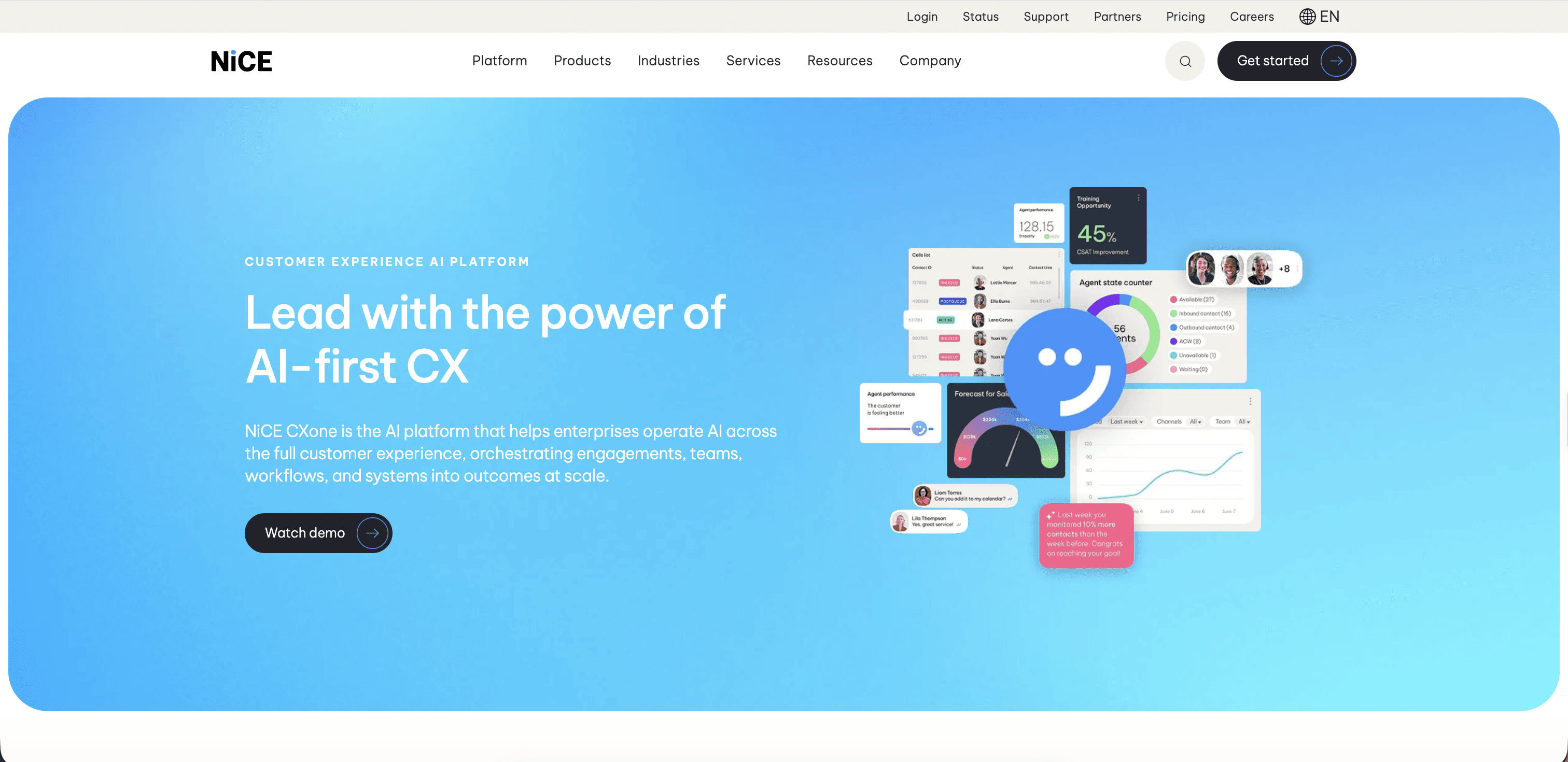
NICE CXone is one of the most established enterprise contact center platforms in banking, combining omnichannel routing, workforce optimization, and speech and voice analytics in a single suite. Its financial services package includes PCI DSS-compliant secure payment capture and automated QA scoring built specifically for regulated call flows. Large banks favor CXone for its depth of workforce management tooling, which matters when scheduling hundreds or thousands of agents across shifts and channels. It also offers strong interaction analytics for spotting compliance risk and coaching opportunities at scale.
Features best suited for banks:
CXone AutoQM for automated, scalable quality scoring
PCI DSS-compliant secure payment capture during live calls
Deep workforce management and forecasting for large agent teams
Interaction and speech analytics for compliance and sentiment
Omnichannel routing across voice, chat, and digital channels
Pre-built financial services workflows and reporting
Best suitable for: NICE CXone is best suited to large banks and enterprise-scale credit unions with thousands of agents and complex workforce scheduling needs. Its depth and configurability come with a steeper learning curve and higher total cost of ownership, so it tends to be overkill for smaller community banks or credit unions with lean IT teams.
Product ratings and customer stories: NICE CXone (Mpower) holds a 4.3 out of 5 rating on G2 from more than 1,700 reviews, and a 4.2 out of 5 rating on Capterra from 543 reviews. Documented banking customers include US Bank, TD Bank, and credit unions PSCU, Maps Credit Union, and Utah Community Credit Union, with Maps Credit Union reporting after-call work reduced by up to 94%.
3. Genesys Cloud CX
Genesys Cloud CX is a cloud-native omnichannel platform known for its AI orchestration layer, which coordinates bots, agents, and predictive routing across a customer journey. In banking, it shows up most often at large, often multinational, institutions that need consistent CX across many countries and languages. Its predictive engagement tools and open API architecture make it a common choice for banks with the internal engineering capacity to build custom banking workflows on top of the platform.
Features best suited for banks:
AI orchestration and copilot tools for blending bots and human agents
Predictive routing based on customer value and intent
Omnichannel support across voice, chat, email, and social
Workforce engagement management for large, distributed teams
Embedded compliance recording and retention
Open APIs for integrating with core banking and CRM systems
Best suitable for: Genesys Cloud CX fits large regional and multinational banks that need a globally consistent platform and have the engineering resources to configure it deeply. Mid-market banks with smaller IT teams sometimes find the licensing and configuration complexity harder to manage than more purpose-built alternatives.
Product ratings and customer stories: Genesys Cloud CX holds a 4.4 out of 5 rating on G2 from roughly 1,520 reviews, and a 4.3 out of 5 rating on Capterra. Banking customers include HSBC, which projects $60 million in three-year value from the platform, BNP Paribas, and M&T Bank, which reported a 100% increase in banker productivity after implementation.
4. Five9
Five9 is a cloud contact center platform with a strong presence in financial services, particularly for collections and outbound-heavy operations where TCPA compliance is critical. Its intelligent virtual agent (IVA) handles high-volume self-service, while its predictive dialer includes compliance controls for outbound calling windows. Five9 has also been paired with Amazon Connect in bank collections modernization projects, reflecting its flexibility as part of a broader stack rather than a single closed platform.
Features best suited for banks:
Intelligent Virtual Agent (IVA) for self-service account inquiries
Predictive dialer with built-in TCPA compliance controls
Real-time call transcription and supervisor monitoring
Financial services-specific workflow templates
Workforce management and forecasting
Flexible integration with other platforms, including Amazon Connect
Best suitable for: Five9 is a strong fit for mid-market to large banks and credit unions with significant outbound calling volume, particularly collections and payment reminder operations that need compliance guardrails built in. It is less commonly the first choice for banks prioritizing inbound digital-first servicing over outbound calling.
Product ratings and customer stories: Five9 holds a 4.1 out of 5 rating on G2 from 625 reviews, and a 4.2 out of 5 rating on Capterra from 484 reviews. Banking customers include Central Bank and MSU Federal Credit Union, which cut its call abandonment rate from 18% to 9.5% after moving from IVR to IVA-led self-service.
5. Talkdesk
Talkdesk stands out in banking for building a dedicated Financial Services Experience Cloud, a purpose-built package rather than a generic contact center configured after the fact. It unifies branch, digital, and contact center context so frontline staff can see a customer's full relationship history in one place, and it layers AI-driven agent assist on top for real-time guidance during calls.
Features best suited for banks:
Financial Services Experience Cloud, a purpose-built banking package
Unified customer context across branch, digital, and contact center
Talkdesk for Financial Centers, extending AI tools to branch staff
Real-time AI agent assist and knowledge surfacing during calls
Pre-built integrations for banking and credit union core systems
Customer Experience Automation for repetitive service workflows
Best suitable for: Talkdesk is best suited to community and regional banks and credit unions that want a banking-specific package they can deploy relatively quickly, without building every compliance and workflow feature from scratch. It has also proven itself in fast periods of new financial services customer growth, making it a reasonable fit for institutions scaling quickly.
Product ratings and customer stories: Talkdesk holds a 4.4 out of 5 rating on G2 from more than 1,600 reviews, and a 4.5 out of 5 rating on Capterra from more than 700 reviews. Its TowneBank case study reports a 23-second reduction in average handle time and a 4.8 CSAT score, and Talkdesk has added credit unions like Avadian and BayPort along with Emprise Bank to its financial services customer base.
6. Amazon Connect
Amazon Connect is AWS's pay-as-you-go contact center service, appealing to banks with strong internal engineering teams that want deep customization and tight integration with the broader AWS ecosystem. Its Contact Lens feature provides built-in QA and sentiment analysis, and it connects natively to Amazon Bedrock for generative AI use cases and Amazon Lex for self-service IVR and chatbots.
Features best suited for banks:
Contact Lens for built-in QA, sentiment, and compliance flagging
Native integration with Amazon Bedrock for generative AI use cases
Amazon Lex-powered self-service IVR and chatbots
Pay-per-use pricing with no large upfront licensing commitment
High customizability through Lambda and AWS services
Strong security and compliance tooling inherited from AWS
Best suitable for: Amazon Connect fits banks, especially digital-first banks and larger institutions, that already run significant workloads on AWS and have engineering teams capable of building and maintaining custom contact center logic. It is a weaker fit for smaller banks or credit unions without dedicated development resources, since much of its value comes from custom configuration rather than out-of-box workflows.
Product ratings and customer stories: Amazon Connect holds a 4.5 out of 5 rating on G2 from 73 reviews, and a similar 4.5 out of 5 rating on Capterra. Banking customers include Capital One, which has adopted Amazon Connect as part of its broader AWS migration, NatWest, which launched 30 new self-serve journeys in three weeks, and Empower, which scaled QA call coverage 20x using Amazon Connect with Amazon Bedrock.
7. Verint
Verint takes a compliance and security-first approach to banking, combining workforce engagement management with fraud and surveillance capabilities that extend beyond the contact center into branches and ATMs. Its Intelligent Virtual Assistant handles financial services self-service, while its automated quality management tools support large-scale compliance monitoring.
Features best suited for banks:
Automated Quality Management for compliance-focused call scoring
Intelligent Virtual Assistant for financial services self-service
Workforce management with scheduling and forecasting
Fraud and surveillance integration across branch, ATM, and call channels
Speech and text analytics for risk and compliance flagging
Compliance-grade archiving and retention
Best suitable for: Verint suits large banks with dedicated fraud, security, and compliance functions that want a single vendor covering both physical security (branch and ATM surveillance) and contact center compliance. It is generally too heavy and specialized for small community banks or credit unions without a formal risk and compliance team.
Product ratings and customer stories: Verint's contact center and workforce products hold roughly a 4.4 out of 5 rating on G2 across nearly 1,000 reviews. Reported banking customers include Customers Bank and Liberty Bank and Trust, and Verint states that more than 100 banks use its technology for compliance and fraud-related use cases.
8. Cisco Webex Contact Center
Cisco Webex Contact Center is a natural fit for banks already standardized on Cisco's networking and unified communications stack. Its AI Assistant generates call summaries and topic analytics automatically, and it pairs with Webex Connect and Engage to build digital banking journeys and fraud-reduction workflows. Umpqua Bank's migration, completed in five months following its acquisition of Columbia Bank, is one of the more notable banking deployments of the platform.
Features best suited for banks:
Cisco AI Assistant for automatic call summaries and topic analytics
Webex Connect and Engage for digital banking journey automation
Customer journey orchestration across channels
Fast migration paths, useful during bank mergers and acquisitions
Integration with existing Cisco networking and UC investments
Real-time agent tools built on Cisco's AI stack
Best suitable for: Webex Contact Center is best suited to banks already running on Cisco infrastructure, or those going through a merger or acquisition that need to consolidate contact center operations quickly. It is a less obvious choice for banks with no existing Cisco footprint, since much of its efficiency comes from that existing integration.
Product ratings and customer stories: Webex Contact Center holds a 4.4 out of 5 rating on G2 from 168 reviews, and the broader Webex Suite holds a 4.4 out of 5 rating on Capterra from more than 7,400 reviews. Banking customers include Umpqua Bank, Columbia Bank, and First Horizon Bank, which has piloted Cisco's AI Assistant for call drop summaries.
9. Avaya
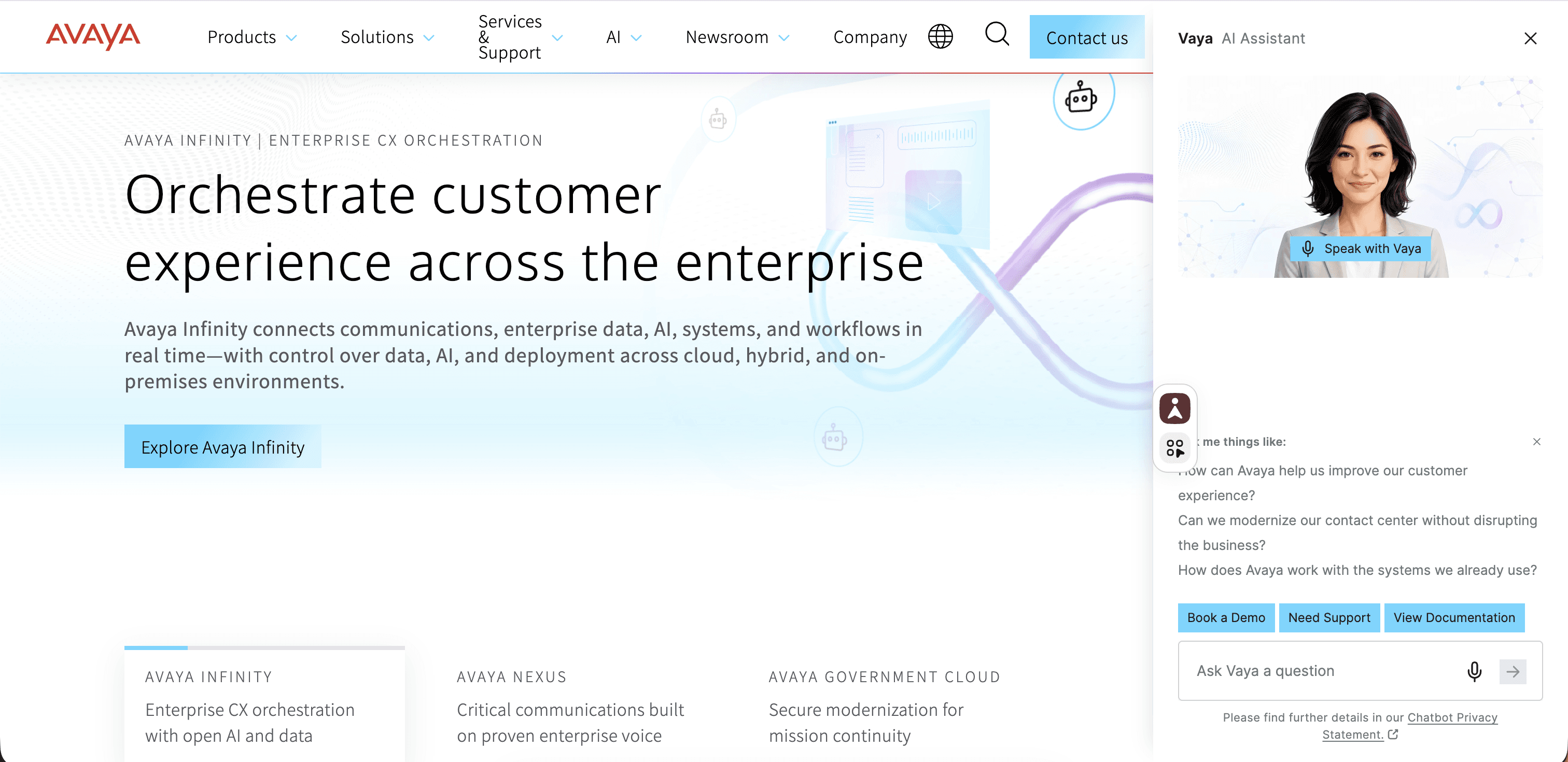
Avaya remains a common presence in banking due to its long history with large, established financial institutions and its hybrid on-premises and cloud deployment options. Its Avaya Experience Platform adds predictive analytics for proactive outreach and unifies voice, video, and chatbot channels, which appeals to banks that need a gradual migration path rather than a full cloud rip-and-replace.
Features best suited for banks:
Predictive analytics for proactive, relationship-driven outreach
Hybrid on-premises and private cloud deployment options
Unified voice and video banking channels
Chatbot integration alongside human agent workflows
Support for gradual, phased cloud migration
Established integrations with legacy banking infrastructure
Best suitable for: Avaya fits large, established banks and credit unions that already run on-premises Avaya infrastructure and want to modernize gradually rather than replace their entire stack at once. It is less commonly chosen by newer, digital-first banks that have no existing Avaya footprint to build on.
Product ratings and customer stories: Avaya Experience Platform holds a 4.1 out of 5 rating on G2 from 181 reviews, and a similar 4.1 out of 5 rating on Capterra. Documented banking customers include Community Bank, N.A., a 250-branch institution that unified its call center, branches, and digital presence with Avaya, and Landmark Bank.
10. Salesforce Service Cloud
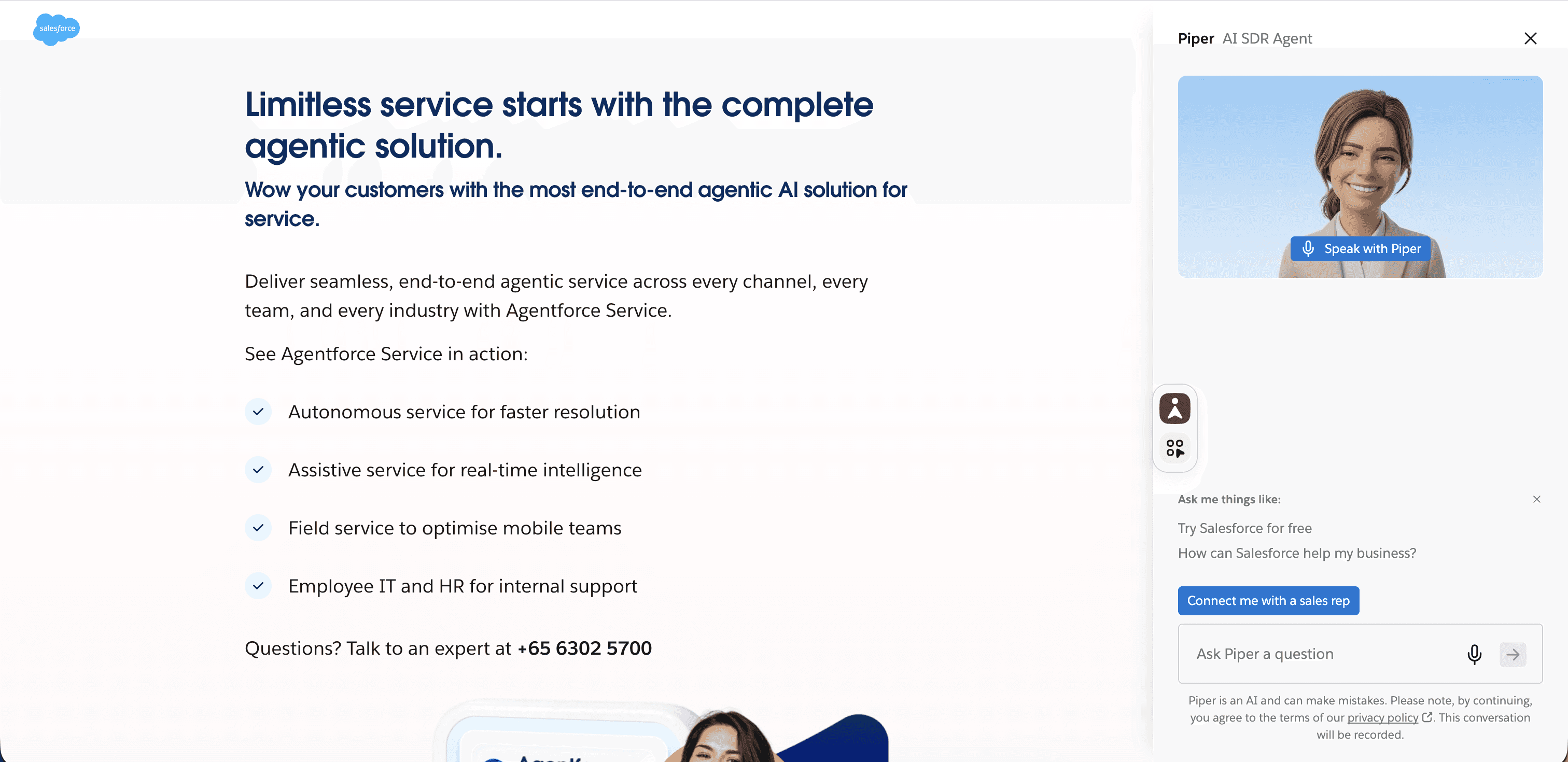
Salesforce Service Cloud, paired with Financial Services Cloud and Agentforce, is the strongest option for banks that want their contact center tightly unified with their CRM. Its data model is built around households and relationships rather than isolated cases, and its Agentforce AI agents are pre-built for common banking requests like balance inquiries, transfers, and card disputes.
Features best suited for banks:
Agentforce prebuilt AI agents for balance, transfer, and dispute handling
Financial Services Cloud data model built around customer relationships
Case management tied to a full 360-degree customer view
Credit-check and loan system integrations
Omnichannel routing across voice, chat, and digital
Large AppExchange ecosystem for banking-specific extensions
Best suitable for: Salesforce Service Cloud is best suited to banks and credit unions that are already running Salesforce as their core CRM and want to unify sales, service, and contact center data on one platform. It tends to work less well as a standalone telephony solution for institutions with no existing Salesforce investment, since much of its value depends on that broader ecosystem.
Product ratings and customer stories: Salesforce Service Cloud holds a 4.5 out of 5 rating on Capterra from 816 reviews, and the broader Salesforce product suite holds a 4.5 out of 5 rating on G2 across more than 97,000 reviews. Dollar Bank is a documented Financial Services Cloud customer, using the platform as the core system for managing customer interactions across channels and teams.
Level AI: built for the compliance reality of banking call centers
Most platforms on this list were built for contact centers in general and adapted for banking afterward. Level AI was built the other way around, starting from the reality that banks and credit unions have to prove compliance on every single interaction, not just route it efficiently. That is why it reviews 100% of calls, chats, and digital conversations automatically instead of relying on a small manual sample, and why it plugs directly into the core banking, lending, and card systems banks already run, rather than asking them to replace what works.
For CX and compliance leaders, that combination matters because it removes the tradeoff between speed and risk. Teams get real-time agent assist during live, high-stakes calls (fraud, disputes, hardship conversations) and automated QA and coaching after the fact, without adding headcount to a manual review queue. Banks and credit unions that are already running Five9, Genesys, NICE, or Amazon Connect can add Level AI on top of that investment instead of starting over.
" transform="translate(85.643 10.143)" width="23.725855670103115px"/><path d="M 71.828 0 L 0 50.702" fill="transparent" height="50.70235051546392px" id="TnJFUMH9b" stroke-dasharray="" stroke-linecap="butt" stroke-linejoin="miter" stroke-miterlimit="10" stroke-width="0.68" stroke="rgb(254, 250, 241)" transform="translate(85.508 75.029)" width="71.82828865979384px"/><path d="M 81.579 0 L 0 52.003" fill="transparent" height="52.00280412371134px" id="ccJzhVTGI" stroke-dasharray="" stroke-linecap="butt" stroke-linejoin="miter" stroke-miterlimit="10" stroke-width="0.68" stroke="rgb(254, 250, 241)" transform="translate(85.495 73.738)" width="81.57921649484533px"/><path d="M 65.653 0 L 0 32.827" fill="transparent" height="32.826556701030924px" id="X0Vp_q8HG" stroke-dasharray="" stroke-linecap="butt" stroke-linejoin="miter" stroke-miterlimit="10" stroke-width="0.68" stroke="rgb(254, 250, 241)" transform="translate(85.462 92.931)" width="65.65311340206183px"/><path d="M 88.08 14.951 L 0 0" fill="transparent" height="14.950762886597914px" id="JM_UgSiJ_" stroke-dasharray="" stroke-linecap="butt" stroke-linejoin="miter" stroke-miterlimit="10" stroke-width="0.68" stroke="rgb(254, 250, 241)" transform="translate(86.233 125.789)" width="88.07950515463914px"/><path d="M 83.204 72.803 L 0 0" fill="transparent" height="72.80313402061856px" id="KlyUUjlMK" stroke-dasharray="" stroke-linecap="butt" stroke-linejoin="miter" stroke-miterlimit="10" stroke-width="0.68" stroke="rgb(254, 250, 241)" transform="translate(85.089 125.71)" width="83.20379381443304px"/><path d="M 7.8 114.081 L 0 0" fill="transparent" height="114.08065979381445px" id="kAiUvduBR" stroke-dasharray="" stroke-linecap="butt" stroke-linejoin="miter" stroke-miterlimit="10" stroke-width="0.68" stroke="rgb(254, 250, 241)" transform="translate(85.95 125.478)" width="7.800247422680428px"/><path d="M 0 93.604 L 9.75 0" fill="transparent" height="93.60445360824741px" id="FsgTAQB0n" stroke-dasharray="" stroke-linecap="butt" stroke-linejoin="miter" stroke-miterlimit="10" stroke-width="0.68" stroke="rgb(254, 250, 241)" transform="translate(76.2 125.421)" width="9.750432989690694px"/><path d="M 0 76.379 L 76.703 0" fill="transparent" height="76.37888659793816px" id="NxOhHvPJ5" stroke-dasharray="" stroke-linecap="butt" stroke-linejoin="miter" stroke-miterlimit="10" stroke-width="0.68" stroke="rgb(254, 250, 241)" transform="translate(9.343 125.217)" width="76.7034556701031px"/><path d="M 0 26.651 L 39.002 0" fill="transparent" height="26.651381443298988px" id="QETNKJ3L6" stroke-dasharray="" stroke-linecap="butt" stroke-linejoin="miter" stroke-miterlimit="10" stroke-width="0.68" stroke="rgb(254, 250, 241)" transform="translate(47.096 125.177)" width="39.0017319587629px"/><path d="M 0 16.901 L 85.154 0" fill="transparent" height="16.900948453608265px" id="BL63wDICD" stroke-dasharray="" stroke-linecap="butt" stroke-linejoin="miter" stroke-miterlimit="10" stroke-width="0.68" stroke="rgb(254, 250, 241)" transform="translate(0.094 125.125)" width="85.15396503092786px"/><path d="M 0 0 L 78.004 17.876" fill="transparent" height="17.875793814432996px" id="PIX70Vlqf" stroke-dasharray="" stroke-linecap="butt" stroke-linejoin="miter" stroke-miterlimit="10" stroke-width="0.68" stroke="rgb(254, 250, 241)" transform="translate(8.362 107.251)" width="78.00376082474227px"/><path d="M 0 0 L 67.928 52.327" fill="transparent" height="52.32742268041238px" id="u_syqWqWD" stroke-dasharray="" stroke-linecap="butt" stroke-linejoin="miter" stroke-miterlimit="10" stroke-width="0.68" stroke="rgb(254, 250, 241)" transform="translate(17.593 72.861)" width="67.92826391752578px"/><path d="M 0 0 L 77.029 70.528" fill="transparent" height="70.52832989690722px" id="DmW_aE2A0" stroke-dasharray="" stroke-linecap="butt" stroke-linejoin="miter" stroke-miterlimit="10" stroke-width="0.68" stroke="rgb(254, 250, 241)" transform="translate(9.489 54.678)" width="77.02866804123713px"/><path d="M 0 0 L 27.301 126.431" fill="transparent" height="126.43109443298971px" id="JrLaRUubC" stroke-dasharray="" stroke-linecap="butt" stroke-linejoin="miter" stroke-miterlimit="10" stroke-width="0.68" stroke="rgb(254, 250, 241)" transform="translate(58.341 -0.071)" width="27.30111340206188px"/><path d="M 0 4.012 C 0 1.796 1.796 0 4.012 0 C 6.228 0 8.025 1.796 8.025 4.012 C 8.025 6.228 6.228 8.025 4.012 8.025 C 1.796 8.025 0 6.228 0 4.012 Z" fill="rgb(254, 80, 0)" height="8.024669690721652px" id="Nh5qrPJs_" transform="translate(81.396 121.369)" width="8.024669690721623px"/></svg>)
1. What's the best call center software for a small community bank or credit union?
For smaller institutions, purpose-built banking packages like Talkdesk's Financial Services Experience Cloud tend to be a better starting point than heavier enterprise platforms like NICE CXone or Genesys, since they come with banking workflows pre-configured instead of requiring a large implementation team. Community banks and credit unions also often layer a tool like Level AI on top of a simpler base platform to get automated compliance coverage without a full platform switch.
Our trends shaping member experience at credit unions covers how smaller institutions are approaching these decisions in 2026.
2. How much does call center software for banking actually cost
Pricing varies widely by vendor and model, from per-seat monthly licensing to consumption-based pricing like Amazon Connect's pay-per-use structure. Banks should budget separately for the core platform, compliance and QA add-ons, and any core banking integration work, since those are often priced apart from the base contract. Our guide to contact center AI pricing models breaks down how these pricing structures typically work
3. Do banks legally have to record and review every customer call?
Not every call requires manual review, but banks are expected to be able to demonstrate that required disclosures were made and that sensitive data like card numbers was handled correctly, which is difficult to prove with a small manual sample. That is why more banks are moving toward automated systems that review 100% of interactions instead of a 2 to 5% sample, so gaps get caught before an examiner finds them
4. Can AI actually replace human agents at a bank call center?
Not entirely, and most banks aren't trying to get there. AI virtual agents are handling routine, low-risk requests like balance checks and card activation, while human agents are increasingly reserved for complex, emotional, or high-stakes conversations like fraud disputes and hardship cases, where trust matters more than speed
5. What's the biggest complaint people have when switching bank call center platforms?
The most common frustration is underestimating how long core banking and digital banking integrations take, since a platform that looks simple in a demo can take months to connect properly to systems like Jack Henry or Fiserv. The second most common complaint is picking a platform sized for a much larger institution than the one buying it, which drives up cost and complexity without adding proportional value