
Key takeaways
Contact center AI pricing follows the vendor's underlying cost structure, compute, transcription, and model inference, not a fixed per-seat convention borrowed from CCaaS or CRM software
Eight pricing models recur across the market: seat-based, usage-based, conversation-based, per-resolution, outcome-based, per-agent, platform licensing, and hybrid
The biggest budget risk is rarely the headline rate. Implementation, integration, and consumption charges turn a competitive quote into a budget overrun
Enterprise buyers should compare vendors on total cost of ownership and cost per resolved case, not the bottom-line annual number alone
Every pricing conversation should end with a written definition of the billable unit, whether that is a seat, an agent, a conversation, or a resolution
Introduction
Gartner predicts that by 2030, the cost per resolution for generative AI in customer service will exceed $3, higher than many B2C offshore human agents cost per interaction today.
“Customer service leaders are determined to use AI to reduce costs, but return on those investments is far from guaranteed,” said Patrick Quinlan, Senior Director Analyst in Gartner’s Customer Service and Support practice
That prediction cuts against a common assumption in the market: that AI pricing only moves in one direction, down. It does not.
Contact center leaders evaluating AI vendors run into a market with no shared pricing standard. Two companies with similar agent counts and call volumes can receive quotes that differ by a wide margin, because each vendor prices a different unit: a seat, a conversation, a resolved case, a minute of transcription.
Enterprise buyers ask what the pricing model is before they ask almost anything else on a first vendor call, because the answer determines whether every other number on the page even applies to their business.
This guide breaks down the pricing models used across contact center AI, the cost drivers procurement teams should model before signing, and the hidden fees that turn a competitive quote into a budget overrun. It also covers how enterprise buyers should evaluate contact center software pricing beyond the license line, since the number on page one of a proposal rarely reflects the total cost of running the platform for three years.
Why Is Contact Center AI Pricing Different From Traditional Software Pricing?
Contact center as a service (CCaaS) platforms and CRM systems settled on a stable pricing convention decades ago: a fixed fee per named user, billed monthly or annually. A five hundred agent team pays close to the same rate per seat as a fifty agent team, because the underlying cost to the vendor barely changes with usage.
Contact center AI pricing does not follow that convention, because the underlying cost structure does not either. Every AI interaction consumes compute: a language model processes the transcript, a speech recognition engine converts audio to text, an evaluation model scores the conversation against a rubric. That compute cost scales with conversation volume and length, not with how many agents are logged in. A vendor pricing a virtual agent, an automated quality assurance tool, or a real-time transcription engine at a flat per-seat rate absorbs a cost that moves independently of the price it charges.
That mismatch is why enterprise AI pricing is rarely a single license fee. Vendors build pricing around the unit that tracks their own cost most closely: minutes processed, conversations handled, resolutions completed, or a hybrid of a base platform fee plus usage. Pricing also shifts with the number of channels covered across voice, chat, email, and SMS, the languages supported, and whether the deployment includes deeper systems integration work. A buyer comparing two contact center pricing models side by side is often comparing two different cost structures, not two prices for the same thing.
What Are the Most Common Contact Center AI Pricing Models?
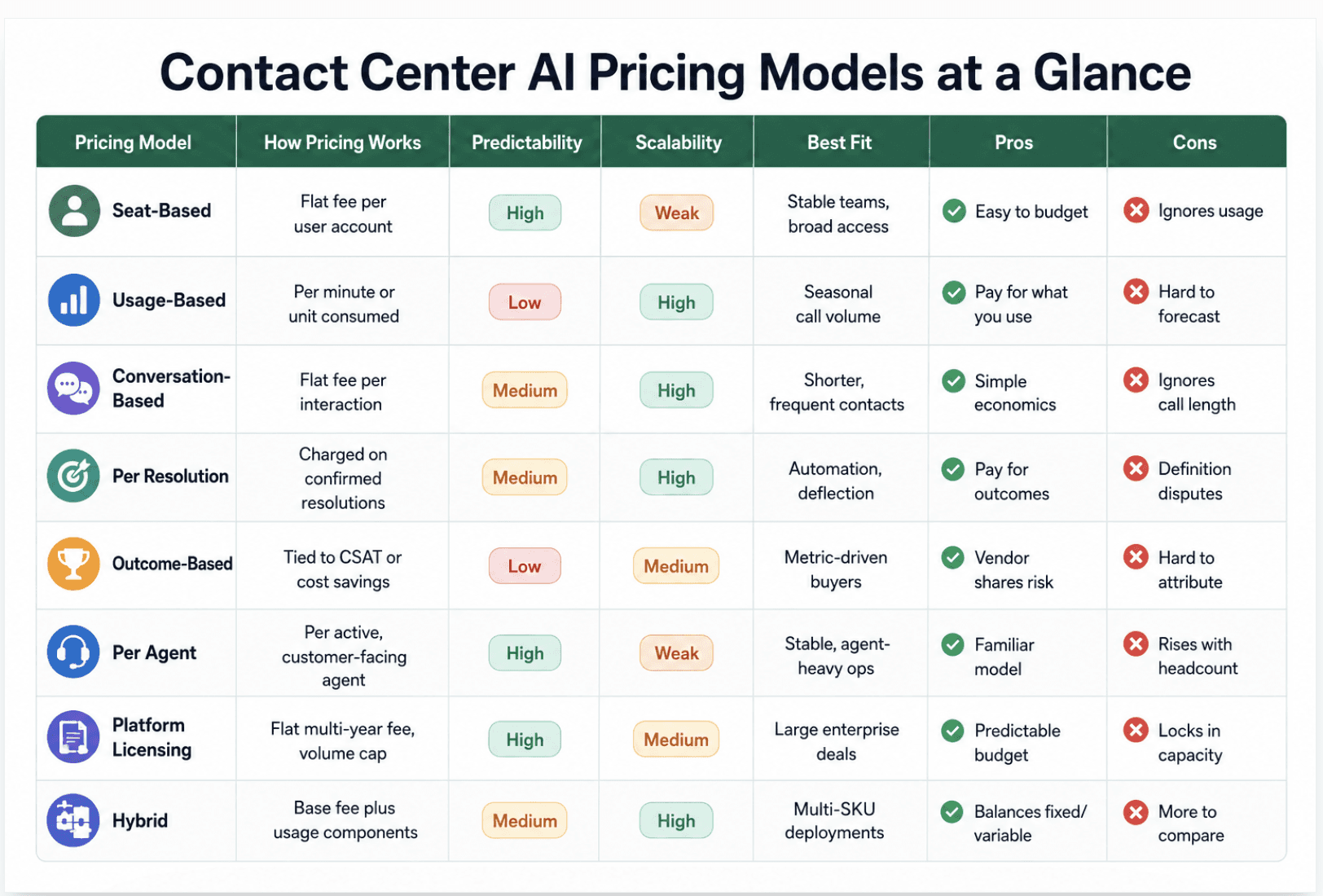
Enterprise contact center AI vendors price their platforms using eight recurring contact center pricing models, often in combination. Each ties cost to a different unit, and each shifts risk between vendor and buyer in a different direction.
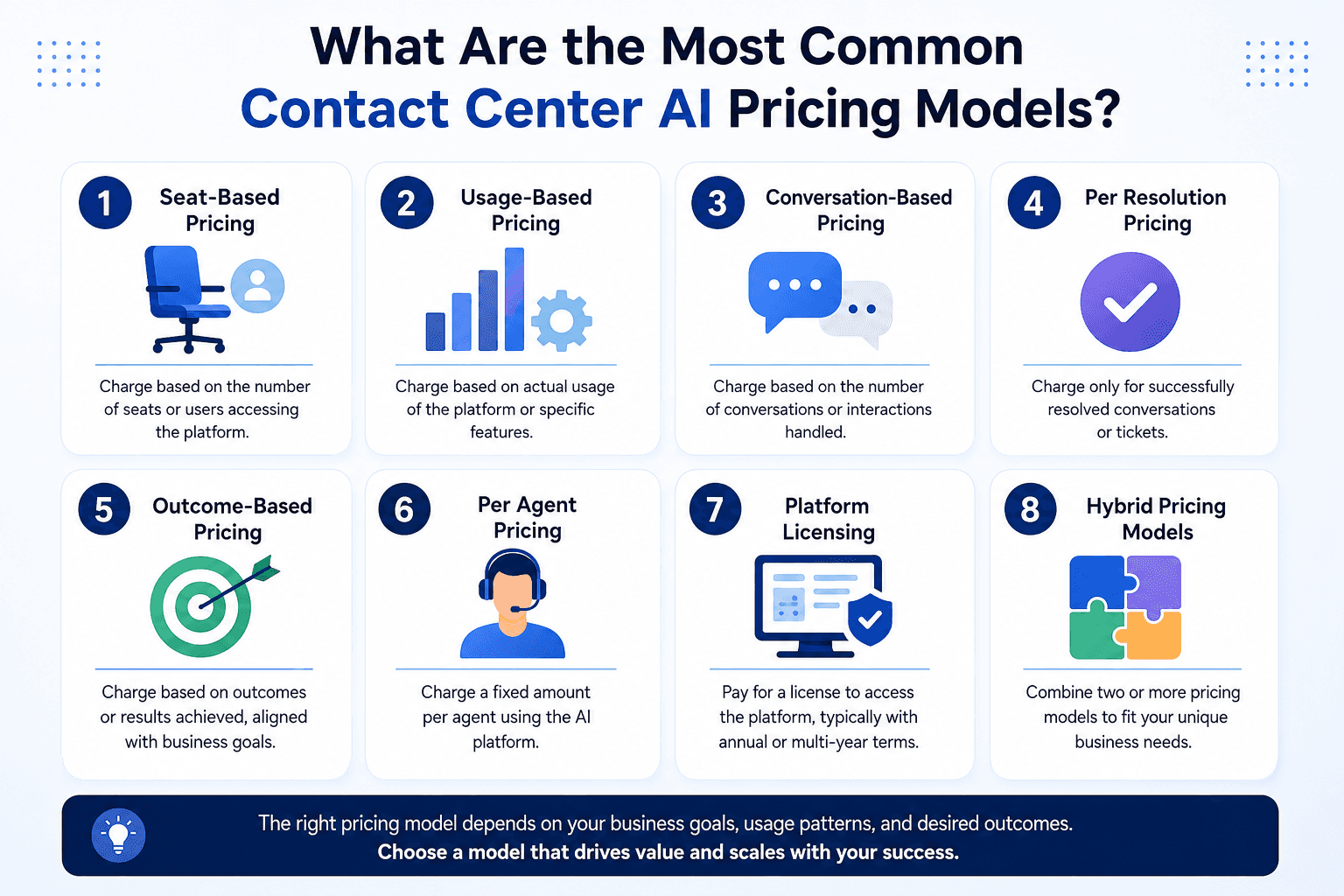
1. Seat-Based Pricing
How it works: A fixed fee for every named user with platform access, whether that person handles interactions daily or logs in once to check a dashboard.
Best suited for: Teams with stable headcount and predictable usage across every role that touches the tool.
Advantages: Fixed, easy to forecast a year out, and simple to compare across vendors.
Limitations: Charges the same rate for a high-volume agent and a supervisor who rarely logs in, so a high ratio of managers and QA staff to active agents inflates cost.
What enterprise buyers should know: Confirm exactly who counts as a seat. A common misconception is that every platform user, including managers who never handle a live interaction, needs the same paid license as an active agent.
2. Useage based pricing
How it works: Cost tracks a consumption unit, most often minutes of audio processed, hours handled, or API calls to a transcription or language model.
Best suited for: Contact centers with seasonal spikes or fluctuating call volume across the year.
Advantages: Cost scales down in a slow month and up in peak season, instead of a fixed rate sized for constant volume.
Limitations: Harder to forecast a year ahead, and a volume spike can move a monthly invoice past budget without a cap in place.
What enterprise buyers should know: Ask how usage is metered. Minutes rounded up, overage rates, and whether idle hold time counts toward the total all change the effective price.
3. Conversation-Based Pricing
How it works: A flat rate per completed conversation, over voice, chat, email, or SMS, regardless of how long it runs.
Best suited for: High volumes of shorter, frequent interactions, such as order status checks or password resets.
Advantages: Easier to model than per-minute pricing, since a conversation counts once no matter its length.
Limitations: A ten-minute escalation and a ninety-second status check cost the same, so wide variation in call length means the rate does not reflect actual effort.
What enterprise buyers should know: Confirm how a conversation is defined. A call followed by a chat an hour later might count as one interaction or two, depending on session logic.
4. Per Resolution Pricing
How it works: Charged only when an interaction reaches a defined resolution, most often for AI-driven automation where a virtual agent completes a request without escalating.
Best suited for: Contact centers piloting an AI virtual agent deployment that want cost tied to completed work, not attempted work.
Advantages: A buyer pays for outcomes delivered, not for interactions the AI system attempted and failed to close.
Limitations: The definition of resolution carries the entire model. Counting a conversation resolved the moment the AI stops responding, even if the customer calls back an hour later, prices a result the buyer never got.
What enterprise buyers should know: Put the resolution definition in the contract. Ask whether a follow-up contact within forty-eight hours voids the charge, and ask for audit rights.
5. Outcome-Based Pricing
How it works: Price ties to a business result the AI system helped produce, such as a CSAT lift or a documented cost saving against a pre-deployment baseline.
Best suited for: Organizations with clean baseline metrics and an executive sponsor who wants vendor incentives tied to a measurable result.
Advantages: The vendor shares performance risk, and price scales with proven value instead of a fixed rate regardless of results.
Limitations: Isolating the AI system’s contribution from staffing changes, seasonality, or a product launch requires an attribution method both sides agree on in advance.
What enterprise buyers should know: Set a documented baseline period before deployment starts, and agree on the outcome formula before the first invoice.
6. Per Agent Pricing
How it works: Priced per active, customer-facing agent, defined by a minimum number of interactions handled per month rather than platform login.
Best suited for: Contact centers with a stable agent headcount and a clear line between agents and staff who only view reports.
Advantages: Familiar, since most CCaaS and workforce management tools already price this way, simplifying quote comparison.
Limitations: Cost rises directly with headcount growth, so an expanding contact center should model cost forward, not just at current staffing.
What enterprise buyers should know: The definition of a billable agent matters more than the headline rate. Ask what interaction threshold qualifies billing, and whether that definition is fixed at renewal.
7. Platform Licensing
How it works: A single annual or multi-year fee covers the full platform, with a contracted volume cap and defined overage tiers.
Best suited for: Large enterprises negotiating a multi-year deal that need one predictable number for budget planning.
Advantages: Removes month-to-month variability and typically bundles product SKUs at a negotiated combined rate.
Limitations: Locks in capacity the contact center might not use in year one, and reducing usage mid-contract rarely reduces the invoice.
What enterprise buyers should know: Negotiate true-up and true-down terms. A true-up clause without a true-down option means the buyer absorbs every volume increase but never recovers cost when volume drops.
8. Hybrid Pricing Models
How it works: A base platform fee covers the core deployment, a per-agent charge covers headcount, and usage-based line items cover overages on transcription or peak-season volume.
Best suited for: Enterprises running multiple product SKUs, such as quality assurance alongside agent assist and a virtual agent.
Advantages: Balances the predictability of a fixed platform fee against usage-based flexibility on the components that vary most.
Limitations: More moving parts to model, and a five-component proposal is harder to compare against a simpler competing quote.
What enterprise buyers should know: Ask for every component broken out by name, platform fee, per-agent cost, consumption fee, so procurement can model each line against a competing structure.
Contact center solution pricing rarely fits neatly into one of these eight categories in practice. A typical enterprise proposal blends two or three, which is why naming each component matters more than comparing bottom-line totals.
What Factors Affect Contact Center AI Pricing?
Contact center solution pricing moves with a defined set of variables, and enterprise buyers who model these upfront negotiate from a stronger position.
Number of agents and seats: Total headcount, plus the ratio of active agents to supervisors, QA staff, and managers who need platform access.
Monthly call and interaction volume: Total conversation volume across every channel, since usage-based and per-resolution pricing scale directly with this number.
AI interaction volume: The share of conversations an AI system, such as a virtual agent or agent assist tool, actually touches.
Voice and digital channel mix: Voice transcription, real-time speech processing, and multi-channel orchestration across chat, email, and SMS each carry separate cost structures.
Number of languages supported: Each additional language typically adds a separate model, translation layer, or tuning cost.
CRM and CCaaS integrations: Connecting to Salesforce, Genesys, NICE, Zendesk, or a proprietary system through integrations adds engineering time some vendors price separately.
Security and compliance requirements: HIPAA, PCI, GDPR, and industry-specific needs add review cycles and, in some cases, dedicated infrastructure costs, covered under Level AI’s security documentation.
Deployment model: Cloud, hybrid, or on-premises deployment changes both implementation cost and ongoing infrastructure fees.
Custom workflows and scorecards: Building custom QA rubrics or routing logic beyond the vendor’s standard configuration adds professional services time.
AI models used: Vendors running proprietary models absorb inference cost differently than vendors passing through third-party language model fees.
Support and implementation tier: Standard support, dedicated customer success, and premium SLAs are priced at different tiers.
What Hidden Costs Should You Watch Out For?
One enterprise buyer summarized a difficult vendor relationship directly in an evaluation call: “The project team, the process, the lack of transparency, the hidden costs, you name it. We experienced it. And if we could divorce them right now, we probably would.”
That kind of experience shapes what procurement teams now ask before signing. Watch for these costs before they show up on an invoice:
Implementation fees: One-time setup charges for configuring the platform and standing up the initial environment.
Professional services: Hourly or project-based charges for custom configuration beyond standard onboarding.
Knowledge base preparation: Cost to structure existing documentation into a format an agent assist tool or virtual agent can retrieve from accurately.
AI training and customization: Cost to tune models, build custom intent categories, or calibrate scoring against an existing QA rubric.
API and LLM usage costs: Fees for transcription, translation, and third-party language model calls billed separately from the base fee.
Integration costs: Per-integration charges, particularly common with platforms that charge separately for every system connection.
Data migration: Cost to move historical conversation data, scorecards, or coaching records from a legacy system.
Ongoing support fees: Charges for support tiers above the standard SLA, or a dedicated customer success contact.
Annual price increases: Contracted escalators that raise the per-unit price at renewal.
Ask for every one of these listed as a named line item before signing. A vendor unwilling to itemize implementation, integration, and support costs separately from the core license is asking the buyer to absorb a share of contact center pricing risk it cannot see.
How Should Enterprise Buyers Compare AI Pricing?
Comparing two vendor quotes on contact center software pricing by their bottom-line annual number misses most of the difference between them. Enterprise buyers get a clearer picture by modeling each proposal against the same set of unit metrics.
Total cost of ownership (TCO): The full three-year cost, including license fees, implementation, integrations, and projected usage overages, not just the first-year contract value.
Cost per interaction: Total annual spend divided by total conversations handled, which normalizes pricing models that charge by different units.
Cost per resolved case: Spend divided by interactions actually resolved, which surfaces the real price of automation that only partially deflects volume.
Cost per automated conversation: For virtual agent deployments, spend isolated to interactions AI handled without human involvement.
Cost per agent: Total platform spend divided by active agent headcount, useful for comparing against traditional per-seat CCaaS pricing.
Expected ROI: Projected savings from reduced handle time, reduced QA labor, or improved first call resolution, weighed against total cost.
Time to value: Weeks or months from signature to the first measurable result. A lower price with a six-month rollout can cost more in delayed value than a higher price with a four-week one.
Enterprise buyers consistently name return on investment as the deciding factor in a final vendor decision. A contact center leader building a business case needs each of these metrics modeled before the deal reaches a CFO.
What Questions Should You Ask Every AI Vendor Before Signing a Contract?
Enterprise procurement teams that ask these questions early avoid the negotiation surprises that show up later in the contract cycle.
What exactly am I paying for? Get the pricing unit named explicitly, seat, agent, minute, conversation, or resolution, before reviewing a single number.
What counts as AI usage? Confirm whether AI-assisted, human-only, and AI-attempted-but-escalated interactions are billed differently.
Are implementation costs included in the quoted price, or billed separately? Ask for one number that includes onboarding.
How are AI model costs charged? Confirm whether transcription, translation, and language model inference are bundled into the platform fee or billed as usage.
Are integrations included, or priced per connection? Some platforms charge separately for every system connection, which adds up quickly across a CRM, a CCaaS platform, and a ticketing tool.
Can pricing scale as my business grows? Ask how the per-unit rate changes at higher volume tiers, and whether growth triggers a full renegotiation.
Are there any hidden charges? Ask the vendor to itemize every possible additional fee in writing.
What happens if I exceed my contracted volume? Confirm the overage rate before signing, not after the first invoice that includes one.
A vendor that answers each question with a specific number, not a range or a deferral to a later call, is the vendor procurement can actually model against a competing bid on contact center pricing.
Which AI Pricing Model Is Right for Your Business?
Mid-sized contact centers with a stable agent count and predictable monthly volume get the clearest budget certainty from per-agent or seat-based pricing, provided the agent definition is written into the contract.
Large enterprises running multi-year deployments across several product SKUs typically negotiate platform licensing or a hybrid model, trading some flexibility for one predictable annual number.
Global organizations supporting multiple languages and regions benefit from a hybrid structure that separates a fixed platform fee from usage-based charges tied to language and channel mix.
High-volume customer support teams with seasonal spikes, such as retail during holiday periods, get more value from usage-based or conversation-based pricing that scales down during slow months.
Highly regulated industries, including financial services, healthcare, and insurance, should weigh vendor selection toward platforms with compliance built into the base price rather than sold as a paid add-on. A security review that surfaces a gap late in procurement can delay a deployment by months.
Wrapping Up: Make Every AI Investment Count With Level AI
Level AI structures its contact center software pricing around the way enterprise contact centers actually operate. Deployments combine per-agent pricing, platform licensing, and usage components based on channel mix, agent count, and product SKUs, so procurement models one deal architecture instead of guessing at a bundled number.
Level AI runs AI agents, quality assurance, agent assist, analytics, and voice AI on one generative AI and semantic intelligence engine, so every interaction across every product feeds the same conversation data instead of five disconnected tools billed separately.
Angela Zander, Director of Operations at Quinstreet, described the shift after consolidating QA coverage on Level AI in the Quinstreet case study: “We’ve gone from manually scoring 1-2% of our calls to using Level AI to score 100% of our calls.”
Customer satisfaction increases 30 percent and contact center efficiency increases 20 percent for teams running quality, coaching, and automation on that shared data.
A leading contact center provider for financial institutions ran into the same reporting gap before centralizing its Voice of the Customer data. Knowledgebase, QA, and product teams each pulled their own numbers from separate systems, with no shared view of why customers were calling. “VoC helped us guide our product roadmap to improve customer experience in ways we didn’t expect,” said the company’s VP of Customer Service, after consolidating reporting onto Voice of the Customer Insights.
Each team had built its own report from its own slice of the data. Afterward, the same call center analytics numbers fed QA, product, and knowledgebase decisions from one source, and the company tied over $3 million in annual savings to insights the old reporting silos had hidden.
" transform="translate(85.643 10.143)" width="23.725855670103115px"/><path d="M 71.828 0 L 0 50.702" fill="transparent" height="50.70235051546392px" id="TnJFUMH9b" stroke-dasharray="" stroke-linecap="butt" stroke-linejoin="miter" stroke-miterlimit="10" stroke-width="0.68" stroke="rgb(254, 250, 241)" transform="translate(85.508 75.029)" width="71.82828865979384px"/><path d="M 81.579 0 L 0 52.003" fill="transparent" height="52.00280412371134px" id="ccJzhVTGI" stroke-dasharray="" stroke-linecap="butt" stroke-linejoin="miter" stroke-miterlimit="10" stroke-width="0.68" stroke="rgb(254, 250, 241)" transform="translate(85.495 73.738)" width="81.57921649484533px"/><path d="M 65.653 0 L 0 32.827" fill="transparent" height="32.826556701030924px" id="X0Vp_q8HG" stroke-dasharray="" stroke-linecap="butt" stroke-linejoin="miter" stroke-miterlimit="10" stroke-width="0.68" stroke="rgb(254, 250, 241)" transform="translate(85.462 92.931)" width="65.65311340206183px"/><path d="M 88.08 14.951 L 0 0" fill="transparent" height="14.950762886597914px" id="JM_UgSiJ_" stroke-dasharray="" stroke-linecap="butt" stroke-linejoin="miter" stroke-miterlimit="10" stroke-width="0.68" stroke="rgb(254, 250, 241)" transform="translate(86.233 125.789)" width="88.07950515463914px"/><path d="M 83.204 72.803 L 0 0" fill="transparent" height="72.80313402061856px" id="KlyUUjlMK" stroke-dasharray="" stroke-linecap="butt" stroke-linejoin="miter" stroke-miterlimit="10" stroke-width="0.68" stroke="rgb(254, 250, 241)" transform="translate(85.089 125.71)" width="83.20379381443304px"/><path d="M 7.8 114.081 L 0 0" fill="transparent" height="114.08065979381445px" id="kAiUvduBR" stroke-dasharray="" stroke-linecap="butt" stroke-linejoin="miter" stroke-miterlimit="10" stroke-width="0.68" stroke="rgb(254, 250, 241)" transform="translate(85.95 125.478)" width="7.800247422680428px"/><path d="M 0 93.604 L 9.75 0" fill="transparent" height="93.60445360824741px" id="FsgTAQB0n" stroke-dasharray="" stroke-linecap="butt" stroke-linejoin="miter" stroke-miterlimit="10" stroke-width="0.68" stroke="rgb(254, 250, 241)" transform="translate(76.2 125.421)" width="9.750432989690694px"/><path d="M 0 76.379 L 76.703 0" fill="transparent" height="76.37888659793816px" id="NxOhHvPJ5" stroke-dasharray="" stroke-linecap="butt" stroke-linejoin="miter" stroke-miterlimit="10" stroke-width="0.68" stroke="rgb(254, 250, 241)" transform="translate(9.343 125.217)" width="76.7034556701031px"/><path d="M 0 26.651 L 39.002 0" fill="transparent" height="26.651381443298988px" id="QETNKJ3L6" stroke-dasharray="" stroke-linecap="butt" stroke-linejoin="miter" stroke-miterlimit="10" stroke-width="0.68" stroke="rgb(254, 250, 241)" transform="translate(47.096 125.177)" width="39.0017319587629px"/><path d="M 0 16.901 L 85.154 0" fill="transparent" height="16.900948453608265px" id="BL63wDICD" stroke-dasharray="" stroke-linecap="butt" stroke-linejoin="miter" stroke-miterlimit="10" stroke-width="0.68" stroke="rgb(254, 250, 241)" transform="translate(0.094 125.125)" width="85.15396503092786px"/><path d="M 0 0 L 78.004 17.876" fill="transparent" height="17.875793814432996px" id="PIX70Vlqf" stroke-dasharray="" stroke-linecap="butt" stroke-linejoin="miter" stroke-miterlimit="10" stroke-width="0.68" stroke="rgb(254, 250, 241)" transform="translate(8.362 107.251)" width="78.00376082474227px"/><path d="M 0 0 L 67.928 52.327" fill="transparent" height="52.32742268041238px" id="u_syqWqWD" stroke-dasharray="" stroke-linecap="butt" stroke-linejoin="miter" stroke-miterlimit="10" stroke-width="0.68" stroke="rgb(254, 250, 241)" transform="translate(17.593 72.861)" width="67.92826391752578px"/><path d="M 0 0 L 77.029 70.528" fill="transparent" height="70.52832989690722px" id="DmW_aE2A0" stroke-dasharray="" stroke-linecap="butt" stroke-linejoin="miter" stroke-miterlimit="10" stroke-width="0.68" stroke="rgb(254, 250, 241)" transform="translate(9.489 54.678)" width="77.02866804123713px"/><path d="M 0 0 L 27.301 126.431" fill="transparent" height="126.43109443298971px" id="JrLaRUubC" stroke-dasharray="" stroke-linecap="butt" stroke-linejoin="miter" stroke-miterlimit="10" stroke-width="0.68" stroke="rgb(254, 250, 241)" transform="translate(58.341 -0.071)" width="27.30111340206188px"/><path d="M 0 4.012 C 0 1.796 1.796 0 4.012 0 C 6.228 0 8.025 1.796 8.025 4.012 C 8.025 6.228 6.228 8.025 4.012 8.025 C 1.796 8.025 0 6.228 0 4.012 Z" fill="rgb(254, 80, 0)" height="8.024669690721652px" id="Nh5qrPJs_" transform="translate(81.396 121.369)" width="8.024669690721623px"/></svg>)
Frequently Asked Questions
What is contact center pricing based on?
Contact center pricing for AI platforms follows the vendor's cost structure more than a single industry standard. Common billable units include seats, active agents, conversations, minutes processed, or resolved cases, and most enterprise deals combine two or more into a hybrid structure.
How much does AI agent pricing cost for a contact center?
Cost depends on deployment scope: channel mix, monthly interaction volume, languages supported, and the number of product SKUs included. Vendors typically need an agent count and monthly call volume before providing even a ballpark estimate.
What enterprise AI costs go beyond the license fee?
Implementation, professional services, integration fees, ongoing support, and consumption charges for transcription or model usage typically sit outside the base license fee. Ask for each cost itemized separately before comparing quotes.
What hidden implementation costs should enterprise buyers ask about?
Knowledge base preparation, historical data migration, custom workflow configuration, and per-system integration fees are the costs buyers most often discover after signing. Itemizing each in the contract prevents that surprise.