
Key takeaways
The top contact center automation tools in 2026 include Level AI, Observe AI, Genesys Cloud CX, NICE CXone, Amazon Connect, Five9, Salesforce Agentforce, Microsoft Dynamics 365 Contact Center, Cresta, and Talkdesk CX Cloud
The strongest contact center automation platforms combine three layers on the same conversation data: virtual agents that resolve requests, real-time agent assist, and automated quality assurance across every interaction
Enterprise buyers should weigh integration depth with their CRM and telephony stack, review scores on G2 and Gartner Peer Insights, and the vendor's track record on measurable outcomes
Level AI scores 100 percent of conversations, guides agents live, and automates repetitive calls on one AI stack. See the full contact center automation tools landscape for context
CCaaS platforms like Genesys, NICE, and Five9 own the infrastructure layer, while AI-first vendors like Level AI, Cresta, and Salesforce Agentforce add the intelligence that runs on top of it
Introduction to contact center automation tools
Contact center automation has shifted from a pilot-stage experiment to core infrastructure. In 2026, 88 percent of contact centers report using some form of AI, yet only 25 percent have fully integrated automation into daily operations, according to CMSWire's 2026 call center statistics. The gap between owning AI tools and operationalizing them defines the current market.
That gap explains why tool selection matters more than tool adoption. A virtual agent that deflects billing questions, an assist layer that surfaces the right knowledge article mid-call, and automated QA that scores every conversation each solve a different operational problem. Buyers who treat automation as a single purchase tend to stall in pilots. Buyers who map specific interactions to specific automation capabilities move faster and measure results sooner.
What is contact center automation tool?
Contact center automation uses AI and software to handle customer interactions and back-office work that human agents once did manually. It covers three layers. Virtual agents resolve routine requests like billing questions, password resets, and appointment scheduling across voice and chat. Real-time assist tools guide human agents during live calls by surfacing knowledge, next steps, and compliance flags. Automated quality assurance scores every conversation instead of the small sample that manual review reaches.
The goal is capacity, not just cost reduction. Automation moves repetitive volume off human agents so they focus on escalations that require judgment, empathy, and negotiation. Done well, it lowers average handle time, improves first-contact resolution, and surfaces patterns across every interaction. For a deeper primer, read what customer experience automation actually looks like inside a working contact center.
How contact center automation works?
Contact center automation starts with conversation data. Every call, chat, and email produces a transcript, and modern platforms run speech recognition and natural language understanding to interpret intent, sentiment, and outcome from that transcript. Virtual agents match customer intent to a resolution path and either complete the request or route it to a human agent with full context. Assist tools read the live conversation and push relevant knowledge to the agent before they have to search for it.
The intelligence layer closes the loop. Automated QA scores each interaction against a rubric, flags compliance risks, and identifies coaching moments by agent and queue. Analytics roll those signals up to show which intents are ready for full automation and which self-service flows leak to human agents. Platforms that run these functions on shared conversation data keep the virtual agents, QA, and coaching aligned, so an insight from analytics can inform what gets automated next.
What are the common use cases for call center automation?
Automated call routing. AI matches intent to the right agent or queue, cutting transfers and misroutes.
Call deflection. Virtual agents resolve high-volume requests like payments, gate codes, and billing questions before they reach a human.
Agent assist. Live guidance surfaces knowledge articles, checklists, and compliance alerts during complex calls.
AI call transcription. Every conversation is transcribed and searchable for QA, analytics, and dispute resolution.
Automated quality assurance. Scoring runs across 100 percent of interactions instead of a sampled few.
After-call work. Automation drafts call summaries and dispositions so agents move to the next contact faster.
Voice-of-customer analysis. Pattern detection across all conversations surfaces friction, intent, and repeat-contact drivers.
See more detail in these AI use cases for contact centers.
What are the best practices for automating your contact center?
Measure before you automate. Analyze all interactions first to identify which intents drive the most repetitive volume and are ready for a virtual agent. Level AI's philosophy is to measure twice and cut once.
Start with high-volume, low-complexity requests. Payments, password resets, and status checks deliver fast, clean automation wins.
Keep humans on judgment work. Route escalations, negotiations, and emotional interactions to agents, and give them real-time assist.
Automate quality assurance early. Scoring every conversation exposes where self-service and virtual agents leak to human agents.
Close the feedback loop. Feed QA and analytics signals back into virtual agent design so automation improves on real failure patterns.
Track outcomes, not activity. Measure handle time, first-contact resolution, deflection rate, and CSAT, not just interaction counts.
What questions should you ask before buying a contact center automation tool?
Does the platform run virtual agents, agent assist, and automated QA on the same conversation data, or across separate systems?
How does it integrate with our current CRM, telephony, and workforce tools?
What percentage of conversations does its QA actually score?
How does the vendor measure and report automation accuracy and containment?
What is the real deployment timeline, including data integration and model tuning?
How does the platform handle handoff between AI agents and human agents?
What outcomes have comparable enterprises reported, and can the vendor show them?
How is pricing structured, per seat, per interaction, or usage-based?
This guide compares the top eight contact center automation tools for 2026. Each entry covers what the platform does, its core features, integration reach, the buyers it fits, and current review scores from G2, Gartner Peer Insights, and Capterra.
Comparison table: Top 8 contact center automation tools
Tool | Core automation features | Best suited for |
|---|---|---|
Level AI | Virtual agents, real-time agent assist, automated QA on 100% of conversations, VoC analytics | Enterprises automating QA, coaching, and voice/chat resolution on one AI stack |
Genesys Cloud CX | Omnichannel routing, bots, workforce engagement, predictive engagement | Large enterprises needing a deeply customizable CCaaS platform |
NICE CXone Mpower | Omnichannel routing, WFM, autopilot bots, analytics | Enterprises standardizing on a broad CCaaS and WEM suite |
Amazon Connect | Pay-as-you-go routing, Lex bots, Contact Lens analytics | AWS-native teams building custom contact center flows |
Five9 | Cloud routing, IVA, agent assist, WFO | Mid-market and enterprise teams modernizing legacy on-prem systems |
Salesforce Agentforce | Autonomous AI agents, CRM-grounded resolution, voice and digital | Salesforce-first organizations automating service inside CRM |
MS Dynamics 365 Contact Center | Copilot-driven routing, self-service, agent assist | Microsoft-stack enterprises unifying CCaaS with Dynamics |
Cresta | Real-time agent assist, conversation intelligence, coaching | Large sales and service centers focused on live guidance |
Talkdesk CX Cloud | Autopilot agents, routing, QM, industry clouds | Mid-market and enterprise teams wanting fast deployment |
Observe AI | Autonomous VoiceAI agents that resolve select calls end-to-end | Large, enterprise contact centers in regulated industries |
Top 11 contact center automation tools for 2026
1. Level AI: Best contact center automation tool for enterprises
Level AI is the best contact center automation tool that pairs a proprietary AI stack with a unified platform, so quality, insights, coaching, automation, and AI agents learn from the same customer conversations.
Level AI is a contact center automation platform built for enterprise voice and chat operations. The platform runs AI virtual agents that resolve routine requests like payments, password resets, and billing questions across voice and chat. It scores 100 percent of interactions through automated quality assurance rather than the 1 to 3 percent that manual sampling covers. During live calls, it surfaces knowledge articles, checklists, and compliance alerts to agents. Every automation decision draws on the same conversation data that feeds analytics and coaching, which keeps the virtual agents, QA, and voice-of-customer insights aligned.
Key Features
AI virtual agents that automate and deflect voice and chat interactions, with automatic evaluation of their own performance for profanity and unresolved topics.
Real-time agent assist that surfaces relevant knowledge, next-best actions, and compliance flags during live conversations.
Automated QA (Auto QA) that scores every interaction across all conversations, not sampled subsets.
Voice-of-customer analytics that identify friction, intent, and repeat-contact drivers across the full conversation set.
Inferred CSAT (iCSAT) that measures satisfaction on every interaction instead of relying on survey response rates.
Agent coaching that ties scores to specific coaching moments by agent, queue, and issue type.
Integrations
Level AI connects with major CRM, helpdesk, and CCaaS systems including Salesforce, Zendesk, Genesys, Five9, and Amazon Connect. Named partnerships include the Level AI and Five9 partnership and the Level AI and Genesys partnership. See the full integrations directory for the current list across telephony, CRM, and workforce tools.
Best Suited For
Level AI fits enterprises that want to automate contact center operations on one AI stack instead of stitching together separate QA, analytics, and virtual agent vendors. Enterprise teams use it to move repetitive calls to virtual agents, guide human agents on complex escalations, and score every conversation for compliance and quality. The shared-data approach means automation targets the interactions that data shows are ready for it, rather than guessing which flows to automate first.
Product Reviews
Level AI holds a 4.7 out of 5 rating across roughly 200 verified reviews on G2. Reviewers cite the reporting depth and the implementation process, with one noting the technology "is reliable, efficient, and continues to exceed expectations." Mid-market accounts make up close to 60 percent of the review base.
2. Genesys Cloud CX
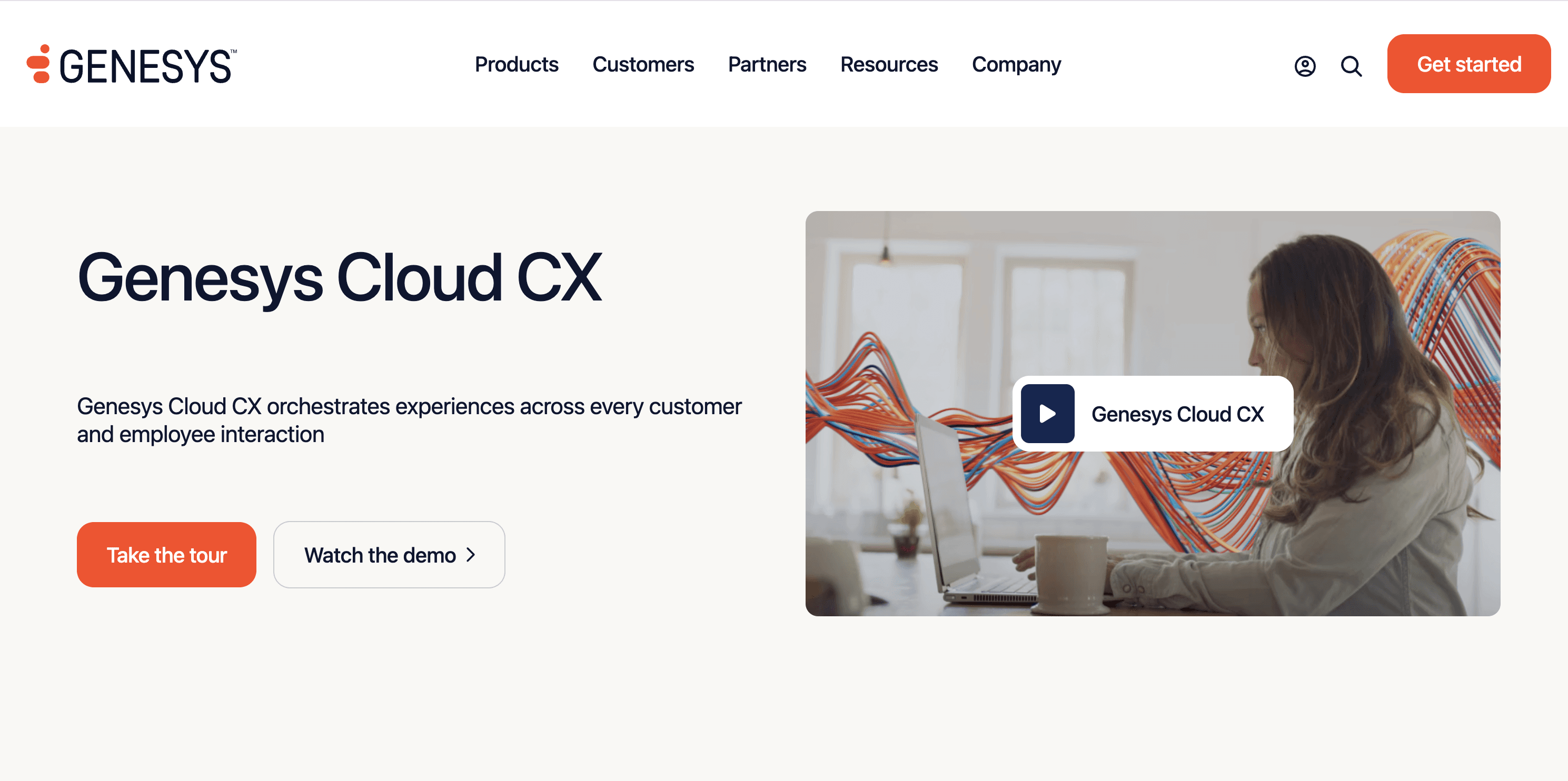
Genesys Cloud CX is a cloud contact center platform that routes voice, email, chat, and messaging through a single system. The platform combines omnichannel routing, bots, and workforce engagement management for large operations. Genesys positions Cloud CX as an orchestration layer for the full customer journey. Enterprises run it as the infrastructure backbone that other automation tools plug into.
Key Features
Omnichannel routing across voice, digital, and social channels.
Native bots and conversational AI for self-service.
Workforce engagement management including forecasting and scheduling.
Predictive engagement that triggers actions based on customer behavior.
Open API framework for custom integrations.
Integrations
Genesys AppFoundry lists hundreds of prebuilt integrations across CRM, WFM, and analytics vendors, including Salesforce, Microsoft, and Zoom. The platform also connects with specialized AI vendors like Level AI for QA and automation on top of Genesys call data.
Best Suited For
Genesys Cloud CX fits large enterprises that need deep customization and stable infrastructure to manage every step of the customer journey. Teams with the technical resources to configure advanced routing and engagement flows get the most from it.
Product Reviews
Genesys Cloud CX holds a 4.4 out of 5 rating on G2. Reviewers praise the integration breadth and channel coverage. The most common critique across reviews concerns cost, with one summary describing it as a "great product at a high price."
3. NICE CXone Mpower

NICE CXone Mpower is an enterprise CCaaS and workforce engagement platform. The platform brings routing, self-service bots, workforce management, and analytics into one suite. NICE markets Mpower as an orchestration system for agents, AI, and knowledge. Large contact centers standardize on it to consolidate multiple point tools.
Key Features
Omnichannel routing and interaction management.
Autopilot conversational bots for self-service.
Workforce management with forecasting and adherence.
Interaction analytics and performance reporting.
Automated quality management across channels.
Integrations
CXone Mpower integrates with major CRMs including Salesforce, Microsoft Dynamics, and ServiceNow, plus a marketplace of prebuilt connectors for telephony and workforce tools.
Best Suited For
NICE CXone Mpower fits enterprises that want a broad CCaaS and workforce engagement suite from a single vendor. Teams consolidating routing, WFM, and QA under one contract get the widest coverage.
Product Reviews
CXone Mpower earns a 4.6 out of 5 across more than 500 reviews on Gartner Peer Insights. Reviewers highlight the analytics and the clean interface. Some cite typical large-vendor implementation friction during rollout.
4. Amazon Connect
Amazon Connect is a pay-as-you-go cloud contact center service from AWS. The platform provides routing, telephony, and built-in AI through services like Amazon Lex and Contact Lens. Amazon Connect ships as building blocks rather than a packaged product. Teams design, build, and operate much of the environment themselves or through AWS partners.
Key Features
Usage-based pricing with no per-seat licensing.
Amazon Lex bots for voice and chat self-service.
Contact Lens for call transcription, sentiment, and analytics.
Skills-based routing and flow design.
Native integration across the AWS service catalog.
Integrations
Amazon Connect connects natively to AWS services and integrates with Salesforce, Zendesk, and other CRMs through prebuilt connectors and APIs. AWS Lambda extends it to custom workflows.
Best Suited For
Amazon Connect fits AWS-native teams that want to build a custom contact center and control cost through usage-based pricing. Organizations without deep AWS experience often need partner support for complex configurations.
Product Reviews
Amazon Connect holds a rating near 4.5 out of 5 across 70-plus reviews on G2. Reviewers value the flexibility, scalability, and AWS integration. Common criticism centers on setup complexity for teams forcing enterprise patterns onto the platform.
5. Five9
Five9 is a cloud contact center platform focused on voice and digital engagement. The platform combines routing, intelligent virtual agents, agent assist, and workforce optimization. Five9 targets teams migrating off legacy on-premise systems. Its AI features run across inbound and outbound operations.
Key Features
Cloud routing across voice and digital channels.
Intelligent Virtual Agent for self-service automation.
Agent Assist for real-time guidance.
Workforce optimization including QM and WFM.
Outbound dialer for sales and collections.
Integrations
Five9 integrates with Salesforce, Microsoft Dynamics, ServiceNow, Oracle, and Zendesk, plus specialized AI vendors. The Level AI and Five9 partnership adds automated QA and analytics on Five9 conversation data.
Best Suited For
Five9 fits mid-market and enterprise teams modernizing legacy contact center infrastructure. Outbound-heavy operations in collections and sales benefit from the dialer and IVA combination.
Product Reviews
Five9 scores 4.1 out of 5 across roughly 600 reviews on G2 and 4.2 out of 5 on Capterra. Reviewers cite reliability and feature depth, with some noting a learning curve on advanced configuration.
6. Salesforce Agentforce Contact Center
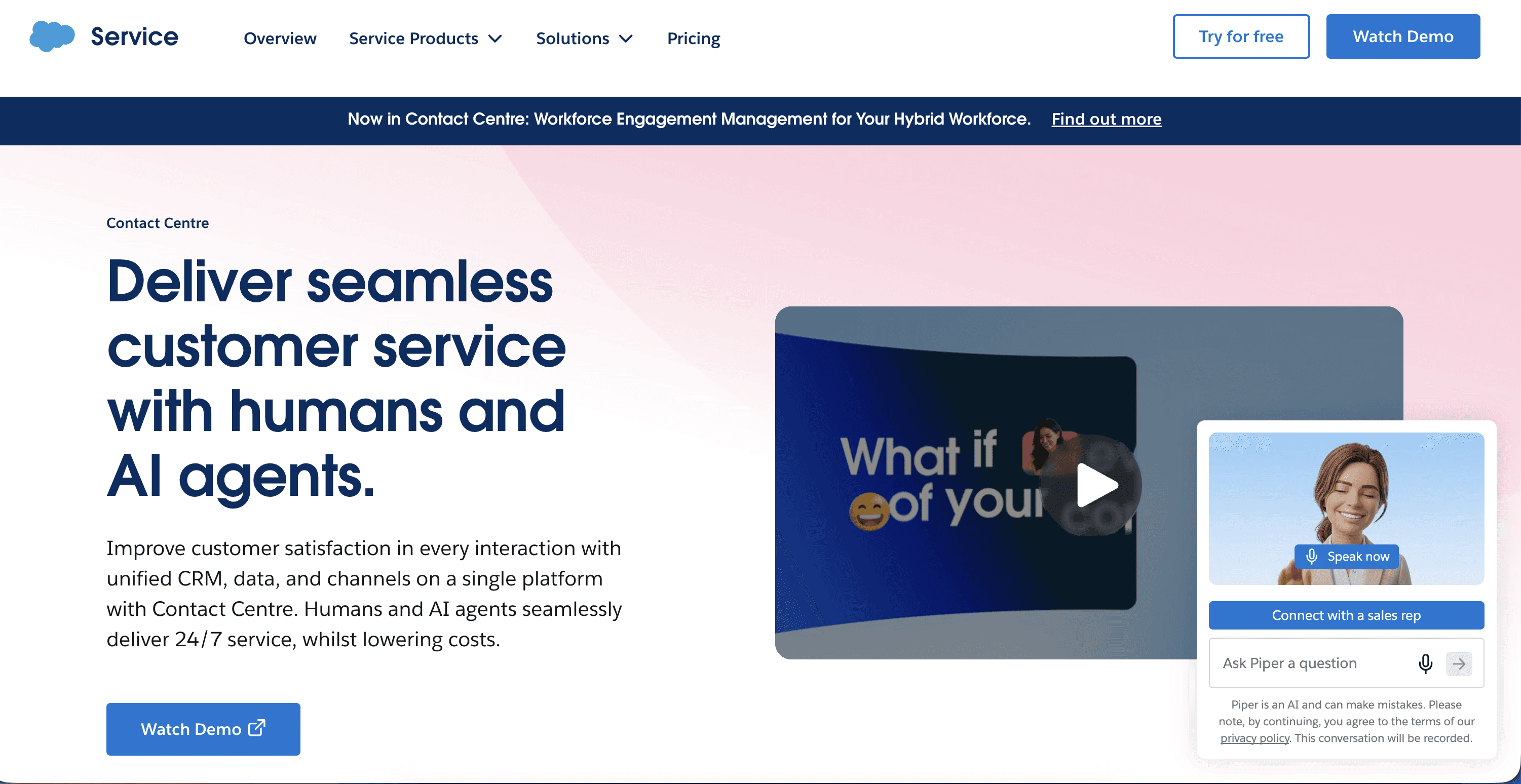
Salesforce Agentforce Contact Center runs autonomous AI agents grounded in Salesforce CRM data. The platform resolves customer requests across voice and digital channels using data already in Service Cloud. Agentforce operates inside the Salesforce environment, so agents act on live account, case, and order records. Salesforce positions it for organizations that want to automate service without moving data out of CRM.
Key Features
Autonomous AI agents that resolve requests end to end within CRM context.
Grounding in Salesforce data for account-aware responses.
Voice and digital channel coverage.
Guardrails and governance controls for agent behavior.
Native handoff between AI agents and human agents.
Integrations
Agentforce runs natively across the Salesforce ecosystem including Service Cloud, Data Cloud, and Slack. It connects to external systems through MuleSoft and the Salesforce AppExchange.
Best Suited For
Salesforce Agentforce fits organizations already standardized on Salesforce that want to automate service inside their CRM. Teams with clean Service Cloud data get the strongest grounding for autonomous agents.
Product Reviews
Agentforce Service, built on Salesforce Service Cloud, carries a 4.4 out of 5 rating across a large review base on G2. Salesforce Agentforce ranked number one in the Agentic AI category in G2's 2026 Best Software Awards. Reviewers cite centralized data and automation strength, with some noting a steep learning curve for new users.
7. Microsoft Dynamics 365 Contact Center
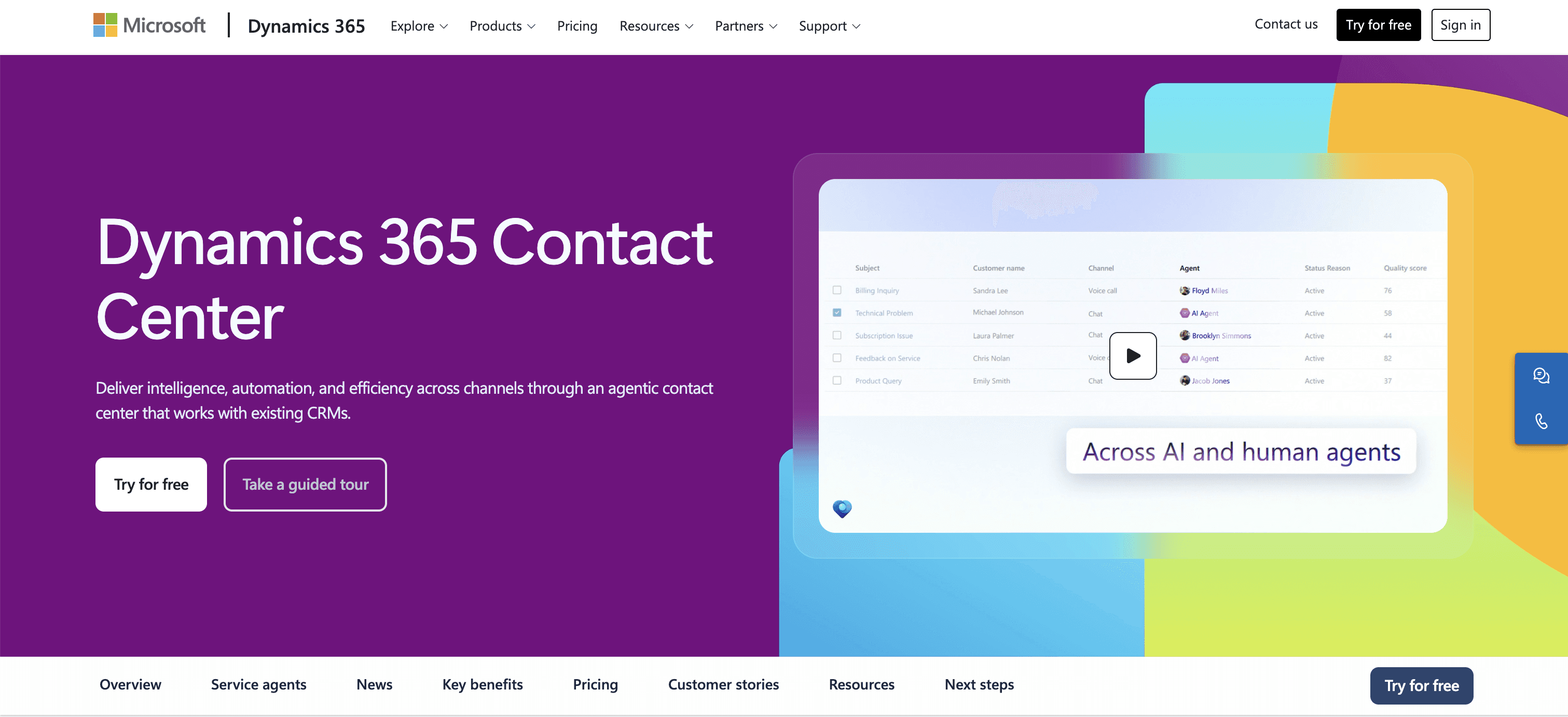
Microsoft Dynamics 365 Contact Center is a Copilot-driven CCaaS product inside the Microsoft ecosystem. The platform manages customer engagement across voice, chat, and digital messaging. It connects directly to Dynamics 365 applications and Microsoft 365 tools. Microsoft targets enterprises already committed to its productivity and data stack.
Key Features
Copilot-assisted routing and case handling.
Self-service voice and chat bots.
Real-time agent assist through Copilot.
Analytics and reporting inside the Power Platform.
Native connection to Teams and Microsoft 365.
Integrations
Dynamics 365 Contact Center integrates across Dynamics 365, Power Platform, Teams, and Azure. It connects to third-party telephony and CRM systems through connectors and APIs.
Best Suited For
Microsoft Dynamics 365 Contact Center fits enterprises standardized on Microsoft that want to unify their contact center with Dynamics and Teams. Organizations running Power Platform for reporting extend that same layer to contact center data.
Product Reviews
Reviews on Gartner Peer Insights skew positive, with reviewers citing the Microsoft-stack integration and Copilot features. Some note that newer AI capabilities are still maturing relative to established CCaaS vendors.
8. Cresta
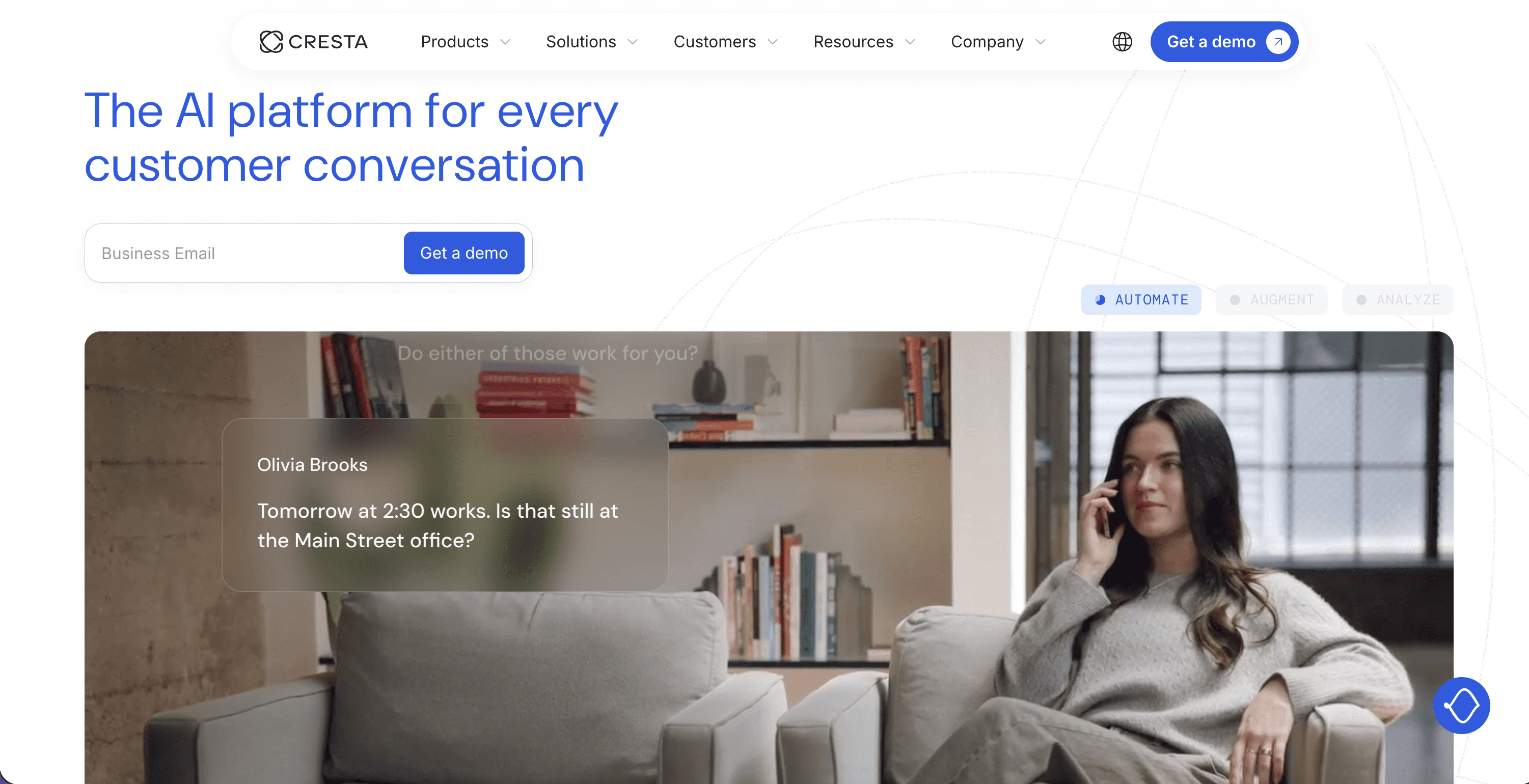
Cresta is an AI platform for real-time agent guidance and conversation intelligence. The platform coaches human agents live and analyzes conversations across voice and digital channels. Cresta targets large sales and service centers that want to lift agent performance during calls. It runs on top of the telephony systems teams already use.
Key Features
Real-time agent assist with live suggestions during calls.
Conversation intelligence across voice and chat.
Automated coaching based on top-performer behavior.
Custom AI models trained on account-specific data.
Analytics for compliance and quality tracking.
Integrations
Cresta connects with major CCaaS and CRM platforms including Genesys, Amazon Connect, and Salesforce. It layers its guidance and analytics onto existing call flows.
Best Suited For
Cresta fits large sales and service operations that prioritize live agent guidance and coaching. Teams with high call volume and complex scripts see the clearest impact. Compare options in the top Cresta alternatives breakdown.
Product Reviews
Cresta holds a 4.2 out of 5 across 43 reviews on G2. Reviewers rate the real-time assist and coaching highly. Common critiques cover setup time, tuning effort, and price relative to smaller point tools.
9. Talkdesk CX Cloud
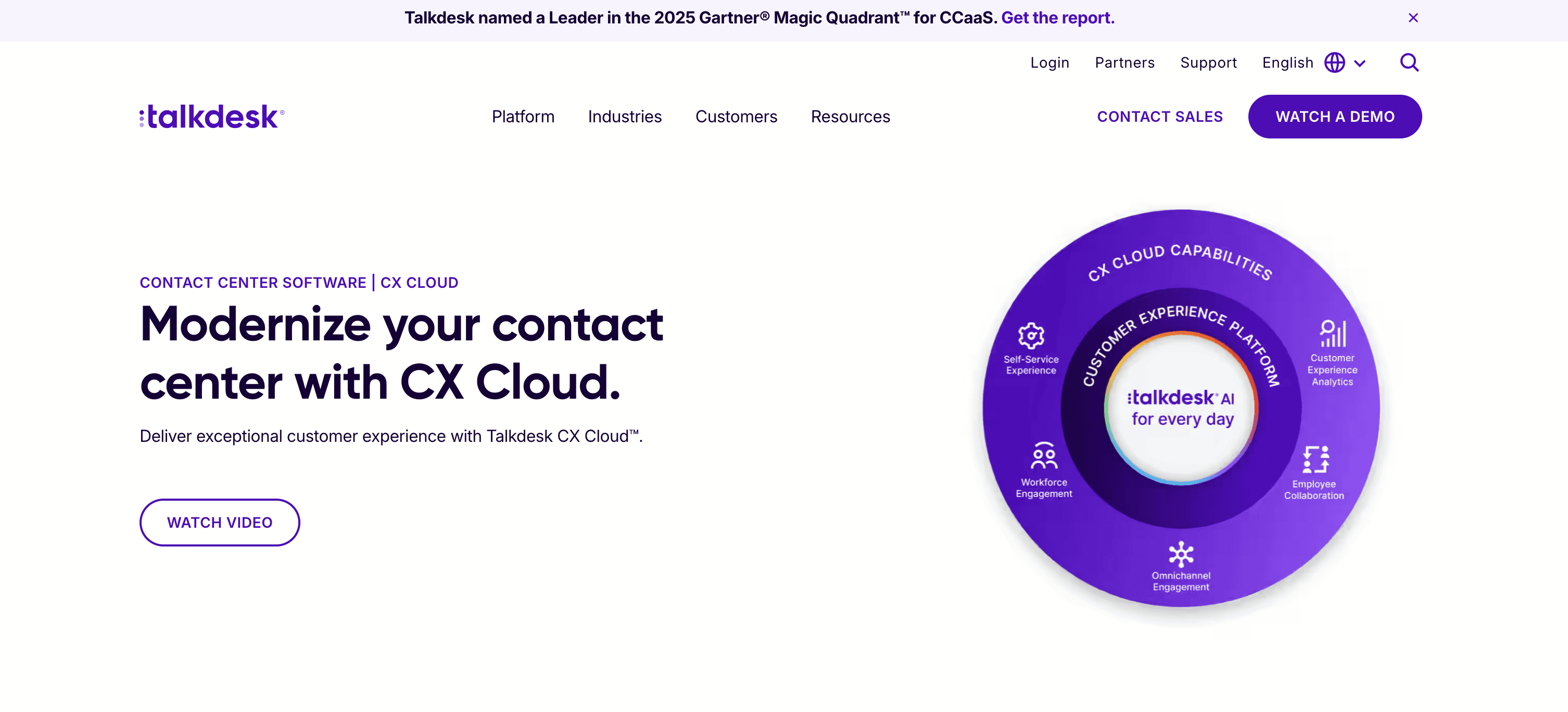
Talkdesk CX Cloud is a cloud contact center platform with built-in AI automation. The platform combines routing, autopilot agents, and quality management across channels. Talkdesk ships industry-specific clouds for healthcare, retail, financial services, and more. Mid-market and enterprise teams choose it for faster deployment than legacy CCaaS vendors.
Key Features
Talkdesk Autopilot for autonomous self-service.
Omnichannel routing across voice and digital.
Quality management and interaction analytics.
Industry-specific clouds with prebuilt workflows.
Agent workspace with AI-assisted handling.
Integrations
Talkdesk offers an AppConnect marketplace with prebuilt integrations for Salesforce, Zendesk, Microsoft, and ServiceNow, plus open APIs for custom connections.
Best Suited For
Talkdesk CX Cloud fits mid-market and enterprise teams that want a fast-to-deploy CCaaS platform with native AI. Organizations in regulated industries benefit from the prebuilt industry clouds.
Product Reviews
Talkdesk earns a 4.4 out of 5 across roughly 2,500 reviews on G2 and 4.6 out of 5 on Capterra. Reviewers highlight the intuitive interface and fast agent onboarding.
10. Observe AI
Observe.AI is an agentic AI platform for contact centers that combines conversation intelligence with autonomous AI agents to support both customers and frontline teams. It ingests voice, chat, email, and SMS interactions, applies speech recognition and PII redaction, and runs them through configurable LLM pipelines to surface intent, sentiment, and compliance signals. Beyond analytics, its VoiceAI agents can now resolve certain customer inquiries end-to-end, while real-time agent assist delivers next-best-action prompts and compliance nudges during live calls. The platform also automates 100% quality assurance scoring, coaching workflows, and after-call summaries, moving teams away from small sampled QA reviews.
Key Features
Automated QA that scores 100% of customer interactions against custom scorecards, versus manual sampling
Real-time agent assist with contextual prompts, next-best actions, and compliance flagging during live calls
Autonomous VoiceAI agents that can independently resolve select call types end to end
AI CoBuilder, a plain-English interface for building and configuring AI agents without technical expertise
Speech analytics with diarized transcription and reported 95% accuracy on transcription and sentiment detection
Business and CX analytics that mine conversations for churn signals, compliance risk, and product feedback trends
Integrations
Observe.AI integrates with major CCaaS platforms including NICE, Five9, Genesys, and Talkdesk, along with CRMs like Salesforce, enabling QA outcomes and coaching insights to flow directly into existing agent workflows. It also connects with knowledge bases and backend APIs, and supports the Model Context Protocol (MCP) for extending its AI agents into broader enterprise systems. This breadth of integration lets contact centers layer Observe.AI's intelligence and automation on top of their existing tech stack rather than replacing it.
Best Suited For
Observe.AI is best suited for large, enterprise contact centers in regulated or high-compliance industries such as banking, insurance, healthcare, and travel/hospitality, where consistent QA and compliance monitoring are critical. It fits organizations looking to scale support without proportionally growing headcount, particularly those wanting to automate both quality management and portions of live customer interaction handling. Its rapid deployment claims (workflows live in minutes to hours) also make it attractive to teams that need to stand up new service processes quickly. It's less suited to small teams or startups needing a lightweight, low-cost QA tool.
Product Reviews
Observe.AI holds a strong 4.6 out of 5 rating on G2 based on 238+ reviews, with 97% of reviewers rating it 4 stars or higher. It has been recognized as a G2 Leader in Conversational Intelligence and ranked #1 for Ease of Setup, Ease of Use, and Ease of Admin in its category. Reviewers consistently highlight its intuitive interface and the speed at which teams can surface coaching and QA insights. Some users note that sentiment analysis accuracy can vary and that initial setup/configuration has a learning curve for more complex deployments.
Why consider Level AI for contact center automation
Level AI runs virtual agents, real-time assist, automated QA, and voice-of-customer analytics on one AI stack, so every automation decision draws on the same customer conversations. That shared foundation is why Smartsheet reported a 12 percent iCSAT increase and a 60 percent gain in contact center efficiency after adopting Level AI's automated QA and unified insights.
As one Level AI customer put it, combining "sentiment, effort, and resolution into one comprehensive measure" gave the team a clearer view of interaction quality and where to improve. Enterprises evaluating contact center automation can review outcomes across industries in the Level AI case studies.
" transform="translate(85.643 10.143)" width="23.725855670103115px"/><path d="M 71.828 0 L 0 50.702" fill="transparent" height="50.70235051546392px" id="TnJFUMH9b" stroke-dasharray="" stroke-linecap="butt" stroke-linejoin="miter" stroke-miterlimit="10" stroke-width="0.68" stroke="rgb(254, 250, 241)" transform="translate(85.508 75.029)" width="71.82828865979384px"/><path d="M 81.579 0 L 0 52.003" fill="transparent" height="52.00280412371134px" id="ccJzhVTGI" stroke-dasharray="" stroke-linecap="butt" stroke-linejoin="miter" stroke-miterlimit="10" stroke-width="0.68" stroke="rgb(254, 250, 241)" transform="translate(85.495 73.738)" width="81.57921649484533px"/><path d="M 65.653 0 L 0 32.827" fill="transparent" height="32.826556701030924px" id="X0Vp_q8HG" stroke-dasharray="" stroke-linecap="butt" stroke-linejoin="miter" stroke-miterlimit="10" stroke-width="0.68" stroke="rgb(254, 250, 241)" transform="translate(85.462 92.931)" width="65.65311340206183px"/><path d="M 88.08 14.951 L 0 0" fill="transparent" height="14.950762886597914px" id="JM_UgSiJ_" stroke-dasharray="" stroke-linecap="butt" stroke-linejoin="miter" stroke-miterlimit="10" stroke-width="0.68" stroke="rgb(254, 250, 241)" transform="translate(86.233 125.789)" width="88.07950515463914px"/><path d="M 83.204 72.803 L 0 0" fill="transparent" height="72.80313402061856px" id="KlyUUjlMK" stroke-dasharray="" stroke-linecap="butt" stroke-linejoin="miter" stroke-miterlimit="10" stroke-width="0.68" stroke="rgb(254, 250, 241)" transform="translate(85.089 125.71)" width="83.20379381443304px"/><path d="M 7.8 114.081 L 0 0" fill="transparent" height="114.08065979381445px" id="kAiUvduBR" stroke-dasharray="" stroke-linecap="butt" stroke-linejoin="miter" stroke-miterlimit="10" stroke-width="0.68" stroke="rgb(254, 250, 241)" transform="translate(85.95 125.478)" width="7.800247422680428px"/><path d="M 0 93.604 L 9.75 0" fill="transparent" height="93.60445360824741px" id="FsgTAQB0n" stroke-dasharray="" stroke-linecap="butt" stroke-linejoin="miter" stroke-miterlimit="10" stroke-width="0.68" stroke="rgb(254, 250, 241)" transform="translate(76.2 125.421)" width="9.750432989690694px"/><path d="M 0 76.379 L 76.703 0" fill="transparent" height="76.37888659793816px" id="NxOhHvPJ5" stroke-dasharray="" stroke-linecap="butt" stroke-linejoin="miter" stroke-miterlimit="10" stroke-width="0.68" stroke="rgb(254, 250, 241)" transform="translate(9.343 125.217)" width="76.7034556701031px"/><path d="M 0 26.651 L 39.002 0" fill="transparent" height="26.651381443298988px" id="QETNKJ3L6" stroke-dasharray="" stroke-linecap="butt" stroke-linejoin="miter" stroke-miterlimit="10" stroke-width="0.68" stroke="rgb(254, 250, 241)" transform="translate(47.096 125.177)" width="39.0017319587629px"/><path d="M 0 16.901 L 85.154 0" fill="transparent" height="16.900948453608265px" id="BL63wDICD" stroke-dasharray="" stroke-linecap="butt" stroke-linejoin="miter" stroke-miterlimit="10" stroke-width="0.68" stroke="rgb(254, 250, 241)" transform="translate(0.094 125.125)" width="85.15396503092786px"/><path d="M 0 0 L 78.004 17.876" fill="transparent" height="17.875793814432996px" id="PIX70Vlqf" stroke-dasharray="" stroke-linecap="butt" stroke-linejoin="miter" stroke-miterlimit="10" stroke-width="0.68" stroke="rgb(254, 250, 241)" transform="translate(8.362 107.251)" width="78.00376082474227px"/><path d="M 0 0 L 67.928 52.327" fill="transparent" height="52.32742268041238px" id="u_syqWqWD" stroke-dasharray="" stroke-linecap="butt" stroke-linejoin="miter" stroke-miterlimit="10" stroke-width="0.68" stroke="rgb(254, 250, 241)" transform="translate(17.593 72.861)" width="67.92826391752578px"/><path d="M 0 0 L 77.029 70.528" fill="transparent" height="70.52832989690722px" id="DmW_aE2A0" stroke-dasharray="" stroke-linecap="butt" stroke-linejoin="miter" stroke-miterlimit="10" stroke-width="0.68" stroke="rgb(254, 250, 241)" transform="translate(9.489 54.678)" width="77.02866804123713px"/><path d="M 0 0 L 27.301 126.431" fill="transparent" height="126.43109443298971px" id="JrLaRUubC" stroke-dasharray="" stroke-linecap="butt" stroke-linejoin="miter" stroke-miterlimit="10" stroke-width="0.68" stroke="rgb(254, 250, 241)" transform="translate(58.341 -0.071)" width="27.30111340206188px"/><path d="M 0 4.012 C 0 1.796 1.796 0 4.012 0 C 6.228 0 8.025 1.796 8.025 4.012 C 8.025 6.228 6.228 8.025 4.012 8.025 C 1.796 8.025 0 6.228 0 4.012 Z" fill="rgb(254, 80, 0)" height="8.024669690721652px" id="Nh5qrPJs_" transform="translate(81.396 121.369)" width="8.024669690721623px"/></svg>)
Frequently Asked Questions
1. How much of a contact center can you actually automate?
Automation rates depend on interaction mix, not on the tool alone. High-volume, repeatable requests like payments, password resets, and status checks reach the highest deflection. A global healthcare provider automated 45 percent of prescription-refill calls with Level AI's virtual agent. The practical path is to analyze your conversation data first, automate the intents that data shows are ready, and route complex work to agents with live assist.
2. What is the difference between a chatbot and contact center automation?
A chatbot handles scripted text responses on one channel. Contact center automation covers virtual agents across voice and chat, real-time agent assist, automated quality assurance, and analytics on every interaction. The distinction matters because a read-only chatbot that cannot resolve requests often creates more work when customers escalate to a human agent anyway.
3. Does contact center automation replace human agents?
No. Automation moves repetitive volume off agents so they focus on escalations that require judgment, empathy, and negotiation. Human agents handle the complex and high-stakes interactions, and assist tools guide them live. The result is higher capacity from the same headcount, not a headcount cut.
4. How long does it take to deploy contact center automation?
Timelines vary with integration depth and data readiness. The main variables are connecting the platform to your CRM and telephony, tuning models on your conversation data, and validating handoff between AI and human agents. Ask each vendor for a realistic timeline that includes integration and tuning, not just the demo environment.
5. How do you measure whether contact center automation is working?
Track outcomes, not activity. The core metrics are deflection rate, average handle time, first-contact resolution, and CSAT or inferred CSAT. Automated QA that scores 100 percent of conversations shows where virtual agents and self-service leak to human agents, which tells you what to fix or automate next.