
Key Takeaways
While Yellow AI serves messaging-first use cases effectively, enterprises with complex voice operations and governance requirements may prefer platforms with more advanced telephony, compliance, and quality assurance functionality.
The strongest Yellow AI alternatives fall into two types: contact center intelligence platforms like Level AI that bundle automation, agent assist, and QA together, and purpose-built bot builders like Cognigy, Kore AI, and Voiceflow that give teams more control over conversation design.
Level AI stands out as the most complete alternative for enterprise contact centers because it goes beyond conversation automation to cover real-time agent coaching, automated quality assurance, and customer analytics in a single platform.
Open-source options like Rasa give engineering teams maximum control but require significant development and infrastructure investment, making them a poor fit for teams without dedicated AI engineers.
When choosing a Yellow AI alternative, prioritize platforms that support your primary channels, include native quality assurance, and integrate cleanly with your existing telephony and CRM infrastructure without requiring heavy custom work.
Understand what a complete contact center AI platform looks like: AI-Powered Quality Assurance for Contact Centers.
Why Buyers Evaluate Yellow AI Alternatives?
Yellow AI has built a strong position in emerging markets, but enterprise buyers consistently run into the same set of limitations when they try to use it as their primary contact center AI platform.
The first is channel depth. Yellow AI is strongest on messaging channels like WhatsApp, Instagram, and web chat. Teams that handle significant phone volume often find the voice capabilities less mature and the telephony integrations harder to configure than platforms purpose-built for call center environments.
The second is quality assurance. Yellow AI does not include native tools for automatically evaluating the quality of customer interactions, scoring agent performance, or flagging compliance issues. For regulated industries like financial services, healthcare, and insurance, this is a dealbreaker. Teams end up purchasing a separate QA tool, which adds cost and creates data silos.
The third is analytics depth. Yellow AI provides containment rates and conversation volume metrics, but contact center leaders typically need more: sentiment trends across topics, emerging customer issues, and the ability to tie conversation data to business outcomes. Yellow AI does not go that deep.
Fourth is real-time agent support. When a customer escalates from a bot to a human agent, that agent needs live guidance. Yellow AI does not include real-time agent assist, meaning agents are on their own the moment a call or chat lands with them.
Fifth is the enterprise integration story in regulated markets. Buyers in contact centers expect tight integrations with platforms like Five9, Genesys, Salesforce, and Verint. Yellow AI has made progress here, but the depth of those integrations often falls short of what purpose-built contact center platforms offer.
See how modern contact center leaders are approaching AI strategy: Solutions for Contact Center Leaders.
How Did We Compare These Tools?
We evaluated each platform across six dimensions: conversation quality on real-world calls and chat complexity, channel coverage across voice and digital, ease of deployment and time to value, depth of analytics and reporting, native quality assurance capabilities, and how well each tool integrates with the enterprise infrastructure most contact centers already rely on.
We also considered who each platform is built for. Some tools on this list are designed for enterprise contact centers running thousands of daily interactions in regulated industries.
Others are developer-friendly bot frameworks that require significant technical investment to operationalize. We have been explicit about which is which, so you can match the platform to your actual team structure and use case.
No single platform wins on every dimension. Our goal was to give you an honest picture of where each tool excels and where it falls short, rather than ranking them in a way that glosses over real trade-offs.
Read real-world results from enterprise teams using Level AI: Level AI Case Studies.
Top Yellow AI Alternatives: Comparison Table
Platform | Best For | Native QA | Voice Support | Key Strength |
Level AI | Enterprise contact centers needing full-stack AI | Yes | Yes | Automation + QA + agent assist + analytics in one platform |
Cognigy | Large enterprises needing flexible bot orchestration | No | Yes | Highly configurable multi-channel bot platform |
Kore AI | Enterprises with complex bot workflows across systems | No | Yes | Deep integration framework for enterprise backends |
PolyAI | High-volume voice IVR replacement | No | Yes | Industry-leading voice naturalness |
Retell AI | Developers building custom voice AI products | No | Yes | Fast API-first voice agent deployment |
Google Dialogflow | Teams in the Google Cloud ecosystem | No | Yes | Deep GCP integration and NLU accuracy |
Ada | Mid-market teams wanting fast chat deflection | No | No | No-code bot builder with easy CRM integrations |
Voiceflow | Teams designing complex multi-channel conversation flows | No | Yes | Visual conversation design with strong prototyping tools |
Rasa | Engineering teams that need full control over bot logic | No | Yes | Open-source, highly customizable framework |
Fin by Salesforce | Teams already using Salesforce Service Cloud | No | No | Native Salesforce integration with AI ticket resolution |
1. Level AI

Level AI is a full-stack contact center intelligence platform built for enterprise teams that handle high volumes of customer interactions across voice and digital channels. Level AI combines AI virtual agents, real-time agent assist, automated quality assurance, and voice-of-the-customer analytics in a single product. This makes it fundamentally different from Yellow AI and most other alternatives on this list, which focus on conversation automation alone.
Where Yellow AI asks you to build bots for messaging channels and then separately figure out how to manage quality and agent performance, Level AI handles the entire contact center workflow. AI virtual agents resolve common questions autonomously. When a conversation moves to a human agent, real-time assist surfaces relevant answers, and compliance alerts live on the call. Every interaction, whether handled by AI or a human, is automatically scored for quality, tone, and compliance.
Level AI integrates with the telephony and CRM platforms enterprise contact centers already use, including Five9, Genesys, NICE, Salesforce, Zendesk, and ServiceNow. It serves customers in financial services, healthcare, retail, insurance, and BPO, and is designed to meet the compliance and operational requirements those industries demand.
Key Features
AI virtual agents that handle full voice and chat conversations end to end, with clean escalation to human agents when needed
Real-time agent assist that surfaces answers, scripts, and compliance alerts during live interactions without agents needing to search
Automated QA that evaluates 100% of interactions across every channel, replacing manual sampling with full coverage
Voice-of-the-customer analytics that identify emerging topics, sentiment trends, and business insights from every conversation
iCSAT, which predicts customer satisfaction on every interaction without relying on post-call surveys
Agent coaching tools that identify individual performance gaps and recommend targeted training based on actual call data
Screen recording and desktop activity capture to give QA teams full operational context during reviews
Deep Level AI integrations with Five9, Genesys, NICE, Salesforce, Zendesk, and ServiceNow
Strengths
The only platform on this list that combines AI virtual agents, real-time agent assist, automated QA, and customer analytics without requiring separate tools for each
100% automated quality assurance removes the compliance risk and visibility gaps that come from manual sampling
Real-time agent assist reduces handle time and improves first-contact resolution during live interactions, not after the fact
iCSAT gives teams a customer satisfaction signal on every single interaction, removing the 95% blind spot that survey-only CSAT creates
Built for regulated industries, with specific workflows for financial services, healthcare, and insurance compliance requirements
Strong telephony integrations mean enterprise contact centers do not need to rearchitect existing infrastructure to deploy
Best For
Level AI is best for enterprise contact centers that handle significant call and chat volume, operate in regulated industries, and want a single platform that covers AI automation, agent performance, and customer intelligence. It is the strongest choice for organizations currently running separate tools for QA, coaching, and analytics who want to consolidate without sacrificing depth.
|
" transform="translate(85.643 10.143)" width="23.725855670103115px"/><path d="M 71.828 0 L 0 50.702" fill="transparent" height="50.70235051546392px" id="TnJFUMH9b" stroke-dasharray="" stroke-linecap="butt" stroke-linejoin="miter" stroke-miterlimit="10" stroke-width="0.68" stroke="rgb(254, 250, 241)" transform="translate(85.508 75.029)" width="71.82828865979384px"/><path d="M 81.579 0 L 0 52.003" fill="transparent" height="52.00280412371134px" id="ccJzhVTGI" stroke-dasharray="" stroke-linecap="butt" stroke-linejoin="miter" stroke-miterlimit="10" stroke-width="0.68" stroke="rgb(254, 250, 241)" transform="translate(85.495 73.738)" width="81.57921649484533px"/><path d="M 65.653 0 L 0 32.827" fill="transparent" height="32.826556701030924px" id="X0Vp_q8HG" stroke-dasharray="" stroke-linecap="butt" stroke-linejoin="miter" stroke-miterlimit="10" stroke-width="0.68" stroke="rgb(254, 250, 241)" transform="translate(85.462 92.931)" width="65.65311340206183px"/><path d="M 88.08 14.951 L 0 0" fill="transparent" height="14.950762886597914px" id="JM_UgSiJ_" stroke-dasharray="" stroke-linecap="butt" stroke-linejoin="miter" stroke-miterlimit="10" stroke-width="0.68" stroke="rgb(254, 250, 241)" transform="translate(86.233 125.789)" width="88.07950515463914px"/><path d="M 83.204 72.803 L 0 0" fill="transparent" height="72.80313402061856px" id="KlyUUjlMK" stroke-dasharray="" stroke-linecap="butt" stroke-linejoin="miter" stroke-miterlimit="10" stroke-width="0.68" stroke="rgb(254, 250, 241)" transform="translate(85.089 125.71)" width="83.20379381443304px"/><path d="M 7.8 114.081 L 0 0" fill="transparent" height="114.08065979381445px" id="kAiUvduBR" stroke-dasharray="" stroke-linecap="butt" stroke-linejoin="miter" stroke-miterlimit="10" stroke-width="0.68" stroke="rgb(254, 250, 241)" transform="translate(85.95 125.478)" width="7.800247422680428px"/><path d="M 0 93.604 L 9.75 0" fill="transparent" height="93.60445360824741px" id="FsgTAQB0n" stroke-dasharray="" stroke-linecap="butt" stroke-linejoin="miter" stroke-miterlimit="10" stroke-width="0.68" stroke="rgb(254, 250, 241)" transform="translate(76.2 125.421)" width="9.750432989690694px"/><path d="M 0 76.379 L 76.703 0" fill="transparent" height="76.37888659793816px" id="NxOhHvPJ5" stroke-dasharray="" stroke-linecap="butt" stroke-linejoin="miter" stroke-miterlimit="10" stroke-width="0.68" stroke="rgb(254, 250, 241)" transform="translate(9.343 125.217)" width="76.7034556701031px"/><path d="M 0 26.651 L 39.002 0" fill="transparent" height="26.651381443298988px" id="QETNKJ3L6" stroke-dasharray="" stroke-linecap="butt" stroke-linejoin="miter" stroke-miterlimit="10" stroke-width="0.68" stroke="rgb(254, 250, 241)" transform="translate(47.096 125.177)" width="39.0017319587629px"/><path d="M 0 16.901 L 85.154 0" fill="transparent" height="16.900948453608265px" id="BL63wDICD" stroke-dasharray="" stroke-linecap="butt" stroke-linejoin="miter" stroke-miterlimit="10" stroke-width="0.68" stroke="rgb(254, 250, 241)" transform="translate(0.094 125.125)" width="85.15396503092786px"/><path d="M 0 0 L 78.004 17.876" fill="transparent" height="17.875793814432996px" id="PIX70Vlqf" stroke-dasharray="" stroke-linecap="butt" stroke-linejoin="miter" stroke-miterlimit="10" stroke-width="0.68" stroke="rgb(254, 250, 241)" transform="translate(8.362 107.251)" width="78.00376082474227px"/><path d="M 0 0 L 67.928 52.327" fill="transparent" height="52.32742268041238px" id="u_syqWqWD" stroke-dasharray="" stroke-linecap="butt" stroke-linejoin="miter" stroke-miterlimit="10" stroke-width="0.68" stroke="rgb(254, 250, 241)" transform="translate(17.593 72.861)" width="67.92826391752578px"/><path d="M 0 0 L 77.029 70.528" fill="transparent" height="70.52832989690722px" id="DmW_aE2A0" stroke-dasharray="" stroke-linecap="butt" stroke-linejoin="miter" stroke-miterlimit="10" stroke-width="0.68" stroke="rgb(254, 250, 241)" transform="translate(9.489 54.678)" width="77.02866804123713px"/><path d="M 0 0 L 27.301 126.431" fill="transparent" height="126.43109443298971px" id="JrLaRUubC" stroke-dasharray="" stroke-linecap="butt" stroke-linejoin="miter" stroke-miterlimit="10" stroke-width="0.68" stroke="rgb(254, 250, 241)" transform="translate(58.341 -0.071)" width="27.30111340206188px"/><path d="M 0 4.012 C 0 1.796 1.796 0 4.012 0 C 6.228 0 8.025 1.796 8.025 4.012 C 8.025 6.228 6.228 8.025 4.012 8.025 C 1.796 8.025 0 6.228 0 4.012 Z" fill="rgb(254, 80, 0)" height="8.024669690721652px" id="Nh5qrPJs_" transform="translate(81.396 121.369)" width="8.024669690721623px"/></svg>)
2. Cognigy
Cognigy is an enterprise conversational AI platform. Its flagship product, Cognigy.AI, is used by large enterprises to design and deploy AI agents for customer service and employee support across voice and digital channels. The platform is known for its flexibility: teams can model complex conversation logic, integrate with enterprise backend systems like SAP, and deploy the same bot across multiple channels from a single design environment.
Cognigy includes a visual flow editor, a natural language understanding engine, a live agent handoff framework called Cognigy Live Agent, and an analytics module called Cognigy Insights. The platform is channel-agnostic and supports telephony, web chat, WhatsApp, Microsoft Teams, and email. Cognigy has a particularly strong presence in automotive, retail, and financial services verticals.
Compared to Yellow AI, Cognigy offers deeper bot orchestration capabilities and stronger enterprise governance features, including audit trails and role-based access. However, like Yellow AI, Cognigy does not include native quality assurance or real-time agent coaching, which means contact center QA teams still need separate tooling.
Understand what automated quality management means for enterprise contact centers: What is Automated Quality Management?.
Key Features
Visual flow editor for building complex, multi-turn conversation logic across channels without deep coding
Cognigy NLU with multilingual support and domain-specific vocabulary fine-tuning
Cognigy Live Agent for managing agent handoffs, queues, and agent workspaces
Cognigy Insights for conversation volume, intent trends, and containment analytics
Enterprise integration framework with SAP, Salesforce, Genesys, Avaya, and others
Omnichannel deployment across telephony, web chat, WhatsApp, Teams, and email
Role-based access controls and audit logging for enterprise governance
European data residency options for GDPR compliance
Strengths
Highly flexible bot orchestration that can model complex service workflows with branching logic and real-time backend lookups
Strong enterprise governance with audit trails and role-based permissions, which matter in regulated industries
Single bot design that deploys consistently across voice and multiple digital channels
Deep integration library for large enterprise systems including legacy telephony and SAP
European data residency is a meaningful differentiator for GDPR-conscious buyers in EU markets
Weaknesses
No native quality assurance or automatic interaction scoring; a separate QA platform is required
Cognigy Insights provides useful high-level metrics, but is not a substitute for deep sentiment analysis or conversation-level analytics
Significant implementation time and partner involvement are typically required before a deployment is production-ready
Real-time agent assist capabilities are limited compared to platforms built specifically around agent productivity
Best For
Cognigy is best for large enterprises that need a highly configurable, enterprise-grade bot platform with strong governance and broad channel coverage. It is well-suited to organizations that need data residency, tight SAP integrations, and control over complex conversation logic.
3. Kore AI
Kore AI is an enterprise conversational AI platform. The company has been building bot frameworks and has grown into a broad platform covering customer service, IT support, and employee experience automation. Kore AI is used by large enterprises in banking, healthcare, and retail, and its strength is handling complex, multi-turn conversations with a flexible integration framework that connects to both modern APIs and legacy backend systems.
The platform includes a visual bot builder, a natural language processing engine, pre-built industry models that reduce initial training time, and a channel-agnostic deployment framework. Teams can deploy the same bot logic across voice, web chat, WhatsApp, and other channels from a unified design environment. Kore AI also offers pre-built templates for common banking, healthcare, and retail workflows.
Compared to Yellow AI, Kore AI offers deeper integration capabilities for complex enterprise environments and a more mature product with a longer track record. However, Kore AI does not include native quality assurance or real-time agent coaching, which means teams that want those capabilities alongside bot automation will still need to add separate tools.
See how AI supports financial services contact centers: Financial Services Contact Center Solutions.
Key Features
Visual conversation designer for building complex bot flows without heavy coding
Pre-built industry models for banking, healthcare, retail, and telecom that reduce initial training time
Omnichannel deployment across voice, web chat, WhatsApp, Teams, Slack, and email
Natural language processing with support for over 100 languages
Agent handoff with conversation context transfer so human agents receive full history
Analytics dashboard showing bot performance, containment rates, and intent distribution
API-first architecture that connects to major CRMs and backend systems including Salesforce and SAP
Pre-built templates for common banking, HR, and retail support workflows
Strengths
Deep enterprise feature set with strong support for complex bot workflows that span multiple backend systems
Long track record in enterprise deployments with solid references in regulated industries
Broad channel support across voice, digital, and internal employee-facing workflows
Pre-built vertical models reduce the time needed to train bots on domain-specific language
Flexible integration framework works with both modern APIs and legacy systems
Weaknesses
No native quality assurance or interaction scoring; teams need a separate QA solution
Platform complexity can slow initial deployment for teams without dedicated AI implementation resources
Real-time agent assist is limited compared to platforms built specifically around agent productivity during live interactions
Pricing is enterprise-grade with custom contracts, which can make evaluation slower for mid-market teams
Best For
Kore AI is best for large enterprises with dedicated AI teams that need a flexible, battle-tested bot-building platform capable of handling complex integration work across voice and digital channels. It works well for organizations that already have QA tooling in place and primarily need a strong conversation automation layer.
4. PolyAI
PolyAI focuses exclusively on voice AI for enterprise contact centers. The product is a voice-first platform designed to replace or supplement traditional interactive voice response systems with AI agents that can handle natural, open-ended conversations on the phone. PolyAI has invested heavily in making its AI agents sound genuinely natural, which has become one of its most cited competitive advantages.
The platform is used by large consumer brands in retail, hospitality, and telecommunications to handle high call volumes for common tasks like order status, reservation management, account inquiries, and payment processing. PolyAI claims that its agents can resolve the majority of inbound calls without transferring to a human, reducing the staffing cost of handling repetitive, predictable call types.
Where PolyAI differs significantly from Yellow AI is its exclusive focus on voice. Yellow AI covers messaging channels first and voice second. PolyAI is voice-only by design. Teams that also need chat automation, email handling, or agent performance management will need separate platforms to cover those areas alongside PolyAI.
Learn about AI virtual agents built for contact center voice interactions: AI Virtual Agents for Contact Centers.
Key Features
High-quality voice AI agents built to handle open-ended phone conversations in a natural, human-sounding way
Intent recognition trained on real contact center call data across retail, hospitality, and telecom verticals
Seamless escalation to human agents with full conversation context passed through to the receiving agent
Integration with major telephony platforms and existing IVR systems
Analytics showing call containment rates, handled topics, resolution rates, and escalation reasons
Multilingual voice support for global call center deployments
Pre-built models for common retail, hospitality, and telecom call types
Strengths
Industry-leading voice naturalness; PolyAI agents are among the most human-sounding available and customers regularly do not realize they are speaking with AI
Strong track record in high-volume IVR replacement across retail and hospitality
Integrates with existing telephony infrastructure without requiring a full platform replacement
Intent recognition performs well on real-world call complexity, including background noise, accents, and interruptions
Clear, focused product vision means the voice capability is genuinely well-developed rather than a secondary feature
Weaknesses
Voice-only platform with no support for chat, email, or other digital channels
No native quality assurance, real-time agent assist, or workforce management features
Limited analytics depth beyond containment rates and escalation volume
Enterprise pricing with custom contracts makes it harder for mid-market teams to evaluate
Best For
PolyAI is best for large consumer brands in retail, hospitality, and telecom that handle very high inbound call volumes and want to automate a large percentage of common call types through natural-sounding voice AI. It is not the right fit for teams that need chat automation, digital channel coverage, or agent performance management from the same platform.
5. Retell AI
Retell AI is a developer-focused platform for building and deploying AI voice agents. Retell AI provides an API-first infrastructure that allows engineering teams to build custom voice AI products quickly, without needing to piece together speech recognition, text-to-speech, and language model components from multiple vendors. Retell AI handles the low-level infrastructure so developers can focus on conversation logic.
The platform supports both inbound and outbound calling, offers a library of voice personas that teams can apply to their agents, and includes basic analytics on call duration, completion rates, and conversation transcripts. Retell AI is designed for speed: developers can have a working voice agent running in hours rather than weeks. The platform integrates with major telephony providers and allows teams to connect their own language models or use Retell AI’s built-in options.
Retell AI is a strong technical tool for development teams, but it is not an enterprise contact center platform. There is no visual interface for non-technical users, no native quality assurance, no agent performance management, and limited analytics depth. Teams that need these capabilities alongside voice automation will need additional platforms.
See how healthcare contact centers use AI to improve patient experience: Healthcare Contact Center Solutions.
Key Features
API-first infrastructure for building custom inbound and outbound voice AI agents quickly
Support for multiple large language models, including the ability to bring your own model
Library of voice personas with customizable tone, speed, and speaking style
Real-time transcription and conversation recording with transcript access via API
Inbound and outbound calling support with integration into major telephony providers
Webhook-based event system for building custom workflows around call events
Basic analytics dashboard covering call volume, duration, and completion rates
Strengths
Fastest path from idea to working voice AI agent for engineering teams with the right technical skills
Flexible model support allows teams to use the language model that best fits their use case and cost requirements
Low-level control over conversation logic appeals to teams building specialized voice AI products rather than generic contact center bots
Competitive pricing makes it accessible for startups and product teams building AI-powered calling features
An active developer community and good documentation accelerate time to production
Weaknesses
Not a contact center platform; no native QA, agent assist, coaching, or workforce management features
Requires engineering resources to implement and maintain; not suitable for non-technical users or teams without developer capacity
Analytics are basic; teams cannot analyze conversation sentiment, topic trends, or agent performance from the platform
No digital channel support; the platform is voice-only
Best For
Retell AI is best for product engineering teams and startups that need to build a custom voice AI product quickly and want API-level control over conversation logic. It is not suited for enterprise contact center teams that need a turnkey platform with built-in quality assurance and agent management capabilities.
6. Google Dialogflow
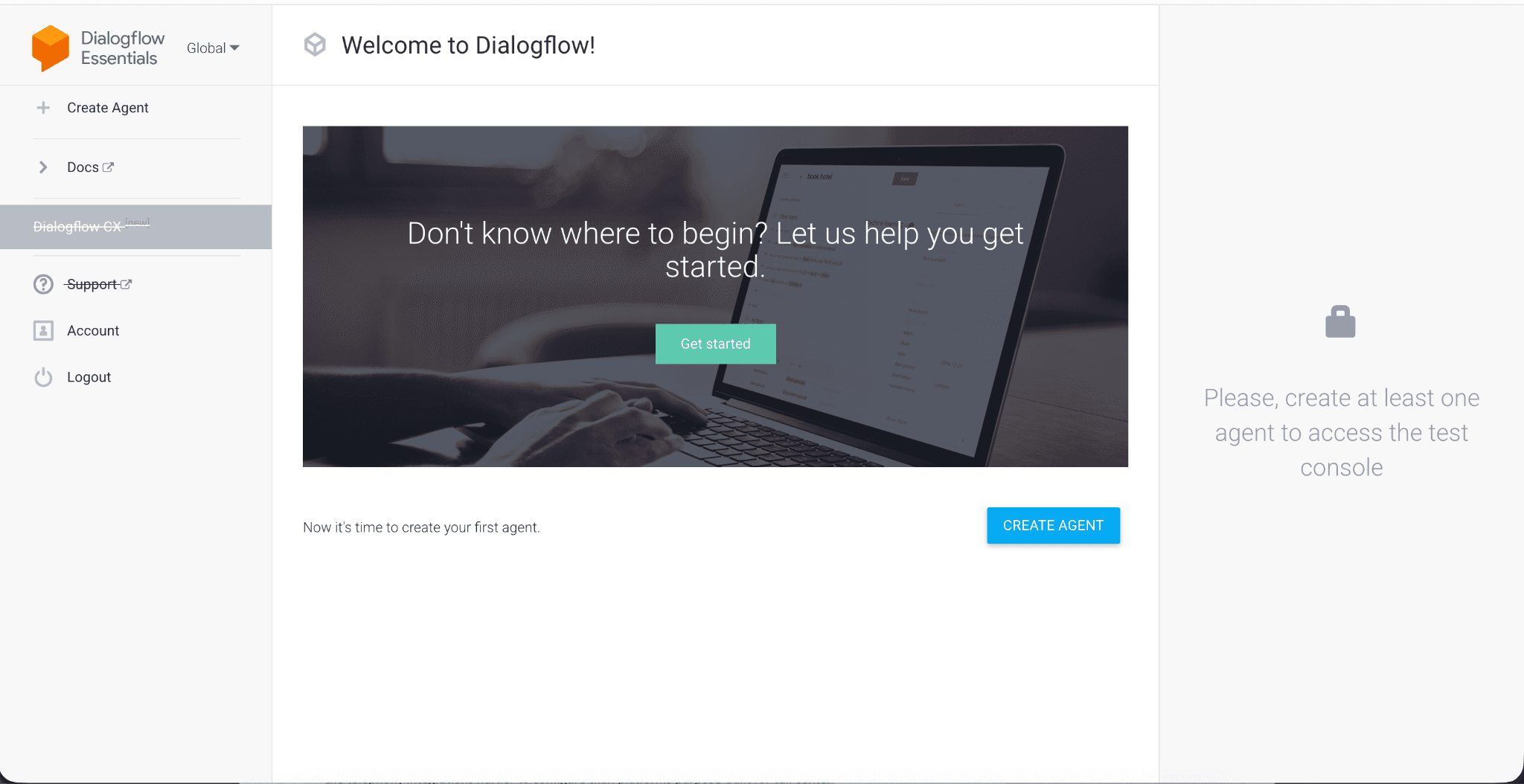
Google Dialogflow is a natural language understanding platform from Google Cloud that allows teams to build conversational interfaces for applications, websites, and contact centers. It started originally as API.AI before Google acquired it) and is one of the most widely used bot-building frameworks in the world.
There are two versions: Dialogflow ES, the original edition suited for simpler bots,
and then the Dialogflow CX, a more advanced version designed for complex, enterprise-grade conversational experiences.
Dialogflow CX offers a visual flow editor, state-based conversation management, and tight integration with Google Cloud services, including Contact Center AI (CCAI), which adds speech recognition, virtual agent capabilities, and agent assist features. For teams already using Google Cloud infrastructure, Dialogflow CX combined with CCAI can provide a strong foundation for contact center automation.
The main challenge with Dialogflow is that it requires meaningful technical investment to build, tune, and maintain. It is a building block, not a finished product. Teams typically need engineering resources to go from a Dialogflow setup to a production-grade contact center bot, and separate solutions for quality assurance and agent performance management are still required.
Compare how Level AI handles voice of the customer versus standard bot analytics: Voice of the Customer Insights.
Key Features
Visual flow editor in Dialogflow CX for designing complex, state-based conversation flows
Natural language understanding powered by Google’s machine learning infrastructure
Integration with Google Cloud Contact Center AI for virtual agents and agent assist features
Support for over 30 languages with strong multilingual intent recognition
Fulfillment webhooks for connecting bot logic to backend systems and APIs
Testing and simulation tools built into the Dialogflow console
Tight integration with Google Cloud services, including BigQuery, Pub/Sub, and Cloud Functions
Deployment across telephony, web chat, Google Assistant, and other channels via integrations
Strengths
Best-in-class natural language understanding backed by Google’s research and infrastructure
Deep integration with Google Cloud services, making it a natural fit for teams already on GCP
Highly scalable infrastructure that handles enterprise-level conversation volumes without performance issues
Strong multilingual support across a wide range of languages and regional dialects
Contact Center AI add-on provides agent assist and virtual agent capabilities for teams that need them
Weaknesses
Requires significant engineering investment to move from a prototype to a production-grade contact center bot
No native quality assurance, conversation scoring, or agent coaching features out of the box
Contact Center AI is a separate product that adds cost and complexity beyond the base Dialogflow setup
Teams not on Google Cloud infrastructure face more friction in integrating Dialogflow with their existing technology stack
Best For
Google Dialogflow is best for engineering teams within organizations already using Google Cloud who want a powerful, scalable NLU framework for building custom conversational experiences. It works well as a bot-building layer for teams with the technical resources to build around it, but is not a turnkey contact center platform.
7. Ada
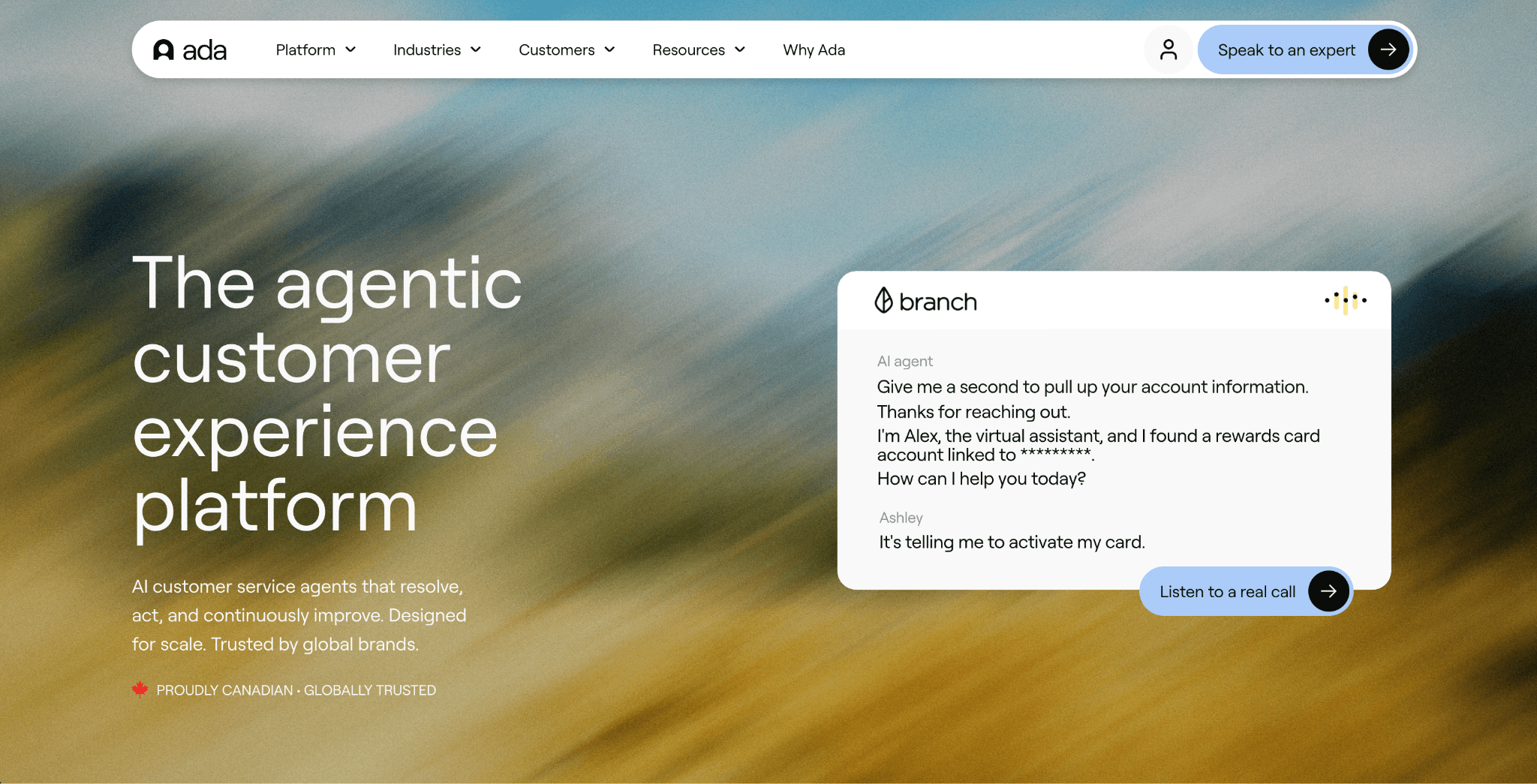
Ada is a customer service automation platform. The platform is designed to help mid-market and enterprise companies reduce support ticket volume through AI-powered chat automation. Ada’s approach centers on a no-code builder that allows support teams, not just developers, to create and manage AI chatbots without technical dependencies. This makes it one of the more accessible enterprise options for teams that want to deploy quickly.
Ada integrates with major CRM and helpdesk platforms including Salesforce, Zendesk, Freshdesk, and Intercom, and connects to knowledge bases and product documentation to generate answers. The platform includes tools for A/B testing bot flows, reviewing conversation analytics, and improving bot performance over time through a feedback loop.
Ada has also added generative AI capabilities that allow its bots to generate more flexible, natural-sounding responses rather than relying solely on predefined scripts.
Compared to Yellow AI, Ada is primarily a digital chat tool. There is no native voice support, no real-time agent assist, and no built-in quality assurance or agent performance management.
See how AI supports retail contact center teams: Retail Contact Center Solutions.
Key Features
No-code bot builder that support teams can manage without engineering help
Generative AI responses drawn from connected knowledge bases and documentation
A/B testing for bot conversation flows to optimize resolution rates
Integrations with Salesforce, Zendesk, Freshdesk, Intercom, and major e-commerce platforms
Multilingual support for global customer bases
Analytics showing containment rates, bot resolution rates, and escalation topics
Human handoff with conversation context sent to the receiving agent
Proactive messaging that triggers bot conversations based on customer behavior
Strengths
No-code builder genuinely empowers non-technical support teams to own and iterate on bot flows without IT dependency
Faster deployment than most enterprise bot platforms; teams can have a working bot live within days
Generative AI capabilities produce more flexible responses than rigid keyword-matching approaches
Strong North American customer base with good references in SaaS, financial services, and e-commerce
A/B testing built into the platform allows teams to continuously improve resolution rates without guesswork
Weaknesses
No voice channel support; Ada is a digital-only chat platform
No native quality assurance, agent coaching, or workforce performance management
Analytics do not go deep on sentiment analysis or customer experience trends at the conversation level
Less suitable for contact centers with complex telephony workflows or regulated industry compliance requirements
Best For
Ada is best for mid-market companies that want to reduce digital support ticket volume quickly through a no-code chatbot platform. It works well for teams whose primary support channel is chat and who do not require voice automation or deep contact center performance management.
8. Voiceflow
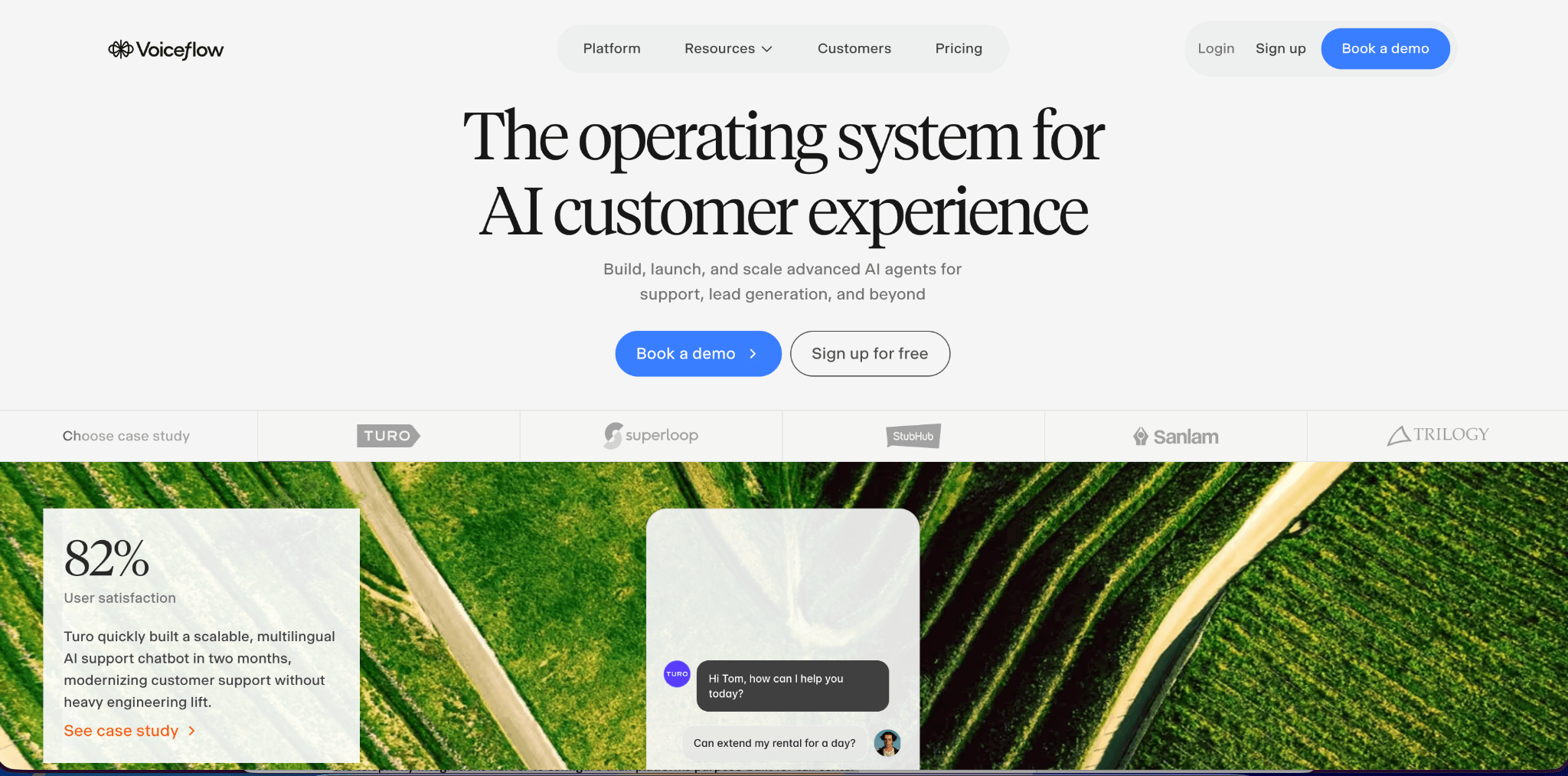
Voiceflow is a conversation design platform. It started as a tool for designing voice experiences for Amazon Alexa and Google Assistant, and has since expanded into a broader platform for designing and deploying AI agents across voice, chat, and other channels. Voiceflow’s core strength is in conversation design: it provides a collaborative, visual environment where product managers, designers, and developers can work together to build complex conversation flows and prototype experiences before they go to production.
The platform includes a drag-and-drop flow builder, a component library for common conversation patterns, a knowledge base integration for generative AI responses, and a developer toolkit for connecting Voiceflow-designed agents to production systems. Voiceflow also offers a testing and simulation environment that allows teams to test conversation flows before deployment.
Voiceflow positions itself more as a design and build tool than a finished contact center platform. It is strong at helping teams design, prototype, and iterate on conversation experiences. However, it does not include quality assurance, real-time agent assist, or workforce management features, and teams need to connect Voiceflow to their own telephony or chat infrastructure to handle production traffic.
Learn how insurance contact centers use AI to improve operations: Insurance Contact Center Solutions.
Key Features
Visual conversation flow builder designed for cross-functional teams, including designers and product managers
A collaborative workspace where multiple team members can contribute to conversation design simultaneously
Knowledge base integration that allows agents to generate responses from connected documentation
Testing and simulation environment for validating conversation flows before going to production
Developer toolkit including APIs and SDKs for connecting Voiceflow-designed agents to production infrastructure
Component library of reusable conversation blocks that speed up design for common patterns
Multi-channel deployment support across voice and chat through integrations with telephony and messaging providers
Version control for conversation designs, allowing teams to track changes and roll back when needed
Strengths
Best-in-class conversation design environment; easier for non-technical team members to contribute than most bot-building platforms
Collaborative features make it well-suited for teams where product, design, and engineering all play a role in conversation development
Strong prototyping and testing tools reduce the risk of deploying conversations that perform poorly in production
Flexible architecture that connects to a wide range of telephony and chat infrastructure rather than locking teams into a proprietary stack
Active community with a strong library of templates and example projects
Weaknesses
Design and prototyping tool first; production deployment requires connecting to external telephony and chat infrastructure
No native quality assurance, agent assist, or contact center performance management
Less suitable for teams that want a fully managed, turnkey contact center platform
Analytics and reporting are limited compared to platforms built specifically for contact center operations
Best For
Voiceflow is best for product and design teams that want a collaborative environment for designing and testing conversational AI experiences before deployment. It is a strong fit for teams building custom AI agents where conversation design quality is a priority and where engineering resources are available to handle production deployment.
9. Rasa
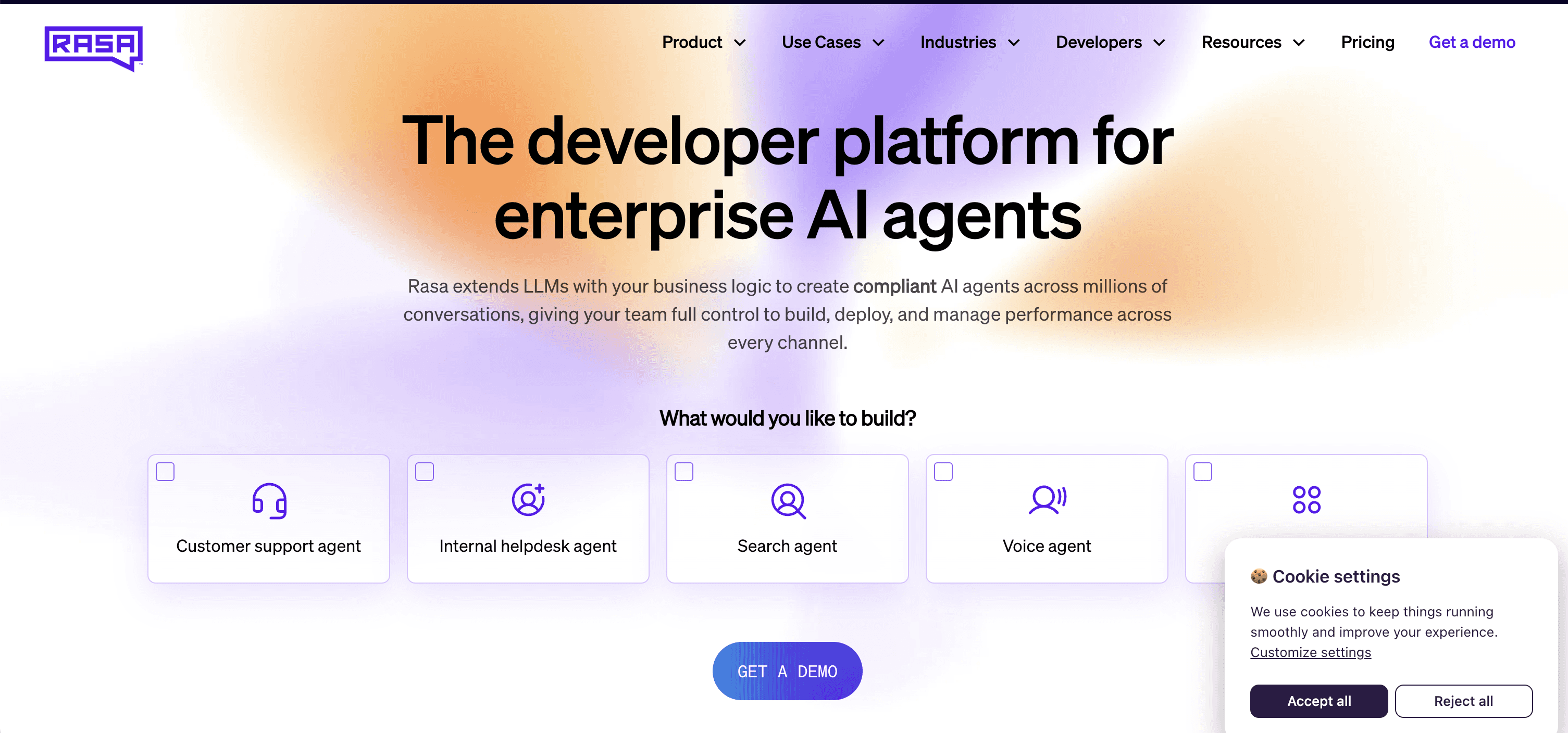
Rasa is an open-source conversational AI framework. It is the most widely used open-source platform for building AI-powered chatbots and voice assistants. Rasa gives engineering teams complete control over every aspect of their conversational AI system: the natural language understanding pipeline, the dialogue management logic, the training data, and the deployment infrastructure. Nothing is black-boxed.
Rasa offers two products: Rasa Open Source, which is the free framework that engineering teams self-host and manage.
Rasa Pro is an enterprise version that adds additional features like a low-code interface, analytics, and enterprise support.
The platform runs on-premises or in a private cloud, which makes it attractive to organizations with strict data sovereignty requirements that cannot use third-party SaaS platforms for conversation data.
The trade-off for that control is investment. Building a production-grade bot on Rasa requires dedicated AI engineers, infrastructure resources, and ongoing maintenance. For teams without those resources, Rasa quickly becomes more burden than benefit. There is no native quality assurance, no agent assist, and no contact center workflow management.
See how Level AI handles sales performance management in contact centers: Sales Performance Solutions.
Key Features
Open-source NLU and dialogue management framework with full access to source code
Custom NLU pipelines using the developer’s choice of machine learning models and components
On-premises and private cloud deployment options for teams with data sovereignty requirements
Rasa Pro enterprise version with low-code interface, analytics, and priority support
Support for custom channel integrations through a flexible connector framework
Active open-source community with a large library of shared components and tutorials
Multi-language support through customizable NLU pipelines
Strengths
Maximum control over conversation logic, training data, and the full NLU pipeline, which matters for teams with unique or sensitive requirements
On-premises deployment means conversation data never leaves the organization’s own infrastructure
No per-message or per-interaction pricing; teams that handle very high volumes can reduce costs significantly versus SaaS platforms
Large, active open-source community provides a rich ecosystem of components, tutorials, and shared knowledge
Strong fit for organizations in highly regulated industries or countries with strict data localization laws
Weaknesses
Requires dedicated AI engineers to build, tune, and maintain; not accessible to teams without technical resources
No native quality assurance, agent assist, coaching, or contact center performance management
Time to production is significantly longer than SaaS alternatives; the open-source nature means teams build more from scratch
Rasa Pro adds enterprise features but at a price point that can compete with fully managed SaaS alternatives that include more out of the box
Best For
Rasa is best for engineering-led organizations with dedicated AI teams that need maximum control over their conversational AI system and have strong data sovereignty or on-premises deployment requirements. It is not suited for teams without AI engineering resources or for contact centers that want a turnkey platform with built-in QA and agent management.
10. Fin by Salesforce

Fin by Salesforce, previously known as Einstein Bots and more recently relaunched as part of Salesforce’s Agentforce platform, is Salesforce’s AI agent offering for customer service teams. It is designed to handle customer inquiries through chat and messaging channels by drawing on Salesforce CRM data, knowledge articles, and case history to generate relevant, personalized responses. For teams already using Salesforce Service Cloud as their primary support system, Fin represents the fastest path to AI-assisted ticket deflection.
The platform uses Salesforce’s Einstein AI capabilities to generate responses, route conversations, and escalate to human agents through the Salesforce Omni-Channel routing system. It connects directly to Salesforce objects, meaning agents and AI can see the same customer data without integration work. Recent updates as part of the Agentforce launch have expanded the platform’s ability to take autonomous actions, like updating records or initiating workflows, based on conversation context.
The main limitation is the same as its main strength: Fin is deeply tied to the Salesforce ecosystem. Teams that do not use Salesforce as their primary CRM will find limited value. The platform also does not include native voice capabilities, quality assurance, or agent coaching features that are table-stakes for enterprise contact center operations.
Key Features
AI agent powered by Salesforce Einstein that handles chat and messaging inquiries using CRM data and knowledge articles
Native integration with Salesforce Service Cloud, including access to case history, account data, and knowledge base
Autonomous action capabilities through Agentforce, including record updates and workflow triggers
Omni-Channel routing integration for escalating conversations to human agents with full context
Einstein conversation analytics showing deflection rates, topic trends, and escalation patterns
Multi-language support for global customer bases
Low-code configuration through Salesforce Flow for building and customizing agent behavior
Strengths
Zero additional integration work for existing Salesforce Service Cloud customers; activation is fast and configuration uses familiar Salesforce tools
Access to full Salesforce CRM context in every conversation allows for genuinely personalized AI responses
Autonomous action capabilities via Agentforce allow the AI to take real actions in Salesforce, not just answer questions
Strong investment from Salesforce means the platform is improving rapidly as part of the broader Agentforce strategy
Native Salesforce reporting means conversation data feeds into existing Salesforce dashboards without extra work
Weaknesses
Entirely Salesforce-dependent; teams not using Salesforce Service Cloud get little value from this platform
No native voice channel support; Fin is focused on chat and messaging interactions
No native quality assurance, real-time agent assist, or workforce performance management beyond what Salesforce Service Cloud provides
Pricing is tied to Salesforce licensing and can become expensive at scale
Best For
Fin by Salesforce is best for organizations with Salesforce Service Cloud as their primary support platform who want to add AI-assisted chat deflection without introducing a separate vendor. It is not suited for contact centers that also handle significant phone volume or need capabilities outside the Salesforce ecosystem.
Why Level AI Is The Right AI Platform for Long-Term Growth?
Yellow AI does a capable job of automating messaging-heavy customer interactions in emerging markets. But enterprise contact center leaders evaluating Yellow AI alternatives are typically looking for something it does not provide: a platform that handles the full contact center workflow, not just the automation layer.
Level AI addresses every major limitation buyers encounter with Yellow AI. Where Yellow AI provides bot automation without built-in quality assurance, Level AI evaluates every interaction automatically. Where Yellow AI does not support real-time agent assist, Level AI surfaces live guidance to agents during calls and chats. Where Yellow AI provides basic analytics, Level AI gives contact center leaders a complete view of customer sentiment, topic trends, and agent performance across every channel.
The result is a platform that does not just automate conversations. It helps contact centers continuously improve: better agents, better customer experiences, and better operational visibility. That is the difference between a bot platform and a contact center intelligence platform.
If you are evaluating Yellow AI alternatives because you want more from your investment in contact center AI, Level AI is the most complete answer available for enterprise teams operating in regulated industries at scale.
Frequently Asked Questions.
1. Is Yellow AI suitable for enterprise businesses?
Yes. Yellow AI is designed for mid-market and enterprise organizations that need AI-powered customer support across multiple channels. However, enterprises looking for deeper contact center capabilities like AI-powered quality assurance, agent assist, and analytics may also evaluate platforms like Level AI.
2. Is Yellow AI difficult to implement?
Implementation varies based on the number of integrations, channels, and workflows you need. Basic chatbot deployments can be relatively quick, while enterprise implementations involving CRM and contact center systems typically require more planning.
3. How does Yellow AI compare to Level AI?
Yellow AI focuses primarily on conversational AI and customer-facing virtual agents. Level AI offers those capabilities while also providing AI-powered quality assurance, agent assist, real-time guidance, conversation intelligence, and performance analytics for enterprise contact centers.
4. Does Yellow AI support omnichannel customer engagement?
Yes. Yellow AI supports conversations across web chat, mobile apps, WhatsApp, social messaging platforms, email, and voice, allowing businesses to provide a consistent customer experience across channels.
5. How much customer support can Yellow AI realistically automate?
Yellow AI can automate repetitive Tier-1 queries such as FAQs, order tracking, and appointment scheduling. The actual automation rate depends on your use case, knowledge base quality, and workflow complexity.