
Key takeaways
Credit union software in 2026 needs to unify core banking, lending, digital banking, CRM, compliance, and contact center systems so every member interaction pulls from one accurate source of truth, not five disconnected logins
Automated, 100% QA coverage (replacing the old 2 to 5% manual sample) is becoming the baseline expectation for credit union contact centers, not a nice-to-have upgrade
Level AI takes a fundamentally different approach than most vendors on this list, it layers 100% automated QA, real-time agent assist, and voice-of-the-member analytics directly onto a credit union's existing telephony (Five9, Genesys, NICE, Amazon Connect) instead of requiring a rip-and-replace of the whole contact center stack
AI agent assist and virtual agents are moving from pilot to production for balance inquiries, card disputes, and loan servicing, freeing human agents for complex, relationship-driven member conversations
The right platform depends heavily on credit union size and existing core banking stack, a single-branch community credit union and a multi-billion-dollar regional credit union will land on different tools even when solving the same underlying problem
Introduction
Credit union software is a broad label that covers a lot of different tools, but the pace of adoption behind it is anything but vague: 59% of credit unions have already deployed generative AI, more than the 49% of banks that have, and credit unions are more than twice as likely as banks to be investing in agentic AI (17% versus 7%), as per a report by Cornerstone Advisors.
That pace of adoption is exactly why credit union leaders are no longer buying a single piece of software, they are assembling a stack. Modern credit unions run several software layers side by side: core banking to process transactions and manage accounts, lending platforms to originate and service loans, digital banking apps for member self-service, CRM to track the full member relationship, compliance tools to satisfy NCUA and state examiners, member engagement software to personalize outreach, and credit union contact center software to handle the calls, chats, and messages that still make up the bulk of day-to-day member service.
This guide breaks down the 10 credit union software platforms getting evaluated most often in 2026, what separates a purpose-built vendor from a repurposed general-CCaaS platform, and where each one actually fits.
What is credit union software?
Credit union software is the umbrella term for every application a credit union uses to serve members, manage risk, and run daily operations. Broadly, it splits into two groups: back-office systems (core banking, lending, compliance, data and reporting) and member-facing systems (digital banking, CRM, and the contact center and customer service tools members actually interact with when they call, chat, or message in).
At the member-facing layer, credit union software has to do everything a typical customer service platform does, routing calls and chats, recording interactions, and tracking agent performance, while also handling things unique to financial cooperatives. That includes member (not customer) data models tied to share accounts and loans, integration with core processors like Fiserv, Jack Henry, and Corelation, and compliance monitoring tuned to NCUA and Reg E requirements rather than generic customer service standards.
Why credit unions need specialized contact center software?
A generic call center platform can route calls just fine, but it will not natively understand what a credit union actually needs it to do. Credit unions operate inside a stack of purpose-built categories, and it helps to see where contact center software sits relative to the rest:
Core banking software: platforms like Fiserv, Jack Henry, and Corelation process share accounts, loans, and transactions, the system of record everything else has to sync with.
Digital banking software: the mobile and online banking apps members use for self-service, often the first point of contact before an issue escalates to a human.
Lending and loan servicing software: handles origination, underwriting, and servicing for auto loans, mortgages, and member business loans.
CRM and member relationship software: tracks the full member relationship across products, so an agent sees history instead of a single account in isolation.
Contact center and customer service software: routes and manages voice, chat, email, and SMS interactions, records them, and provides QA and coaching. This is the category this guide focuses on, and it's often where real-time agent assist closes the gap between what a member needs and what a newer agent knows.
AI and automation software: layers on top of some or all of the above to automate repetitive requests, detect sentiment, and give agents next-best-action guidance in the moment.
Specialized contact center software matters because credit unions carry compliance obligations a generic platform doesn't handle out of the box, NCUA exam readiness, Reg E error resolution timelines, and BSA/AML monitoring, on top of the trust members place in an institution they often see as a not-for-profit partner rather than a faceless bank. Manual QA sampling, the traditional way contact centers checked for these issues, only reviews 2 to 5% of calls, meaning the overwhelming majority of member interactions are never checked for a missed disclosure or a frustrated member falling through the cracks. Automated call center compliance monitoring closes that gap by reviewing 100% of interactions instead of a thin sample.
What should you look for in credit union software?
Omnichannel member support Members expect to reach their credit union the same way they reach any other service, by voice, chat, email, SMS, or social, and expect the conversation to carry context across channels. A member who starts a dispute over chat shouldn't have to repeat everything when they call back an hour later.
AI-powered automation AI virtual agents that handle balance inquiries, card activation, and address changes end-to-end free up human agents for the loan conversations and hardship cases that actually need a person. This is one of the fastest-growing line items in credit union technology budgets for 2026.
Agent assist Real-time guidance during a live call, next-best-action prompts, relevant knowledge base articles, and suggested responses, shortens handle time and helps newer member service reps sound like five-year veterans. Agent assist tools are increasingly table stakes rather than a premium add-on.
Conversation intelligence Transcription, intent detection, sentiment analysis, and automatic categorization turn every call and chat into structured data a credit union can act on, not just an audio file sitting in cold storage.
Quality assurance Automated QA that evaluates 100% of interactions catches issues a 2 to 5% manual sample simply cannot: missed disclosures, rude agents, call avoidance, and member frustration that never gets escalated. Quality assurance software built for this scale is quickly becoming the default rather than the exception.
Analytics and reporting Dashboards that surface contact drivers, agent performance, and member experience trends help contact center leaders make staffing and coaching decisions with actual data instead of gut feel.
Integrations The contact center platform has to talk to core banking, CRM, telephony, and knowledge base systems, otherwise agents end up toggling between five screens to answer one question, which is exactly the kind of friction that drives up handle time and member frustration.
Security and compliance This matters more for credit union contact centers than almost any other industry vertical. Member interactions routinely involve account numbers, SSNs, and payment details, and a missed disclosure or mishandled dispute carries real regulatory compliance exposure with NCUA examiners.
Credit union software comparison
Software | Key Features | Best For |
|---|---|---|
Level AI | 100% automated QA, real-time agent assist, voice-of-the-member analytics, core banking integrations | Credit unions layering AI onto an existing telephony platform |
NICE CXone | Omnichannel routing, AutoQM, deep workforce management, speech analytics | Large, multi-branch credit unions and CUSOs |
Genesys Cloud CX | AI orchestration, predictive routing, omnichannel, workforce engagement management | Large regional credit unions modernizing off on-premise systems |
Five9 | Intelligent virtual agent, predictive dialer with TCPA controls, agent assist | Credit unions with meaningful outbound and collections volume |
Talkdesk | Financial Services Experience Cloud, branch-to-contact-center unification | Community and regional credit unions wanting a banking-ready package |
Salesforce Service Cloud | Agentforce banking agents, Financial Services Cloud data model | Credit unions standardized on Salesforce CRM |
Zendesk | Unified ticketing, omnichannel messaging, automation and triggers | Smaller credit unions wanting a lightweight helpdesk |
Eltropy | Text messaging, secure chat, video banking, voice, all in one interface | Community credit unions modernizing member communication channels |
Glia | Banking AI operating system, CoBrowsing, digital-first engagement | Credit unions modernizing digital member service and loan growth |
interface.ai | Voice AI and Chat AI virtual assistants built for credit unions | Credit unions wanting fast, high call automation without a big platform overhaul |
10 best credit union software platforms in 2026
Let us talk more about these software platforms in detail. now. We have evaluated them based on features, pricing, user ratings and best suitable for.
Level AI
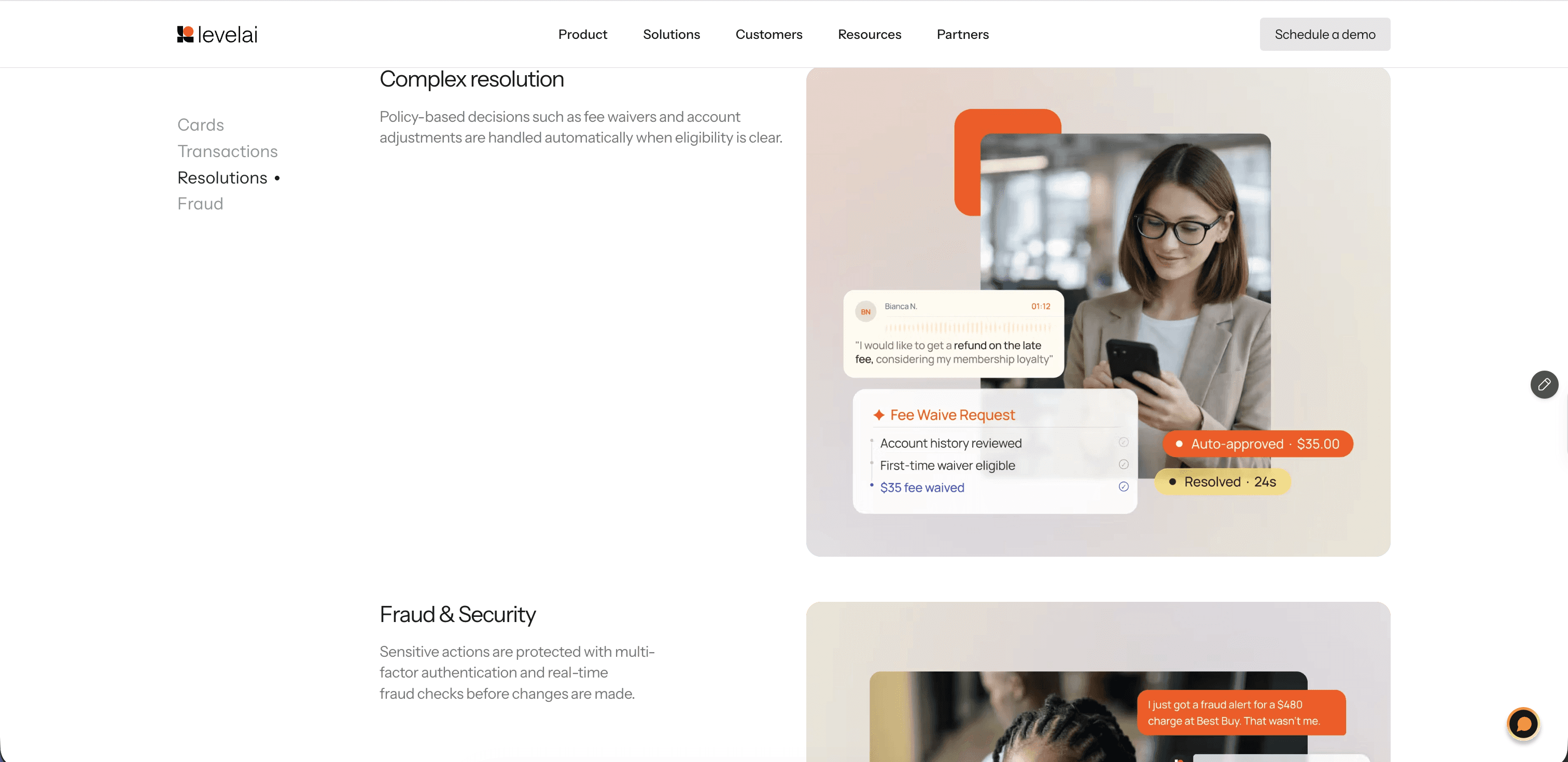
Level AI is an AI-native contact center intelligence platform built for regulated industries including credit unions, community banks, and insurance. Rather than replacing a credit union's existing telephony, it layers automated QA, real-time agent assist, and voice-of-the-member analytics on top of platforms like Five9, Genesys, NICE, and Amazon Connect. Its semantic intelligence engine reviews 100% of member interactions for compliance risk, script adherence, and sentiment, directly relevant to NCUA and Reg E obligations. Level AI also connects to core banking, digital banking, lending, and card platforms so supervisors get a single view of a member's history across every channel.
Features best suited for credit unions:
Automated quality assurance scoring 100% of interactions instead of a small manual sample
Real-time agent assist surfacing disclosures, next-best-action, and account context mid-call
Automatic PII and account-number redaction across calls, chats, and digital channels
Voice-of-the-member analytics flagging sentiment, churn risk, and repeat-contact drivers
Direct integrations with core banking, digital banking, lending, and card platforms
AI Workers that automate routine tier-1 requests like balance checks and card status
Best suitable for: Level AI fits mid-size to large credit unions that already run a telephony or CCaaS platform and want to add AI-driven QA, compliance, and agent assist without a rip-and-replace project. It's also a strong fit for credit unions running lean QA teams relative to call volume, since automated coverage replaces hours of manual review. Multi-branch credit unions layering Level AI on top of an existing Five9 deployment tend to see the fastest time to value.
Product ratings and customer stories: Level AI holds a 4.6 out of 5 rating on G2 based on 220 reviews. Its case study of a financial services firm documents how a financial services and insurance provider used Level AI to cut repetitive, avoidable calls and improve first-call resolution across its contact center.
" transform="translate(85.643 10.143)" width="23.725855670103115px"/><path d="M 71.828 0 L 0 50.702" fill="transparent" height="50.70235051546392px" id="TnJFUMH9b" stroke-dasharray="" stroke-linecap="butt" stroke-linejoin="miter" stroke-miterlimit="10" stroke-width="0.68" stroke="rgb(254, 250, 241)" transform="translate(85.508 75.029)" width="71.82828865979384px"/><path d="M 81.579 0 L 0 52.003" fill="transparent" height="52.00280412371134px" id="ccJzhVTGI" stroke-dasharray="" stroke-linecap="butt" stroke-linejoin="miter" stroke-miterlimit="10" stroke-width="0.68" stroke="rgb(254, 250, 241)" transform="translate(85.495 73.738)" width="81.57921649484533px"/><path d="M 65.653 0 L 0 32.827" fill="transparent" height="32.826556701030924px" id="X0Vp_q8HG" stroke-dasharray="" stroke-linecap="butt" stroke-linejoin="miter" stroke-miterlimit="10" stroke-width="0.68" stroke="rgb(254, 250, 241)" transform="translate(85.462 92.931)" width="65.65311340206183px"/><path d="M 88.08 14.951 L 0 0" fill="transparent" height="14.950762886597914px" id="JM_UgSiJ_" stroke-dasharray="" stroke-linecap="butt" stroke-linejoin="miter" stroke-miterlimit="10" stroke-width="0.68" stroke="rgb(254, 250, 241)" transform="translate(86.233 125.789)" width="88.07950515463914px"/><path d="M 83.204 72.803 L 0 0" fill="transparent" height="72.80313402061856px" id="KlyUUjlMK" stroke-dasharray="" stroke-linecap="butt" stroke-linejoin="miter" stroke-miterlimit="10" stroke-width="0.68" stroke="rgb(254, 250, 241)" transform="translate(85.089 125.71)" width="83.20379381443304px"/><path d="M 7.8 114.081 L 0 0" fill="transparent" height="114.08065979381445px" id="kAiUvduBR" stroke-dasharray="" stroke-linecap="butt" stroke-linejoin="miter" stroke-miterlimit="10" stroke-width="0.68" stroke="rgb(254, 250, 241)" transform="translate(85.95 125.478)" width="7.800247422680428px"/><path d="M 0 93.604 L 9.75 0" fill="transparent" height="93.60445360824741px" id="FsgTAQB0n" stroke-dasharray="" stroke-linecap="butt" stroke-linejoin="miter" stroke-miterlimit="10" stroke-width="0.68" stroke="rgb(254, 250, 241)" transform="translate(76.2 125.421)" width="9.750432989690694px"/><path d="M 0 76.379 L 76.703 0" fill="transparent" height="76.37888659793816px" id="NxOhHvPJ5" stroke-dasharray="" stroke-linecap="butt" stroke-linejoin="miter" stroke-miterlimit="10" stroke-width="0.68" stroke="rgb(254, 250, 241)" transform="translate(9.343 125.217)" width="76.7034556701031px"/><path d="M 0 26.651 L 39.002 0" fill="transparent" height="26.651381443298988px" id="QETNKJ3L6" stroke-dasharray="" stroke-linecap="butt" stroke-linejoin="miter" stroke-miterlimit="10" stroke-width="0.68" stroke="rgb(254, 250, 241)" transform="translate(47.096 125.177)" width="39.0017319587629px"/><path d="M 0 16.901 L 85.154 0" fill="transparent" height="16.900948453608265px" id="BL63wDICD" stroke-dasharray="" stroke-linecap="butt" stroke-linejoin="miter" stroke-miterlimit="10" stroke-width="0.68" stroke="rgb(254, 250, 241)" transform="translate(0.094 125.125)" width="85.15396503092786px"/><path d="M 0 0 L 78.004 17.876" fill="transparent" height="17.875793814432996px" id="PIX70Vlqf" stroke-dasharray="" stroke-linecap="butt" stroke-linejoin="miter" stroke-miterlimit="10" stroke-width="0.68" stroke="rgb(254, 250, 241)" transform="translate(8.362 107.251)" width="78.00376082474227px"/><path d="M 0 0 L 67.928 52.327" fill="transparent" height="52.32742268041238px" id="u_syqWqWD" stroke-dasharray="" stroke-linecap="butt" stroke-linejoin="miter" stroke-miterlimit="10" stroke-width="0.68" stroke="rgb(254, 250, 241)" transform="translate(17.593 72.861)" width="67.92826391752578px"/><path d="M 0 0 L 77.029 70.528" fill="transparent" height="70.52832989690722px" id="DmW_aE2A0" stroke-dasharray="" stroke-linecap="butt" stroke-linejoin="miter" stroke-miterlimit="10" stroke-width="0.68" stroke="rgb(254, 250, 241)" transform="translate(9.489 54.678)" width="77.02866804123713px"/><path d="M 0 0 L 27.301 126.431" fill="transparent" height="126.43109443298971px" id="JrLaRUubC" stroke-dasharray="" stroke-linecap="butt" stroke-linejoin="miter" stroke-miterlimit="10" stroke-width="0.68" stroke="rgb(254, 250, 241)" transform="translate(58.341 -0.071)" width="27.30111340206188px"/><path d="M 0 4.012 C 0 1.796 1.796 0 4.012 0 C 6.228 0 8.025 1.796 8.025 4.012 C 8.025 6.228 6.228 8.025 4.012 8.025 C 1.796 8.025 0 6.228 0 4.012 Z" fill="rgb(254, 80, 0)" height="8.024669690721652px" id="Nh5qrPJs_" transform="translate(81.396 121.369)" width="8.024669690721623px"/></svg>)
2. NICE CXone
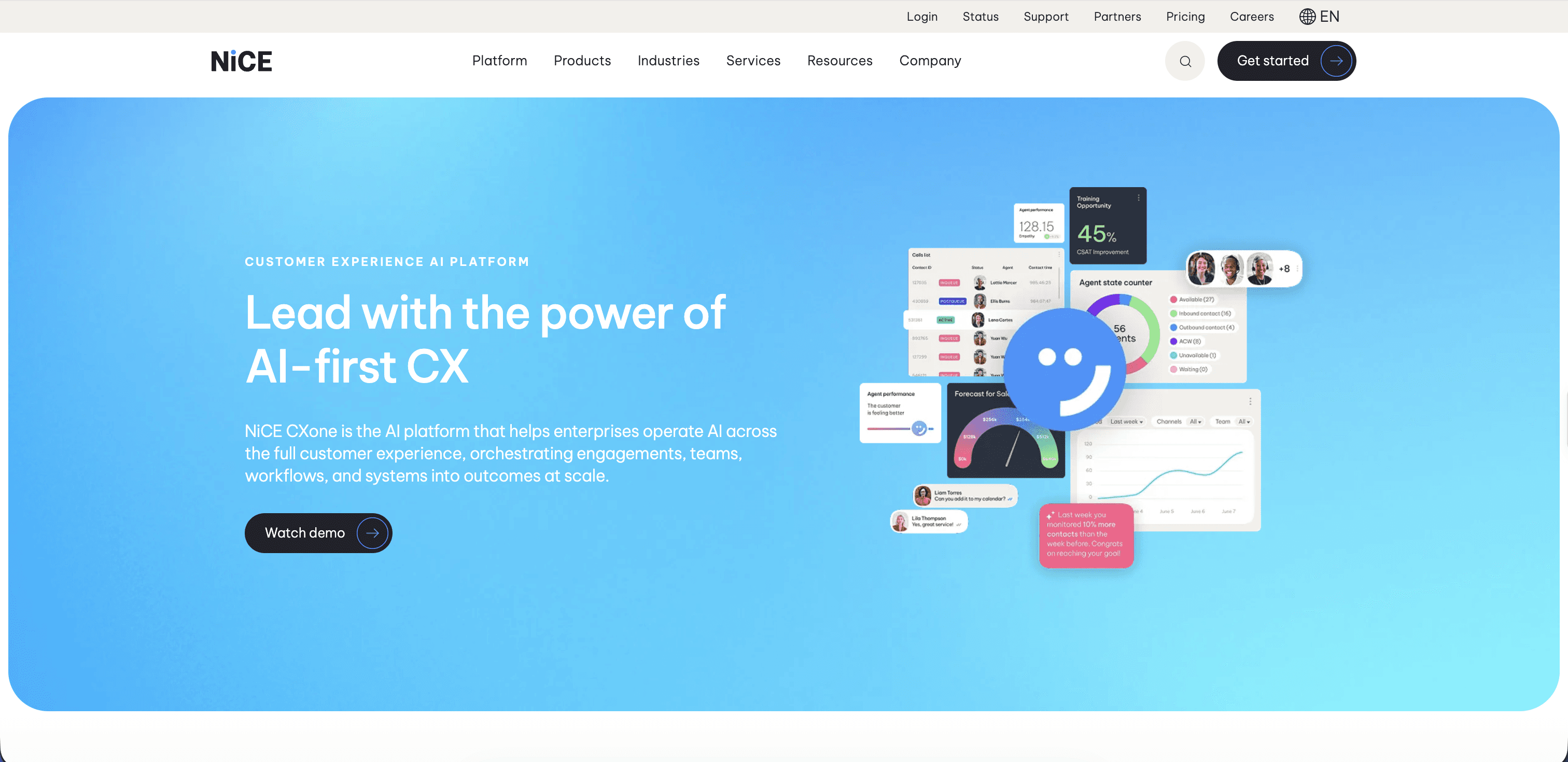
NICE CXone is one of the most established enterprise contact center platforms in financial services, combining omnichannel routing, workforce optimization, and speech and voice analytics in one suite. Large credit unions favor CXone for its workforce management depth, useful when scheduling hundreds of member service reps across shifts and channels, and its automated QA scoring built for regulated call flows. It has documented deployments across credit unions of multiple asset sizes.
Features best suited for credit unions:
CXone AutoQM for automated, scalable quality scoring
Deep workforce management and forecasting for large member service teams
Interaction and speech analytics for compliance and sentiment
Omnichannel routing across voice, chat, and digital channels
PCI DSS-compliant secure payment capture during live calls
Pre-built financial services workflows and reporting
Best suitable for: NICE CXone suits large, multi-branch credit unions and CUSOs (credit union service organizations) with thousands of member service reps and complex scheduling needs. Its depth and configurability come with a steeper learning curve and higher total cost of ownership, so it tends to be overkill for a single-branch community credit union with a lean IT team.
Product ratings and customer stories: NICE CXone (Mpower) holds a 4.3 out of 5 rating on G2 from more than 1,700 reviews, and a 4.2 out of 5 rating on Capterra from 543 reviews. Documented credit union customers include PSCU, Maps Credit Union, and Utah Community Credit Union, with Maps Credit Union reporting after-call work reduced by up to 94%.
3. Genesys Cloud CX
Genesys Cloud CX is a cloud-native omnichannel platform known for its AI orchestration layer, coordinating bots, agents, and predictive routing across a member's journey. Large regional credit unions and CUSOs serving multiple credit unions favor it for consistent CX across many branches and call centers, and its open API architecture lets institutions build custom member-facing workflows on top of the platform. Credit unions migrating off legacy on-premise systems often land here when they want a fully cloud-native rebuild rather than a lift-and-shift.
Features best suited for credit unions:
AI orchestration and copilot tools for blending bots and human agents
Predictive routing based on member value and intent
Omnichannel support across voice, chat, email, and social
Workforce engagement management for large, distributed teams
Embedded compliance recording and retention
Open APIs for integrating with core banking and CRM systems
Best suitable for: Genesys Cloud CX fits large regional credit unions and CUSOs with the engineering resources to configure it deeply and a need for a consistent platform across many branches. Credit unions already running Genesys as their core telephony platform often layer AI-driven QA and agent assist on top rather than replacing it outright. Smaller credit unions with lean IT teams sometimes find the licensing and configuration complexity harder to manage than more purpose-built alternatives.
Product ratings and customer stories: Genesys Cloud CX holds a 4.4 out of 5 rating on G2 from roughly 1,520 reviews, and a 4.3 out of 5 rating on Capterra. Its documented financial services customers include HSBC and M&T Bank, which reported a 100% increase in banker productivity after implementation, and it's a frequently cited platform among credit unions modernizing off on-premise contact center infrastructure.
4. Five9
Five9 is a cloud contact center platform with a strong presence in credit unions and community banks, particularly for collections and outbound-heavy member communication where TCPA compliance matters. Its intelligent virtual agent (IVA) handles high-volume self-service, while its predictive dialer includes compliance controls for outbound calling windows. Five9's Agent Assist is already in production at credit unions handling member service at scale, often as the base layer that other AI tools get layered on top of.
Features best suited for credit unions:
Intelligent Virtual Agent (IVA) for self-service account inquiries
Predictive dialer with built-in TCPA compliance controls
Five9 Agent Assist for real-time call transcription and guidance
Financial services-specific workflow templates
Workforce management and forecasting
Flexible integration with AI layers for added QA and analytics coverage
Best suitable for: Five9 is a strong fit for mid-market to large credit unions with meaningful outbound calling volume, particularly collections and payment reminder operations that need compliance guardrails built in. It's less commonly the first choice for smaller credit unions prioritizing inbound, digital-first member servicing over outbound calling.
Product ratings and customer stories: Five9 holds a 4.1 out of 5 rating on G2 from 625 reviews, and a 4.2 out of 5 rating on Capterra from 484 reviews. Credit union customers include MSU Federal Credit Union, which cut its call abandonment rate from 18% to 9.5% after moving from IVR to IVA-led self-service.
5. Talkdesk

Talkdesk stands out in credit unions for its dedicated Financial Services Experience Cloud, a purpose-built package rather than a generic contact center configured after the fact. It unifies branch, digital, and contact center context so frontline staff see a member's full relationship history in one place, and layers AI-driven agent assist on top for real-time guidance during calls. Talkdesk has picked up credit union and community bank customers specifically looking for a banking-ready package they can deploy without months of custom configuration.
Features best suited for credit unions:
Financial Services Experience Cloud, a purpose-built banking and credit union package
Unified member context across branch, digital, and contact center
Talkdesk for Financial Centers, extending AI tools to branch staff
Real-time AI agent assist and knowledge surfacing during calls
Pre-built integrations for banking and credit union core systems
Customer Experience Automation for repetitive service workflows
Best suitable for: Talkdesk is best suited to community and regional credit unions that want a banking-specific package they can deploy relatively quickly, without building every compliance and workflow feature from scratch. It has also proven itself with financial institutions scaling quickly, making it a reasonable fit for growing credit unions.
Product ratings and customer stories: Talkdesk holds a 4.4 out of 5 rating on G2 from more than 1,600 reviews, and a 4.5 out of 5 rating on Capterra from more than 700 reviews. Its financial services customer base includes credit unions like Avadian and BayPort, along with TowneBank, whose case study reports a 23-second reduction in average handle time and a 4.8 CSAT score.
6. Salesforce Service Cloud
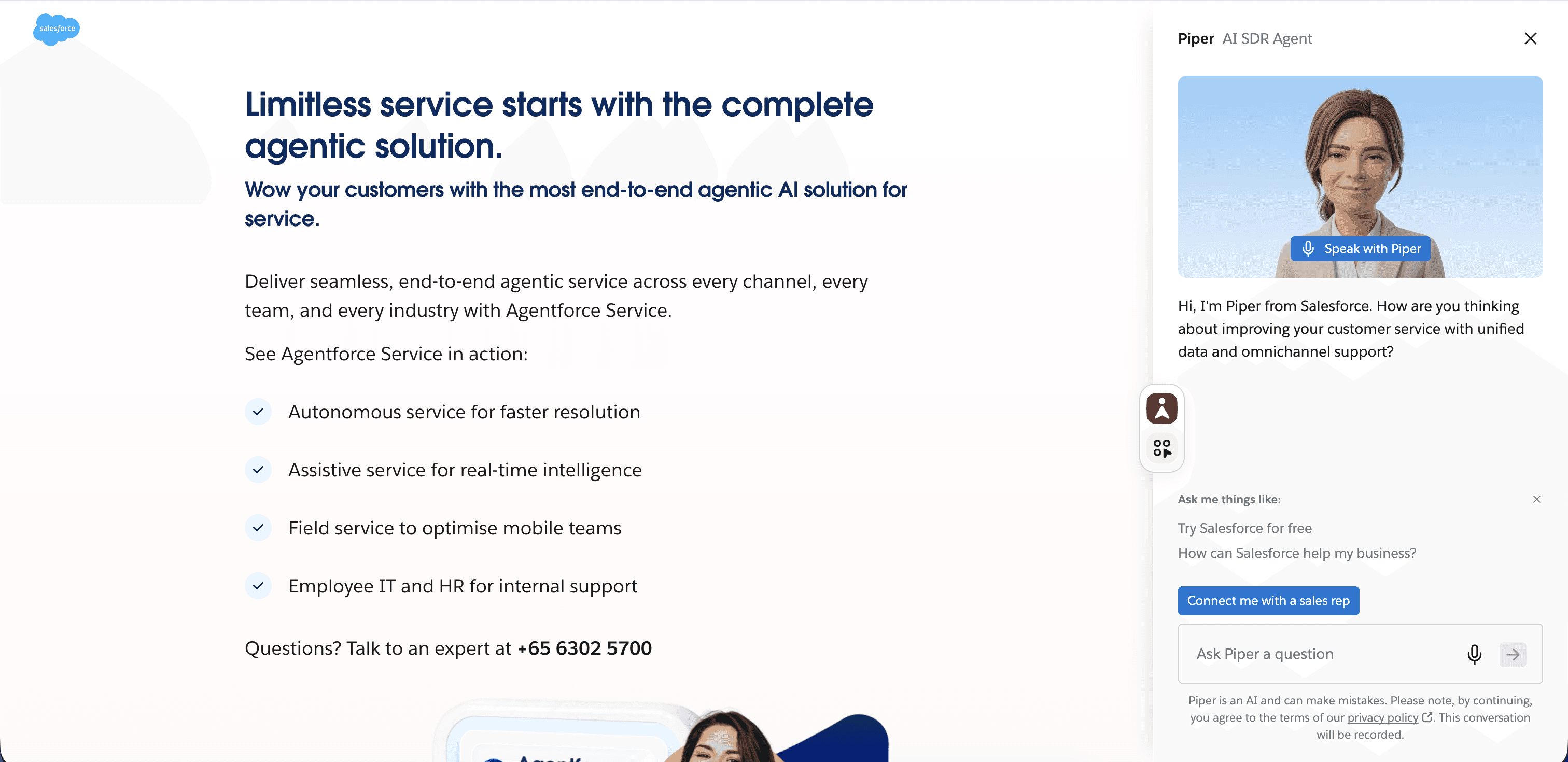
Salesforce Service Cloud, paired with Financial Services Cloud and Agentforce, is the strongest option for credit unions that want their contact center tightly unified with their CRM. Its data model is built around member households and relationships rather than isolated cases, and its Agentforce AI agents are pre-built for common member requests like balance inquiries, transfers, and card disputes. It shows up most often at credit unions that already run Salesforce for lending or member relationship management and want the contact center to feed the same system.
Features best suited for credit unions:
Agentforce prebuilt AI agents for balance, transfer, and dispute handling
Financial Services Cloud data model built around member relationships
Case management tied to a full 360-degree member view
Credit-check and loan system integrations
Omnichannel routing across voice, chat, and digital
Large AppExchange ecosystem for credit union-specific extensions
Best suitable for: Salesforce Service Cloud is best suited to credit unions already running Salesforce as their core CRM and lending platform that want to unify sales, service, and contact center data on one system. It tends to work less well as a standalone telephony solution for smaller credit unions with no existing Salesforce investment, since much of its value depends on that broader ecosystem, and its FSC Accelerator pricing is aimed at institutions under $10 billion in assets.
Product ratings and customer stories: Salesforce Service Cloud holds a 4.5 out of 5 rating on Capterra from 816 reviews, and the broader Salesforce product suite holds a 4.5 out of 5 rating on G2 across more than 97,000 reviews. BCU, a $6 billion credit union serving more than 360,000 members, is a documented Agentforce customer, with its Chief Data Officer noting that Salesforce made scalability feel achievable for the first time.
7. Zendesk
Zendesk is a widely adopted customer service platform that credit unions choose when they want a lighter-weight, faster-to-deploy alternative to a full CCaaS suite. It pulls email, chat, voice, and social into one ticket view, with triggers, macros, and automation rules that let smaller member service teams encode real process without heavy configuration. Its financial services customers include credit unions consolidating disconnected systems, shared inboxes, and legacy chat tools into one member-facing record.
Features best suited for credit unions:
Unified ticketing across email, chat, voice, and social channels
Triggers, macros, and automations for routine member requests
AI-powered ticket routing and suggested replies
Integration with core banking and digital banking platforms
Self-service help center for common member questions
Reporting dashboards for ticket volume and resolution time
Best suitable for: Zendesk fits smaller and mid-size credit unions that want to consolidate member communications into one system without the cost and complexity of an enterprise CCaaS platform. It's a weaker fit for credit unions with heavy outbound calling or collections volume, since its roots are in ticketing rather than voice-first contact center operations.
Product ratings and customer stories: Zendesk holds roughly a 4.3 out of 5 rating on G2 from about 6,700 reviews, and a 4.5 out of 5 rating on Capterra. Its Credit Union of Colorado case study documents how the credit union replaced a shared Outlook inbox and disconnected chat tools with one centralized ticketing system, improving both agent and member satisfaction.
8. Eltropy
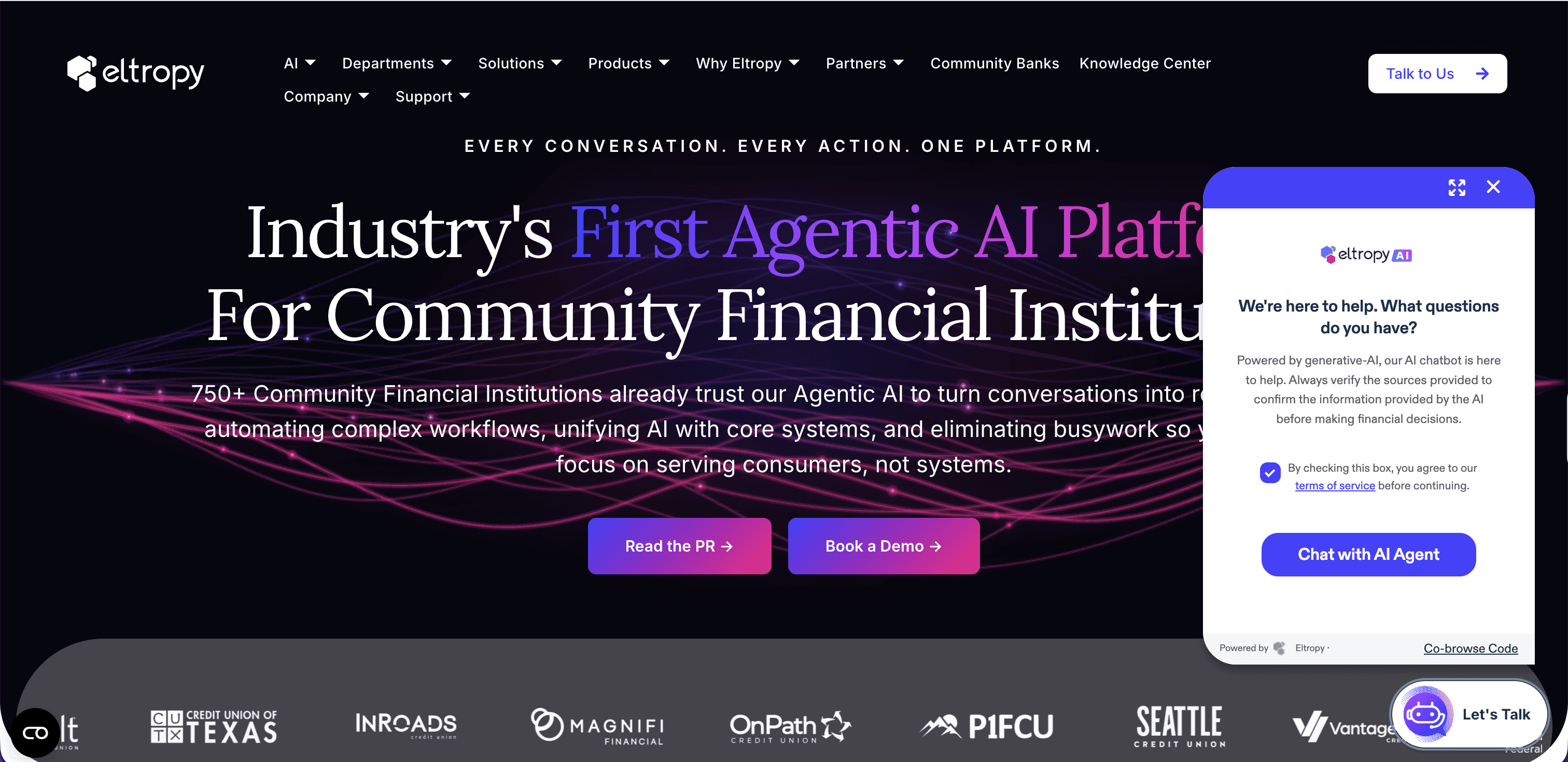
Eltropy is a digital communications platform built specifically for credit unions and community financial institutions, unifying text messaging, secure chat, video banking, and voice into one interface. Rather than replacing a credit union's core telephony, it focuses on the messaging and video layer members increasingly expect, letting loan officers, collections staff, and member service reps text and video-chat with members inside a compliant, recorded system. It's one of the more focused, credit union-native vendors on this list rather than a repurposed general-purpose platform.
Features best suited for credit unions:
Text messaging and secure two-way chat for member communication
Video banking for face-to-face service without a branch visit
Campaign and template tools for loan officers and collections teams
Compliant recording and archiving of all text and chat interactions
Integration with core banking and loan origination systems
Co-browsing and screen sharing for guided digital support
Best suitable for: Eltropy fits community credit unions and smaller community banks that want to modernize member communication channels, especially text and video, without taking on a full CCaaS replacement project. It's a particularly strong fit for lending and collections teams that need a compliant way to text members rather than relying on personal phones.
Product ratings and customer stories: Eltropy holds a 4.4 out of 5 rating on G2 from 51 reviews, and a 4.9 out of 5 rating on Capterra from 27 reviews, with credit union reviewers citing its robustness relative to competitors and reasonable pricing. Its customer base is concentrated among credit unions and community banks using it for member texting, loan servicing communication, and collections outreach.
9. Glia
Glia positions itself as a Banking AI operating system built specifically for community and regional financial institutions, layering an AI workforce of specialized agents on top of a credit union's existing tech stack. Its CoBrowsing and onscreen voice tools let agents guide members through digital forms in real time, and its Banking AI layer automates workflows across both voice and digital channels, from the front office to the back office. Glia is trusted by more than 700 banks and credit unions and backs its accuracy claims with a contractual no-hallucination guarantee, a notable positioning move in a category where AI reliability is a real concern.
Features best suited for credit unions:
Banking AI operating system automating workflows across voice and digital
CoBrowsing and onscreen voice for real-time guided member support
Virtual assistant for member-facing self-service
Contractual no-hallucination guarantee for AI-generated responses
Digital-first engagement tools built for loan growth and deposit generation
Integration with core banking and existing telephony systems
Best suitable for: Glia is a strong fit for community and regional credit unions specifically looking to modernize digital member engagement, cobrowsing, and AI-assisted self-service, rather than replacing their entire voice contact center stack. Credit unions already using Glia for member-facing UI report it working well alongside separate contact center platforms rather than as a full replacement.
Product ratings and customer stories: Glia holds a 4.8 out of 5 rating on G2 from 89 reviews. Credit union customers include Bank-Fund Staff Federal Credit Union, First Technology Federal Credit Union, and Unitus Community Credit Union, and Glia reports credit union clients seeing member satisfaction scores as high as 4.7 out of 5 on digital interactions.
10. interface.ai
interface.ai is a voice and chat AI platform built exclusively for credit unions and community banks, positioning itself as the industry's first BankGPT for the category. Its Voice AI and Chat AI virtual assistants handle member calls and digital conversations end-to-end, rather than just assisting a human agent, and it reports working with more than 100 credit unions and community banks. Its case studies lean heavily on hard automation numbers rather than general platform claims, which makes it easy to evaluate against a credit union's own call volume.
Features best suited for credit unions:
Voice AI virtual assistant handling member calls end-to-end
Chat AI for digital self-service across web and mobile banking
Employee AI to assist internal staff with policy and account lookups
Fraud prevention AI layered into voice interactions
Rapid deployment, with measurable automation gains within 30 days
Purpose-built specifically for credit union and community bank workflows
Best suitable for: interface.ai fits credit unions of almost any size that want to automate a large share of routine member calls quickly, without a multi-quarter CCaaS overhaul. It's a particularly strong fit for credit unions scaling membership without proportionally scaling contact center headcount, since several of its case studies specifically document avoiding new hires while call volume grew.
Product ratings and customer stories: interface.ai doesn't yet have a meaningful review base on G2 or Capterra, a common pattern for newer, credit union-specific vendors sold primarily through direct relationships rather than self-serve trials. Its case study results carry the weight instead: Neighborhood Credit Union reports 90% call automation and $4.4 million saved in support operations, and Credit Union of America reports a 4.73 out of 5 member satisfaction score alongside a steep drop in agent turnover.
How much does credit union software cost?
Pricing varies significantly by category and vendor, but credit union contact center software generally falls between $10 and $250+ per agent per month. Small contact centers with 1 to 20 agents typically pay $10 to $50 per agent per month for basic voice and routing capabilities. Mid-size teams with 20 to 100 agents usually land between $50 and $200 per agent per month once AI assist and quality management are added. Enterprise deployments with 100 or more agents commonly run $200 or more per agent per month for custom AI, complex workforce optimization, and deep CRM integration.
AI features are typically priced on top of the base platform in one of three ways: bundled into a top-tier plan (roughly $95 to $110 per agent all-in), sold as a per-seat add-on (often $20 to $50 per agent for agent assist or automated QA), or priced on usage per interaction or token for self-service AI agents. CRM-centric platforms like Salesforce Financial Services Cloud run differently, with FSC licensing typically priced at $300 to $500 per user per month plus $50,000 to $200,000 or more for implementation, though FSC Accelerator packages reduce that for credit unions under $10 billion in assets.
Whatever platform a credit union chooses, it's worth budgeting separately for onboarding, core banking integration work, and any AI add-ons, since these are frequently priced apart from the base contract. Our guide to contact center AI pricing models breaks down these structures in more detail.
How to choose the right credit union software?
The right platform depends less on which vendor has the longest feature list and more on matching the tool to your credit union's size, existing tech stack, and the specific problem you're trying to solve. A few factors tend to matter more than the rest:
Start with your core banking integration. A platform that looks great in a demo but takes eight months to connect to your core processor isn't actually the faster option. Ask vendors for a specific integration timeline with your exact core banking platform, not a generic range.
Map your channel mix before you shop. A credit union that gets 80% of its volume through voice needs a different platform than one where digital and chat have already overtaken phone calls. Buying for the channel mix you have today, not the one you hope to have in three years, avoids paying for capacity you won't use.
Separate "nice to have" AI from AI that reduces manual work. Automated QA and real-time agent assist tend to show measurable ROI quickly. Flashier AI features sometimes take longer to prove out, so weight your evaluation toward the use cases with the clearest path to a number your CFO will recognize.
Check review volume, not just star rating. A 4.9 rating built on 20 reviews carries less signal than a 4.4 rating built on 1,500. Look at both the score and the sample size before treating a rating as decisive.
Involve compliance and QA early, not after signing. The teams that actually have to prove NCUA and Reg E compliance should be in the room during evaluation, not handed a platform after procurement has already decided.
For a more complete framework, our guide on how to evaluate a contact center platform for full-journey AI orchestration walks through the same process in more depth.
Why ai is becoming important for credit union contact centers?
AI has moved past the pilot phase in credit union contact centers, though not every deployment gets there cleanly. The use cases showing up most often in 2026 include:
Automated 100% QA and compliance scoring, replacing small manual samples with review of every call, chat, and digital interaction.
Real-time agent assist that surfaces next-best-action, relevant disclosures, and account context mid-call, especially for fraud, disputes, and hardship conversations.
AI virtual agents handling high-volume, low-complexity requests (balance checks, card activation, address updates) so human agents can focus on relationship-driving conversations.
Voice authentication and fraud detection, using voice biometrics and conversation analytics to flag social engineering attempts before a transaction goes through. Getting this right takes a resilient voice authentication strategy, not just a single verification step.
Sentiment and voice-of-the-member analytics that flag frustration or churn risk before it shows up in a member satisfaction survey.
Multilingual and personalized service, an increasingly common ask as credit unions serve more Spanish-speaking and other non-English-speaking members who expect the same quality of service in their preferred language.
Not every AI pilot makes it to production, though. Credit unions that stall out often do so because they scoped the pilot too narrowly or picked a use case with no clear path to ROI. Our piece on why banking AI pilots never end and how credit unions can launch in weeks covers how to avoid that trap.
Why level ai is the best credit union software for your contact center?
Most of the platforms on this list were built for contact centers in general and adapted for financial services afterward. Level AI was built the other way around, starting from the reality that credit unions have to prove compliance on every single member interaction, not just route it efficiently, while still keeping the personal, relationship-driven feel members expect from a not-for-profit financial cooperative. That's why it reviews 100% of calls, chats, and digital conversations automatically instead of relying on a small manual sample, and why it plugs directly into the core banking, lending, and card systems credit unions already run, rather than asking them to replace what works.
For credit union CX and compliance leaders, that combination removes the tradeoff between speed and risk. Teams get real-time agent assist during complex, high-stakes member conversations (fraud, disputes, hardship cases) and automated QA and coaching after the fact, without adding headcount to a manual review queue. Credit unions already running Five9, Genesys, NICE, or Amazon Connect can add Level AI on top of that investment instead of starting over.
1. What's the best credit union software for a small, single-branch credit union?
For smaller credit unions, purpose-built packages like Eltropy or Talkdesk's Financial Services Experience Cloud tend to be a better starting point than heavier enterprise platforms like NICE CXone or Genesys, since they come with credit union workflows pre-configured instead of requiring a large implementation team. Many smaller credit unions also layer a tool like Level AI on top of a simpler base platform to get automated compliance coverage without a full platform switch. Our breakdown of trends shaping member experience at credit unions covers how smaller institutions are approaching these decisions in 2026
2. How much does credit union member service software actually cost?
Pricing varies widely, from per-seat monthly licensing in the $10 to $250+ per agent per month range to consumption-based pricing for AI features. Credit unions should budget separately for the core platform, AI or QA add-ons, and any core banking integration work, since those are often priced apart from the base contract. Our guide to contact center AI pricing models breaks down how these structures typically work
3. Is it worth replacing a chatbot that members keep complaining about?
If a chatbot only reads back FAQ answers and can't actually complete a transaction or route a genuinely complex request to a human without losing context, it's usually doing more harm than good. Member frustration with dead-end bots is one of the most common complaints credit unions hear. Our piece on why read-only chatbots create more work for credit union contact centers digs into why this happens and what to replace it with
4. Can AI actually replace human agents at a credit union?
Customer intelligence (CI) refers to the process of collecting, analyzing, and interpreting data about your customers to gain insights into their needs, preferences, and behaviors. This information can be used to improve various aspects of your business, such as marketing, product development, and customer service.
5. What's the biggest mistake credit unions make when switching contact center platforms?
The most common mistake is underestimating how long core banking integration takes, since a platform that looks simple in a demo can take months to connect properly to systems like Jack Henry, Fiserv, or Corelation. The second most common mistake is buying a platform sized for a much larger institution than the one buying it, which drives up cost and complexity without adding proportional value. Our guide on evaluating a contact center platform for full-journey AI orchestration walks through a more complete evaluation framework