

Key takeaways
Agent memory is now a baseline expectation, not a nice-to-have — 70% of customers expect full context in every interaction, but most virtual agents lose track of details as conversations progress.
Level AI's Variable Management gives virtual agents true AI agent memory through one shared, structured data layer, replacing scattered per-workflow variables that break and go out of sync.
Reliable agent memory runs on four steps: Smart Recognition, Accurate Data Syncing, Chronological Read/Write Execution, and Centralized CX Personalization.
Mapping AI agent memory directly to verified CRM and database records, instead of raw chat history, is what eliminates hallucinated customer data like order IDs or balances.
Built-in guardrails protect live agent memory configurations, so teams can edit variables without breaking active customer conversations in production.
Short term memory limitations break the customer experience
According to data from Zendesk’s global customer service benchmark research, 70% of customers expect anyone they interact with to have the full context of their situation. Yet, in modern contact centers, virtual agents routinely fail to meet this standard. The underlying challenge is that as conversations progress, context complexity causes the AI to lose track of early details.
Worse, conventional bots rely on the AI model to blindly remember unstructured data—like customer IDs or API outputs—from the raw chat history. Without saving these details as structured variables, the virtual agent frequently retrieves the information incorrectly or hallucinates critical numbers during the call.
This systemic memory gap directly complicates the backend setup. Teams are forced to reconstruct rules within every workflow node to pass data reliably from one step to the next. As AI scales, the backend canvas quickly devolves into an unmanageable web of disconnected information. And for the caller, this infrastructure breakdown translates into immediate frustration, forcing them to repeat details multiple times just to complete a single transaction.
Introducing Variable Management for virtual agents
Level AI resolves this fragmentation via a central memory system through a workspace called Variable Management. By storing all customer information in a single shared location, we enable teams to build and scale complex virtual agents much faster while ensuring the bot never drops important context at any stage of the conversation.
The Variable Management dashboard lets teams organize critical data points, such as phone numbers, or complete customer profiles, via a single interface. This creates a highly secure, structured backend infrastructure that prevents broken automation paths and data errors. Level AI’s virtual agent platform coordinates memory through four direct steps:
Smart Recognition: Our virtual agent automatically captures customer metadata, such as phone numbers, from incoming channels. Storing this data as a structured variable allows teams to inject it directly into welcome messages, trigger relevant conversational/workflow instructions, or initiate relevant tool calls both during and after the call ensuring immediate, context-aware routing.
Accurate Data Syncing: Level AI’s virtual agent uses bidirectional connections with core business applications to map specific response fields directly as custom variables. Because it connects straight to system records, it provides accurate, reliable answers about routine queries eliminating any hallucinations.
Chronological Read/Write Execution: The platform separates variables into distinct source stages - pre-conversation, in-conversation, and post-conversation flows. This clean structure stops the bot from mixing up notes or overwriting critical details, keeping the automated experience stable even during long, multi-step journeys.
Centralized and Dynamic CX Personalization: Personalizing conversations is crucial for a great user experience. Instead of defining variables for every workflow, developers can now create a centralized repository of dynamic data points such as customer names or account details and seamlessly insert it across any workflow with simple text placeholders. And, Level AI’s virtual agent automatically customizes the conversation for every single caller - giving customers an individualized experience at scale without any maintenance overheads.
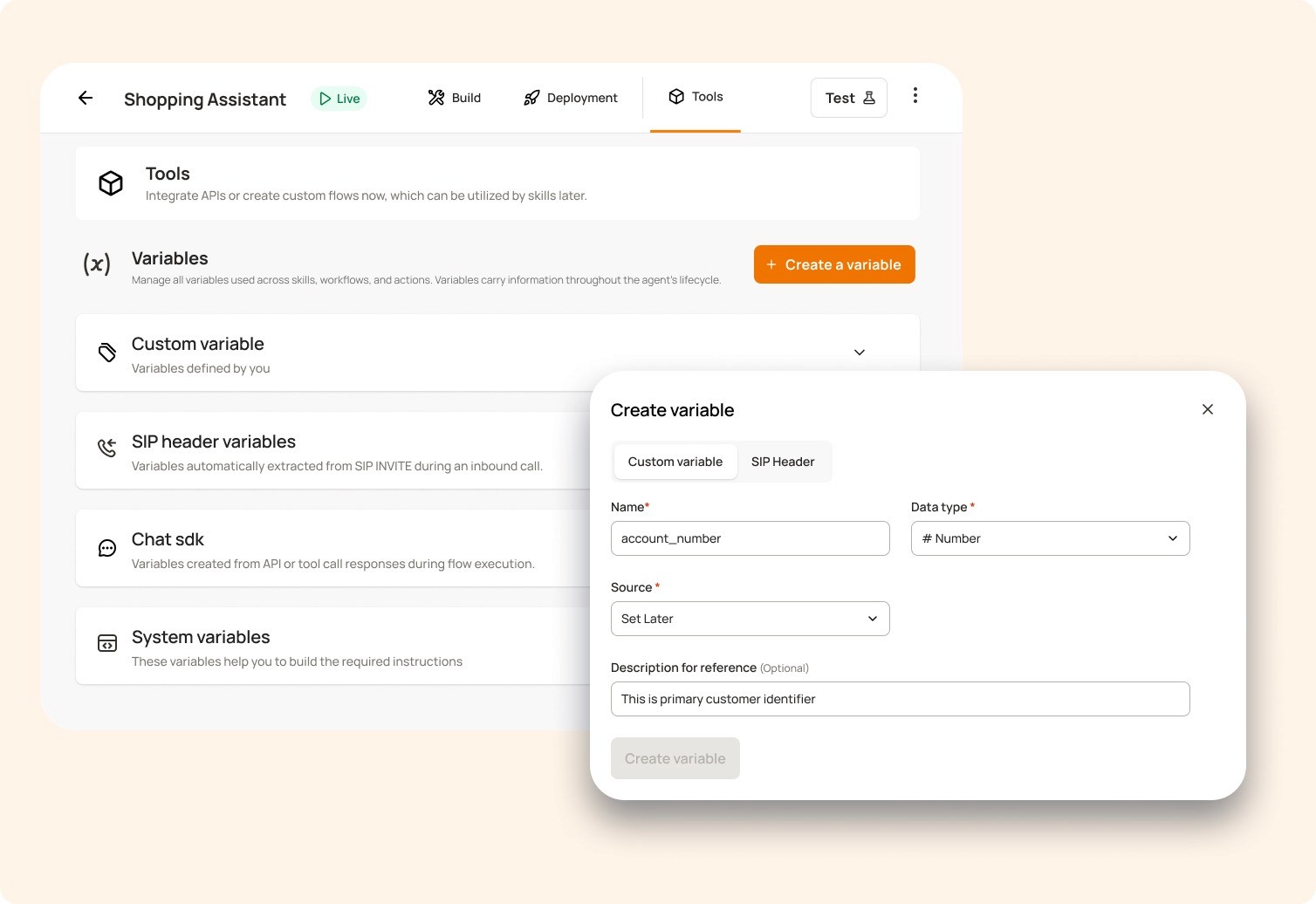
From Broken Handoffs to Single-Session Resolutions: The Value of Variable Management
Standardizing the continuous customer data layer allows enterprise CX teams to build highly sophisticated, frictionless multi-step customer journeys. Here are a few ways teams could leverage Level AI’s variable management to improve their customer experiences at scale:
Personalizing greetings and routing from the start of a call
Instead of forcing callers to type in an account number just to get started, the virtual agent instantly reads the incoming phone signal. Our platform matches that number against your CRM records to find the customer’s name and account tier even before the conversation even begins to greet the caller by name and route them to a specialized workflow.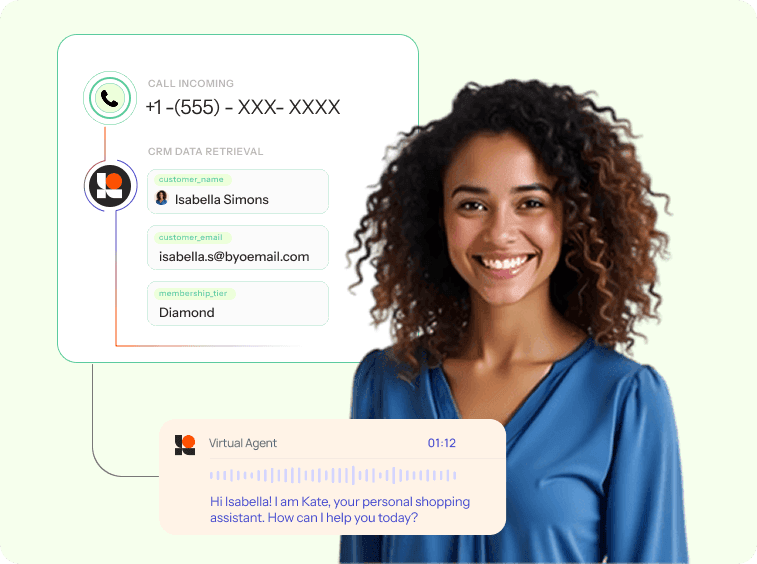
Connecting tools to complete complex tasks without data gaps
Many customer requests require multiple applications to work together. For example, a customer might want to modify an order, which requires checking an inventory tool and then creating a ticket in a CRM.
With persistent memory, the virtual agent can look up a booking ID in your database and automatically carry that exact number over to fill out fields in the CRM. Because the system passes data seamlessly across platforms, our virtual agents can resolve complex, multi-step transactions in a single session.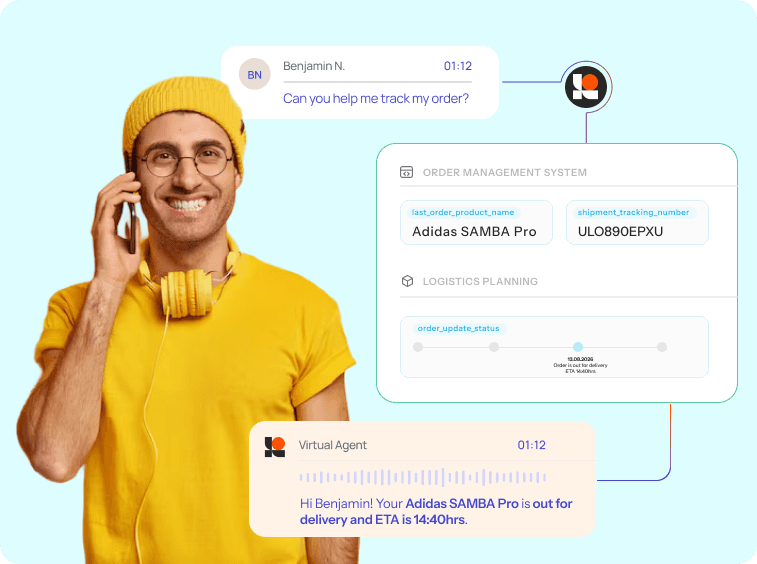
Extracting post-call data to update customer records automatically
Once the call ends, a central processing step reviews the complete conversation transcript and identifies the final resolution details.Our platform pulls these relevant details out of the call transcript and automatically saves them into your global customer data fields. This updates your CRM instantly, ensuring your team has accurate customer history for future interactions without requiring agents to spend time typing up manual notes.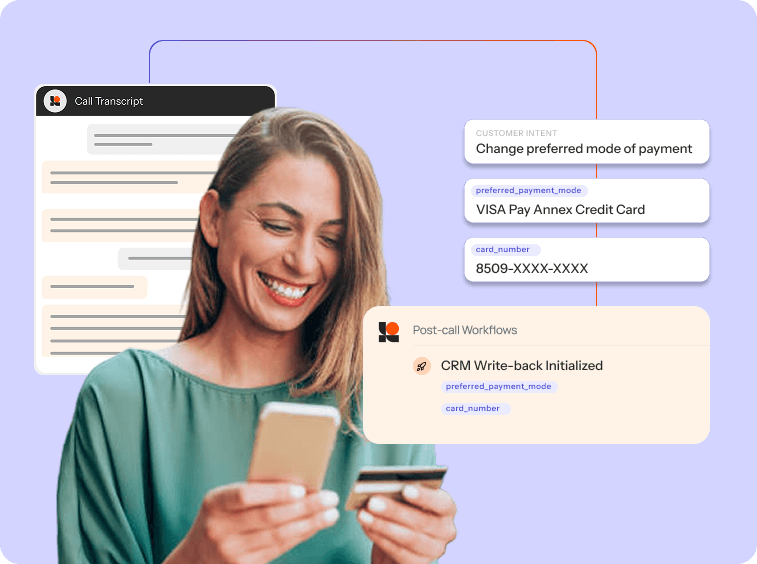
The ultimate value of a continuous data layer is operational flexibility. By giving the virtual agent a dependable memory, we enable CX leaders to easily automate complex customer journeys that used to require a live agent. This allows businesses to scale support efficiently while giving customers the fast, effortless service they expect.
The Level AI Advantage: Built-In Persistent Memory, Hallucination-Free Mapping, Live Guardrails
While many conventional platforms use unstructured isolated data points within any workflow to track customer details, we’ve built persistent memory directly within our architecture. Here’s how this structural difference matters for enterprise teams:
Inline variable creation keeps virtual agent building fast and uninterrupted
Instead of forcing teams to define isolated data fields in a separate settings menu, Level AI allows developers to set up and assign variables directly inside the current agent creation step. This enables teams to design and activate complex workflows continuously without wasting time switching menus.Direct database matching removes the risk of AI hallucinations
Instead of relying on loose instructions for the AI to guess or remember details, Level AI maps variables directly to verified business software records. Ensuring that the data is accurate, preventing the AI from making up incorrect customer information.Automated guardrails prevent updates from breaking your agents in production
In legacy tools, deleting or changing a data field can accidentally break active customer service lines. Level AI automatically scans the configuration and flags every impacted step before a builder saves changes. The result? Teams can optimize workflows confidently without the risk of causing unexpected live outages.
Persistent conversation memory shapes the future of contact center automation
The long-term value of conversational AI depends entirely on data infrastructure. As virtual agents assume more complex, cross-platform responsibilities, the ability to maintain unbroken context becomes the baseline requirement for true automation maturity.
Achieving this requires moving away from fragmented, step-by-step logic toward a unified data layer. When enterprises treat conversation memory as core infrastructure rather than an afterthought, they can finally bridge the gap between complex backend systems and seamless customer experiences.
" transform="translate(85.643 10.143)" width="23.725855670103115px"/><path d="M 71.828 0 L 0 50.702" fill="transparent" height="50.70235051546392px" id="TnJFUMH9b" stroke-dasharray="" stroke-linecap="butt" stroke-linejoin="miter" stroke-miterlimit="10" stroke-width="0.68" stroke="rgb(254, 250, 241)" transform="translate(85.508 75.029)" width="71.82828865979384px"/><path d="M 81.579 0 L 0 52.003" fill="transparent" height="52.00280412371134px" id="ccJzhVTGI" stroke-dasharray="" stroke-linecap="butt" stroke-linejoin="miter" stroke-miterlimit="10" stroke-width="0.68" stroke="rgb(254, 250, 241)" transform="translate(85.495 73.738)" width="81.57921649484533px"/><path d="M 65.653 0 L 0 32.827" fill="transparent" height="32.826556701030924px" id="X0Vp_q8HG" stroke-dasharray="" stroke-linecap="butt" stroke-linejoin="miter" stroke-miterlimit="10" stroke-width="0.68" stroke="rgb(254, 250, 241)" transform="translate(85.462 92.931)" width="65.65311340206183px"/><path d="M 88.08 14.951 L 0 0" fill="transparent" height="14.950762886597914px" id="JM_UgSiJ_" stroke-dasharray="" stroke-linecap="butt" stroke-linejoin="miter" stroke-miterlimit="10" stroke-width="0.68" stroke="rgb(254, 250, 241)" transform="translate(86.233 125.789)" width="88.07950515463914px"/><path d="M 83.204 72.803 L 0 0" fill="transparent" height="72.80313402061856px" id="KlyUUjlMK" stroke-dasharray="" stroke-linecap="butt" stroke-linejoin="miter" stroke-miterlimit="10" stroke-width="0.68" stroke="rgb(254, 250, 241)" transform="translate(85.089 125.71)" width="83.20379381443304px"/><path d="M 7.8 114.081 L 0 0" fill="transparent" height="114.08065979381445px" id="kAiUvduBR" stroke-dasharray="" stroke-linecap="butt" stroke-linejoin="miter" stroke-miterlimit="10" stroke-width="0.68" stroke="rgb(254, 250, 241)" transform="translate(85.95 125.478)" width="7.800247422680428px"/><path d="M 0 93.604 L 9.75 0" fill="transparent" height="93.60445360824741px" id="FsgTAQB0n" stroke-dasharray="" stroke-linecap="butt" stroke-linejoin="miter" stroke-miterlimit="10" stroke-width="0.68" stroke="rgb(254, 250, 241)" transform="translate(76.2 125.421)" width="9.750432989690694px"/><path d="M 0 76.379 L 76.703 0" fill="transparent" height="76.37888659793816px" id="NxOhHvPJ5" stroke-dasharray="" stroke-linecap="butt" stroke-linejoin="miter" stroke-miterlimit="10" stroke-width="0.68" stroke="rgb(254, 250, 241)" transform="translate(9.343 125.217)" width="76.7034556701031px"/><path d="M 0 26.651 L 39.002 0" fill="transparent" height="26.651381443298988px" id="QETNKJ3L6" stroke-dasharray="" stroke-linecap="butt" stroke-linejoin="miter" stroke-miterlimit="10" stroke-width="0.68" stroke="rgb(254, 250, 241)" transform="translate(47.096 125.177)" width="39.0017319587629px"/><path d="M 0 16.901 L 85.154 0" fill="transparent" height="16.900948453608265px" id="BL63wDICD" stroke-dasharray="" stroke-linecap="butt" stroke-linejoin="miter" stroke-miterlimit="10" stroke-width="0.68" stroke="rgb(254, 250, 241)" transform="translate(0.094 125.125)" width="85.15396503092786px"/><path d="M 0 0 L 78.004 17.876" fill="transparent" height="17.875793814432996px" id="PIX70Vlqf" stroke-dasharray="" stroke-linecap="butt" stroke-linejoin="miter" stroke-miterlimit="10" stroke-width="0.68" stroke="rgb(254, 250, 241)" transform="translate(8.362 107.251)" width="78.00376082474227px"/><path d="M 0 0 L 67.928 52.327" fill="transparent" height="52.32742268041238px" id="u_syqWqWD" stroke-dasharray="" stroke-linecap="butt" stroke-linejoin="miter" stroke-miterlimit="10" stroke-width="0.68" stroke="rgb(254, 250, 241)" transform="translate(17.593 72.861)" width="67.92826391752578px"/><path d="M 0 0 L 77.029 70.528" fill="transparent" height="70.52832989690722px" id="DmW_aE2A0" stroke-dasharray="" stroke-linecap="butt" stroke-linejoin="miter" stroke-miterlimit="10" stroke-width="0.68" stroke="rgb(254, 250, 241)" transform="translate(9.489 54.678)" width="77.02866804123713px"/><path d="M 0 0 L 27.301 126.431" fill="transparent" height="126.43109443298971px" id="JrLaRUubC" stroke-dasharray="" stroke-linecap="butt" stroke-linejoin="miter" stroke-miterlimit="10" stroke-width="0.68" stroke="rgb(254, 250, 241)" transform="translate(58.341 -0.071)" width="27.30111340206188px"/><path d="M 0 4.012 C 0 1.796 1.796 0 4.012 0 C 6.228 0 8.025 1.796 8.025 4.012 C 8.025 6.228 6.228 8.025 4.012 8.025 C 1.796 8.025 0 6.228 0 4.012 Z" fill="rgb(254, 80, 0)" height="8.024669690721652px" id="Nh5qrPJs_" transform="translate(81.396 121.369)" width="8.024669690721623px"/></svg>)
Frequently asked questions
What is agent memory in AI, and how is it different from a context window?
A context window is the amount of text a model can process in a single pass. Agent memory is the system that decides what gets written down, stored, and pulled back into that window later across turns, tools, and sessions. Retrieval-Augmented Generation (RAG), persistent memory rely on external knowledge retrieval rather than the model's built-in context window. A model can have a huge context window and still have no real memory if nothing persists once the conversation ends.
Why do AI agents forget things mid-conversation even in the same chat?
Most agents are stateless by default. Every turn is processed fresh, with only a rolling window of recent messages carried forward. Once a detail scrolls out of that window or gets summarized away, the agent has no reliable way to recall it unless it was explicitly saved as a structured variable. This is one of the reasons modern AI customer service agents combine language models with external memory and business systems instead of relying only on conversation history.
How do AI agents remember information across multiple sessions or channels?
This requires long-term memory, typically backed by a database, variable store, or vector index that persists outside the chat transcript. When a customer returns through a different channel, the agent retrieves their stored profile instead of relying on the model to remember the previous conversation. This architecture is common in modern AI virtual agents, where persistent memory is combined with enterprise data to deliver consistent customer experiences.
What's the difference between short-term and long-term memory in AI agents?
Short-term memory holds the working context for the current interaction, including recent conversation turns, active tool outputs, and in-progress task state. Long-term memory persists facts such as customer names, preferences, and case history across sessions so the agent doesn't start from zero every time. This distinction becomes especially important when designing scalable AI agent architectures for enterprise customer support.
Can AI agent memory cause hallucinations, and how do you prevent that?
Yes. If an agent is left to remember data from unstructured chat history, it can misremember or invent details such as order IDs or account balances. As discussed in our guide on AI hallucinations, the best approach is to map memory directly to verified systems of record such as CRMs and databases instead of trusting the model to recall critical information from previous conversations.