
Key takeaways
Customer experience management software connects conversation data, quality scoring, and customer feedback into one operational view instead of three disconnected tools.
AI now scores 100 percent of interactions on leading platforms, replacing the 1 to 2 percent manual sampling that most QA programs ran on for two decades.
The strongest platforms combine conversation intelligence, automated quality assurance, real-time agent assist, and voice of the customer analytics on the same data set.
Enterprise platforms like Medallia, Qualtrics, and Verint carry deep survey and workforce engagement capabilities but depend on manual configuration and, in many cases, post-interaction survey data with low response rates.
Level AI, CallMiner, and NICE CXone lead the category for contact centers that need conversation-level analytics tied directly to agent coaching and customer insight.
Match the platform to your contact center's interaction volume and existing tech stack before comparing feature lists. A platform built for a 50-agent team and one built for a 5,000-agent enterprise solve different problems.
Introduction
Customer expectations have changed dramatically. It’s no longer enough to resolve tickets quickly or keep wait times low. Today’s leading businesses compete on the quality of every customer interaction. Whether issues are resolved on the first contact, agents have the right context, and every conversation contributes to a better experience. The right customer experience platform helps organizations deliver consistent, personalized support while turning customer feedback and interactions into measurable business outcomes.
Two things changed the math. First, AI models now read and score every conversation a contact center handles, rather than a sampled slice of it. Second, agents receive real-time context during a live call rather than a coaching note three days later. Both shifts move customer experience management from a reporting function to an operational one that shapes what happens on the very next call.
This guide ranks the 10 customer experience management platforms contact centers rely on in 2026. Each entry covers what the platform does, its strengths, its limitations, and who it fits. You will also find a breakdown of the features that separate a genuine CXM platform from a ticketing tool with an analytics dashboard bolted on, plus a straight answer to how CXM software differs from CRM and customer service tools.
What Is Customer Experience Management (CXM) Software?
Customer experience management software collects, analyzes, and acts on data from every customer interaction, across calls, chats, emails, and social channels, and turns that data into a measurable view of satisfaction, effort, and intent. Instead of a single ticket or a single call, Customer Experience Management software looks at the full arc of how a customer experiences a company over time.
That distinguishes it from a CRM, which stores customer records and transaction history, and from customer service software, which manages the mechanics of resolving a support request. A CRM answers “what did this customer buy and when.” Customer service software answers “how do we close this ticket?” CXM software answers a different question: why did this interaction go well or badly, and what does that reveal about the product, the process, or the agent?
Contact centers need a dedicated CXM platform because interaction volume makes manual review impossible past a certain scale. A team handling 50,000 calls a month cannot read transcripts one at a time to find the three product issues driving half of their contact volume. CXM platforms apply language models to every interaction to surface those patterns, score quality, and flag risk in near real time, work that would take a QA team months to do by hand.
Why Do Contact Centers Need Customer Experience Software?
Improve CSAT, NPS, and CES. Post-interaction surveys capture a fraction of the picture. Survey response rates for contact centers fall between 1 and 10 percent, and the responses skew toward the extremes: customers who are very happy or very frustrated respond, while the quiet majority in between does not. Inferred satisfaction scoring built directly into conversation analysis scores every interaction instead of only the ones a customer chooses to rate.
Gain real-time customer insights. Waiting on a monthly survey report to learn that a shipping policy change is driving complaints costs a business weeks of avoidable contact volume. Customer Experience Management software surfaces emerging issues as they appear in conversations, before they show up in a survey summary.
Automate quality assurance. Manual QA programs score 1 to 2 percent of calls because that is what a human team reviews in a working day. Automated QA scores every call against the same rubric, applying it consistently across agents, shifts, and locations.
Coach agents with AI. Coaching that arrives a week after a difficult call has already lost its relevance to the agent. Coaching tied directly to specific, timestamped moments in a recent conversation gives managers something concrete to work from and gives agents a reason to act on it.
Reduce churn and increase loyalty. A customer who has to explain their problem twice, or who gets passed between three agents, forms an opinion about the company that a single follow-up survey will not capture. CXM data connects those friction points to downstream churn.
Improve operational efficiency. Contact centers that automate quality review free up QA staff to spend their time on coaching and root-cause analysis instead of manual scoring, and agents get answers faster instead of placing customers on hold to search a knowledge base.
Key Features to Look for in Customer Experience Software
AI-powered conversation intelligence. The platform should turn every call, chat, and email into structured data: reason for contact, resolution, effort, and sentiment, without requiring your team to build keyword libraries by hand.
Voice of Customer (VoC) analytics. Look for a system that pulls signal from unstructured conversations instead of structured survey fields alone. Voice of the customer software that only ingests survey responses misses everything a customer says outside of that survey.
Quality assurance automation. The platform should score 100 percent of interactions against your actual rubric, with an explanation and supporting quotes attached to every score, not a black-box number.
Sentiment and emotion analysis. A platform that only classifies conversations as positive or negative misses the difference between mild frustration and genuine anger. Look for models that detect specific emotions and weight them by where they occur in the conversation.
Omnichannel support. Customers move between phone, chat, and email within the same issue. The platform needs to track that journey as one thread, not three disconnected records.
Real-time agent assistance. Live guidance during a call, drawing on the knowledge base and prior interaction history, changes what happens on that specific call instead of only informing a report generated afterward.
Customer journey analytics. The software should connect individual interactions into a full journey view, so a manager sees where a customer’s experience broke down across multiple touchpoints instead of within a single call.
Workflow automation. Escalation rules, alert routing, and coaching assignment should trigger automatically based on what the AI detects, rather than requiring a manager to review dashboards manually to catch problems.
CRM and CCaaS integrations. The platform needs to connect to your existing telephony and customer record systems directly. A CXM tool that operates in isolation from your CRM data loses the context that makes its scoring useful.
Compliance monitoring and reporting. For regulated industries, the platform should flag compliance violations automatically and produce audit-ready reports, backed by GDPR, HIPAA, PCI, and ISO 27001 compliance at the infrastructure level.
Let’s Compare Top Customer Experience Management Platforms
The table below compares the 10 platforms on deployment model, conversation intelligence depth, and trial availability. Most enterprise Customer Experience Management vendors sell through a demo and custom quote rather than a public free trial, which reflects the complexity of onboarding a system that touches live customer conversations.
Software | Best For | Deployment | AI Features | Free Trial |
Level AI | Full-stack AI customer experience platform | Cloud | 100% automated scoring, real-time assist, iCSAT, VoC | Demo |
Qualtrics | Enterprise voice of customer programs | Cloud | Predictive analytics, text analytics | Demo |
Medallia | Enterprise experience management | Cloud | Text analytics, journey mapping | Demo |
Verint | Workforce engagement and quality management | Cloud/On-prem | Speech analytics, WFM automation | Demo |
NICE CXone | Large enterprise omnichannel contact centers | Cloud | Interaction analytics, AI routing | Demo |
CallMiner | Conversation intelligence and speech analytics | Cloud | Speech-to-text analytics, categorization | Demo |
Genesys Cloud CX | Omnichannel contact center operations | Cloud | Predictive routing, journey analytics | Free trial |
Sprinklr Service | Customer engagement across digital and social channels | Cloud | Unified inbox AI, sentiment detection | Demo |
Zendesk | Ticketing and support for growing teams | Cloud | AI ticket routing, agent copilot | Free trial |
Gladly | Personalized customer service | Cloud | Customer timeline AI, sentiment routing | Demo |
Top 10 Customer Experience Software for Contact Centers
1. Level AI: Best Overall AI-Powered Customer Experience Platform
Level AI runs quality assurance, voice of the customer analytics, real-time agent assist, and coaching on the same conversation data, so a QA score, a coaching recommendation, and a customer insight all trace back to the same underlying interaction instead of three disconnected reports. The platform analyzes calls, chats, emails, and SMS across 100 percent of volume, and its natural language models pinpoint intent and key moments with twice the accuracy of legacy phrase-based systems, with zero setup required to start.
Key Features
QA-GPT scores 100 percent of interactions with over 90 percent agreement with expert human QA reviewers, 6 times faster than manual review
Inferred CSAT (iCSAT) scores customer satisfaction across every interaction without a post-call survey
Real-time agent assist surfaces knowledge base articles and policy answers during live calls, cutting hold time by 40 percent
Manager Assist gives supervisors live sentiment alerts and one-click coach, whisper, and escalate controls
Custom scorecards built by typing rubric questions in plain language, with a sandbox to validate accuracy before rollout
Live agent coaching plans tied directly to specific, timestamped moments from real conversations
GDPR, HIPAA, PCI, and ISO 27001 compliant infrastructure
“We’ve gone from manually scoring 1–2% of our calls to using Level AI to score 100% of our calls.”
— Angela Zander, Director of Operations, QuinStreet
Strengths
Scores 100 percent of interactions instead of the 1 to 2 percent typical of manual QA sampling
Quality scores, coaching, and customer insight run on the same conversation data, so a manager does not switch tools to connect a QA finding to a coaching action
Reduces manual QA effort by up to 90 percent and cuts new-hire training time by 50 percent
Erin Tillery, Sr. Service Excellence Manager at Affirm, reported the platform “removed all of the manual and tedious work from the QA auditors’ plates and gave them time to focus on training, coaching, and helping agents”
CMP Research named Level AI a Prism Pioneer in Customer Analytics for 2025
Best For
Mid-market and enterprise contact centers that want quality assurance, agent coaching, and customer insight running on one data set instead of three separate systems, and that have outgrown manual call sampling.
" transform="translate(85.643 10.143)" width="23.725855670103115px"/><path d="M 71.828 0 L 0 50.702" fill="transparent" height="50.70235051546392px" id="TnJFUMH9b" stroke-dasharray="" stroke-linecap="butt" stroke-linejoin="miter" stroke-miterlimit="10" stroke-width="0.68" stroke="rgb(254, 250, 241)" transform="translate(85.508 75.029)" width="71.82828865979384px"/><path d="M 81.579 0 L 0 52.003" fill="transparent" height="52.00280412371134px" id="ccJzhVTGI" stroke-dasharray="" stroke-linecap="butt" stroke-linejoin="miter" stroke-miterlimit="10" stroke-width="0.68" stroke="rgb(254, 250, 241)" transform="translate(85.495 73.738)" width="81.57921649484533px"/><path d="M 65.653 0 L 0 32.827" fill="transparent" height="32.826556701030924px" id="X0Vp_q8HG" stroke-dasharray="" stroke-linecap="butt" stroke-linejoin="miter" stroke-miterlimit="10" stroke-width="0.68" stroke="rgb(254, 250, 241)" transform="translate(85.462 92.931)" width="65.65311340206183px"/><path d="M 88.08 14.951 L 0 0" fill="transparent" height="14.950762886597914px" id="JM_UgSiJ_" stroke-dasharray="" stroke-linecap="butt" stroke-linejoin="miter" stroke-miterlimit="10" stroke-width="0.68" stroke="rgb(254, 250, 241)" transform="translate(86.233 125.789)" width="88.07950515463914px"/><path d="M 83.204 72.803 L 0 0" fill="transparent" height="72.80313402061856px" id="KlyUUjlMK" stroke-dasharray="" stroke-linecap="butt" stroke-linejoin="miter" stroke-miterlimit="10" stroke-width="0.68" stroke="rgb(254, 250, 241)" transform="translate(85.089 125.71)" width="83.20379381443304px"/><path d="M 7.8 114.081 L 0 0" fill="transparent" height="114.08065979381445px" id="kAiUvduBR" stroke-dasharray="" stroke-linecap="butt" stroke-linejoin="miter" stroke-miterlimit="10" stroke-width="0.68" stroke="rgb(254, 250, 241)" transform="translate(85.95 125.478)" width="7.800247422680428px"/><path d="M 0 93.604 L 9.75 0" fill="transparent" height="93.60445360824741px" id="FsgTAQB0n" stroke-dasharray="" stroke-linecap="butt" stroke-linejoin="miter" stroke-miterlimit="10" stroke-width="0.68" stroke="rgb(254, 250, 241)" transform="translate(76.2 125.421)" width="9.750432989690694px"/><path d="M 0 76.379 L 76.703 0" fill="transparent" height="76.37888659793816px" id="NxOhHvPJ5" stroke-dasharray="" stroke-linecap="butt" stroke-linejoin="miter" stroke-miterlimit="10" stroke-width="0.68" stroke="rgb(254, 250, 241)" transform="translate(9.343 125.217)" width="76.7034556701031px"/><path d="M 0 26.651 L 39.002 0" fill="transparent" height="26.651381443298988px" id="QETNKJ3L6" stroke-dasharray="" stroke-linecap="butt" stroke-linejoin="miter" stroke-miterlimit="10" stroke-width="0.68" stroke="rgb(254, 250, 241)" transform="translate(47.096 125.177)" width="39.0017319587629px"/><path d="M 0 16.901 L 85.154 0" fill="transparent" height="16.900948453608265px" id="BL63wDICD" stroke-dasharray="" stroke-linecap="butt" stroke-linejoin="miter" stroke-miterlimit="10" stroke-width="0.68" stroke="rgb(254, 250, 241)" transform="translate(0.094 125.125)" width="85.15396503092786px"/><path d="M 0 0 L 78.004 17.876" fill="transparent" height="17.875793814432996px" id="PIX70Vlqf" stroke-dasharray="" stroke-linecap="butt" stroke-linejoin="miter" stroke-miterlimit="10" stroke-width="0.68" stroke="rgb(254, 250, 241)" transform="translate(8.362 107.251)" width="78.00376082474227px"/><path d="M 0 0 L 67.928 52.327" fill="transparent" height="52.32742268041238px" id="u_syqWqWD" stroke-dasharray="" stroke-linecap="butt" stroke-linejoin="miter" stroke-miterlimit="10" stroke-width="0.68" stroke="rgb(254, 250, 241)" transform="translate(17.593 72.861)" width="67.92826391752578px"/><path d="M 0 0 L 77.029 70.528" fill="transparent" height="70.52832989690722px" id="DmW_aE2A0" stroke-dasharray="" stroke-linecap="butt" stroke-linejoin="miter" stroke-miterlimit="10" stroke-width="0.68" stroke="rgb(254, 250, 241)" transform="translate(9.489 54.678)" width="77.02866804123713px"/><path d="M 0 0 L 27.301 126.431" fill="transparent" height="126.43109443298971px" id="JrLaRUubC" stroke-dasharray="" stroke-linecap="butt" stroke-linejoin="miter" stroke-miterlimit="10" stroke-width="0.68" stroke="rgb(254, 250, 241)" transform="translate(58.341 -0.071)" width="27.30111340206188px"/><path d="M 0 4.012 C 0 1.796 1.796 0 4.012 0 C 6.228 0 8.025 1.796 8.025 4.012 C 8.025 6.228 6.228 8.025 4.012 8.025 C 1.796 8.025 0 6.228 0 4.012 Z" fill="rgb(254, 80, 0)" height="8.024669690721652px" id="Nh5qrPJs_" transform="translate(81.396 121.369)" width="8.024669690721623px"/></svg>)
2. Qualtrics: Best Enterprise Voice of Customer Platform
Qualtrics built its name on experience management surveys and remains one of the most widely deployed voice of customer tools in large enterprises. The platform collects feedback through post-call, post-transaction, email, and IVR surveys, then applies predictive analytics and text analytics to identify themes across responses.
Customers use Qualtrics for structured feedback collection at a company-wide level, spanning customer experience, employee experience, and product experience programs under one contract. That breadth makes it a common choice for enterprises that already run cross-functional experience programs beyond the contact center.
Key Features
Survey design and distribution across call, email, SMS, and IVR channels
Predictive analytics that model the drivers behind satisfaction scores
Text analytics for topic and sentiment classification within survey comments
Cross-program dashboards spanning customer, employee, and product experience
Enterprise-grade role-based access and governance controls
Best For
Enterprises that want a single platform to run customer, employee, and product experience surveys across the entire organization rather than the contact center alone.
3. Medallia: Best Enterprise Customer Experience Management Platform
Medallia is one of the longest-standing names in enterprise experience management, built around collecting feedback across the customer journey and applying text analytics to surface patterns. Contact centers use Medallia to run structured VoC programs alongside broader company-wide experience initiatives spanning retail, hospitality, and financial services.
The platform’s text analytics engine breaks survey comments and interaction data into topics and subtopics, though building that taxonomy to match a specific business requires manual configuration and ongoing tuning.
Key Features
Journey mapping across digital, voice, and in-person touchpoints
Text analytics with topic and subtopic classification
Case management for closing the loop on flagged feedback
Integration options for consolidating data from CRM and other survey tools
Executive dashboards for company-wide experience reporting
Best For
Large enterprises running company-wide experience programs across retail, hospitality, or travel, where the contact center is one channel among several being measured.
4. Verint: Best for Workforce Engagement and Quality Management
Verint combines workforce engagement management with quality monitoring and speech analytics, targeting large contact centers that want scheduling, forecasting, and QA under one vendor. The platform has deep roots in workforce management, and its quality and analytics modules extend that base rather than replacing it.
Verint deploys in both cloud and on-premises environments, which keeps it in consideration for regulated industries with data residency requirements that rule out pure cloud alternatives.
Key Features
Workforce management: scheduling, forecasting, and adherence tracking
Speech and text analytics for interaction categorization
Quality management scorecards with sampling and full-coverage options
On-premises deployment option alongside cloud
Compliance recording for regulated industries
Best For
Large enterprise or regulated contact centers that want workforce management and quality monitoring from a single vendor, including teams with on-premises deployment requirements.
5. NICE CXone
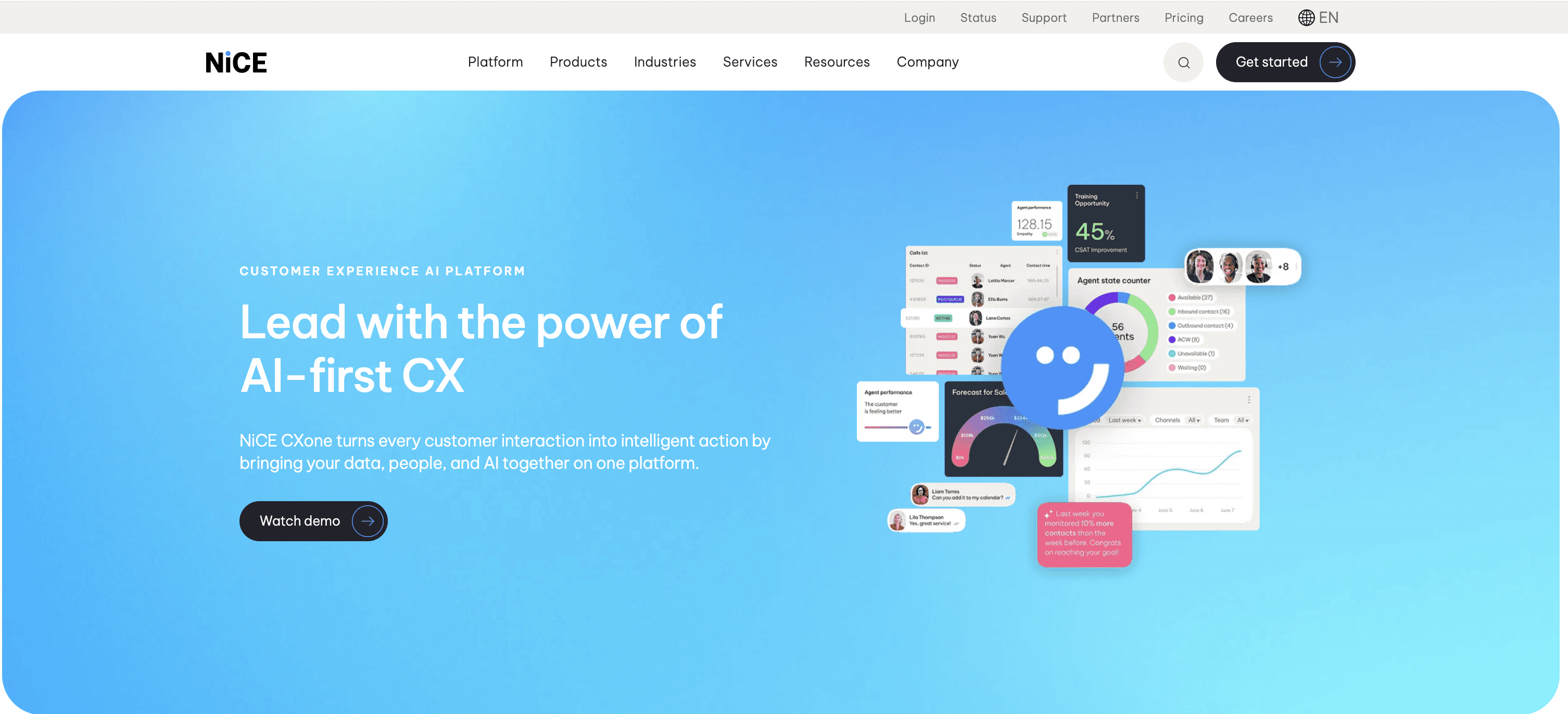
NICE CXone is a full contact center platform spanning routing, workforce management, analytics, and digital engagement, built for large enterprises running high interaction volume across many channels. The platform’s interaction analytics module scores and categorizes conversations, feeding into its broader routing and workforce management systems.
Because CXone functions as a complete CCaaS suite rather than a point analytics tool, contact centers already running their telephony and routing on NICE gain the most from adding its analytics layer on top.
Key Features
Cloud contact center platform with omnichannel routing
Interaction analytics for conversation scoring and categorization
AI-based predictive routing that matches customers to agents
Workforce management and scheduling built into the same suite
Extensive third-party integration marketplace
Best For
Large enterprise contact centers replacing their entire CCaaS stack, telephony, routing, workforce management, and analytics, under one vendor.
See how contact center AI solutions compare across platforms
6. CallMiner: Best for Conversation Intelligence and Speech Analytics
CallMiner has specialized in speech and conversation analytics for more than two decades, with a particular strength in regulatory compliance monitoring for financial services, healthcare, and insurance. The platform processes high call volumes and categorizes them across a large number of custom dimensions, appealing to organizations with dedicated analytics teams.
That depth comes with a configuration cost. Getting full value from CallMiner’s categorization engine generally requires either an in-house analyst or a professional services engagement to build out the taxonomy correctly.
Key Features
Speech-to-text analytics across large call volumes
Custom categorization across compliance, quality, and performance dimensions
Compliance monitoring built for regulated industries
Coaching and performance modules added in recent releases
Real-time analytics for select use cases
Best For
Regulated industries with dedicated analytics teams that need deep, customizable speech analytics for compliance monitoring at high call volume.
Compare CallMiner and Level AI directly
7. Genesys Cloud CX: Best Omnichannel Contact Center Platform
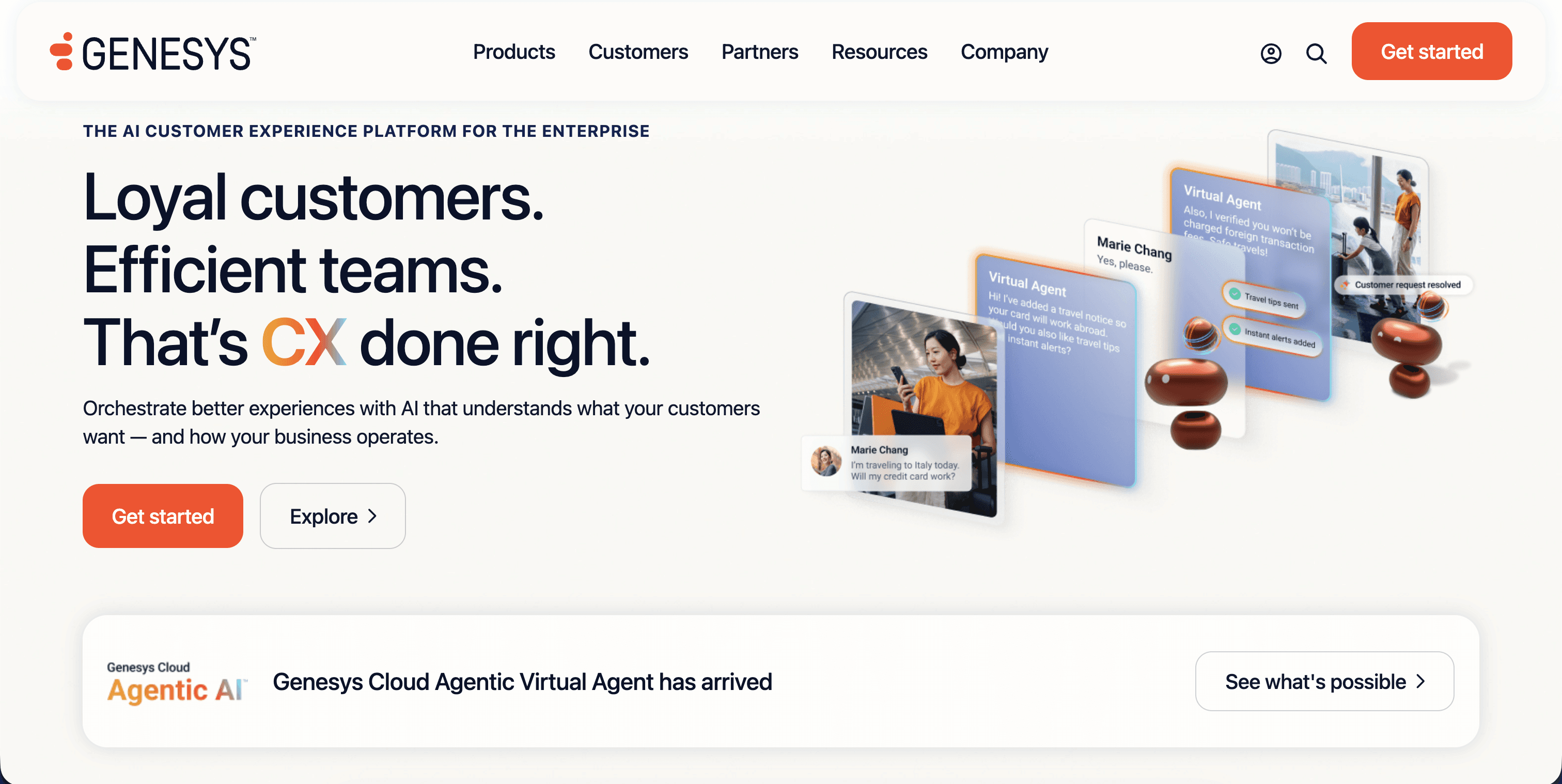
Genesys Cloud CX is a cloud contact center platform built around omnichannel routing, journey orchestration, and a broad app marketplace. Contact centers use Genesys to unify voice, chat, email, and social interactions under one routing engine, with journey analytics that track a customer across channels within a single case.
Genesys offers a public free trial, which sets it apart from most enterprise CXM and CCaaS vendors that sell exclusively through demos and custom quotes.
Key Features
Omnichannel routing across voice, chat, email, and social
Predictive engagement and journey analytics
AppFoundry marketplace with hundreds of third-party integrations
Workforce engagement management module
Public free trial for smaller teams to test the platform directly
Best For
Contact centers that want a single cloud routing and engagement platform across channels, with the option to trial the platform directly before a full enterprise commitment.
Read our omnichannel contact center comparison guide
8. Sprinklr Service: Best Unified Customer Experience Platform
Sprinklr Service consolidates social media, chat, email, and voice interactions into a single agent inbox, positioning itself around brands with a heavy social and digital support volume. The platform’s AI classifies incoming messages by intent and sentiment and routes them to the right team, combining social listening with case management in one interface.
Sprinklr’s origin in social media management still shows in its strongest features: brands with significant Twitter, Instagram, or review-site volume get more value from the platform than contact centers running primarily voice.
Key Features
Unified inbox combining social, chat, email, and voice channels
AI-based message classification and routing by intent and sentiment
Social listening integrated directly into case management
Analytics dashboards spanning brand and case-level metrics
Multi-brand and multi-market support for global enterprises
Best For
Large enterprises with high social media and digital engagement volume that want case management and social listening in one workspace.
Explore AI tools for customer service in the contact center
9. Zendesk: Best Customer Service Platform for Growing Teams
Zendesk is a ticketing and support platform built for teams managing customer requests across email, chat, and voice. Agents use Zendesk as their primary workspace to see a customer’s history and resolve a ticket, and the platform offers a public free trial, making it accessible to growing teams without an enterprise sales cycle.
Zendesk functions as a ticketing and case management system rather than a dedicated customer experience analytics platform. Contact centers running Zendesk for agent workflows commonly pair it with a conversation intelligence layer to score quality and surface customer insight, since Zendesk integrates directly with platforms like Level AI to bring conversational data and agent assist functionality into the same workspace.
Key Features
Ticketing system with multi-channel support: email, chat, voice, and social
AI-based ticket routing and suggested responses
Knowledge base and help center tools
Reporting on ticket volume, resolution time, and agent performance
Broad marketplace of app integrations
Best For
Growing support teams that need an accessible, well-integrated ticketing platform and plan to add dedicated quality and insight tools as they scale.
See how AI customer service agents extend platforms like Zendesk
10. Gladly: Best Personalized Customer Service Platform
Gladly organizes customer service around the person rather than the ticket, keeping a single, continuous conversation thread for each customer across every channel they use. Agents see a customer’s full history in one timeline instead of a stack of separate tickets, a structure built for brands that prioritize personalized, high-touch support.
Gladly connects natively with conversation intelligence platforms including Level AI, allowing contact centers to keep Gladly as the agent-facing workspace while running quality scoring and customer insight through a dedicated analytics layer.
Key Features
Customer timeline that unifies every channel into one continuous conversation
AI-based sentiment and intent routing
Voice, chat, email, and SMS support in one interface
Native integrations with conversation intelligence and QA platforms
Focus on agent-customer relationship continuity across interactions
Best For
Consumer and retail brands that want a person-centered agent workspace and plan to pair it with a dedicated quality and insight platform.
How to Choose the Right Customer Experience Software?
Evaluate your business size and contact center volume. A platform built for a 5,000-agent enterprise carries configuration overhead that a 50-agent team does not need, and the reverse is true as well: a lightweight tool will not hold up at high interaction volume.
Define your customer experience goals. Decide whether the priority is closing the survey response gap, automating quality review, or giving agents real-time guidance during calls, since different platforms lead with different strengths.
Assess AI and automation capabilities. Ask whether the platform scores 100 percent of interactions or still depends on manual sampling, and whether its language models understand intent or only match keywords.
Review analytics and reporting features. Confirm that scores and insights come with an explanation and supporting evidence from the conversation, rather than a number on a dashboard alone.
Check integration with your existing tech stack. Confirm the platform connects directly to your CCaaS, CRM, and workforce management systems before signing a contract, since data trapped in a separate system loses much of its value.
Compare pricing and scalability. Understand what happens to cost as you add agents, channels, or interaction volume, beyond the starting price alone.
Consider implementation time and support. Ask vendors directly how long it takes to go live with full production data, and what support looks like after the initial rollout, since post-launch responsiveness varies widely across this category.
Customer Experience Software vs. Customer Service Software
Customer Experience Software | Customer Service Software |
Analyzes the entire customer journey | Resolves individual support requests |
Includes VoC, QA, analytics, and AI scoring | Includes ticketing, chat, and knowledge base |
Measures long-term customer satisfaction | Measures support efficiency and resolution time |
Surfaces patterns for proactive improvement | Handles reactive, one-at-a-time support |
Contact centers commonly run both categories together: a ticketing platform like Zendesk manages the agent workflow, while a CXM platform analyzes the conversations happening inside it to surface quality scores and customer insight.
Why Level AI Is the Best Customer Experience Management Software for Contact Centers?
Manual sampling and survey-dependent measurement gave up ground to scoring built from actual conversation data across every interaction. Enterprise platforms like Medallia, Qualtrics, and Verint carry deep survey and workforce management capability. Specialists like CallMiner and Sprinklr lead in speech analytics and social engagement. Each solves a piece of the customer experience problem.
Level AI runs quality scoring, real-time agent assist, coaching, and voice of the customer analytics on the same conversation data, across 100 percent of interactions rather than a sampled fraction. A QA score, a coaching recommendation, and a customer insight all trace back to the same conversation instead of three separate systems a manager has to reconcile by hand. Contact centers running on sampled QA and survey-dependent satisfaction scores miss the patterns buried in the 90-plus percent of interactions that never generate a data point.
Frequently Asked Questions
What is customer experience management software?
Customer experience management software analyzes customer interactions across every channel and turns them into measurable data on satisfaction, effort, and intent, giving a business a full view of how customers experience its product or service over time.
What is the difference between CXM and CRM?
A CRM stores customer records, transaction history, and account data. CXM software analyzes the conversations and interactions themselves to measure satisfaction and surface the reasons behind it. Many contact centers run both, connecting CRM records to conversation-level insight.
How does customer experience software improve CSAT?
It scores satisfaction across every interaction using conversation analysis instead of relying only on post-call surveys, which capture responses from a small, self-selected share of customers. Inferred CSAT scoring extends satisfaction measurement to 100 percent of interactions.
What features should contact centers look for in CX software?
Prioritize automated quality assurance covering 100 percent of interactions, real-time agent assist, voice of customer analytics built from unstructured conversation data, and direct integration with your existing CCaaS and CRM systems.
Which customer experience platform is best for enterprise contact centers?
Level AI, NICE CXone, and Verint each fit large enterprise contact centers, with Level AI leading on conversation-level AI accuracy and unified QA, coaching, and VoC data, and NICE CXone and Verint leading on full CCaaS and workforce management breadth.