Meet the team behind your team




From coding agents producing over 80% of code, to legal agents handling deep research and review, it’s undeniable that AI agents are transforming how the modern enterprise operates.
However, in customer service, that attention has largely gone to the front office. Over the past decade, enterprise CX has invested billions in voice bots, chat deflection, self-service portals, and IVR routing. But the people running operations roles behind those customer interactions received none of it. In the U.S. alone, there are over 4 million roles that do this work.
Coaches, QA leads, analysts, and team managers determine whether agents improve, whether churn drivers get caught, and whether compliance risks surface before they compound. They do this work manually, every day, across disconnected BI platforms, manual transcript reviews, and spreadsheets maintained by the one person who built them.
The overhead pattern repeats across every role: 80% of the week goes to finding, pulling, and preparing. The remaining 20% is where the actual coaching, analysis, and decision-making happens, when there is time left for it.
The current wave of AI investment has largely bypassed this “middle office” of CX operations. 56% of CEOs report no measurable return from AI spend (PwC Global CEO Survey, 2026), and the reason is structural: general-purpose AI tools solve for shallow extraction, not execution. They summarize a call, tag a sentiment, and surface a topic. They do not understand scoring rubrics, org structure, or the operational workflow that connects an insight to a coaching decision. The summary gets produced, but everything after it is still manual.
Today, that changes. AI Workers will be the future of CX operations, from intelligence to insights to actions, for every role. We are excited to create that future.
Introducing AI Workers
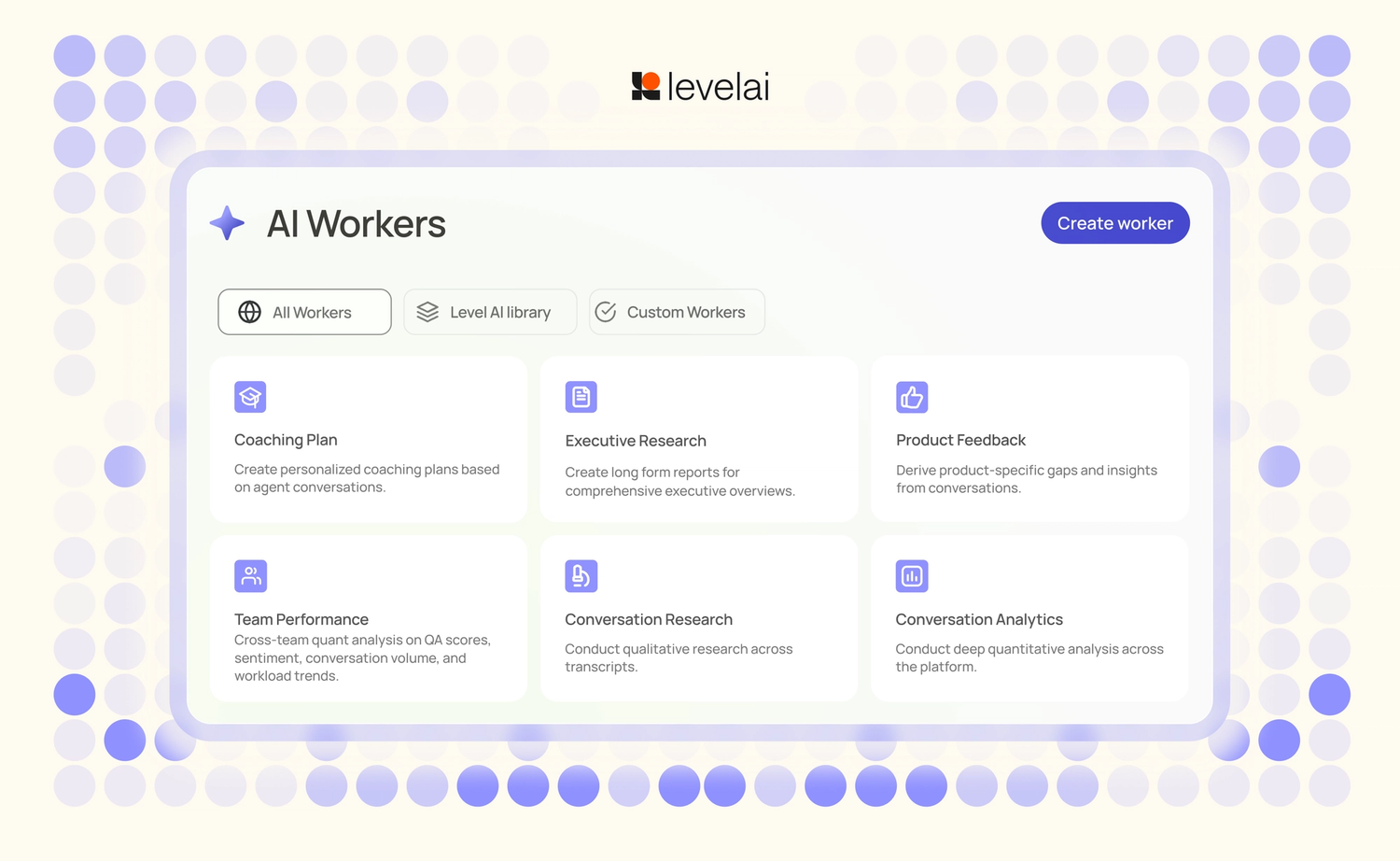
AI Workers are specialized agents scoped to individual CX operations roles. Each one owns a defined job: building coaching plans, researching conversations, analyzing team performance. Each one produces a specific deliverable, runs on the same customer intelligence data your QA and analytics teams already use, and operates within your existing access controls.
Almost 100 enterprise CX orgs are already running AI Workers today, with over 25,000 worker runs executed across the Level AI platform and overwhelmingly positive user feedback. Teams at Smartsheet, VistaPrint, and Ollie Pets that use AI Workers daily have seen work that previously consumed hours of analyst and coaching time completed in seconds, and against 100% of conversations rather than a sampled subset.
Purpose-built AI agents for automating entire CX workflows
Coaching Plan Worker
A team lead preparing for a 1:1 used to pull up a handful of recent calls, listen for coachable moments, and build a session plan by hand. The Coaching Plan Worker reads every interaction for that agent and produces a structured coaching brief: the specific calls, the specific moments, and the talking points, aligned to the same behaviors the QA team scores against.
AI Workers are the coolest thing you've launched yet. There is so much power in the tool for us to take advantage of.
Empyrean, an enterprise benefits administration company, deployed AI Workers during the beta. The team uses them to surface performance data and trend analysis for client conversations through a single prompt, which has entirely changed how they prepare for client conversations and individual coaching sessions.
"AI Workers are the coolest thing you've launched yet," said Freddie Berberena, VP, Member Experience and Service Innovation at Empyrean. "There is so much power in the tool for us to take advantage of. Having that level of information at our fingertips allows us to bring data and trends to our clients or use it internally for coaching on individual strengths, weaknesses, or opportunities within the tool. It has been really cool to work through."
Conversation Research Worker
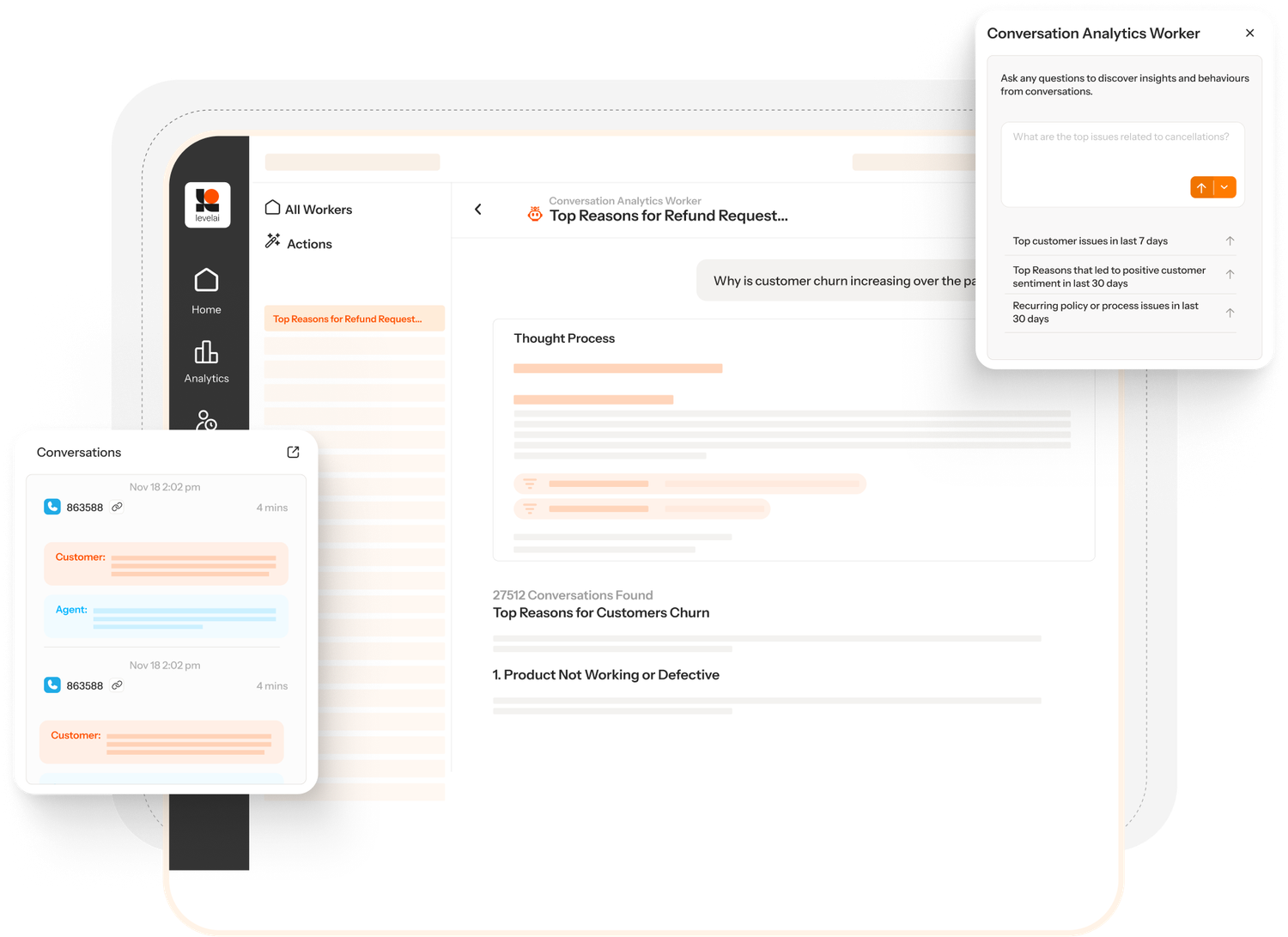
Product teams that need customer evidence for sprint planning typically wait days for an analyst to pull transcripts, tag themes, and compile a report. The Conversation Research Worker searches every transcript semantically, matching meaning rather than keywords, and produces a research report with thematic clusters, direct customer language, and volume data. An analyst's judgment still determines what to prioritize… but the research that feeds that judgment is immediate.


Executive Research Worker
A VP of CX preparing for a QBR needs performance trends, customer sentiment shifts, coaching coverage, and compliance flags pulled together into one narrative. That research typically takes an analyst days across multiple systems. The Executive Research Worker runs multi-step investigations: it determines which sub-questions to answer, dispatches parallel queries against different data domains, and synthesizes the results into a single long-form report with citations tracing every claim back to a specific conversation, score, or data point.
Additional Workers
| Worker | What it Does |
|---|---|
| Conversation Analytics Worker | Deep quantitative analysis across all of your conversations |
| Team Performance Worker | Cross-team analysis on QA scores, sentiment, conversation volume, and workload trends. |
| Product Feedback Worker | Quantified product feedback from conversations |
| Screen Recording Evaluation Worker | Evaluates agent screen activity during a conversation |
| Resolution Insights Worker | Themes and correlations from customer resolutions |
| Sentiment Insights Worker | Insights from advanced sentiment analysis |
| iCSAT Insights Worker | Themes and correlations from inferred CSAT |
| VoC Insights Worker | Insights from VoC and constituent AI factors |
AI Workers plug into the existing Level AI stack and produce output from day one. Workers respond to anomalies on their own, run scheduled analyses, and deliver results directly to the inbox. The operational overhead of analysis and reporting moves off the team entirely, and human time goes to judgment, strategy, and the decisions that require context no agent can replicate.Every worker described above addresses a different role, but the operational shift is the same: the human bottleneck between raw conversation data and a usable output disappears. Coaching plans, research reports, performance analyses, and product feedback summaries that required hours of manual assembly now generate in seconds, against the full conversation corpus.
The question that follows is how… so let’s talk about the architecture that makes this possible.
Under the hood
While foundation AI models have made impressive gains in reasoning over unstructured conversation data at enterprise quality. In reality, we’ve seen that 95% of generative AI pilots never move past the experimental phase (Fortune on MIT NANDA, The GenAI Divide, 2025) because broad tools built for everyone end up owned by no one.
In customer experience, impact doesn't come from generic intelligence; it comes from context. That’s why AI Workers read from the same intelligence foundation. This layer links conversations and transcripts, QA frameworks and scoring history, context from dozens of apps, CRM records, team hierarchy, and AI-enriched signals (sentiment, effort, resolution outcomes, VoC themes) into one customer 360 context graph. When a worker produces output, it draws from the same scored, tagged, and structured data that your QA and analytics programs already rely on. There is no parallel data pipeline or reconciliation step.


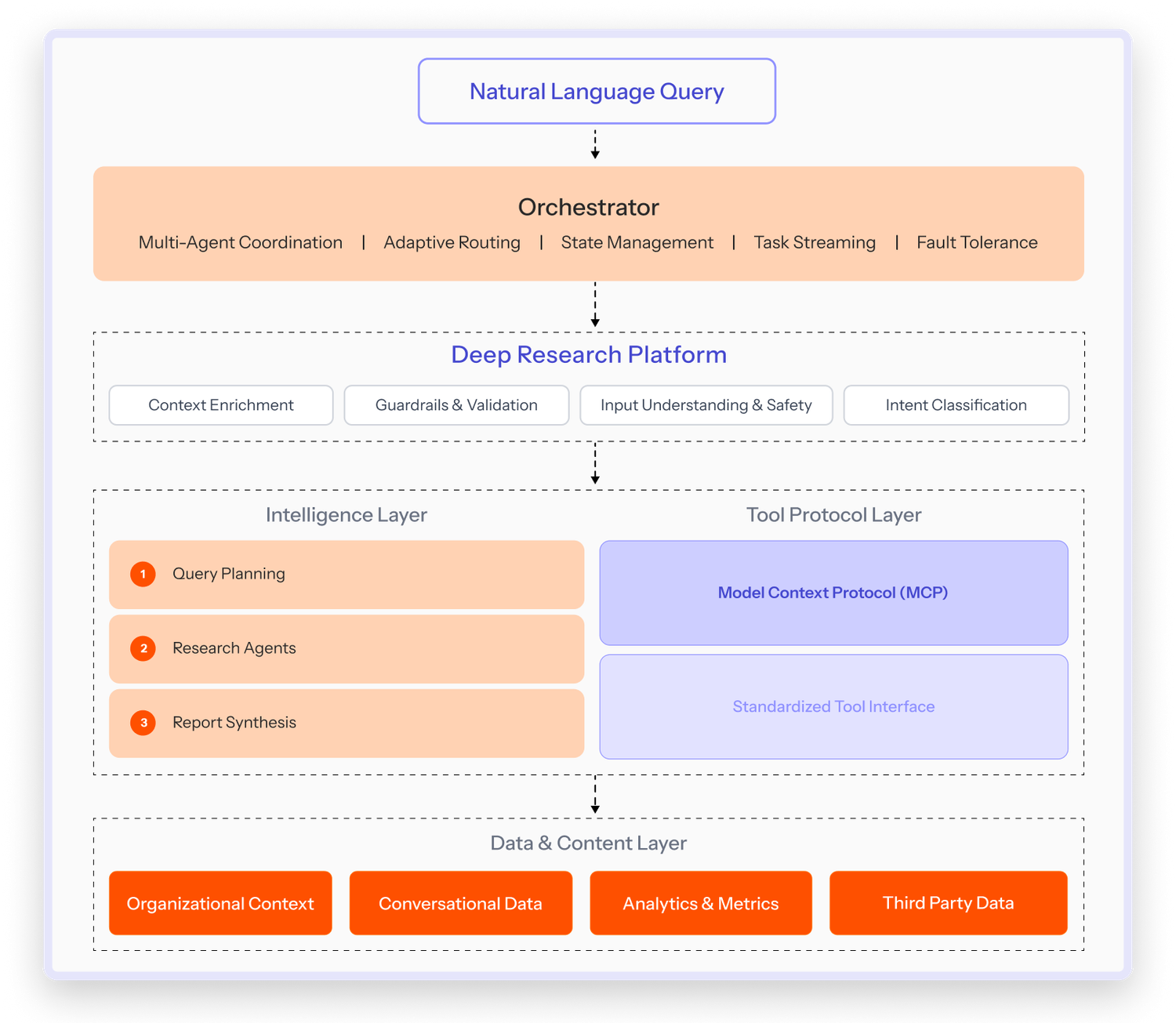
Our worker architecture is engineered as a multi-tier agentic harness, moving from simple retrieval to complex, high-fidelity orchestration.
Tier 1: Unified retrieval & analytical harness
At the foundational level, workers leverage a dual-mode retrieval system. Search mode executes high-recall search across the transcripts corpus, while the Analytics mode performs structured data analysis and extraction across the data lake. By correlating signals from conversational metrics, QA rubrics, CRM records, and operational metadata, the system ensures every agent operates with full environmental context.
2. Deep research (multi-agent orchestration)
Next, the deep research tier utilizes a sophisticated "Plan - Execute - Synthesize" framework. When a complex query is received, a Lead Orchestrator decomposes the objective into discrete sub-tasks. These are then dispatched to specialized Parallel Research Agents that query diverse data domains simultaneously, significantly reducing latency for high-dimensional investigations.
3. Integrated evaluation & traceability
To ensure reliability, the final synthesis step acts as a deterministic filter. Every output is subjected to an evidence-attribution layer, where claims are mapped back to specific source data, scores, or conversation segments. This creates a closed-loop evaluation system, transforming raw unstructured data into verifiable, executive-grade business intelligence.
These workers are extensible to other data sources and Level AI core capabilities through MCPs, creating a scalable intelligence and action framework.
AI Workers are not copilots
AI Workers come with a job description. A team lead who deploys the Coaching Plan Worker knows what it will produce, when it will produce it, and how to evaluate the output.
AI Workers also preserve the division of labor. For example, the Coaching Plan Worker produces the plan, while the CX supervisor delivers the session and decides what to emphasize. The Conversation Analytics Worker correlates cross-signal data, which allows the Ops Director to decide what action to take. The boundary between automated output and human decision stays explicit and stable.
Finally, AI Workers compound on a shared data layer. Each AI worker reads from the conversation intelligence that already powers QA, VoC, coaching, and analytics across the platform. The Conversation Research Worker pulls on the same scoring and tagging the QA team uses. The Coaching Plan Worker writes plans that align to the same behaviors the QA team flags. The VoC Insights Worker reports on the same tags the analytics team already trusts. Each AI worker reinforces the others because they operate on a single source of record.
See AI Workers in action
AI Workers are available now. Each one is scoped to a specific CX operations role, runs on your existing intelligence and shared metadata, and produces a defined deliverable against 100% of your conversation data.
Dozens of enterprise contact centers are already running them in production.
What's next: Build your own worker
We’re excited to share that we’ll soon also be opening up the orchestration engine, data layer, and protocol infrastructure behind these workers to customers.
Level AI’s Build Your Own Worker platform will let teams create agents scoped to jobs specific to their operation: a compliance team auditing calls against a custom rubric, a fraud team surfacing suspicious patterns, or an ops team tuned to a proprietary quality program. If your team has a workflow that runs on conversation data and human overhead, you can build a worker for it.
Keep reading
View all