

The problem: one customer, four systems, zero learning
At the heart of customer experience lies a simple truth: the customer is one.
Whether it’s a global bank, an e-commerce giant, or a telecom provider, the brand serves a single customer across an entire journey. Yet the tools used to serve that customer are anything but unified.
In a typical enterprise setup today, a single customer interaction might look like this:
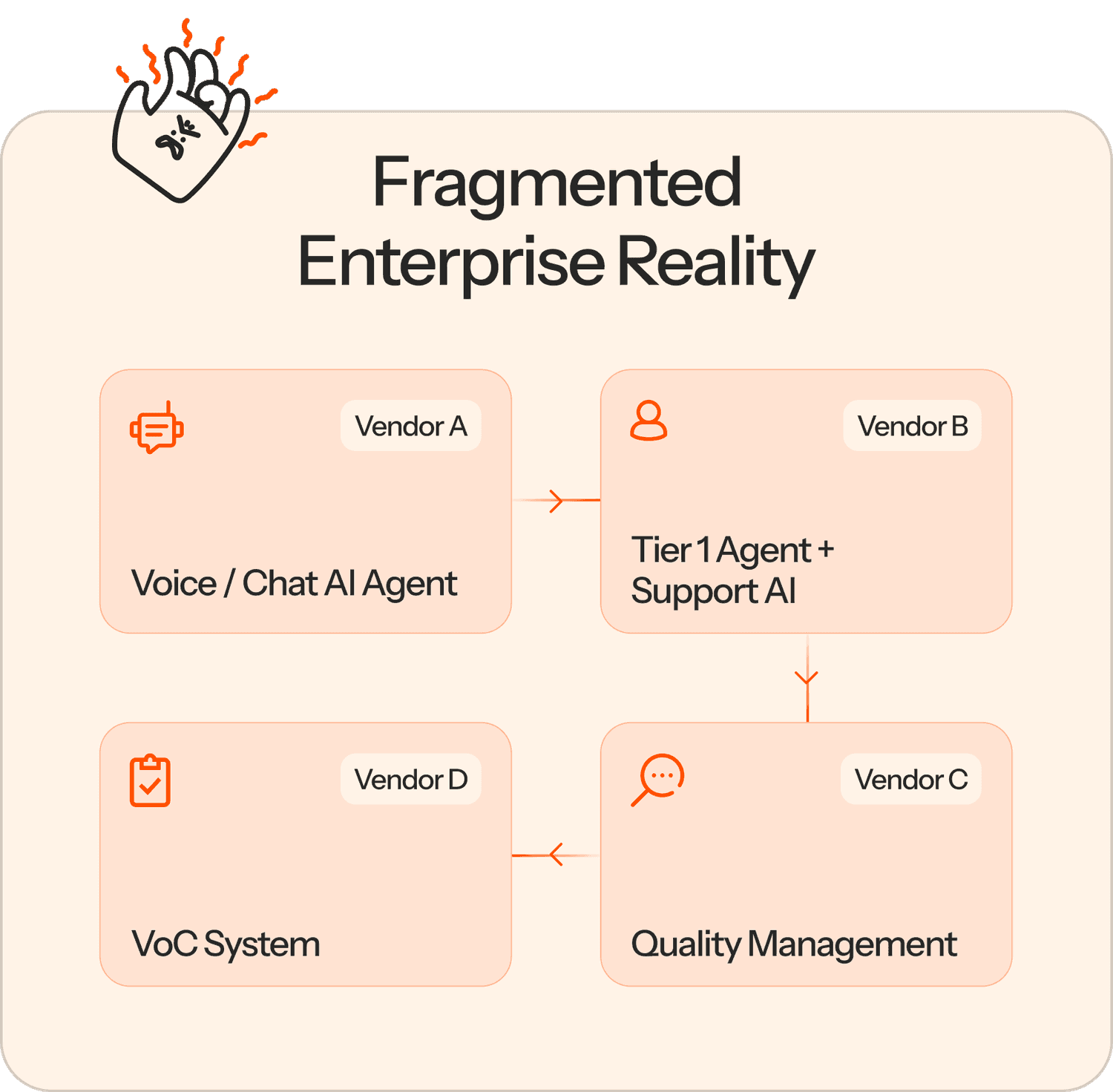
The journey begins with a voice or chat AI agent from Vendor A
The conversation is then escalated to a human agent, assisted in real time by an AI from Vendor B
The interaction is later reviewed for quality by a QA platform from Vendor C
Finally, a Voice of the Customer (VoC) tool from Vendor D analyzes sentiment and survey feedback…
On paper, each tool does its job well. In reality, this fragmented stack creates four fundamental problems.
AI and human agents don’t learn from each other
One of our e-commerce customers described this perfectly.
A customer issue flows from an AI agent → to a Tier 1 human agent → to a Tier 2 or specialist agent before it’s finally resolved. The most valuable learning happens at the end of this chain—when the expert agent figures out what actually worked.
But today, that learning dies there.
The AI agent that first handled the interaction never learns how the issue was resolved
The Tier 1 agent doesn’t get systematic coaching based on Tier 2 best practices
Human coaching systems and AI training pipelines operate in complete isolation
We have programs to coach humans.
We have systems to retrain AI agents.
But those systems don’t talk to each other.
The result is a decoupled learning loop where humans and AI improve separately—when in reality, they should be learning together.
CX leaders can’t see the customer journey end-to-end
CX leaders don’t care about tools.
They care about outcomes.
They’re not asking: “How was the experience with the bot?”, “How did the human agent perform?”
They’re asking:
Did this customer have a good experience with our brand?
Will they buy again?
Will they stay loyal?
Will they spend more with us?
Answering these questions today is surprisingly hard.
To reconstruct a single customer journey, leaders must:
Query the AI agent platform for bot interactions
Pull data from the human agent system
Analyze QA scores from a separate tool
Review VoC surveys at the end of the journey
When customer data is siloed across four or five systems, it is nearly impossible to get a unified, real-time view of experience across the full journey.
Operational complexity explodes for CX teams
Now zoom out to the CX leader’s operational reality.
They are expected to:
Manage 3–4 different vendors
Maintain multiple AI systems
Tune, upgrade, and optimize disconnected platforms
Coordinate roadmaps, integrations, and renewals
Each system evolves independently. Improvements in one don’t propagate to the others. The operational overhead becomes massive, slowing down innovation and decision-making.
Total cost of ownership quietly balloons
Finally, there’s the economics.
When you buy four separate systems, you’re effectively paying a vendor tax multiple times:
Overlapping infrastructure
Redundant AI capabilities
Duplicated analytics and storage
Parallel professional services and integrations
Each vendor captures only a slice of value—but charges as if they’re solving the whole problem.
The end result: higher cost, lower leverage, and fragmented value creation.
These four issues—broken learning loops, siloed customer data, operational complexity, and rising TCO—are all symptoms of the same root cause: CX systems were built as point solutions, not as an end-to-end platform.
The strategic fix: a full-stack AI architecture
Fixing siloed AI requires owning the intelligence layer end to end—not better prompts or looser integrations. Level AI’s Full-Stack AI Architecture unifies human agents, AI agents, and customer journeys into a single learning system built for trust, scale, and continuous improvement.
A connected intelligence layer allows specialized AI models to continuously learn from and reinforce one another. Across QA, VoC, iCSAT, tagging, analytics, and automation, the platform generates enriched, structured signals-far beyond raw transcripts-that are shared and reused across workflows. The result is compounding learning: models build on validated context instead of starting from scratch, delivering more accurate, explainable, and consistent outcomes across every use case.
Owned compute: eliminate fragmentation at the source
Level AI owns its GPU clusters, eliminating external API hops entirely. Intelligence is executed, observed, and improved within a single controlled environment, enabling processing of 200M+ conversations per month with sub-second latency at enterprise scale. Speed is no longer a best-effort outcome; it is an architectural guarantee. Just as importantly, learning signals remain inside one system and can be reused across every use case.
Proprietary SLMs: specialists, not generalists
Instead of relying on generic models, Level AI uses proprietary Small Language Models and specialized AI models fine-tuned on hundreds of millions of real CX interactions. These models are purpose-built for the noisy, high-variance reality of customer service—understanding accents, background noise, and domain-specific language out of the box. The result is significantly higher accuracy at a fraction of the cost of generic mega-models. These models are built for CX, not repurposed for it.
Unified intelligence layer: where learning compounds
Across Automated QA, Voice of the Customer, iCSAT, tagging, analytics, and Agent Assist, Level AI generates enriched metadata—structured signals such as quality scores, sentiment, customer effort, key events, and agent behaviors. This intelligence is shared across the platform rather than trapped in individual tools. Models build on validated insights instead of reprocessing raw transcripts, allowing what works at the end of the journey to improve the beginning. Human excellence trains AI, and AI insights improve human performance, creating a closed-loop learning system.
Governance by design: supervised AI at scale
Governance is native to a full-stack architecture. Every AI interaction is evaluated using 100% Automated QA, scoring for accuracy, empathy, and compliance in real time. Errors are traceable, performance is measurable, and improvements are systematic. Instead of deploying AI and hoping for the best, enterprises manage a supervised digital workforce—coached, audited, and improved just like human teams.
The future of CX is unified
Customer experience is one journey. AI systems must reflect that reality.
Siloed AI delivers isolated wins and compounding risk. A full-stack architecture delivers trust, speed, and continuous improvement at scale.
Stop renting intelligence in pieces. Build for one customer journey.
That is the true promise of One AI.