
Key takeaways
Most Retell AI alternatives are built for developers or small teams and lack the enterprise-grade quality assurance, coaching, and compliance features that large contact centers require.
Tools like Cognigy and PolyAI are strong for scripted voice automation but require significant implementation time and dedicated technical resources to maintain at scale.
Level AI is the only platform in this list that combines a voice AI agent with real-time agent assist, automated QA, and conversation intelligence inside a single system built specifically for enterprise contact centers.
Enterprises evaluating voice AI should look beyond call deflection rates and consider how well each platform supports human agents who still handle complex, sensitive, or high-value customer calls.
Pricing and support models vary significantly across these platforms, and the total cost of ownership is often higher than the initial licensing fee once you factor in custom development, integration work, and ongoing model tuning.
Why Buyers Evaluate Retell AI?
Retell AI made it easy for developers to spin up a voice agent quickly. That appeals to startups and product teams that want to prototype fast. But as organizations grow and contact center volumes increase, the gaps in Retell AI’s enterprise readiness start to show. There is no built-in quality assurance layer, no real-time coaching for human agents, no compliance monitoring, and limited support for regulated industries like healthcare and financial services.
This pushes enterprise buyers to look elsewhere. According to Gartner, by 2028, at least 70% of customers are expected to begin their customer service journey through conversational AI. As conversational AI becomes a primary channel for customer interactions, enterprises need platforms that can support high call volumes, complex integrations, compliance requirements, and seamless collaboration between AI and human agents—not just basic voice automation.
If you are a contact center leader evaluating voice AI for your team, the tools in this article represent the most serious alternatives to Retell AI available today. Each one approaches the problem differently, and understanding those differences is what this guide is designed to help with. You can also explore what conversational AI means for contact centers before diving into the comparisons below.
How We Compared These Tools?
We evaluated each platform across six dimensions that matter most to enterprise buyers:
Voice AI quality: How natural and accurate is the voice interaction? Can it handle accents, interruptions, and complex multi-turn conversations?
Enterprise readiness: Does the platform support SSO, role-based access, SOC 2 compliance, and dedicated SLAs?
Human agent support: Does the platform help human agents with real-time guidance and post-call coaching, or does it only automate calls?
QA and compliance: Is there built-in call quality monitoring, or do you need a separate tool for that?
Integration depth: How well does it connect with existing CRMs, telephony stacks, and contact center platforms?
Time to value: How long does it realistically take to go live in a production environment?
We looked at public documentation, G2 reviews, third-party analyst reports, and direct product experience to form these assessments.
Top Retell AI Alternatives: Comparison Table
Platform | Best For | QA Built In | Real-Time Agent Assist | Enterprise Support | Deployment |
Level AI | Enterprise contact centers | Yes | Yes | Yes | Cloud |
Cognigy | Large enterprise automation | No | Limited | Yes | Cloud / On-prem |
PolyAI | Hospitality and retail voice | No | No | Yes | Cloud |
Sierra | Customer experience workflows | No | No | Yes | Cloud |
Voiceflow | Prototyping and no-code builds | No | No | Limited | Cloud |
Bland AI | High-volume outbound calling | No | No | Limited | Cloud |
Vapi | Developer-first voice AI | No | No | Limited | Cloud |
Synthflow | No-code voice automation for SMBs | No | No | No | Cloud |
LiveKit | Real-time voice infrastructure | No | No | Limited | Cloud / Self-hosted |
Goodcall | SMB inbound call handling | No | No | No | Cloud |
Top Retell AI Alternatives: Detailed Descriptions
1. Level AI
Level AI is a purpose-built enterprise contact center intelligence platform that goes well beyond basic voice automation. While most tools in this list focus only on automating calls, Level AI connects the dots between your AI virtual agent, your human agents, your QA team, and your leadership. The result is a single platform where automated voice interactions and human-assisted calls are both monitored, scored, and continuously improved.
Level AI’s voice AI handles inbound and outbound calls with high accuracy, and when a call needs to be escalated to a human, the handoff is smooth. Human agents then receive real-time suggestions powered by the same AI that understands the full conversation. After the call, QA teams get automated scoring, coaching recommendations, and compliance alerts without needing to manually listen to recordings. This closed-loop approach is what separates Level AI from every other platform in this comparison.
Enterprises in financial services, healthcare, retail, and BPO operations use Level AI to reduce handle time, improve first contact resolution, and cut QA labor costs. Paul Harraghty, VP of Global CARE at VistaPrint, said it directly: “With Level AI, we were able to save hundreds of thousands of dollars. But the bigger impact is we’ve expanded entry points with customers, and those interactions are delivering revenue through CARE to the business.”
Key Features
AI-powered virtual agent for inbound and outbound voice interactions
Real-time agent assist with live call guidance and suggested responses
Automated quality assurance that scores 100% of calls without manual effort
Conversation intelligence that surfaces trends, risks, and customer sentiment across all calls
Agent coaching tools that identify individual skill gaps and recommend targeted training
Voice of the customer insights that connect call data to business outcomes
Compliance monitoring with automated alerts for regulatory and script violations
Native integrations with Salesforce, Zendesk, ServiceNow, and leading telephony platforms
Strengths
The only platform in this list that combines voice AI, real-time assist, automated QA, and coaching in one system
Purpose-built for enterprise contact centers with regulated industry support out of the box
Significantly reduces QA team workload by automating 100% call scoring
Provides actionable coaching recommendations, not just raw data
Strong implementation support and dedicated customer success for enterprise accounts
Conversation intelligence layer gives leadership visibility into what is happening across every call
Best For
Level AI is the right choice for enterprise contact centers that handle high call volumes, operate in regulated industries, or need their voice AI and human agents to work as a connected team. If you want a platform that improves not just call automation but the overall performance of your entire contact center, Level AI is built for that.
" transform="translate(85.643 10.143)" width="23.725855670103115px"/><path d="M 71.828 0 L 0 50.702" fill="transparent" height="50.70235051546392px" id="TnJFUMH9b" stroke-dasharray="" stroke-linecap="butt" stroke-linejoin="miter" stroke-miterlimit="10" stroke-width="0.68" stroke="rgb(254, 250, 241)" transform="translate(85.508 75.029)" width="71.82828865979384px"/><path d="M 81.579 0 L 0 52.003" fill="transparent" height="52.00280412371134px" id="ccJzhVTGI" stroke-dasharray="" stroke-linecap="butt" stroke-linejoin="miter" stroke-miterlimit="10" stroke-width="0.68" stroke="rgb(254, 250, 241)" transform="translate(85.495 73.738)" width="81.57921649484533px"/><path d="M 65.653 0 L 0 32.827" fill="transparent" height="32.826556701030924px" id="X0Vp_q8HG" stroke-dasharray="" stroke-linecap="butt" stroke-linejoin="miter" stroke-miterlimit="10" stroke-width="0.68" stroke="rgb(254, 250, 241)" transform="translate(85.462 92.931)" width="65.65311340206183px"/><path d="M 88.08 14.951 L 0 0" fill="transparent" height="14.950762886597914px" id="JM_UgSiJ_" stroke-dasharray="" stroke-linecap="butt" stroke-linejoin="miter" stroke-miterlimit="10" stroke-width="0.68" stroke="rgb(254, 250, 241)" transform="translate(86.233 125.789)" width="88.07950515463914px"/><path d="M 83.204 72.803 L 0 0" fill="transparent" height="72.80313402061856px" id="KlyUUjlMK" stroke-dasharray="" stroke-linecap="butt" stroke-linejoin="miter" stroke-miterlimit="10" stroke-width="0.68" stroke="rgb(254, 250, 241)" transform="translate(85.089 125.71)" width="83.20379381443304px"/><path d="M 7.8 114.081 L 0 0" fill="transparent" height="114.08065979381445px" id="kAiUvduBR" stroke-dasharray="" stroke-linecap="butt" stroke-linejoin="miter" stroke-miterlimit="10" stroke-width="0.68" stroke="rgb(254, 250, 241)" transform="translate(85.95 125.478)" width="7.800247422680428px"/><path d="M 0 93.604 L 9.75 0" fill="transparent" height="93.60445360824741px" id="FsgTAQB0n" stroke-dasharray="" stroke-linecap="butt" stroke-linejoin="miter" stroke-miterlimit="10" stroke-width="0.68" stroke="rgb(254, 250, 241)" transform="translate(76.2 125.421)" width="9.750432989690694px"/><path d="M 0 76.379 L 76.703 0" fill="transparent" height="76.37888659793816px" id="NxOhHvPJ5" stroke-dasharray="" stroke-linecap="butt" stroke-linejoin="miter" stroke-miterlimit="10" stroke-width="0.68" stroke="rgb(254, 250, 241)" transform="translate(9.343 125.217)" width="76.7034556701031px"/><path d="M 0 26.651 L 39.002 0" fill="transparent" height="26.651381443298988px" id="QETNKJ3L6" stroke-dasharray="" stroke-linecap="butt" stroke-linejoin="miter" stroke-miterlimit="10" stroke-width="0.68" stroke="rgb(254, 250, 241)" transform="translate(47.096 125.177)" width="39.0017319587629px"/><path d="M 0 16.901 L 85.154 0" fill="transparent" height="16.900948453608265px" id="BL63wDICD" stroke-dasharray="" stroke-linecap="butt" stroke-linejoin="miter" stroke-miterlimit="10" stroke-width="0.68" stroke="rgb(254, 250, 241)" transform="translate(0.094 125.125)" width="85.15396503092786px"/><path d="M 0 0 L 78.004 17.876" fill="transparent" height="17.875793814432996px" id="PIX70Vlqf" stroke-dasharray="" stroke-linecap="butt" stroke-linejoin="miter" stroke-miterlimit="10" stroke-width="0.68" stroke="rgb(254, 250, 241)" transform="translate(8.362 107.251)" width="78.00376082474227px"/><path d="M 0 0 L 67.928 52.327" fill="transparent" height="52.32742268041238px" id="u_syqWqWD" stroke-dasharray="" stroke-linecap="butt" stroke-linejoin="miter" stroke-miterlimit="10" stroke-width="0.68" stroke="rgb(254, 250, 241)" transform="translate(17.593 72.861)" width="67.92826391752578px"/><path d="M 0 0 L 77.029 70.528" fill="transparent" height="70.52832989690722px" id="DmW_aE2A0" stroke-dasharray="" stroke-linecap="butt" stroke-linejoin="miter" stroke-miterlimit="10" stroke-width="0.68" stroke="rgb(254, 250, 241)" transform="translate(9.489 54.678)" width="77.02866804123713px"/><path d="M 0 0 L 27.301 126.431" fill="transparent" height="126.43109443298971px" id="JrLaRUubC" stroke-dasharray="" stroke-linecap="butt" stroke-linejoin="miter" stroke-miterlimit="10" stroke-width="0.68" stroke="rgb(254, 250, 241)" transform="translate(58.341 -0.071)" width="27.30111340206188px"/><path d="M 0 4.012 C 0 1.796 1.796 0 4.012 0 C 6.228 0 8.025 1.796 8.025 4.012 C 8.025 6.228 6.228 8.025 4.012 8.025 C 1.796 8.025 0 6.228 0 4.012 Z" fill="rgb(254, 80, 0)" height="8.024669690721652px" id="Nh5qrPJs_" transform="translate(81.396 121.369)" width="8.024669690721623px"/></svg>)
2. Cognigy
Cognigy is a conversational AI platform designed for large enterprises that need to automate complex, multi-channel customer interactions at scale. It supports both voice and chat channels and is widely used across telecommunications, banking, insurance, and retail. Cognigy’s architecture allows enterprises to build sophisticated conversation flows using a visual design tool, and its AI Copilot feature provides some level of real-time support for human agents during live calls.
One of Cognigy’s key strengths is its on-premises deployment option, which is important for enterprises with strict data residency requirements. It also supports over 100 languages, making it a viable option for global organizations. However, Cognigy does not include built-in quality assurance or post-call analytics, so teams that need those capabilities will need to integrate a separate tool. The platform also has a steep learning curve and typically requires dedicated implementation support to get up and running.
For enterprise teams evaluating Cognigy, it is worth understanding how real-time agent assist compares across platforms, since Cognigy’s AI Copilot feature is more limited than what enterprise contact centers typically need.
Key Features
Visual conversation flow builder for designing complex multi-turn interactions
AI Copilot for live agent support during calls
Support for 100+ languages across voice and chat
On-premises and cloud deployment options
Native integrations with major CRM and contact center platforms
Advanced NLU with intent detection and entity recognition
Analytics dashboard for conversation performance tracking
Pre-built connectors for SAP, Salesforce, and ServiceNow
Strengths
Strong enterprise security and compliance posture with on-premises deployment
Excellent multi-language support for global operations
Mature platform with a wide ecosystem of integrations and partners
Visual flow builder makes it accessible to non-technical teams once trained
Proven at scale with Fortune 500 customers across regulated industries
Weaknesses
No built-in QA or automated call scoring, requiring a separate tool for quality management
High implementation complexity with a long time to value for most enterprise deployments
AI Copilot for agents is less mature than dedicated agent assist platforms
Pricing is not transparent and often requires custom enterprise negotiation
Best For
Cognigy is best suited for large enterprises that need a powerful multi-channel automation platform with strict data residency requirements, global language support, and the internal technical resources to implement and maintain it over time.
3. PolyAI
PolyAI is a voice AI company focused on building AI call agents that can handle real conversations at scale. It is particularly strong in industries like hospitality, retail, and utilities, where customers typically call with structured, predictable requests. PolyAI’s voice agents are known for their natural conversational quality and their ability to handle interruptions, topic changes, and heavy accents better than many competing platforms.
The company works primarily through enterprise contracts and provides a managed service model, meaning PolyAI handles the setup, tuning, and ongoing optimization of the voice agent on your behalf. This reduces the technical burden on your internal team but also means you have less direct control over the configuration. There is no built-in QA layer, no real-time agent assist for human calls, and limited self-serve capabilities.
For contact centers in retail or travel and hospitality, PolyAI can handle a large share of routine inbound volume. But teams that also need visibility into human agent performance or compliance monitoring will need to supplement PolyAI with additional tooling.
Key Features
Enterprise-grade voice AI with high natural language accuracy
Handles complex, multi-turn conversations with interruptions and topic switches
Multilingual support for global customer bases
Managed service model with ongoing optimization handled by PolyAI
Pre-built integrations with contact center telephony systems
Real-time call transcription and conversation logging
Industry-specific conversation templates for hospitality, retail, and utilities
Analytics and reporting on call volume, deflection, and resolution rates
Strengths
Among the most natural-sounding voice AI available for enterprise inbound calls
Managed service model reduces internal technical workload
Strong performance in specific verticals like hospitality and retail
Handles accent variation and background noise better than most competitors
Proven at high call volumes with major enterprise deployments
Weaknesses
Limited self-serve configuration, relying heavily on PolyAI’s managed team for changes
No built-in QA, coaching, or human agent assist capabilities
Less flexibility for companies that need custom integrations or unique conversation designs
Not well suited for outbound calling campaigns
Best For
PolyAI works best for enterprise organizations in hospitality, retail, or utilities that primarily need to automate inbound call volume and are comfortable with a managed service model where the vendor handles the technical configuration.
4. Sierra

Sierra is a customer experience AI platform built to handle complex, multi-step customer service workflows. It integrates with existing business systems to give its AI agent access to real data so it can do things like process returns, update account information, or schedule appointments during a live conversation. Sierra’s strength is its ability to execute actions across integrated systems end-to-end, not just answer questions.
However, Sierra does not offer real-time agent assist for human agents, automated quality assurance, or any post-call analytics layer. It is primarily a customer-facing automation tool. Teams evaluating Sierra alongside platforms like Level AI should review what an AI customer service agent actually needs to deliver in an enterprise context before making a decision.
You can also look at how Level AI compares to Sierra directly to understand the differences in scope.
Key Features
AI agent capable of executing multi-step transactional workflows
Deep integrations with CRM, order management, and ticketing systems
Natural language interface for complex customer requests
Topic-specific AI model fine-tuning per use case
Escalation pathways to human agents with context handoff
Real-time action execution during live conversations
Support for both voice and text channels
Enterprise-grade security and data handling
Strengths
Unique ability to complete complex multi-step actions, not just answer questions
Deep system integrations enable true end-to-end automation
Strong backing and rapid product development cadence
Good fit for complex workflows like e-commerce returns or account changes
Clean, modern interface for both setup and monitoring
Weaknesses
No quality assurance, call scoring, or coaching features for human agents
Limited track record at very large enterprise scale compared to more mature competitors
Pricing is enterprise-level and not publicly available
Primarily suited for transactional use cases rather than complex support conversations
Best For
Sierra is the right fit for companies that need an AI agent to complete multi-step customer service transactions across integrated systems, particularly in e-commerce, financial services, or SaaS businesses where customers frequently make account changes.
5. Voiceflow
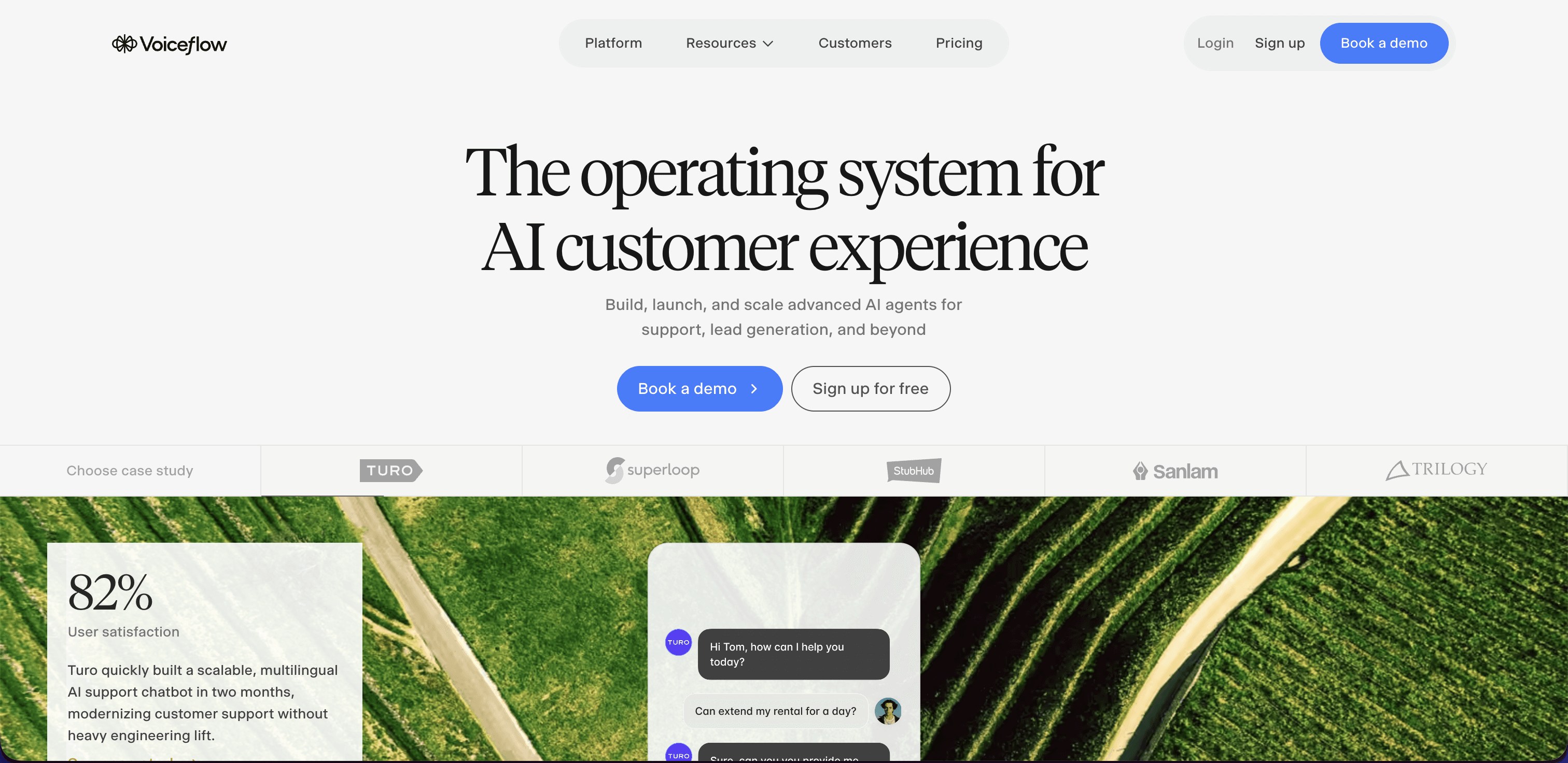
Voiceflow is a design and development platform for building conversational AI experiences across voice, chat, and messaging channels. It is primarily used by product teams, designers, and developers who want a visual, collaborative environment for prototyping and deploying AI-powered interactions. Voiceflow supports rapid prototyping, has a growing library of templates, and allows non-technical team members to participate in the design process.
For teams building AI tools for customer service at enterprise scale, Voiceflow can be a useful design tool but is unlikely to meet the operational requirements of a full contact center deployment on its own. There is no quality assurance layer, no real-time agent assist, no compliance monitoring, and limited enterprise-grade support.
Key Features
Visual no-code canvas for building voice and chat conversation flows
Collaborative workspace with multi-user editing and version control
API integration to connect with external data sources and business systems
Built-in testing and simulation tools for conversation flows
Support for multiple AI models and NLU providers
Template library for common conversation patterns
Analytics on conversation paths and user drop-off points
Export and deployment to multiple channels including voice, web, and messaging
Strengths
Fastest platform in this list for getting a prototype running without developer resources
Strong collaborative design environment for cross-functional teams
Growing ecosystem of integrations and community templates
Flexible enough to support a wide range of use cases
More affordable than enterprise platforms, with a generous free tier for experimentation
Weaknesses
Not built for enterprise contact center operations at scale
No QA, agent coaching, or compliance monitoring features
Limited enterprise support and security documentation
Teams often outgrow Voiceflow quickly as their AI deployment scales up
Best For
Voiceflow is best for product teams and developers who need to prototype, test, and iterate on conversational AI experiences quickly. It is not the right tool for enterprises that need a production-ready, compliance-aware voice AI platform for their contact center.
6. Bland AI
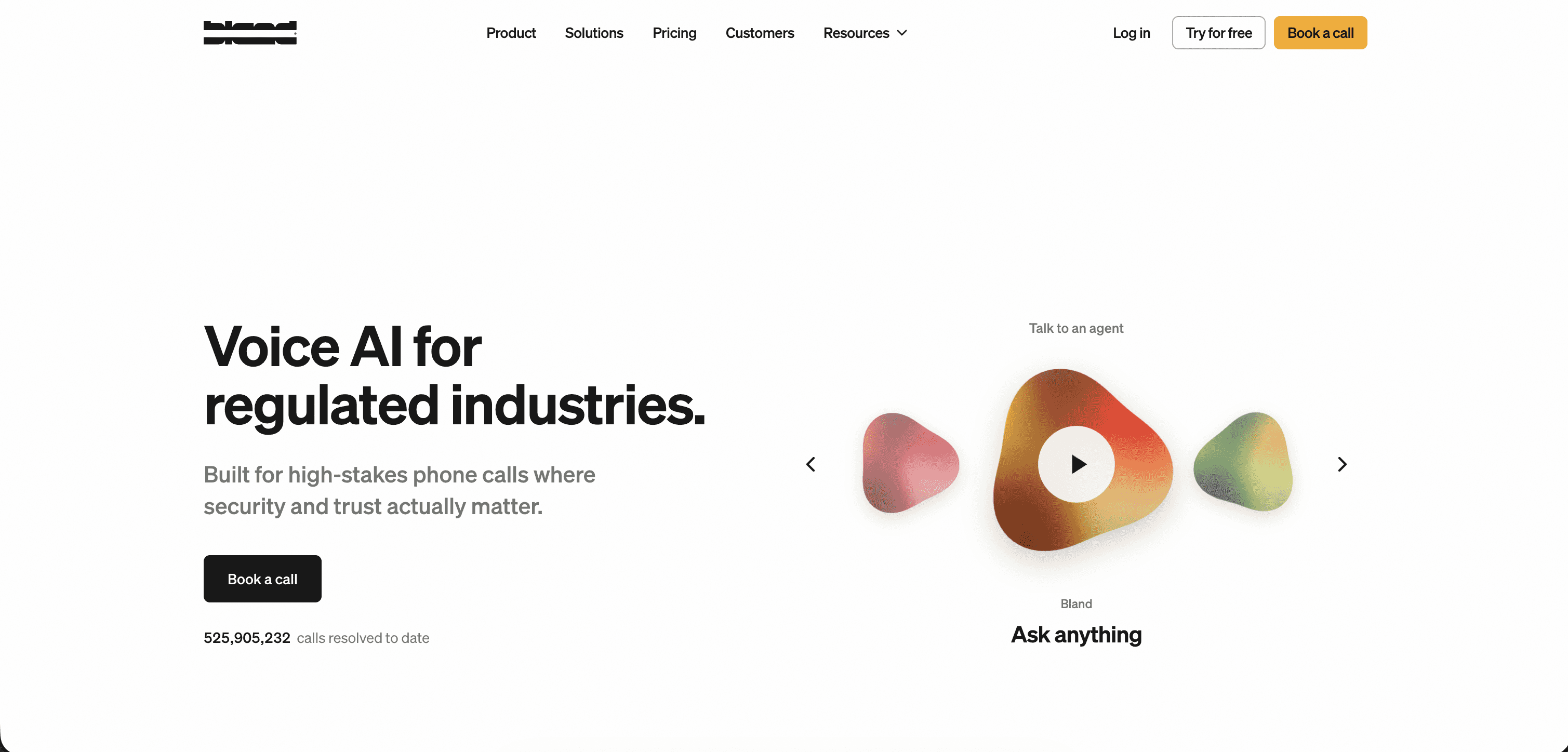
Bland AI is a developer-focused platform built for high-volume outbound phone call automation. It works well for scenarios where the call script is relatively simple, and the volume is high, such as sales prospecting, appointment scheduling, and survey collection. Setup is straightforward through the API, and pricing is usage-based, which keeps costs predictable at scale.
Enterprises that need to run outbound campaigns while also monitoring call center quality assurance will need a separate solution for the oversight layer. Bland AI does not provide that, and it is not designed for inbound call handling at enterprise scale or for compliance-sensitive environments.
Key Features
High-volume outbound call automation via API
Customizable call scripts and conversation flows
Batch call scheduling with time zone controls
Real-time call monitoring and transcription
Webhook integrations for connecting call outcomes to CRM and databases
Voice customization with multiple voice options
Analytics on call completion rates, outcomes, and transfer rates
Low per-minute pricing for large volume campaigns
Strengths
Extremely fast to set up for basic outbound calling use cases
Low cost per call makes it economical for high-volume campaigns
API-first design works well for development teams with existing automation pipelines
Reliable throughput for large batch calling campaigns
Good fit for sales, outreach, and appointment reminder workflows
Weaknesses
No enterprise-grade security, compliance, or SLA commitments
Not designed for inbound calls or complex multi-turn conversations
No QA, coaching, or agent assist features
Not suitable for regulated industries without significant additional tooling
Best For
Bland AI is best for startups and growth-stage companies that need to automate outbound phone campaigns at high volume with minimal setup. It is not a fit for enterprise contact centers that need inbound coverage, compliance monitoring, or human agent support.
7. Vapi
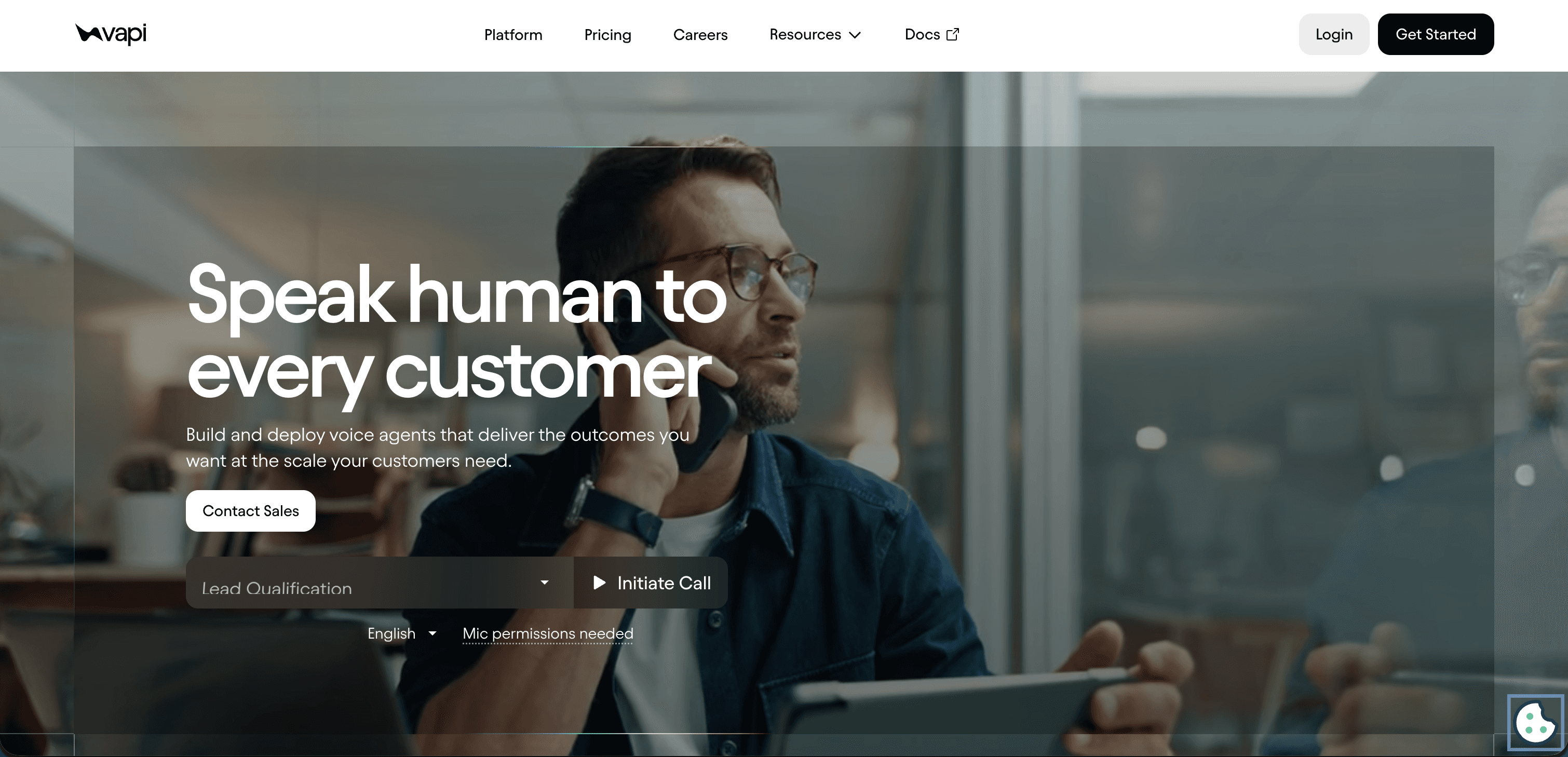
Vapi is a developer-focused voice AI infrastructure platform that gives engineering teams the building blocks to create custom voice AI applications. It handles the infrastructure layer including WebRTC connections, speech-to-text and text-to-speech integrations, and call routing. Vapi is model-agnostic, meaning teams can connect their preferred language model and speech provider.
The platform is well-regarded for its flexibility and documentation. However, Vapi is infrastructure, not a packaged enterprise solution. Teams using Vapi need to build their own QA layer, their own compliance controls, and their own agent assist tooling from scratch. For enterprises, it is worth reading about voice of the customer insights and what gets lost when your voice platform has no conversation intelligence built in.
Key Features
Voice AI infrastructure with WebRTC, speech-to-text, and text-to-speech integrations
Support for multiple language models including GPT-4, Claude, and Gemini
Inbound and outbound call handling with programmable call logic
Phone number provisioning and call routing
Real-time transcription and conversation logging
Webhook support for connecting call events to external systems
Active developer community with documentation and support
Usage-based pricing with no minimum commitment
Strengths
Maximum flexibility for engineering teams that want full control over the voice stack
Model-agnostic design lets teams switch or combine language models
Strong developer documentation and community support
Fast to prototype and iterate for technically capable teams
Affordable entry point with pay-as-you-go pricing
Weaknesses
Requires significant engineering resources to build a production-ready voice application
No built-in QA, compliance monitoring, or agent assist features
Not suitable for non-technical teams without developer support
Total cost of ownership increases significantly when you factor in internal development time
Best For
Vapi is the right choice for engineering teams that need flexible voice AI infrastructure and have the development resources to build a custom application on top of it. It is not the right fit for enterprise contact centers that need a packaged solution with QA and compliance built in.
8. Synthflow
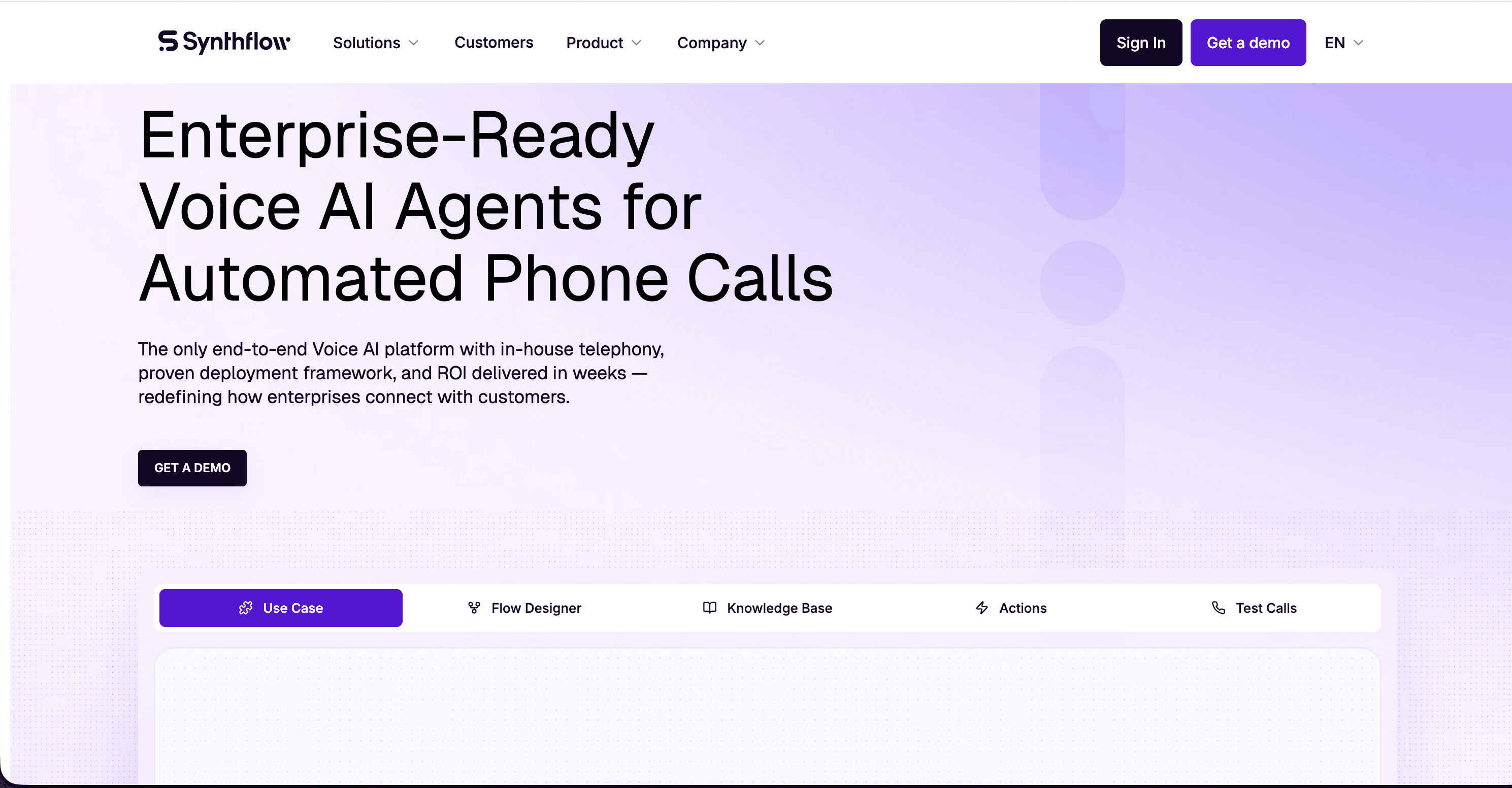
Synthflow is a no-code voice AI platform designed for small and mid-sized businesses that want to deploy an AI phone agent without writing code. It offers a simple interface for building voice agents, connecting to appointment scheduling tools, and handling basic inbound and outbound calls. Synthflow targets agencies, local businesses, and SMBs that want to automate phone interactions without developer resources.
For teams exploring AI for contact centers, reviewing contact center AI solutions at enterprise scale shows how different the requirements are compared to what Synthflow offers. The platform does not offer enterprise security certifications, QA or compliance monitoring, or support for the complex integrations that large contact centers require.
Key Features
No-code voice agent builder with a visual interface
Inbound and outbound call handling for common business scenarios
Appointment scheduling integration with Calendly and similar tools
CRM integrations with HubSpot, GoHighLevel, and others
Call recording and basic analytics dashboard
Multilingual support for select languages
White-label options for agency resellers
Affordable pricing tiers for small business use cases
Strengths
Very easy to set up without technical expertise
Good fit for local businesses, agencies, and SMBs with simple call handling needs
White-label capabilities make it attractive for agencies building client solutions
Affordable pricing compared to enterprise platforms
Integrates well with common SMB tools and CRMs
Weaknesses
Not suitable for enterprise contact centers with high call volumes
No QA, call scoring, compliance monitoring, or agent assist features
Limited security documentation and no enterprise-grade SLAs
Not designed for regulated industries like healthcare or financial services
Best For
Synthflow is best for small businesses, local service companies, and agencies that need a simple, affordable AI phone agent for basic call handling. It is not an appropriate choice for enterprise contact center operations.
9. LiveKit
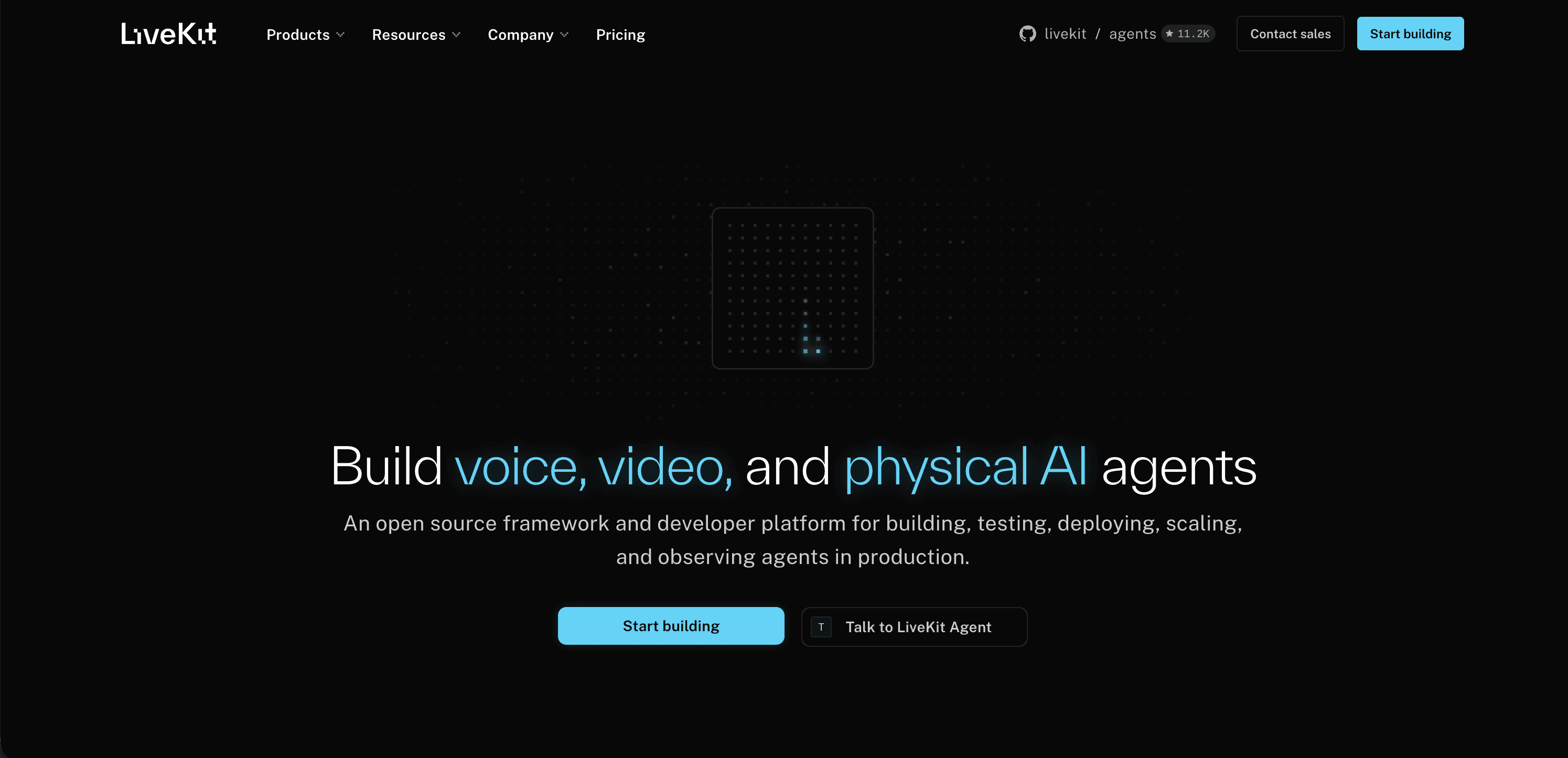
LiveKit is an open-source real-time communications infrastructure platform that supports audio, video, and data streaming. It is not a voice AI product in the traditional sense but rather a foundational layer that developers use to build voice AI applications and real-time communication features. Teams that want to deploy a voice AI agent using LiveKit need to bring their own AI models, speech-to-text providers, text-to-speech engines, and application logic.
For enterprises evaluating build-versus-buy decisions in this space, reviewing a practical guide to evaluating virtual agents can help clarify where the hidden complexity lives. Contact center use cases that platforms like Level AI or PolyAI address out of the box require significant development work to build on top of LiveKit.
Key Features
Open-source real-time audio and video infrastructure
Self-hosting option for complete data sovereignty
WebRTC-based architecture with low-latency audio streaming
SDKs for JavaScript, Python, Swift, Kotlin, and other languages
Support for connecting external AI models and speech services
Room management, participant tracking, and session recording
Scalable cloud-hosted option alongside the self-hosted version
Active open-source community with strong documentation
Strengths
Complete control and flexibility for teams with strong engineering capabilities
Self-hosting option eliminates data residency concerns
Open-source model means no vendor lock-in
Strong performance for low-latency real-time audio applications
Active community and good documentation for developers
Weaknesses
Not a packaged voice AI solution, requires significant custom development
No built-in AI capabilities, QA, compliance, or agent assist features
Requires dedicated engineering resources to build and maintain
Time to production is measured in months, not days
Best For
LiveKit is best for engineering teams at technology companies that are building a custom real-time voice application and need low-level infrastructure control, or for organizations with strict data residency requirements that need to self-host their entire voice stack.
10. Goodcall
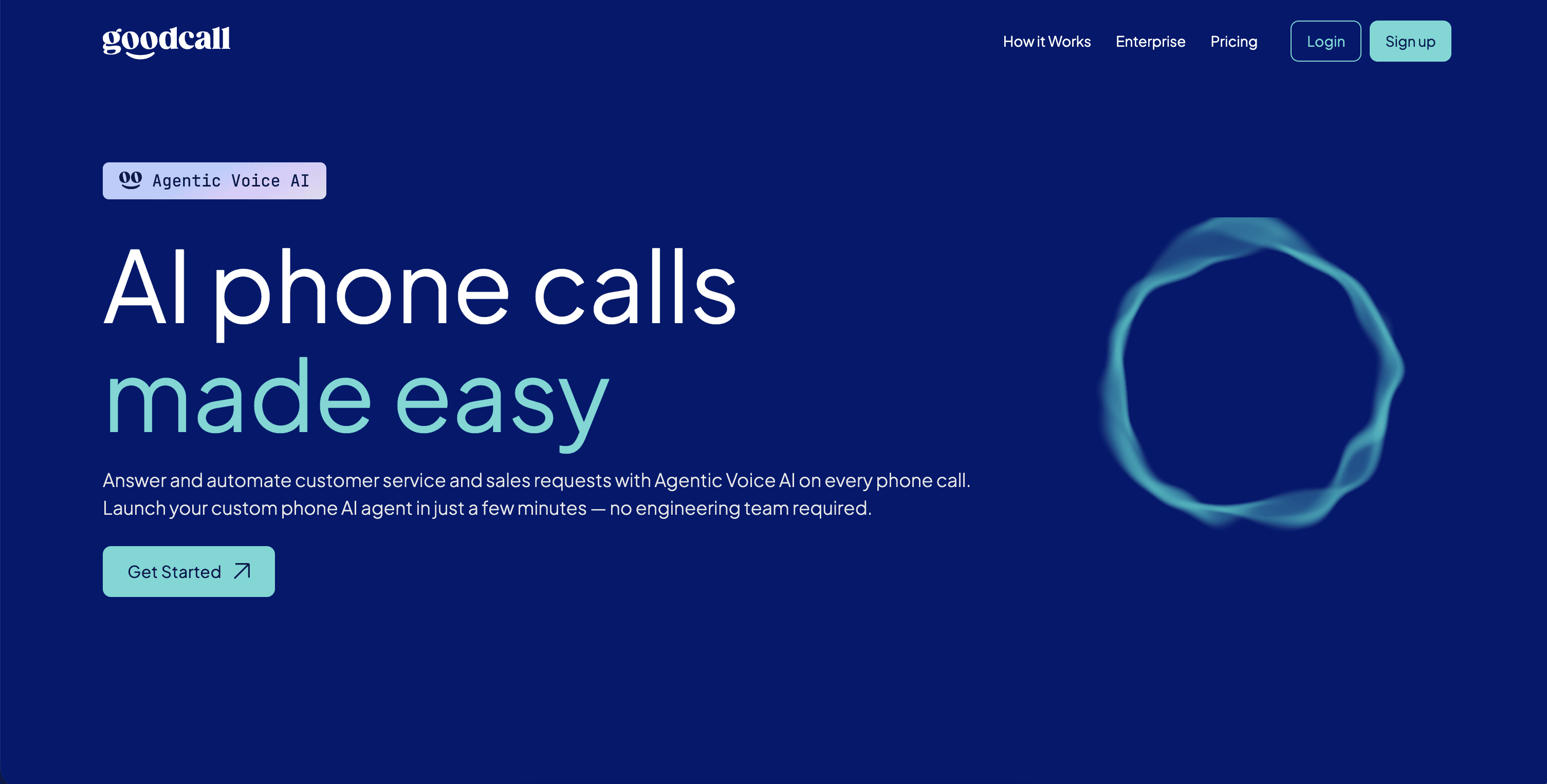
Goodcall is an AI phone agent platform focused on helping small businesses handle inbound calls automatically. It positions itself as an AI-powered alternative to a traditional receptionist, handling tasks like answering common questions, collecting caller information, routing calls, and scheduling appointments. Goodcall integrates with Google Calendar and various CRMs to make it easy to set up a basic automated call experience.
For businesses that are just starting to explore how AI can help with customer calls, reviewing the top benefits of virtual agents for enterprise teams gives a useful sense of what mature enterprise deployments look like compared to SMB tools like Goodcall.
Key Features
AI phone agent for answering and routing inbound calls
Integration with Google Calendar for appointment scheduling
Basic CRM integrations for logging call data
Customizable greetings and call handling scripts
Call recording and voicemail management
Simple web-based setup without technical expertise
Real-time call monitoring for business owners
Affordable monthly pricing for small business budgets
Strengths
Extremely simple to set up and manage for non-technical users
Good fit for small businesses that need to handle basic inbound call inquiries
Affordable pricing with no long-term contracts required
Handles after-hours calls and overflow traffic reliably
Quick to deploy with minimal configuration required
Weaknesses
Not designed for contact centers or any enterprise-scale operations
No QA, compliance, coaching, or conversation intelligence features
Limited conversational ability for complex or multi-step interactions
Does not support outbound calling or multi-agent workflows
Best For
Goodcall is best for small businesses like medical offices, law firms, home services companies, and local retailers that want an automated phone agent to handle basic inbound call traffic without investing in a full contact center platform.
Wrapping Up: The Enterprise Choice for Modern Contact Centers
Most platforms in this list are either built for developers who want to prototype quickly or for small businesses that need a basic phone answering tool. Retell AI itself falls into the developer category: it makes it easy to stand up a voice agent, but it does not have the quality assurance, compliance monitoring, coaching, or conversation intelligence that enterprise contact centers require.
Level AI is different. It was purpose-built for enterprise contact centers and approaches the problem from the inside out. Instead of starting with a voice bot and adding enterprise features later, Level AI starts with the full picture of what a contact center needs: a voice AI platform that automates routine calls, real-time agent assist that guides human agents during live conversations, automated QA that scores every call without manual effort, and conversation intelligence that gives leadership visibility into what is happening across the entire operation.
Enterprises in financial services, healthcare, insurance, and retail use Level AI because it solves the whole problem, not just one part of it. If you are evaluating Retell AI alternatives for your enterprise, Level AI is the only platform in this comparison that gives you a complete, integrated answer.
Frequently Asked Questions
1. Is Retell AI suitable for enterprise contact centers?
Retell AI is designed primarily for developers who want to build voice AI applications quickly. It lacks built-in quality assurance, compliance monitoring, real-time agent assist, and enterprise-grade support options. Most large contact centers find that they need to layer multiple additional tools on top of Retell AI to meet their operational requirements, which increases complexity and cost.
2. What is the biggest difference between Retell AI and platforms like Level AI or Cognigy?
The biggest difference is scope. Retell AI is a voice infrastructure tool. Platforms like Level AI and Cognigy are enterprise systems designed to manage the full contact center workflow, including automated QA, agent coaching, compliance monitoring, and conversation analytics. If you only need to build a basic voice bot, Retell AI may be sufficient. If you need to run a contact center at scale, you need a platform built for that.
3. How long does it take to deploy a Retell AI alternative for an enterprise contact center?
Deployment timelines vary significantly. Developer tools like Vapi or Bland AI can be running in days but require significant custom development for a production-ready deployment. Enterprise platforms like Level AI and Cognigy typically require four to twelve weeks for a full deployment, depending on the complexity of your integrations, call flows, and compliance requirements. Managed service models like PolyAI can shorten this timeline since the vendor handles most of the configuration.
4. Do any of these platforms include built-in call quality assurance?
Among the platforms reviewed in this article, Level AI is the only one that includes built-in automated QA as a core feature. It scores 100% of calls automatically using AI, surfaces compliance risks, and generates coaching recommendations without requiring QA teams to manually listen to recordings. All other platforms in this list require a separate QA tool.
5. What should enterprise buyers prioritize when evaluating Retell AI alternatives?
Start with the questions that matter most to your contact center: Do you need to support both AI-automated calls and human-assisted calls on the same platform? Do you need automated QA and compliance monitoring? Do you operate in a regulated industry? Do you need real-time agent assist during live calls? If the answer to most of these is yes, you need an enterprise-grade platform like Level AI, not a developer-focused voice infrastructure tool. Reviewing the one AI platform overview from Level AI is a good starting point for understanding what an integrated system looks like.