

Key takeaways
Balto handles real-time script guidance well, but falls short when contact centers need QA automation, voice of the customer analysis, and coaching workflows connected to the same data.
The top alternatives in 2026 fall into three categories: purpose-built agent assist platforms (Level AI, Observe.AI, Cresta), CCaaS platforms with built-in guidance (Genesys, Talkdesk, Five9, NICE CXone), and sales-focused conversation tools (Gong, Revenue.io)
For contact centers that need real-time guidance tied to 100% QA coverage and post-call coaching on one platform, Level AI is the strongest replacement
Level AI reduces manual QA effort by up to 90%, cuts new-hire training time by 50%, and scores every interaction against custom rubrics with over 90% agreement with expert human evaluators.
Introduction
Balto built its reputation on real-time agent guidance: checklists, scripts, and prompts delivered during live calls to keep agents on script. For contact centers where script adherence is the primary concern, it covers that use case.
Contact center leaders move on from Balto when their requirements outgrow that lane. Some need deeper QA coverage. Others need real-time agent guidance to connect to post-call analytics, coaching workflows, or voice of the customer data. Others run their operations inside a CCaaS platform and want native tooling rather than a point solution. Sales teams have their own set of requirements that Balto was not built to address.
This article covers the top Balto alternatives across three categories: real-time agent assist platforms, CCaaS tools with built-in guidance capabilities, and sales-focused conversation tools. Each entry includes a product description, key features, strengths, weaknesses, and who the tool fits best.
Why Companies Look for Balto Alternatives?
Balto’s core product is real-time guidance during live calls. That focus is also its constraint.
Limited QA depth. Balto offers automated QA as an add-on, but it is not the primary product. Contact centers that need open-ended rubric evaluation, evidence-backed scoring with timestamps and quotes, or 100% call coverage often find that Balto’s QA layer does not match what purpose-built QA platforms deliver.
Siloed analytics. Balto’s insights concentrate around guidance events during calls. VoC analysis, sentiment trends, root cause identification, and coaching workflows require separate tools or integrations that sit outside the Balto ecosystem.
Rigid real-time prompting. Real-time checklists work well for script-heavy environments. For contact centers handling complex, variable conversations, agents report that persistent on-screen prompts disrupt conversation flow rather than support it.
CCaaS integration friction. Organizations already running on Genesys, Five9, Talkdesk, or NICE often prefer native functionality over a third-party point solution. Balto’s integrations require ongoing maintenance and introduce another vendor into the stack.
Sales team misalignment. Sales teams that need conversation intelligence tied to deal outcomes, pipeline data, and revenue forecasting find Balto’s feature set misaligned with those goals.
Top Balto Alternatives by Category
Category 1: Real-Time Agent Assist Platforms
These platforms put agent guidance at the center of the product. Unlike CCaaS platforms, where guidance is one module among dozens, these tools are built specifically for the contact center agent experience during and after each conversation.
Platform | Real-Time Guidance | QA Automation | VoC Analytics | Native CCaaS | Best Fit |
Level AI | ✅ | ✅ | ✅ | ⚠️ | Contact Centers |
✅ | ✅ | ⚠️ | ❌ | QA & Coaching | |
Cresta | ✅ | ⚠️ | ⚠️ | ❌ | Agent Coaching |
Genesys | ⚠️ | ⚠️ | ⚠️ | ✅ | Enterprise CCaaS |
Talkdesk | ⚠️ | ⚠️ | ❌ | ✅ | Mid-Market CCaaS |
Five9 | ⚠️ | ❌ | ❌ | ✅ | Reliability-Focused Teams |
NICE CXone | ✅ | ✅ | ✅ | ✅ | Regulated Enterprises |
Gong | ⚠️ | ❌ | ❌ | ❌ | B2B Sales Teams |
Revenue.io | ✅ | ❌ | ❌ | ❌ | Outbound Sales Teams |
1. Level AI
Level AI is a contact center intelligence platform that runs quality management, voice of the customer insights, agent assist, and coaching on the same conversation data. Agent guidance during live calls connects directly to the same scoring and analytics engine that evaluates every interaction post-call.
Real-time guidance in Level AI is intent-based. The platform reads the direction of a live conversation and surfaces relevant knowledge base articles, policy snippets, and next-best-action hints based on what the customer is actually asking, not a fixed call flow. After each call, it auto-generates a structured summary and feeds the interaction into QA scoring and coaching workflows automatically. This means the guidance an agent received during a call informs how that agent is coached and evaluated afterward.
Key Features
Real-time KB articles, FAQs, and policy snippets surfaced based on live customer intent
Intent-based hints and flags guiding agents on next best actions during calls
AgentGPT: instant answers from the knowledge base during live conversations
Auto-generated after-call summaries that cut post-call wrap-up by 30%
Manager Assist dashboard with live call health metrics, sentiment alerts, and one-click escalation controls
QA-GPT that scores 100% of interactions against custom rubrics with over 90% agreement with expert human evaluators
VoC analysis across calls, chats, emails, and SMS with no manual setup required
Strengths
Agent guidance, QA, VoC, and coaching run on the same data, so coaching plans are built from actual interaction quality scores
QA-GPT delivers 6x faster reviews for human auditors and reduces manual QA effort by up to 90%
New-hire training time drops by 50% when agents receive real-time guidance from day one
100% interaction coverage across every channel, not a sampled 1-2% of calls
Compliant with GDPR, HIPAA, PCI, and ISO 27001
Best For
Contact centers that need real-time agent guidance connected to quality management and coaching in one platform. Teams moving from sampled QA programs to 100% interaction coverage will see the strongest return. Well-suited to mid-market and enterprise operations in regulated industries.
" transform="translate(85.643 10.143)" width="23.725855670103115px"/><path d="M 71.828 0 L 0 50.702" fill="transparent" height="50.70235051546392px" id="TnJFUMH9b" stroke-dasharray="" stroke-linecap="butt" stroke-linejoin="miter" stroke-miterlimit="10" stroke-width="0.68" stroke="rgb(254, 250, 241)" transform="translate(85.508 75.029)" width="71.82828865979384px"/><path d="M 81.579 0 L 0 52.003" fill="transparent" height="52.00280412371134px" id="ccJzhVTGI" stroke-dasharray="" stroke-linecap="butt" stroke-linejoin="miter" stroke-miterlimit="10" stroke-width="0.68" stroke="rgb(254, 250, 241)" transform="translate(85.495 73.738)" width="81.57921649484533px"/><path d="M 65.653 0 L 0 32.827" fill="transparent" height="32.826556701030924px" id="X0Vp_q8HG" stroke-dasharray="" stroke-linecap="butt" stroke-linejoin="miter" stroke-miterlimit="10" stroke-width="0.68" stroke="rgb(254, 250, 241)" transform="translate(85.462 92.931)" width="65.65311340206183px"/><path d="M 88.08 14.951 L 0 0" fill="transparent" height="14.950762886597914px" id="JM_UgSiJ_" stroke-dasharray="" stroke-linecap="butt" stroke-linejoin="miter" stroke-miterlimit="10" stroke-width="0.68" stroke="rgb(254, 250, 241)" transform="translate(86.233 125.789)" width="88.07950515463914px"/><path d="M 83.204 72.803 L 0 0" fill="transparent" height="72.80313402061856px" id="KlyUUjlMK" stroke-dasharray="" stroke-linecap="butt" stroke-linejoin="miter" stroke-miterlimit="10" stroke-width="0.68" stroke="rgb(254, 250, 241)" transform="translate(85.089 125.71)" width="83.20379381443304px"/><path d="M 7.8 114.081 L 0 0" fill="transparent" height="114.08065979381445px" id="kAiUvduBR" stroke-dasharray="" stroke-linecap="butt" stroke-linejoin="miter" stroke-miterlimit="10" stroke-width="0.68" stroke="rgb(254, 250, 241)" transform="translate(85.95 125.478)" width="7.800247422680428px"/><path d="M 0 93.604 L 9.75 0" fill="transparent" height="93.60445360824741px" id="FsgTAQB0n" stroke-dasharray="" stroke-linecap="butt" stroke-linejoin="miter" stroke-miterlimit="10" stroke-width="0.68" stroke="rgb(254, 250, 241)" transform="translate(76.2 125.421)" width="9.750432989690694px"/><path d="M 0 76.379 L 76.703 0" fill="transparent" height="76.37888659793816px" id="NxOhHvPJ5" stroke-dasharray="" stroke-linecap="butt" stroke-linejoin="miter" stroke-miterlimit="10" stroke-width="0.68" stroke="rgb(254, 250, 241)" transform="translate(9.343 125.217)" width="76.7034556701031px"/><path d="M 0 26.651 L 39.002 0" fill="transparent" height="26.651381443298988px" id="QETNKJ3L6" stroke-dasharray="" stroke-linecap="butt" stroke-linejoin="miter" stroke-miterlimit="10" stroke-width="0.68" stroke="rgb(254, 250, 241)" transform="translate(47.096 125.177)" width="39.0017319587629px"/><path d="M 0 16.901 L 85.154 0" fill="transparent" height="16.900948453608265px" id="BL63wDICD" stroke-dasharray="" stroke-linecap="butt" stroke-linejoin="miter" stroke-miterlimit="10" stroke-width="0.68" stroke="rgb(254, 250, 241)" transform="translate(0.094 125.125)" width="85.15396503092786px"/><path d="M 0 0 L 78.004 17.876" fill="transparent" height="17.875793814432996px" id="PIX70Vlqf" stroke-dasharray="" stroke-linecap="butt" stroke-linejoin="miter" stroke-miterlimit="10" stroke-width="0.68" stroke="rgb(254, 250, 241)" transform="translate(8.362 107.251)" width="78.00376082474227px"/><path d="M 0 0 L 67.928 52.327" fill="transparent" height="52.32742268041238px" id="u_syqWqWD" stroke-dasharray="" stroke-linecap="butt" stroke-linejoin="miter" stroke-miterlimit="10" stroke-width="0.68" stroke="rgb(254, 250, 241)" transform="translate(17.593 72.861)" width="67.92826391752578px"/><path d="M 0 0 L 77.029 70.528" fill="transparent" height="70.52832989690722px" id="DmW_aE2A0" stroke-dasharray="" stroke-linecap="butt" stroke-linejoin="miter" stroke-miterlimit="10" stroke-width="0.68" stroke="rgb(254, 250, 241)" transform="translate(9.489 54.678)" width="77.02866804123713px"/><path d="M 0 0 L 27.301 126.431" fill="transparent" height="126.43109443298971px" id="JrLaRUubC" stroke-dasharray="" stroke-linecap="butt" stroke-linejoin="miter" stroke-miterlimit="10" stroke-width="0.68" stroke="rgb(254, 250, 241)" transform="translate(58.341 -0.071)" width="27.30111340206188px"/><path d="M 0 4.012 C 0 1.796 1.796 0 4.012 0 C 6.228 0 8.025 1.796 8.025 4.012 C 8.025 6.228 6.228 8.025 4.012 8.025 C 1.796 8.025 0 6.228 0 4.012 Z" fill="rgb(254, 80, 0)" height="8.024669690721652px" id="Nh5qrPJs_" transform="translate(81.396 121.369)" width="8.024669690721623px"/></svg>)
2. Observe.AI
Observe.AI is a conversation intelligence platform focused on post-call analysis, agent coaching, and QA automation. The platform added real-time agent guidance capabilities through its Engage product, which surfaces knowledge and prompts during live calls.
Observe.AI’s foundation is post-call analytics. Real-time features exist but were built after the core product was established around post-call workflows. Teams that need both live guidance and deep post-call analytics can access both, though the two layers operate from separate data pipelines.
Key Features
Real-time agent assist with knowledge surfacing during live calls
Automated QA scoring against customizable rubrics
Post-call conversation summaries and action items
Agent performance dashboards and coaching workflows
Sentiment analysis and topic detection across calls
Integrations with major CCaaS platforms
Strengths
Strong post-call analytics with detailed conversation intelligence
Established QA automation with flexible scorecards
Broad CCaaS integration library
Agent coaching tools with performance tracking over time
Well-documented onboarding resources
Weaknesses
Real-time and post-call data can feel disconnected because they were built at different times
VoC and business-level insights are less developed than purpose-built VoC platforms
Pricing scales quickly for full-platform access
Best For
Contact centers that prioritize post-call QA automation and coaching workflows, and want real-time guidance as a secondary capability. Fits mid-to-large operations with existing structured QA programs that are adding a live guidance layer.
See the Level AI vs. Observe.AI comparison for a direct feature breakdown.
3. Cresta
Cresta is a real-time intelligence platform built on large language model technology. It delivers coaching nudges to agents during live conversations and provides post-call performance analytics. Cresta serves both contact centers and B2B sales teams through separate product configurations.
Real-time coaching is the core capability. QA and analytics are built to support that experience rather than as independent programs. Cresta’s positioning centers on improving agent behavior during the conversation rather than evaluating it comprehensively afterward.
Key Features
Real-time coaching suggestions delivered to agents during live calls
AI-generated call summaries after each interaction
Automated QA scoring with customizable rubrics
Performance analytics by agent, team, and topic
Knowledge base integration for real-time article surfacing
Integrations with Salesforce, Genesys, and other enterprise platforms
Strengths
Real-time coaching nudges work well for complex, non-scripted conversations
Strong performance analytics for identifying coaching gaps across teams
Covers both contact center and sales use cases
Good integration options with major CRM and CCaaS platforms
Weaknesses
QA capabilities are secondary to coaching, which limits depth for quality-first programs
VoC and customer-level insights require additional configuration
Enterprise pricing puts it outside the range of smaller contact centers
Best For
Contact centers with a strong coaching culture that want real-time performance nudges for agents handling complex conversations. Also fits B2B sales teams that want conversation coaching connected to performance analytics.
See the Level AI vs. Cresta comparison for a detailed breakdown.
Category 2: CCaaS Platforms with Built-In Agent Guidance
These platforms are complete cloud contact center systems. Agent guidance is one capability within broader infrastructure that covers routing, workforce management, reporting, and channel management. They are relevant Balto alternatives for teams that want to consolidate their tech stack rather than manage a separate point solution.
4. Genesys
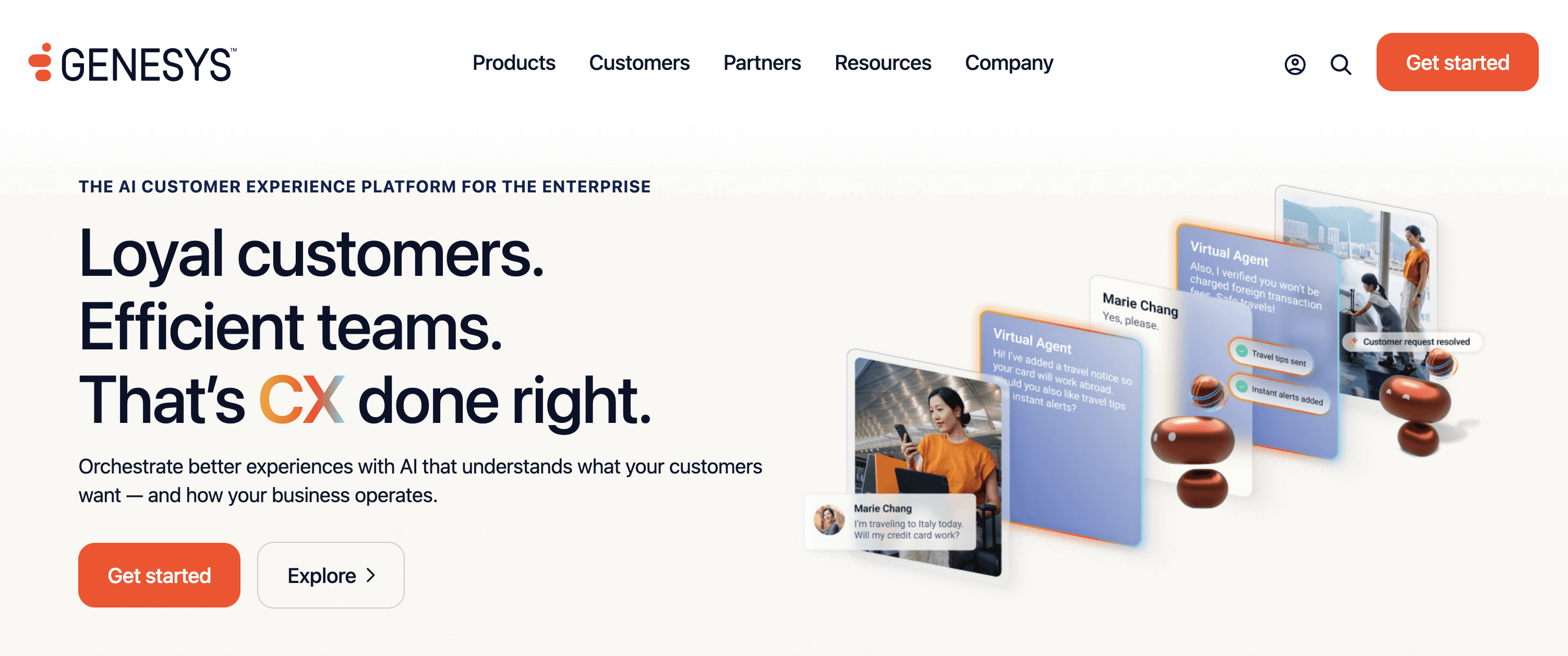
Genesys Cloud CX is one of the most widely deployed cloud contact center platforms. It covers omnichannel routing, workforce engagement management, reporting, and an expanding AI layer through its Genesys AI products.
Agent assist and real-time guidance features are available as modules within Genesys Cloud. Teams already on Genesys can access knowledge surfacing and basic QA automation without adding another vendor to their stack.
Key Features
Omnichannel routing across voice, chat, email, and social
Agent assist with knowledge article surfacing during live interactions
Automated QA scoring through Genesys Cloud Quality Management
Workforce management, including scheduling and forecasting
Real-time and historical reporting dashboards
Native CRM integrations with Salesforce, ServiceNow, and others
Strengths
Full CCaaS infrastructure in one platform, reducing vendor count
Strong global reliability and enterprise-grade uptime
Broad integration ecosystem with established vendor relationships
Ongoing AI feature development built into existing licensing
Weaknesses
Agent guidance and QA capabilities are less advanced than purpose-built platforms
Pricing and contract structures are complex at the enterprise scale
Adding advanced AI features often requires additional licensing on top of base cost
Best For
Large enterprise contact centers looking to consolidate CCaaS infrastructure and basic agent guidance under one platform. Best for organizations where Genesys is already the infrastructure layer and adding a dedicated AI vendor is not preferred.
5. Talkdesk
Talkdesk is a cloud contact center platform targeting mid-market and enterprise operations. It includes native AI features through its AI product line, including real-time agent guidance through Talkdesk Copilot and QA automation through Talkdesk QM.
Both products are available as modules within the Talkdesk platform. Teams that want real-time guidance and basic QA without managing a separate vendor can access both within a single contract.
Key Features
Real-time agent Copilot with knowledge surfacing and next-step guidance
Automated QA scoring with customizable rubrics
Virtual agent for inbound call handling and deflection
Workforce management and scheduling
Analytics and reporting dashboards
Integrations with Salesforce, Zendesk, and major CRMs
Strengths
Clean interface with strong usability
Competitive mid-market pricing relative to larger CCaaS platforms
Real-time and post-call capabilities in one contract
Good CRM integration
Weaknesses
QA depth and VoC analytics are limited compared to specialized platforms
Real-time guidance is not as intent-driven as purpose-built agent assist tools
Performance at enterprise scale can be inconsistent
Best For
Mid-market contact centers that want real-time guidance and QA automation within a single CCaaS platform. Fits teams actively evaluating Talkdesk as their core infrastructure rather than teams that already have a CCaaS in place.
Review contact center automation tools to understand how CCaaS AI layers compare to dedicated agent assist platforms.
6. Five9
Five9 is a cloud contact center platform with a strong track record in mid-market and enterprise deployments. Its AI layer, Five9 Intelligent CX, covers virtual agents, agent assist, and workflow automation. Five9 Genius Agent is the real-time guidance product, surfacing suggested responses and knowledge articles based on conversation context.
Five9 also maintains an open integration framework, which lets teams layer specialist AI tools on top of the core Five9 infrastructure without replacing it.
Key Features
Real-time agent assist with knowledge and response suggestions
Virtual agent for call deflection and self-service
Automated post-call summaries
Workforce management and optimization tools
Analytics and reporting with CRM data integration
Open integration framework for third-party AI tools
Strengths
Strong reputation for call reliability and uptime
Flexible integration framework for adding specialist tools
Good workforce management capabilities
Well-established enterprise support infrastructure
Weaknesses
Native AI features are less advanced than dedicated agent assist or QA platforms
VoC and deep conversation analytics require third-party integrations
UI lags newer entrants on usability
Best For
Contact centers that prioritize call reliability and workforce management, and want basic agent guidance without adding a separate vendor. Also fits teams that want flexible infrastructure they can extend with specialist tools over time.
7. NICE CXone
NICE CXone is an enterprise cloud contact center platform with one of the broadest feature sets available. NICE has invested in AI through its Enlighten AI product line, covering QA automation, agent guidance, workforce forecasting, and customer sentiment analysis.
CXone includes real-time agent guidance through Enlighten Copilot and post-call QA automation through Enlighten QM. For organizations already on NICE, these represent a native path to adding guidance and QA without a separate vendor.
Key Features
Enlighten Copilot for real-time agent guidance and knowledge surfacing
Automated QA scoring with Enlighten QM analytics
Workforce management and forecasting
Customer sentiment analysis across interactions
Omnichannel routing and channel management
Compliance tools for regulated industries
Strengths
Broadest feature set of any CCaaS platform in this list
Strong compliance and security capabilities for regulated industries
Established AI layer with years of development behind it
Large professional services and support network
Weaknesses
Platform complexity slows implementation significantly
High total cost of ownership, particularly for smaller operations
Enlighten AI feature depth varies across the product line
Best For
Large enterprise contact centers with complex compliance requirements that want a single-vendor solution across CCaaS, QA, and agent guidance. Strong fit for regulated industries, including financial services, insurance, and healthcare.
Contact centers evaluating QA as an independent decision should review contact center QA best practices to understand what strong quality programs require beyond platform choice.
Category 3: Sales-Focused Conversation Tools
These tools were not built for contact centers. They were built for sales teams. Balto users who primarily support outbound sales operations sometimes evaluate these platforms because they address conversation coaching with revenue metrics in mind.
8. Gong
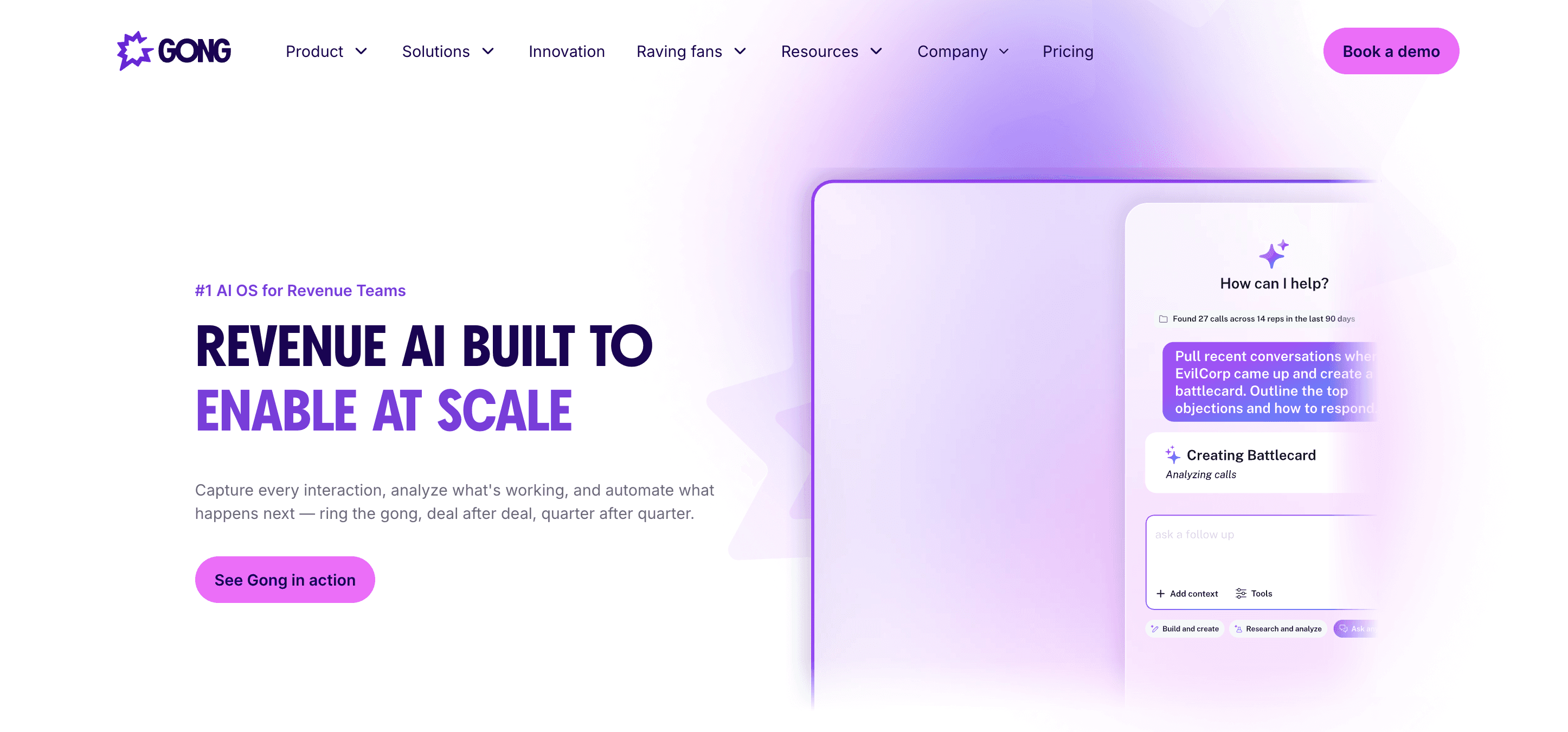
Gong is a revenue intelligence platform. It records and analyzes sales calls, emails, and meetings, then surfaces insights connected to deal outcomes and pipeline data. The primary audience is B2B sales teams, not contact center agents.
Gong indexes conversation data against CRM pipeline to identify patterns in calls that correlate with closed deals. Managers use this to coach reps and inform revenue forecasting. Real-time guidance is available through Gong Assist, though post-call analytics is the product’s core strength.
Key Features
Post-call recording, transcription, and analysis for sales conversations
Deal intelligence tied to conversation patterns and CRM pipeline data
Coaching workflows connected to deal outcomes
Revenue forecasting informed by conversation-based signals
Real-time guidance through Gong Assist
Integration with Salesforce, HubSpot, and major CRMs
Strengths
Revenue analytics connecting conversation behavior directly to deal outcomes
Strong adoption among enterprise B2B sales teams
Forecasting accuracy from conversation-based signals
Deep CRM integration with Salesforce and HubSpot
Weaknesses
Built for sales, not contact centers: lacks QA workflows, compliance tools, and inbound support analysis
Real-time guidance is secondary to post-call analytics
Not suited for inbound customer support or regulated environments
Best For
B2B sales teams looking to connect conversation coaching to revenue outcomes and pipeline forecasting. Not a fit for customer support operations, inbound contact centers, or compliance-sensitive environments.
9. Revenue.io
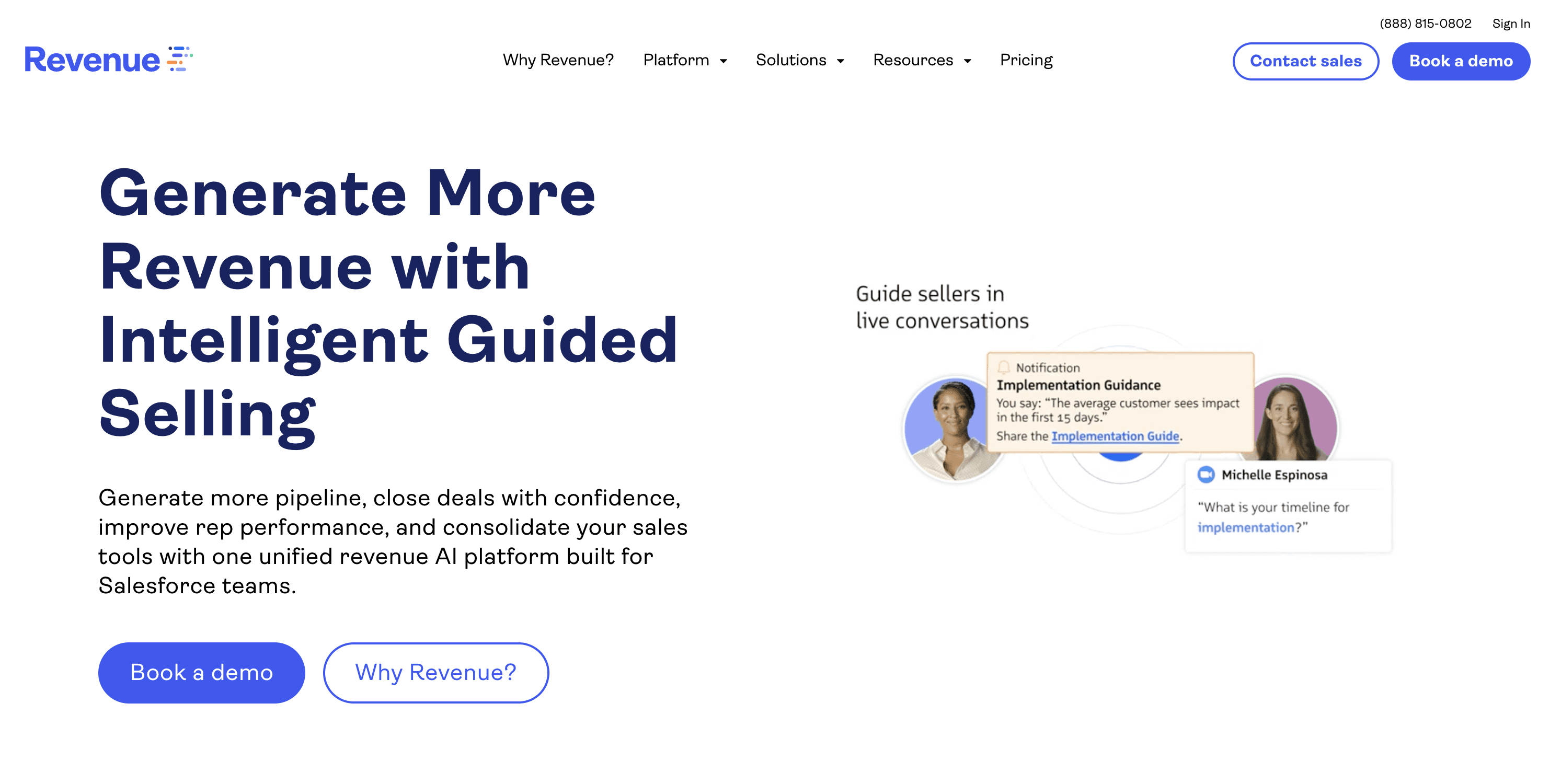
Revenue.io is a real-time revenue intelligence platform for sales teams. It delivers live coaching prompts during sales calls and connects post-call analytics to pipeline and revenue data. Like Gong, it was built for B2B sales operations, not contact center support.
Revenue.io’s real-time layer is more developed than Gong’s. The platform delivers in-call notifications, battlecards, and objection-handling prompts as conversations progress, all synced to Salesforce in real time.
Key Features
Real-time in-call coaching prompts, battlecards, and objection handling guidance
Post-call analytics connected to pipeline and deal data
Automated call summaries synced to Salesforce
Conversation analytics by rep, team, and deal stage
Real-time manager alerts for live sales call monitoring
Integration with Salesforce and major sales tools
Strengths
Strong real-time guidance designed specifically for sales conversations
Tight Salesforce integration with real-time CRM data sync
Manager visibility into live sales calls
ROI framing tied to revenue and pipeline, not just call quality
Weaknesses
Built for sales, not contact centers: lacks QA, compliance tools, and VoC capabilities
Limited omnichannel coverage beyond phone and video calls
Not suitable for inbound support operations or regulated industries
Best For
Inside sales teams and outbound sales contact centers focused on conversion rate and deal velocity. Not suited for customer support programs, QA-heavy operations, or compliance-sensitive contact centers.
Conclusion: Why Level AI is the Best Balto Alternative?
CCaaS platforms offer guidance as one module inside a large infrastructure. Post-call analytics tools add real-time layers after their core has been built. Sales tools serve a different buyer entirely.
Level AI is the strongest Balto alternative for contact centers that need real-time agent guidance connected to the rest of their quality and intelligence program. Agent guidance, QA scoring, VoC analysis, and coaching all run on the same interaction data. That connection is what most Balto replacements do not offer.
The outcomes are specific. Contact centers using Level AI reduce manual QA effort by up to 90%, cut new-hire training time by 50%, and increase CSAT scores by 30%. QA-GPT scores every interaction against custom rubrics, not a sampled 1-2%, with over 90% agreement with expert human evaluators.
Frequently Asked Questions
What does Balto do?
Balto is a real-time agent guidance platform for contact centers. It delivers checklists, scripts, and prompts to agents during live calls. It also includes QA automation and coaching features, though these are secondary to the real-time guidance core.
What is the best Balto alternative for contact centers?
Level AI is the strongest alternative for contact centers that need real-time guidance connected to QA automation, coaching workflows, and voice of the customer analysis on a single platform.
Is Balto a CCaaS platform?
No. Balto is a point solution that integrates with CCaaS platforms. It does not replace routing, workforce management, or core contact center infrastructure.
What should contact centers look for in a Balto alternative?
Real-time guidance connected to post-call QA, coaching workflows informed by interaction scores, VoC analysis across all channels, compliance coverage for regulated industries, and a data model where guidance and quality run together rather than in separate systems.
Does Level AI work for both voice and digital channels?
Yes. Level AI covers calls, chats, emails, and SMS. QA scoring, VoC analysis, and agent guidance operate across all channels from the same platform