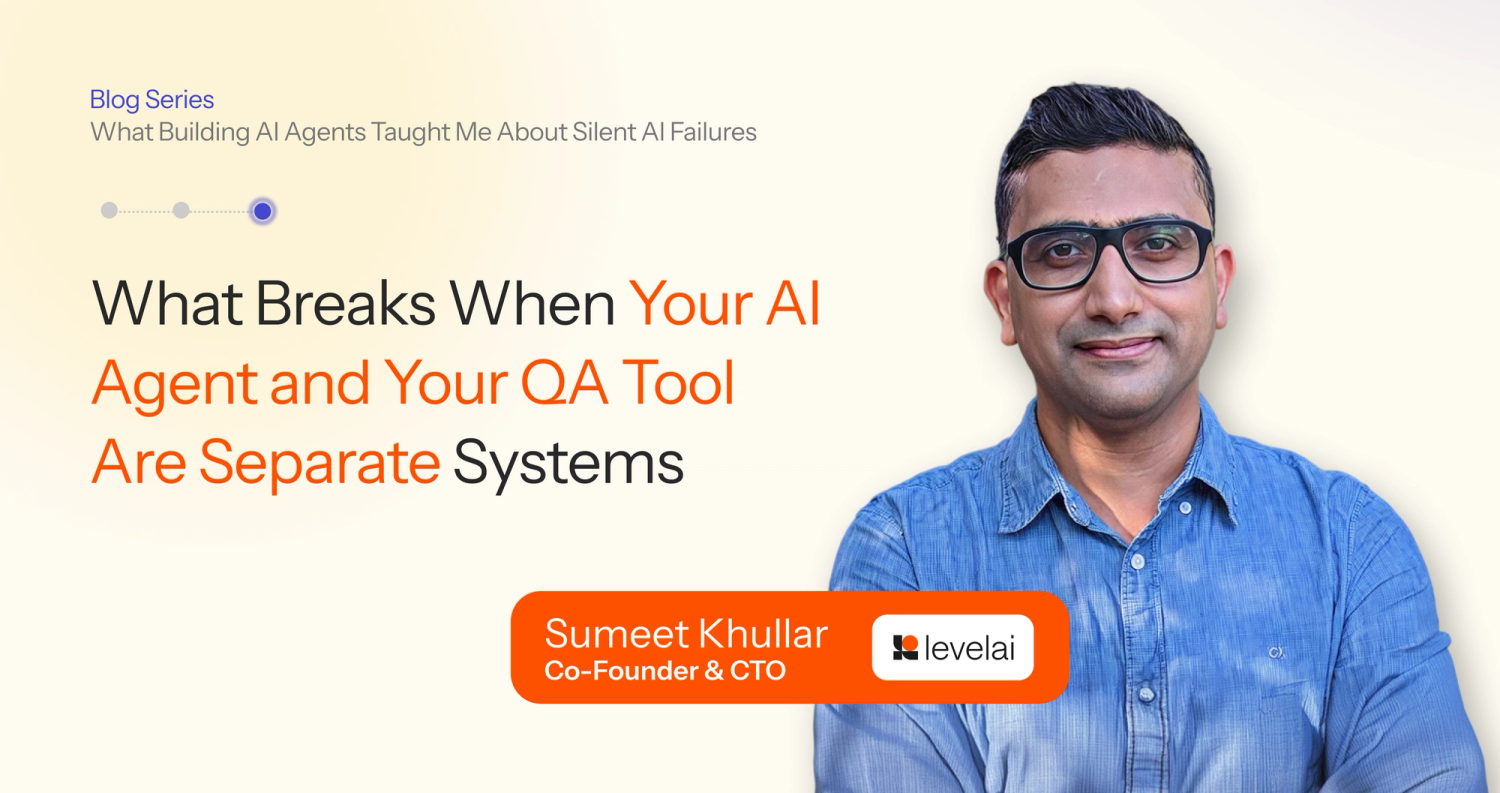
What Breaks When Your AI Agent and Your QA Tool Are Separate Systems?





Summary
- When scoring and configuration live in separate systems, guardrail breaches can score as acceptable simply because the evaluation tool has no visibility into the policies that were actually configured.
- A unified AI powered chatbot platform closes this loop natively by keeping the agent's decision log, tool calls, active policies, and scoring layer in one place, enabling corrections that run continuously rather than reactively.The real accountability bar for enterprise operators is a complete, auditable record of what the agent did at every decision point in every conversation.
- Level AI's VA Pulse scores 100% of conversations across four dimensions: agent decisioning, conversation quality, system performance, and safety, each with a transparent explanation tied directly to configured policy. Most teams cannot answer QA related questions for their AI agents yet. Learn why AI-powered contact centers are raising the bar on agent accountability.
Introduction
The question I hear from CTOs and engineering leaders once an AI agent is running in production is consistent. It is not about language quality or containment rate. It is: "Can I go back and see exactly what happened at every step? Which system did my AI powered chatbot platform contact? What did it send? What policy was it operating under when it made that decision?"
That is the accountability bar enterprise operators hold their agents to. A complete, auditable record of what the agent did at each decision point in every conversation. Visibility into the decision-making process of AI agents is crucial because of their non-deterministic nature.
Providing this across separate tools produces a specific gap. The agent was built by one vendor. A QA tool, if there is one, sits outside it. The configuration rules defining what the agent is authorized to do live in one place. The scoring layer evaluating whether those rules were followed lives somewhere else with no direct access to them. The scoring layer evaluates the agent against a generic rubric rather than against the specific policies configured for that deployment. A guardrail breach scores as acceptable because the evaluation tool has no visibility into what the guardrail actually required.
Fixing a failure caught in scoring requires the same separation to work in reverse. The scoring layer identifies that the agent contacted the wrong backend system and reported an action as complete when it was never processed. That finding needs to reach the configuration layer so the same failure does not repeat across the next day's calls. When scoring and configuration are separate products, that correction requires someone to manually translate the finding into a configuration change, which happens when a person has time for it, not as a continuous operational process.
Level AI built “VA Pulse”, a gold standard for AI agent conversations to close this gap natively. It sits on top of the full record of what the agent did in each conversation: the transcript, the systems the agent contacted, the instructions it sent to those systems, and the rules that were active at each decision point, all in one view. VA Pulse evaluates what the agent did against the specific policies set at configuration, not against a generic rubric. When it catches a failure, the operator applies a fix inside the same platform. The agent is scored again on the same conversation type after the fix. The score changes. That sequence runs on every conversation without manual translation between systems.
VA Pulse scores every conversation across four dimensions:
- Agent decisioning covers whether the agent achieved its goal, whether its actions were accurate, whether it contacted the correct systems, and whether it sent correct parameters.
- Conversation quality covers response clarity, tone, and how handoffs to human agents are handled.
- System performance covers response latency, transcription accuracy, and whether response times stayed within the range required for natural conversation.
- Safety covers whether the agent stayed within its configured scope, avoided disclosing protected information, and handled sensitive interactions within policy.
Every score has an explanation behind it. The operator can see what the agent was supposed to do, what it did, and where the gap was. This is what allows a contact center director to answer their board's question with data rather than assumption. To be able to answer this question, enterprises need an AI powered chatbot platform instead of fragmented AI vendors for every part of the customer journey.
Three questions I ask in every customer conversation about AI agent governance:
- What is the agent's goal achievement rate from last week?
- Where are its out-of-scope failures concentrated, by interaction type?
- How did its performance on each dimension trend over the past 30 days?
These are questions teams can answer today about their human agents using their existing QA programme. The fact that most cannot answer them for their AI agent is the gap the three steps I am covering on May 7 are designed to close: configure with explicit rules, maintain full visibility during every conversation, score 100% of interactions after.
I will walk through all three live in the Level AI platform, including a real failed conversation being caught, explained, and fixed.



Frequently Asked Questions:
Q1: What breaks when your AI powered chatbot platform and QA tool are separate systems?
A: When scoring and configuration live in different products, the evaluation layer has no access to the policies the agent was actually operating under. Guardrail breaches go undetected, failed tool calls require manual follow-up, and fixes depend on someone translating findings across systems rather than applying them automatically.
Q2: How does fragmented AI vendor management create compliance risk in contact centers?
A: When the agent, its configuration rules, and the QA scoring layer are owned by separate vendors, there is no guarantee the evaluation is measuring against the right policies. In regulated industries, this means a compliance breach can score as acceptable simply because the QA tool lacks visibility into what the guardrail required.
Q3: What should enterprises look for in an AI powered chatbot platform for contact centers?
A: Look for a platform that maintains a full, auditable record of every agent decision, including which systems were contacted, what instructions were sent, and which policies were active. Scoring should run against your specific configuration, not a generic rubric, and fixes should apply inside the same system without manual handoffs.
Q4: How is AI agent governance different from traditional contact center QA?
A: Traditional QA measures communication quality across a sample of conversations. AI agent governance requires scoring 100% of interactions across decisioning accuracy, system performance, safety, and conversation quality, all tied to the specific rules configured for that deployment rather than a general evaluation framework.
Q5: What metrics should teams track to measure AI agent performance effectively?
A: The three most actionable metrics are goal achievement rate, out-of-scope failure concentration by interaction type, and performance trends across each scoring dimension over 30 days. These are the same questions teams already answer for human agents; most cannot yet answer them for their AI agents, which is precisely where unified platform visibility makes the difference.
Keep reading
View all