
Key takeaways
Autonomous AI agents complete a customer request inside the conversation, deciding the next step themselves instead of routing the caller through a fixed script
Rising contact volumes, agent burnout, long wait times, and staffing shortages push contact centers toward autonomous agents faster than any hiring plan can close the gap
Autonomous AI runs on a language model, memory, planning logic, tool calls, system integrations, and knowledge retrieval working as one loop
Retail, banking, insurance, healthcare, telecom, and travel brands already use autonomous agents to complete transactions such as returns, claims, and appointment changes
Contact centers move through four adoption stages: measuring conversations, automating workflows, assisting agents in real time, and running fully autonomous interactions
Level AI runs its virtual agent, quality assurance, and Voice of the Customer insights on one generative AI engine, so every autonomous interaction gets scored and analyzed from the same conversation data.
Introduction
Contact centers answer more conversations than their headcount was built to handle. A scripted virtual agent that follows a fixed decision tree cannot close that gap, because it stops at the first request the script did not anticipate.
Autonomous AI agents work differently. They hold the full conversation, decide what to do next, and complete the transaction inside the call or chat, without a person directing each step.
This guide covers what autonomous AI agents are, why contact centers are adopting them, how the technology works underneath, and where autonomous agents already resolve conversations in retail, banking, insurance, healthcare, telecom, and travel. It also maps the four stages contact centers move through on the way to full autonomy.
What Are Autonomous AI Agents and How Do They Differ?
Autonomous AI agents are software systems that decide what to do next in a customer conversation and execute that decision inside connected business systems, without a person scripting each step in advance. A virtual agent built this way completes an order change, a claims update, or an appointment booking inside the same conversation where the customer raised the request.
Autonomous AI vs. Chatbots
A chatbot matches a customer’s words against a script and returns the closest pre-written answer. When a request falls outside that script, the chatbot repeats a menu or hands the conversation to a queue. Autonomous AI agents parse the full sentence, check account data, and choose a next step the script never anticipated, a distinction covered in virtual agent vs. chatbot comparisons.
Autonomous AI vs. AI Agents
An AI agent is any system built to converse with a customer and take action on their behalf. Autonomy describes how much of that action happens without a person approving each step. A copilot-style agent drafts a response, and a human agent still sends it. An autonomous agent sends the response, updates the record, and closes the interaction on its own, then routes to a human only when the conversation crosses a defined threshold.
What Are The Key Characteristics of Autonomous AI?
Multi-channel deployment: The same agent logic runs across voice, chat, email, and SMS, so a contact center configures one set of intents instead of a separate script per channel, an approach detailed on the voice AI platform page.
Context retention across turns: The agent tracks what a customer said earlier in the conversation and carries that context forward, instead of asking the customer to repeat an account number.
Direct system access: The agent reads and writes to a CRM, billing system, or ticketing tool mid-conversation through a platform’s integrations, rather than describing an answer it cannot act on.
Continuous evaluation: Every autonomous interaction is scored through the same quality assurance engine that scores a human agent’s call, so an incorrect action surfaces before it repeats across hundreds of conversations.
Why Do Contact Centers Need Autonomous AI Agents Today?
Rising contact volumes: Digital channels multiplied the ways a customer reaches a contact center, and volume grew faster than a fixed hiring plan accounts for. Contact center leaders route a share of that volume to an autonomous agent instead of waiting on a hiring cycle.
Agent burnout: Repetitive password resets and status checks fill shifts that could go toward calls that need judgment. Autonomous agents absorb that repetitive share, and agent coaching time shifts toward the complex calls that remain.
Long wait times: A caller stuck in a queue for a password reset abandons the call or escalates frustrated. An autonomous agent answers that request the moment it arrives, at any hour, without adding a shift to the schedule.
High-quality assurance costs: A manual review program samples 1 to 2 percent of calls, leaving the rest unscored. Level AI’s Auto-QA reviews 100 percent of interactions and cuts manual QA effort by up to 90 percent, a shift Quinstreet’s Director of Operations, Angela Zander, described directly in the Quinstreet case study: “We’ve gone from manually scoring 1-2% of our calls to using Level AI to score 100% of our calls.”
Staffing shortages: Contact centers compete for the same labor pool as retail and hospitality, and open requisitions for entry-level agent roles stay open longer than a queue can wait. Autonomous agents absorb volume without adding headcount, a model covered further for BPO operations.
Increasing customer expectations: A customer who resolved a banking dispute in two taps on a mobile app expects the same speed on a phone call. Autonomous agents complete that same request inside the call, closing the gap between what a digital channel already delivers and what a phone line has offered.
How Do Autonomous AI Agents Actually Work?
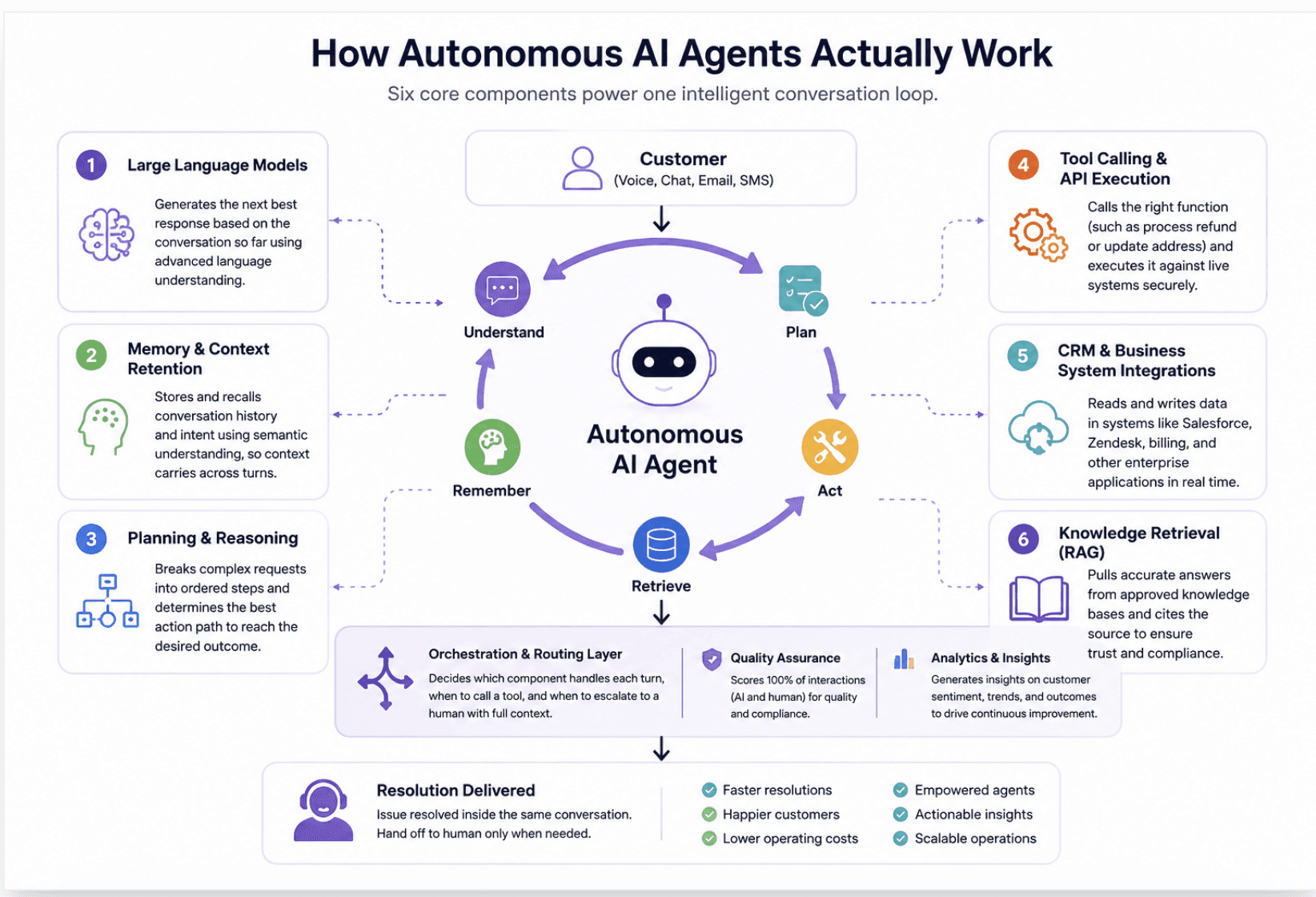
Autonomous AI agents combine six components into one conversation loop, and removing any one of them breaks the loop.
Large language models: A language model generates the agent’s next sentence based on the conversation so far, built on patterns of language rather than a fixed script tree.
Memory and context retention: The agent stores what happened earlier in the same conversation, using semantic understanding of intent rather than keyword matching, so a question asked in turn two does not need to be asked again in turn eight.
Planning and reasoning: The agent breaks a request like “cancel my order and refund the difference” into ordered steps, cancel then refund, instead of matching the sentence against a single script line.
Tool calling and API execution: The agent calls a function, such as processing a refund or updating an address, and the surrounding system executes that function against a live account, rather than describing the action in text only.
CRM and business system integrations: The agent reads and writes to Salesforce, Zendesk, or a proprietary system through a platform’s integrations layer, so an account lookup happens inside the conversation instead of a manual step after the call.
Knowledge retrieval: The agent pulls an answer from an approved knowledge base, a method known as retrieval-augmented generation, and grounds that answer in a source document instead of generating an unverified response.
A routing layer decides which component handles a given turn and when to hand the conversation to a human agent with full context attached. The one AI platform architecture runs that orchestration layer alongside quality assurance and analytics, on the same conversation data.
What Can Autonomous AI Agents Do in Modern Contact Centers?
Resolve conversations across voice and digital channels: The agent holds the full conversation on a phone call, in chat, or over SMS, and completes the request inside that channel.
Complete backend actions: The agent updates a CRM record, processes a refund, or books an appointment inside the conversation, using the same integrations that connect agent assist to a contact center’s systems.
Assist human agents in real time: The same conversational core surfaces a knowledge base answer through AgentGPT mid-call, cutting hold time by 40 percent when an agent pulls a policy answer instead of placing the customer on hold.
Automate quality assurance across every interaction: Every autonomous conversation, and every human agent conversation, runs through the same Auto-QA scoring engine, reaching over 90 percent agreement with expert human QA reviewers.
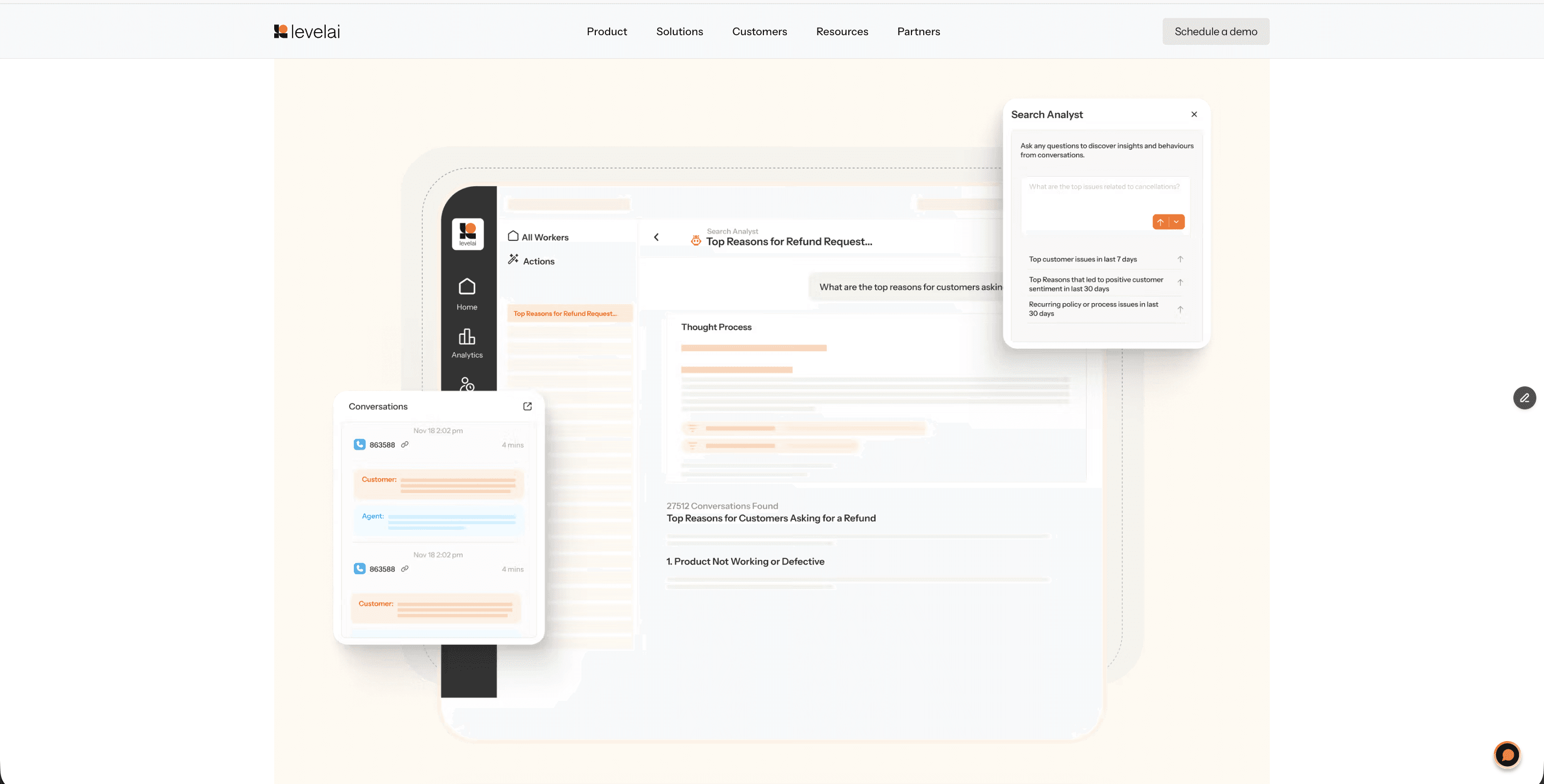
Generate insights from customer conversations: Autonomous agents produce structured Voice of the Customer insights from 100 percent of interactions, surfacing a product issue or a policy gap before it turns into a support spike.
" transform="translate(85.643 10.143)" width="23.725855670103115px"/><path d="M 71.828 0 L 0 50.702" fill="transparent" height="50.70235051546392px" id="TnJFUMH9b" stroke-dasharray="" stroke-linecap="butt" stroke-linejoin="miter" stroke-miterlimit="10" stroke-width="0.68" stroke="rgb(254, 250, 241)" transform="translate(85.508 75.029)" width="71.82828865979384px"/><path d="M 81.579 0 L 0 52.003" fill="transparent" height="52.00280412371134px" id="ccJzhVTGI" stroke-dasharray="" stroke-linecap="butt" stroke-linejoin="miter" stroke-miterlimit="10" stroke-width="0.68" stroke="rgb(254, 250, 241)" transform="translate(85.495 73.738)" width="81.57921649484533px"/><path d="M 65.653 0 L 0 32.827" fill="transparent" height="32.826556701030924px" id="X0Vp_q8HG" stroke-dasharray="" stroke-linecap="butt" stroke-linejoin="miter" stroke-miterlimit="10" stroke-width="0.68" stroke="rgb(254, 250, 241)" transform="translate(85.462 92.931)" width="65.65311340206183px"/><path d="M 88.08 14.951 L 0 0" fill="transparent" height="14.950762886597914px" id="JM_UgSiJ_" stroke-dasharray="" stroke-linecap="butt" stroke-linejoin="miter" stroke-miterlimit="10" stroke-width="0.68" stroke="rgb(254, 250, 241)" transform="translate(86.233 125.789)" width="88.07950515463914px"/><path d="M 83.204 72.803 L 0 0" fill="transparent" height="72.80313402061856px" id="KlyUUjlMK" stroke-dasharray="" stroke-linecap="butt" stroke-linejoin="miter" stroke-miterlimit="10" stroke-width="0.68" stroke="rgb(254, 250, 241)" transform="translate(85.089 125.71)" width="83.20379381443304px"/><path d="M 7.8 114.081 L 0 0" fill="transparent" height="114.08065979381445px" id="kAiUvduBR" stroke-dasharray="" stroke-linecap="butt" stroke-linejoin="miter" stroke-miterlimit="10" stroke-width="0.68" stroke="rgb(254, 250, 241)" transform="translate(85.95 125.478)" width="7.800247422680428px"/><path d="M 0 93.604 L 9.75 0" fill="transparent" height="93.60445360824741px" id="FsgTAQB0n" stroke-dasharray="" stroke-linecap="butt" stroke-linejoin="miter" stroke-miterlimit="10" stroke-width="0.68" stroke="rgb(254, 250, 241)" transform="translate(76.2 125.421)" width="9.750432989690694px"/><path d="M 0 76.379 L 76.703 0" fill="transparent" height="76.37888659793816px" id="NxOhHvPJ5" stroke-dasharray="" stroke-linecap="butt" stroke-linejoin="miter" stroke-miterlimit="10" stroke-width="0.68" stroke="rgb(254, 250, 241)" transform="translate(9.343 125.217)" width="76.7034556701031px"/><path d="M 0 26.651 L 39.002 0" fill="transparent" height="26.651381443298988px" id="QETNKJ3L6" stroke-dasharray="" stroke-linecap="butt" stroke-linejoin="miter" stroke-miterlimit="10" stroke-width="0.68" stroke="rgb(254, 250, 241)" transform="translate(47.096 125.177)" width="39.0017319587629px"/><path d="M 0 16.901 L 85.154 0" fill="transparent" height="16.900948453608265px" id="BL63wDICD" stroke-dasharray="" stroke-linecap="butt" stroke-linejoin="miter" stroke-miterlimit="10" stroke-width="0.68" stroke="rgb(254, 250, 241)" transform="translate(0.094 125.125)" width="85.15396503092786px"/><path d="M 0 0 L 78.004 17.876" fill="transparent" height="17.875793814432996px" id="PIX70Vlqf" stroke-dasharray="" stroke-linecap="butt" stroke-linejoin="miter" stroke-miterlimit="10" stroke-width="0.68" stroke="rgb(254, 250, 241)" transform="translate(8.362 107.251)" width="78.00376082474227px"/><path d="M 0 0 L 67.928 52.327" fill="transparent" height="52.32742268041238px" id="u_syqWqWD" stroke-dasharray="" stroke-linecap="butt" stroke-linejoin="miter" stroke-miterlimit="10" stroke-width="0.68" stroke="rgb(254, 250, 241)" transform="translate(17.593 72.861)" width="67.92826391752578px"/><path d="M 0 0 L 77.029 70.528" fill="transparent" height="70.52832989690722px" id="DmW_aE2A0" stroke-dasharray="" stroke-linecap="butt" stroke-linejoin="miter" stroke-miterlimit="10" stroke-width="0.68" stroke="rgb(254, 250, 241)" transform="translate(9.489 54.678)" width="77.02866804123713px"/><path d="M 0 0 L 27.301 126.431" fill="transparent" height="126.43109443298971px" id="JrLaRUubC" stroke-dasharray="" stroke-linecap="butt" stroke-linejoin="miter" stroke-miterlimit="10" stroke-width="0.68" stroke="rgb(254, 250, 241)" transform="translate(58.341 -0.071)" width="27.30111340206188px"/><path d="M 0 4.012 C 0 1.796 1.796 0 4.012 0 C 6.228 0 8.025 1.796 8.025 4.012 C 8.025 6.228 6.228 8.025 4.012 8.025 C 1.796 8.025 0 6.228 0 4.012 Z" fill="rgb(254, 80, 0)" height="8.024669690721652px" id="Nh5qrPJs_" transform="translate(81.396 121.369)" width="8.024669690721623px"/></svg>)
Where Are Autonomous AI Agents Used in Contact Centers Today?
Retail: order management and returns. An autonomous agent looks up an order, processes a return, and issues store credit inside the same chat conversation, connected through the systems covered under retail deployments.
Banking: account servicing and fraud support. An agent verifies identity through multi-factor authentication, checks a balance, or flags a disputed charge for review, inside the workflows covered for banking and credit unions. The same agent runs under the compliance controls built into the virtual agent platform.
Insurance: claims processing. An agent collects claim details, checks policy status, and opens a case in the claims system, a workflow covered for insurance carriers.
Healthcare: appointment scheduling and patient inquiries. An agent schedules or reschedules an appointment and answers a benefits question, running under the HIPAA compliance built into the Level AI virtual agent for healthcare.
Telecom: troubleshooting and service requests. An agent walks a customer through a device reset or schedules a technician visit, closing a service request without a hold queue.
Travel and hospitality: booking changes and cancellations. An agent rebooks a flight, cancels a reservation, or applies a credit inside the conversation, a use case covered for travel and hospitality brands.
How Can Contact Centers Successfully Adopt Autonomous AI?
Contact centers move through four stages on the way to autonomous service. Skipping a stage means rebuilding the skipped work later.
Wave 1: Foundational Intelligence
The first stage analyzes conversations that already happen, without changing how any of them run. Conversation intelligence categorizes reason, resolution, effort, and sentiment across every call, chat, and email. That analysis measures customer experience and sets a performance baseline before any automation work starts.
Wave 2: Workflow Automation
The second stage automates the administrative work sitting around the conversation itself. Auto-QA scores 100 percent of interactions instead of the 1 to 2 percent a manual program samples, and generative summaries close out after-call work automatically, eliminating 50 percent of manual wrap-up.
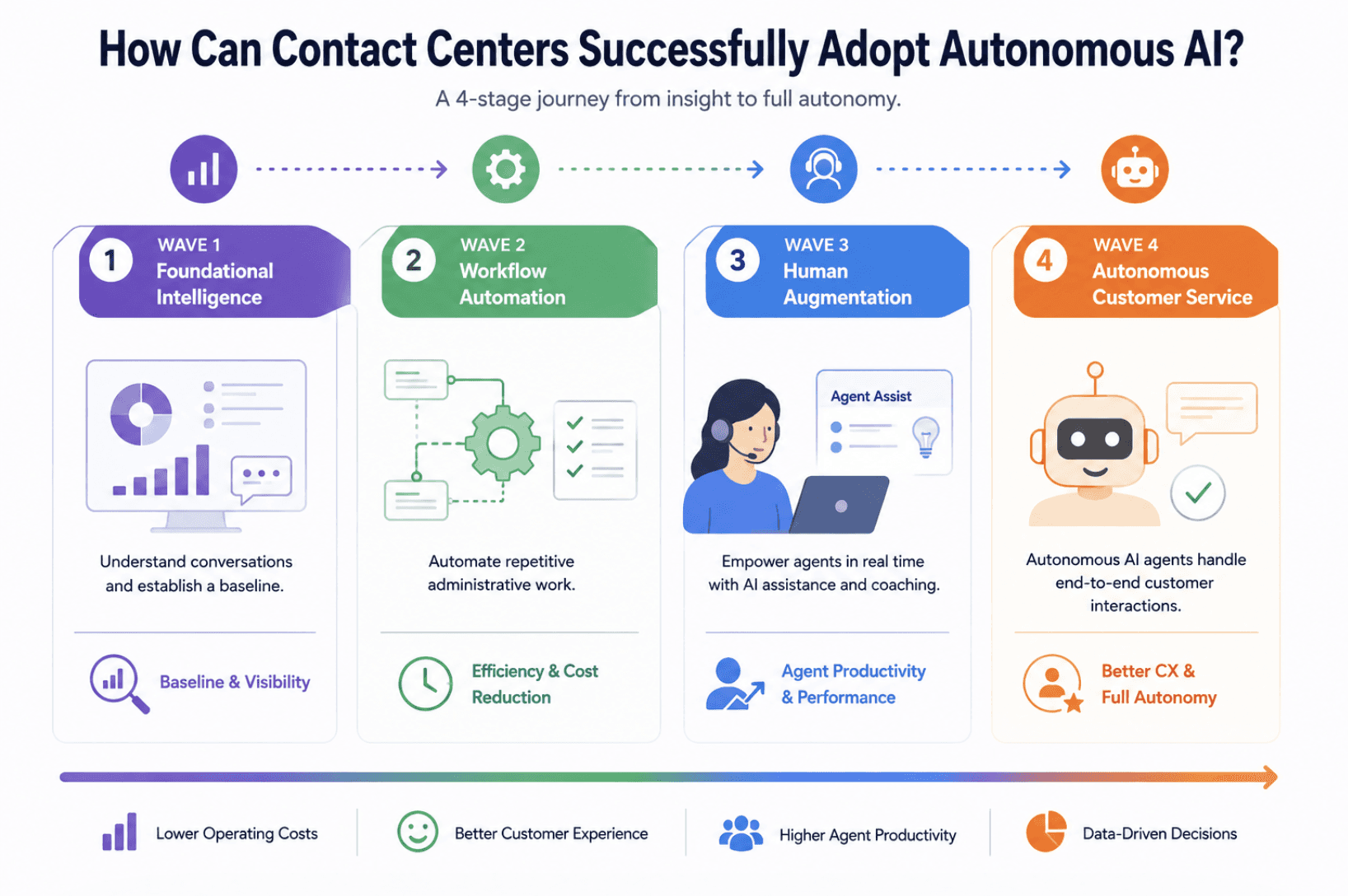
Wave 3: Human Augmentation
The third stage puts the same intelligence in front of an agent during the call, not only in a report afterward. Agent Assist surfaces a knowledge base answer or a coaching recommendation mid-conversation, cutting new-hire training time by 50 percent and reducing post-call work by 30 percent.
Wave 4: Autonomous Customer Service
The fourth stage hands complete interactions to the virtual agent, which runs the conversation from greeting to resolution and routes to a human agent only when the request crosses a defined threshold. Human agents spend the freed time on the complex, high-value conversations that still need judgment.
What’s Next for Autonomous AI in Contact Centers?
Level AI already extends its conversational core into specialized AI workers built for one task each, such as coaching an agent after a call or flagging a compliance gap for a supervisor to review. The same worker model extends into workforce management, where an autonomous system forecasts staffing needs from real conversation volume instead of a historical average.
Predictive customer service moves the intervention earlier than the complaint. A conversation flagged for rising frustration across a product line surfaces on a manager dashboard before the volume of related contacts climbs, rather than after a spike shows up in next month’s report.
Human agents and autonomous agents will keep splitting the same queue, with the agent handling judgment calls and the autonomous system handling the transactional volume behind it. Contact centers that build this split into their operating model now add each new use case to one system, instead of running automation as a separate project next to the existing floor.
Ready to Build an Autonomous Contact Center with Level AI?
Level AI runs conversation intelligence, automated quality assurance, agent assist, and the virtual agent on one generative AI and semantic intelligence engine, so an autonomous agent’s conversation gets analyzed by the same system that scores a human agent’s call. Eileen Conboy, Support Operations Principal at Via Transportation, described that shift after moving off a keyword-based tool in the Via Transportation case study: “Level AI listened to the whole story.”
A contact center running Level AI gets a virtual agent that resolves voice and chat conversations directly. The same conversation data feeds Auto-QA, which scores 100 percent of interactions instead of a manual sample. It also feeds Voice of the Customer insights, surfacing a product or process issue before it turns into a support spike.
Customer satisfaction increases 30 percent when quality, coaching, and automation run on that shared conversation data instead of three disconnected tools. Contact center efficiency increases 20 percent under the same setup. Agent satisfaction increases 45 percent for the agents working alongside it.
Contact centers that treat autonomous AI as a single, disconnected pilot rebuild the integration work every time a new use case gets added. Contact centers that run conversation intelligence, quality assurance, agent assist, and the virtual agent on one engine add each new use case to a system that already holds the conversation data behind it.
The mechanics behind an autonomous agent, language understanding, memory, tool calls, and grounded knowledge retrieval, already run in production across retail, banking, insurance, healthcare, telecom, and travel. The remaining decision for a CX leader is which conversations move to autonomous resolution first, and which stay with a human agent handling the judgment calls that still need one.
Frequently Asked Questions
What's the difference between an AI agent, an autonomous AI agent, and agentic AI?
An AI agent performs specific tasks based on user requests, while an autonomous AI agent can independently plan, make decisions, and complete end-to-end workflows with minimal human intervention. Agentic AI is the broader concept that enables this autonomous behavior through reasoning, planning, and tool use. In contact centers, platforms like Level AI use autonomous AI agents to resolve customer issues while seamlessly handing off complex cases to human agents when needed.
Can autonomous AI agents really resolve customer issues without human intervention?
Yes, autonomous AI agents can independently resolve routine customer requests such as order updates, appointment scheduling, refunds, and account inquiries. When a request requires empathy, complex judgment, or falls outside predefined guardrails, the conversation is transferred to a human agent with full context, ensuring a seamless customer experience
What can autonomous AI agents actually do in a contact center today?
Autonomous AI agents can answer customer questions, process transactions, update CRM records, schedule appointments, and troubleshoot common issues across voice and digital channels. Solutions like Level AI also combine autonomous agents with Auto-QA, Agent Assist, and Voice of the Customer analytics, helping organizations automate conversations while continuously improving service quality.
What are the biggest challenges of implementing autonomous AI?
The biggest challenges include ensuring accurate responses, integrating with business systems, maintaining security and compliance, and defining when AI should escalate to a human. Organizations that combine strong governance with continuous monitoring are far more likely to deploy autonomous AI successfully.
How do you choose the right autonomous AI platform?
Choose a platform that supports voice and digital channels, integrates with your CRM and contact center systems, provides enterprise-grade security, and includes built-in analytics. Platforms like Level AI go beyond automation by combining conversational intelligence, quality assurance, agent assistance, and autonomous AI in a single platform, making it easier to scale AI across the contact center.