
Key Takeaways
Decagon handles digital chat support well for SaaS and fintech teams, but buyers consistently run into three gaps: no native voice support, no built-in quality assurance, and integration friction when chat transcripts are passed to platforms like Zendesk as a single unstructured block of text.
The core reason teams look for alternatives is consolidation. Most Decagon users also run separate tools for QA, agent performance, and conversation analytics. Level AI removes that overhead by combining AI automation, real-time agent assist, automated QA, and customer insights in one platform.
Decagon is perceived as a capable and innovative product but one that carries a higher price tag relative to what it covers. Teams that want more capability per dollar look toward platforms that bundle automation with operational intelligence.
Sierra is the strongest Decagon alternative for consumer and DTC brands that primarily want polished, brand-consistent chat experiences, with documented results at companies like Brex, Gap, and Tubi.
Cresta and Level AI are the strongest options for teams whose contact center handles both chat and voice, and who need agent coaching and QA coverage alongside conversation automation.
See how Level AI compares directly to Decagon: Level AI vs Decagon.
What is Decagon?
Decagon is an AI customer support platform built to handle complex, multi-step support conversations in digital channels. Unlike basic keyword-matching chatbots, Decagon agents can reason across topics, execute transactional actions like account updates or refund processing, and retrieve answers from connected knowledge bases with citations showing customers where information came from.
The platform is used primarily by SaaS companies and fintech teams that need an AI agent capable of handling support complexity beyond a simple FAQ. Its natural language approach has produced strong results in deflection rates for companies like Chime, Rippling, Duolingo, and Substack. Decagon also offers agent assist functionality that surfaces suggested responses by crawling internal and external knowledge sources during live conversations.
Where Decagon ends is also where most buyers start looking elsewhere. The platform covers digital chat and, increasingly, email and voice in specific contexts, but it does not include quality assurance, conversation analytics at the contact center level, or real-time agent coaching. Teams that want those capabilities in the same system need to look at broader platforms.
Read why siloed AI tools create operational blind spots: What Breaks When Your AI Agent and QA Tool Are Separate Systems.
Why Buyers Evaluate Decagon Alternatives?
Conversations with teams evaluating or already using Decagon reveal a consistent set of reasons they start looking at alternatives. Understanding these helps you know whether any of them apply to your situation.
The first reason is tool sprawl and cost. Decagon handles the chatbot and agent assist layer. But most contact center and support teams also run a separate QA platform, a separate analytics tool, and often a separate agent coaching solution. Each of those costs money, requires its own integration, and produces data that lives in a silo. Teams that want to reduce that overhead look for platforms that bundle more capabilities together.
The second reason is integration friction. Decagon escalates conversations by sending the full chat transcript as a single block of text into platforms like Zendesk. For teams running conversation intelligence tools alongside Decagon, that unstructured format can make it harder to analyze what happened during the AI-handled portion of the conversation. Teams that want clean, structured data flowing into their support stack flag this as a recurring frustration.
The third reason is the absence of voice. Decagon is built for digital channels. Teams whose contact centers handle significant phone volume, or who want to move toward a unified AI platform across both voice and chat, cannot accomplish that with Decagon alone. They need a platform that handles telephony natively.
The fourth reason is pricing. Decagon is positioned as a premium AI product, and its pricing reflects that. For teams that are not yet at the scale where Decagon’s depth justifies the cost, or teams that want more capability per dollar, there are alternatives that offer a broader feature set at a more competitive price point.
Explore the full landscape of contact center automation tools: Contact Center Automation Tools.
How Did We Compare These Tools?
We evaluated each platform on five criteria that matter most to buyers coming from Decagon.
First, conversation handling quality: how well does the AI manage complex, multi-step queries, including topic switches, ambiguous intent, and transactional actions?
Second, channel coverage: does the platform handle voice, chat, email, or a combination?
Third, built-in operational capabilities: does it include QA, agent assist, coaching, or analytics, or does it require separate tools for those functions?
Fourth, integration with the enterprise stack: how cleanly does it connect with Zendesk, Salesforce, Genesys, and other systems the team already uses?
Fifth, pricing transparency and fit for the team size.
We also paid attention to which platforms are truly built for enterprise contact centers versus which are better suited for smaller SaaS support teams. The distinction matters because the requirements around compliance, call volume, telephony, and workforce management diverge significantly at enterprise scale.
See real outcomes from enterprise teams that have evaluated these choices: Level AI Customer Case Studies.
Top Decagon Alternatives: Comparison Table
Platform | Best For | Voice Support | Native QA | Key Differentiator |
Level AI | Enterprise contact centers needing full-stack AI coverage | Yes | Yes | Automation + QA + agent assist + analytics in one platform |
Sierra | Consumer and DTC brands wanting polished branded AI agents | Yes | No | Highest-quality branded chat experience with proven consumer ROI |
Ada | Mid-market teams wanting fast no-code chat deflection | No | No | No-code builder that non-technical support teams can manage |
Cognigy | Large enterprises needing complex bot orchestration across channels | Yes | No | Flexible conversation design with enterprise governance features |
Kore.ai | Enterprises with multi-system bot workflows and legacy integrations | Yes | No | Deep enterprise backend integrations including SAP and legacy systems |
Parloa | European enterprises with high-volume voice automation needs | Yes | No | Voice-first automation with strong DACH market presence |
Fin | Teams using Intercom who want fast AI chat deflection | No | No | Zero-friction activation for existing Intercom customers |
Cresta | Enterprise contact centers needing voice AI plus agent coaching | Yes | Yes | Combines virtual agents with real-time coaching on a single platform |
Bland AI | Developers building custom voice AI products and workflows | Yes | No | API-first voice infrastructure for engineering teams |
Tidio | Small and mid-market teams wanting affordable live chat plus AI | No | No | Low-cost entry point with built-in live chat and basic AI deflection |
1. Level AI
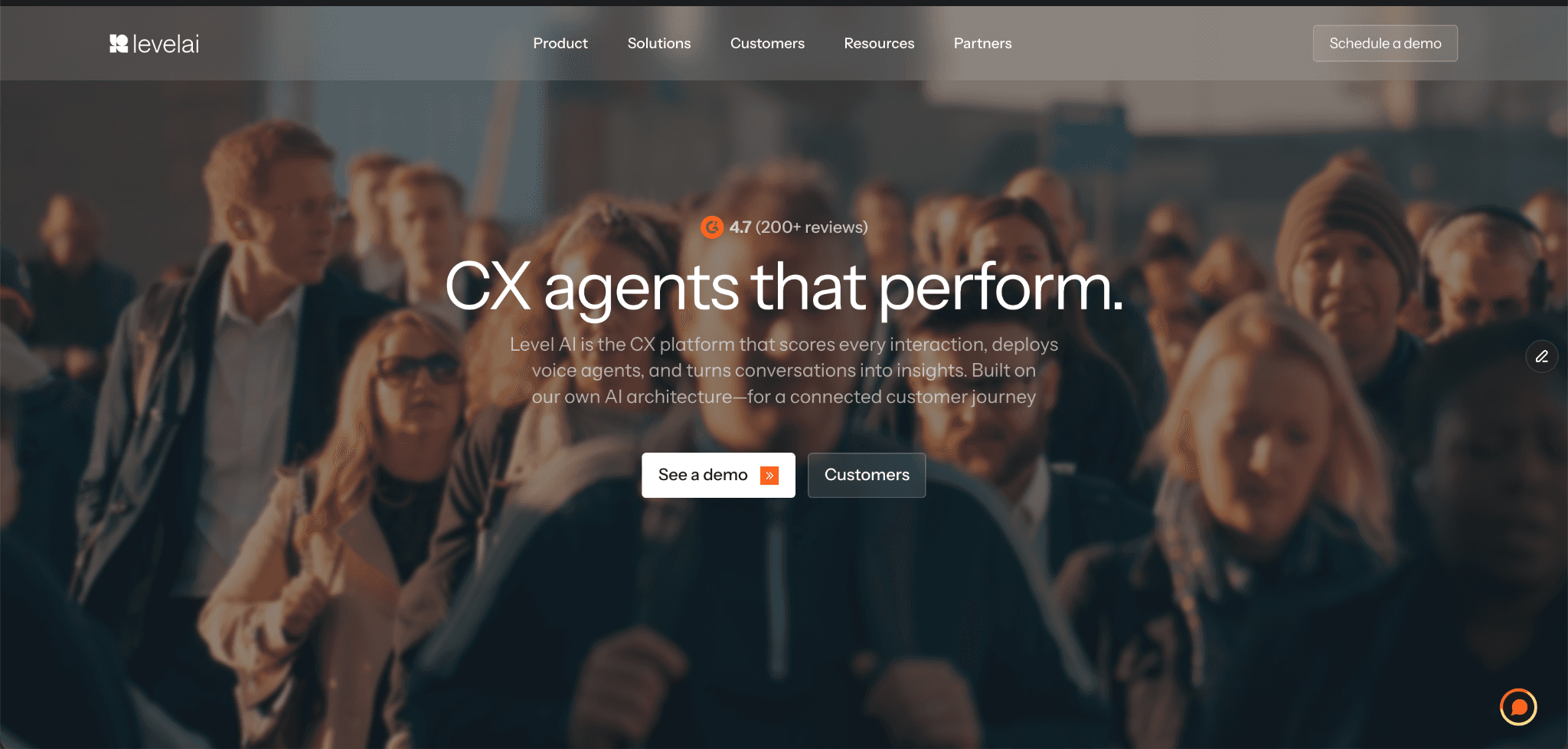
For teams looking to replace or expand beyond Decagon, Level AI addresses the most common gaps in a single platform. While Decagon handles the chat automation layer, Level AI covers the complete contact center workflow: AI virtual agents that resolve conversations autonomously, real-time agent assist that surfaces answers and compliance guidance during live interactions, automated quality assurance that evaluates every interaction without sampling, and customer analytics that surface what is actually driving contact volume and sentiment.
The practical difference matters for enterprise teams. A Decagon customer running separate QA and analytics tools is managing at least three vendor relationships, three sets of data in three systems, and three integration points to maintain. Level AI consolidates that into one. Every AI-handled conversation and every human-handled conversation runs through the same intelligence layer, so QA managers and contact center leaders see a complete picture rather than a fragmented one.
Level AI works across voice and digital channels and connects with the telephony and CRM platforms enterprise contact centers already run, including Five9, Genesys, Salesforce, and Zendesk. Customers in fintech, insurance, healthcare, and retail use it to automate routine conversations, improve agent performance, and get operational insight from their entire conversation data set rather than a small sample.
Key Features
AI virtual agents that handle end-to-end conversations across voice and chat, with clean handoffs to human agents when the conversation requires it
Real-time agent assist that surfaces relevant answers, next-best-action guidance, and compliance alerts during live calls and chats without agents needing to search
Automated QA that scores every interaction against custom scorecards and compliance criteria, replacing manual sampling with complete coverage
Voice-of-the-customer analytics that identify topic trends, sentiment shifts, and emerging issues from every conversation, not just a sample
iCSAT, which predicts customer satisfaction on every interaction without requiring post-call surveys, giving teams a signal on 100% of conversations
Agent coaching that identifies skill gaps from actual interaction data and recommends targeted development rather than generic training
Screen recording and desktop capture that give QA reviewers full operational context alongside the conversation transcript
Native integrations with Five9, Genesys, NICE CXone, Salesforce, Zendesk, ServiceNow, and major telephony providers
Strengths
The only platform in this list that covers AI virtual agents, real-time agent assist, automated QA, and customer analytics in a single product, removing the integration overhead that Decagon users who also run separate QA and analytics tools deal with today
Automated QA on every interaction means compliance teams have complete coverage, not the 2-5% visibility that manual sampling produces
Works across voice and digital channels, which matters for contact centers that cannot serve their customers through chat alone
iCSAT removes the dependency on post-call surveys, giving leaders a satisfaction signal on interactions where customers never complete a survey
Telephony integrations mean enterprise contact centers can deploy without re-architecting existing infrastructure
Designed for regulated industries, with specific compliance monitoring capabilities for financial services, healthcare, and insurance
Best For
Level AI is best for enterprise contact centers in financial services, healthcare, insurance, retail, and BPO that handle significant interaction volume across voice and digital channels and want to move from running separate tools for automation, QA, and analytics to a single connected platform. It is the natural choice for teams that have outgrown Decagon, or that started with Decagon for chat and now need voice and quality management to match.
|
" transform="translate(85.643 10.143)" width="23.725855670103115px"/><path d="M 71.828 0 L 0 50.702" fill="transparent" height="50.70235051546392px" id="TnJFUMH9b" stroke-dasharray="" stroke-linecap="butt" stroke-linejoin="miter" stroke-miterlimit="10" stroke-width="0.68" stroke="rgb(254, 250, 241)" transform="translate(85.508 75.029)" width="71.82828865979384px"/><path d="M 81.579 0 L 0 52.003" fill="transparent" height="52.00280412371134px" id="ccJzhVTGI" stroke-dasharray="" stroke-linecap="butt" stroke-linejoin="miter" stroke-miterlimit="10" stroke-width="0.68" stroke="rgb(254, 250, 241)" transform="translate(85.495 73.738)" width="81.57921649484533px"/><path d="M 65.653 0 L 0 32.827" fill="transparent" height="32.826556701030924px" id="X0Vp_q8HG" stroke-dasharray="" stroke-linecap="butt" stroke-linejoin="miter" stroke-miterlimit="10" stroke-width="0.68" stroke="rgb(254, 250, 241)" transform="translate(85.462 92.931)" width="65.65311340206183px"/><path d="M 88.08 14.951 L 0 0" fill="transparent" height="14.950762886597914px" id="JM_UgSiJ_" stroke-dasharray="" stroke-linecap="butt" stroke-linejoin="miter" stroke-miterlimit="10" stroke-width="0.68" stroke="rgb(254, 250, 241)" transform="translate(86.233 125.789)" width="88.07950515463914px"/><path d="M 83.204 72.803 L 0 0" fill="transparent" height="72.80313402061856px" id="KlyUUjlMK" stroke-dasharray="" stroke-linecap="butt" stroke-linejoin="miter" stroke-miterlimit="10" stroke-width="0.68" stroke="rgb(254, 250, 241)" transform="translate(85.089 125.71)" width="83.20379381443304px"/><path d="M 7.8 114.081 L 0 0" fill="transparent" height="114.08065979381445px" id="kAiUvduBR" stroke-dasharray="" stroke-linecap="butt" stroke-linejoin="miter" stroke-miterlimit="10" stroke-width="0.68" stroke="rgb(254, 250, 241)" transform="translate(85.95 125.478)" width="7.800247422680428px"/><path d="M 0 93.604 L 9.75 0" fill="transparent" height="93.60445360824741px" id="FsgTAQB0n" stroke-dasharray="" stroke-linecap="butt" stroke-linejoin="miter" stroke-miterlimit="10" stroke-width="0.68" stroke="rgb(254, 250, 241)" transform="translate(76.2 125.421)" width="9.750432989690694px"/><path d="M 0 76.379 L 76.703 0" fill="transparent" height="76.37888659793816px" id="NxOhHvPJ5" stroke-dasharray="" stroke-linecap="butt" stroke-linejoin="miter" stroke-miterlimit="10" stroke-width="0.68" stroke="rgb(254, 250, 241)" transform="translate(9.343 125.217)" width="76.7034556701031px"/><path d="M 0 26.651 L 39.002 0" fill="transparent" height="26.651381443298988px" id="QETNKJ3L6" stroke-dasharray="" stroke-linecap="butt" stroke-linejoin="miter" stroke-miterlimit="10" stroke-width="0.68" stroke="rgb(254, 250, 241)" transform="translate(47.096 125.177)" width="39.0017319587629px"/><path d="M 0 16.901 L 85.154 0" fill="transparent" height="16.900948453608265px" id="BL63wDICD" stroke-dasharray="" stroke-linecap="butt" stroke-linejoin="miter" stroke-miterlimit="10" stroke-width="0.68" stroke="rgb(254, 250, 241)" transform="translate(0.094 125.125)" width="85.15396503092786px"/><path d="M 0 0 L 78.004 17.876" fill="transparent" height="17.875793814432996px" id="PIX70Vlqf" stroke-dasharray="" stroke-linecap="butt" stroke-linejoin="miter" stroke-miterlimit="10" stroke-width="0.68" stroke="rgb(254, 250, 241)" transform="translate(8.362 107.251)" width="78.00376082474227px"/><path d="M 0 0 L 67.928 52.327" fill="transparent" height="52.32742268041238px" id="u_syqWqWD" stroke-dasharray="" stroke-linecap="butt" stroke-linejoin="miter" stroke-miterlimit="10" stroke-width="0.68" stroke="rgb(254, 250, 241)" transform="translate(17.593 72.861)" width="67.92826391752578px"/><path d="M 0 0 L 77.029 70.528" fill="transparent" height="70.52832989690722px" id="DmW_aE2A0" stroke-dasharray="" stroke-linecap="butt" stroke-linejoin="miter" stroke-miterlimit="10" stroke-width="0.68" stroke="rgb(254, 250, 241)" transform="translate(9.489 54.678)" width="77.02866804123713px"/><path d="M 0 0 L 27.301 126.431" fill="transparent" height="126.43109443298971px" id="JrLaRUubC" stroke-dasharray="" stroke-linecap="butt" stroke-linejoin="miter" stroke-miterlimit="10" stroke-width="0.68" stroke="rgb(254, 250, 241)" transform="translate(58.341 -0.071)" width="27.30111340206188px"/><path d="M 0 4.012 C 0 1.796 1.796 0 4.012 0 C 6.228 0 8.025 1.796 8.025 4.012 C 8.025 6.228 6.228 8.025 4.012 8.025 C 1.796 8.025 0 6.228 0 4.012 Z" fill="rgb(254, 80, 0)" height="8.024669690721652px" id="Nh5qrPJs_" transform="translate(81.396 121.369)" width="8.024669690721623px"/></svg>)
Learn how automated QA works across every interaction: Fully Automated QA for Contact Centers.
2. Sierra

Sierra is an AI agent platform positioned for consumer brands and fintech companies that want AI-powered customer interactions to feel like a natural extension of their brand identity. The platform allows companies to define the tone, persona, and decision-making boundaries of their AI agent in detail, and Sierra adapts its behavior accordingly across chat, voice, email, and WhatsApp.
Sierra has documented strong results with well-known consumer brands. Brex customers received support 90% faster after deployment
Compared to Decagon, Sierra offers a broader channel footprint and a stronger brand persona customization story. Where Decagon focuses on knowledge retrieval and transactional accuracy, Sierra emphasizes conversation quality and brand alignment. The trade-off is that Sierra, like Decagon, does not include native quality assurance, agent coaching, or deep contact center analytics.
See a direct comparison of Level AI and Sierra capabilities: Level AI vs Sierra.
Key Features
Highly customizable AI agent personas that reflect brand voice, values, and customer service policies
Multi-channel support across chat, voice, email, and WhatsApp from a unified agent configuration
Policy-aware conversation logic that applies company-specific rules such as return policies and escalation criteria to every interaction
34-language support for global customer bases across diverse markets
Escalation pathways to human agents with full conversation context transferred at handoff
Integration with CRM and commerce platforms for personalized, data-informed responses
Analytics dashboard showing resolution rates, CSAT trends, and escalation patterns
Strengths
Multi-channel from launch rather than as an add-on, covering chat, voice, email, and messaging in a single product
Strong traction in consumer retail and fintech verticals, where the platform is most thoroughly proven
Policy-aware decision-making reduces the risk of the AI giving answers that conflict with company rules on pricing, refunds, or compliance
Weaknesses
No native quality assurance, interaction scoring, or agent performance management; contact center QA teams need a separate solution
Limited track record in regulated enterprise contact center environments, such as healthcare and financial services compliance workflows
Analytics cover AI performance but do not go deep on contact center workforce management or conversation-level sentiment at scale
Best For
Sierra is best for consumer and DTC brands that handle high chat volumes, care deeply about brand consistency in every AI interaction, and have the budget for a premium platform. It is a strong fit for retail, fintech, and media companies that want AI that feels like an earned brand asset rather than a cost-cutting tool.
3. Ada
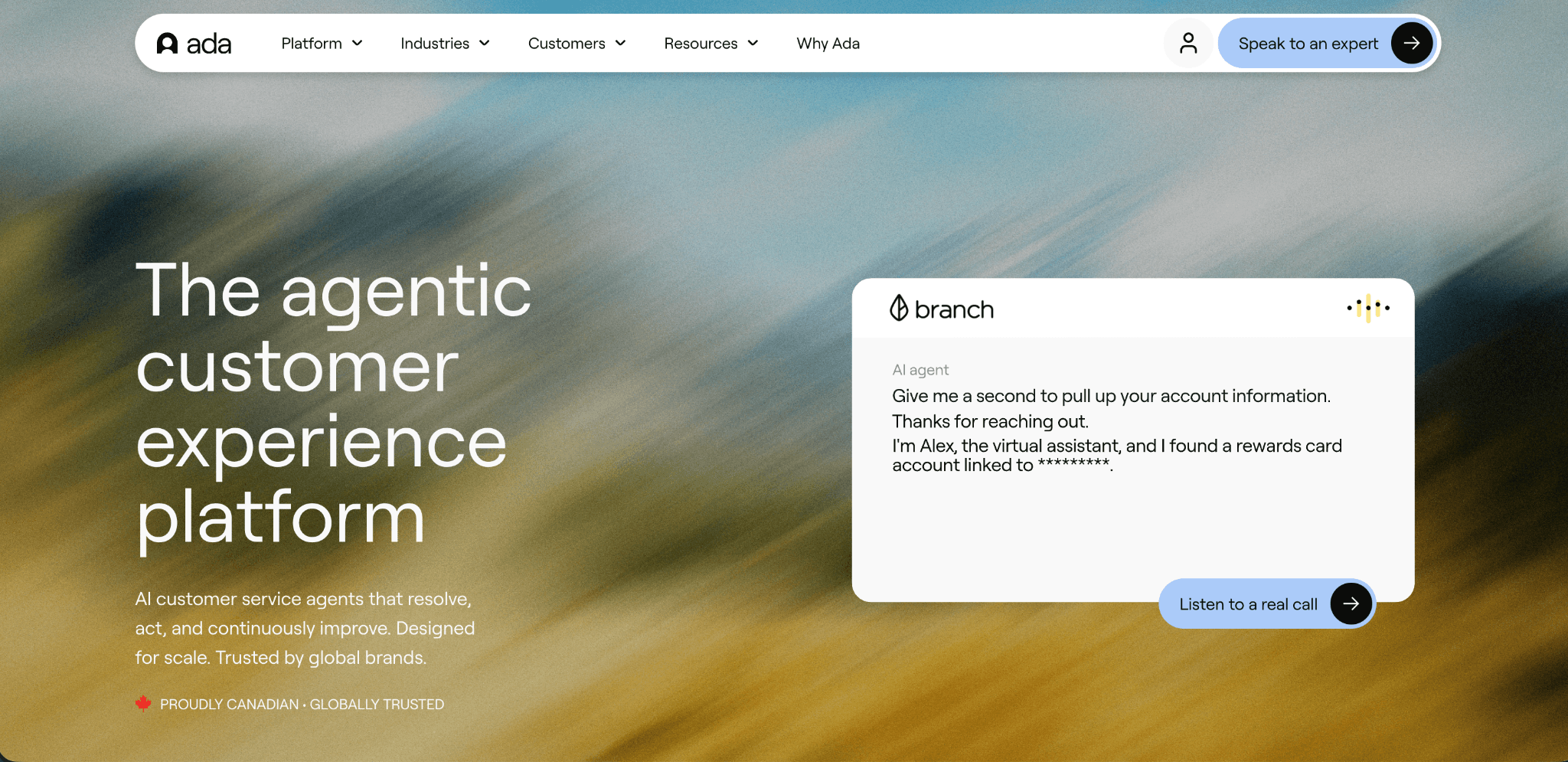
Ada is a customer service automation platform designed to help support teams reduce ticket volume through AI-powered chat without requiring engineering resources to build and maintain the bot. Its no-code builder lets support managers, not developers, create, edit, and iterate on AI conversation flows independently. This makes Ada one of the most accessible enterprise options for teams that want to move quickly without creating a dependency on technical teams for every change.
Ada connects to major helpdesk and CRM platforms including Salesforce, Zendesk, Freshdesk, and Intercom. It uses generative AI to produce more flexible, natural-sounding responses rather than rigid decision-tree scripts, and includes A/B testing tools so teams can compare conversation flows and optimize resolution rates over time. The platform has a solid customer base in North American SaaS, financial services, and e-commerce.
Ada is a meaningful step up from a basic chatbot in terms of response quality and bot management tooling, but it shares the same boundary as Decagon: it is a digital chat deflection platform. Teams that also handle phone interactions, need agent coaching, or want QA coverage on human-handled conversations alongside AI-handled ones will still need separate tools.
Learn how AI is improving retail customer support outcomes: AI Solutions for Retail Contact Centers.
Key Features
No-code conversation builder that support team managers can use to create and update bot flows without engineering help
Generative AI responses drawn from connected knowledge bases, help centers, and documentation
A/B testing for conversation flows to identify which approaches produce the highest resolution rates
Integrations with Salesforce, Zendesk, Freshdesk, Intercom, Shopify, and other common support and commerce platforms
Proactive messaging that triggers bot conversations based on customer behavior on the page or in the app
Multilingual support for global customer bases
Analytics showing deflection rates, escalation volumes, and top topics driving bot conversations
Strengths
Non-technical users can genuinely own the bot without IT support; this is rare at the enterprise tier and saves meaningful time when policies or products change
Faster deployment than most enterprise bot platforms; teams can have a working bot live in days
A/B testing built into the platform allows continuous improvement without guesswork or custom analytics work
Strong references in North American SaaS and e-commerce, where the platform is most commonly deployed
Generative AI capabilities produce more conversational, flexible responses than template-driven approaches
Weaknesses
Digital-only; no voice channel support, which limits usefulness for contact centers that handle phone interactions
No native quality assurance, agent performance scoring, or coaching capabilities
Analytics are focused on bot performance metrics rather than conversation-level intelligence or customer sentiment trends
Less suited for regulated industries where compliance monitoring and audit trails on every interaction are required
Best For
Ada is best for mid-market companies in North America that want to reduce digital support ticket volume quickly, empower a non-technical support team to manage the bot independently, and do not yet need voice channel coverage or contact center QA. It is a strong starting point for teams moving from a basic chatbot to a more capable AI support layer.
4. Cognigy
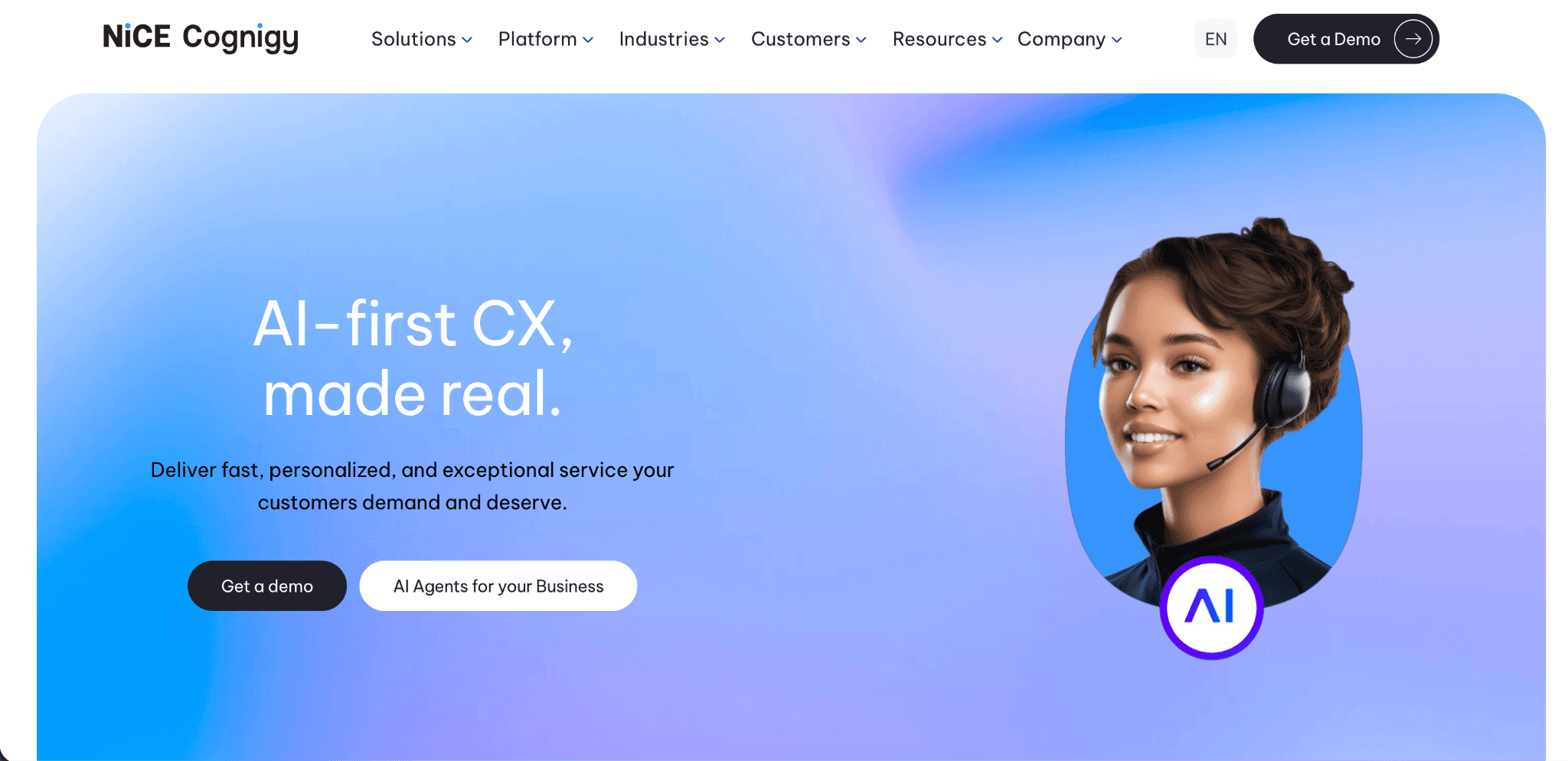
Cognigy is an enterprise conversational AI platform that lets large organizations design, deploy, and manage AI agents for customer service and employee support across voice and digital channels. Its visual flow editor gives teams a flexible environment for modeling complex conversation logic, branching scenarios, and backend system lookups without requiring every customization to go through an engineering ticket.
The platform includes a live agent handoff framework, an analytics module covering conversation volume and intent trends, and deep integration support for enterprise backend systems including SAP, Salesforce, and Genesys. Cognigy is channel-agnostic: the same conversation design deploys across telephony, web chat, WhatsApp, and Microsoft Teams, which makes it attractive to large organizations that want consistent bot behavior across touchpoints.
Cognigy goes broader than Decagon in terms of channel coverage and bot orchestration flexibility. It is also better suited to European enterprises given its strong GDPR compliance posture and data residency options. The gap relative to Level AI is the same as with Decagon: Cognigy does not include native quality assurance or real-time agent coaching, so contact center leaders still need additional tools to manage agent performance.
See how AI is supporting financial services contact centers: AI Solutions for Financial Services.
Key Features
Visual flow editor for designing complex, multi-turn conversation logic across channels without heavy coding dependencies
Cognigy Live Agent for managing agent handoffs, routing queues, and providing agents with conversation context at escalation
Cognigy Insights analytics covering intent trends, session volumes, and bot containment metrics
Integration framework connecting to SAP, Salesforce, Genesys, Avaya, and other enterprise backend systems
Omnichannel deployment covering telephony, web chat, WhatsApp, Microsoft Teams, and email from a unified design environment
Role-based access controls and audit logging for enterprise governance and compliance requirements
European data residency options for organizations with GDPR data sovereignty requirements
Pre-built connectors for major CRM, ERP, and contact center platforms
Strengths
Bot orchestration flexibility is best-in-class for teams that need complex branching logic, real-time backend lookups, and multi-system integrations in a single conversation flow
European data residency and GDPR compliance features are meaningful differentiators for buyers in EU markets where data localization matters
Channel-agnostic design means the same conversation logic deploys consistently across voice and digital without maintaining separate versions
Enterprise governance tooling including audit trails and role-based access satisfies procurement and compliance requirements in regulated industries
SAP integration depth is stronger than most alternatives, making Cognigy a natural choice for SAP-centric enterprises
Weaknesses
No native quality assurance or interaction scoring; teams running contact center QA programs still need a separate platform
Meaningful implementation investment is required before a deployment is production-ready; off-the-shelf configurations require customization for most enterprise environments
Cognigy Insights provides high-level volume and intent data but does not go deep on sentiment, customer effort, or agent performance analytics
Real-time agent coaching during live interactions is not a core capability; teams that want live guidance for agents need additional tooling
Best For
Cognigy is best for large enterprises with dedicated implementation resources that need a highly configurable bot platform, strong GDPR compliance posture, and deep integrations with SAP and other enterprise backend systems. It is particularly well-suited to DACH-market organizations running complex, multi-channel customer service workflows.
5. Kore.ai
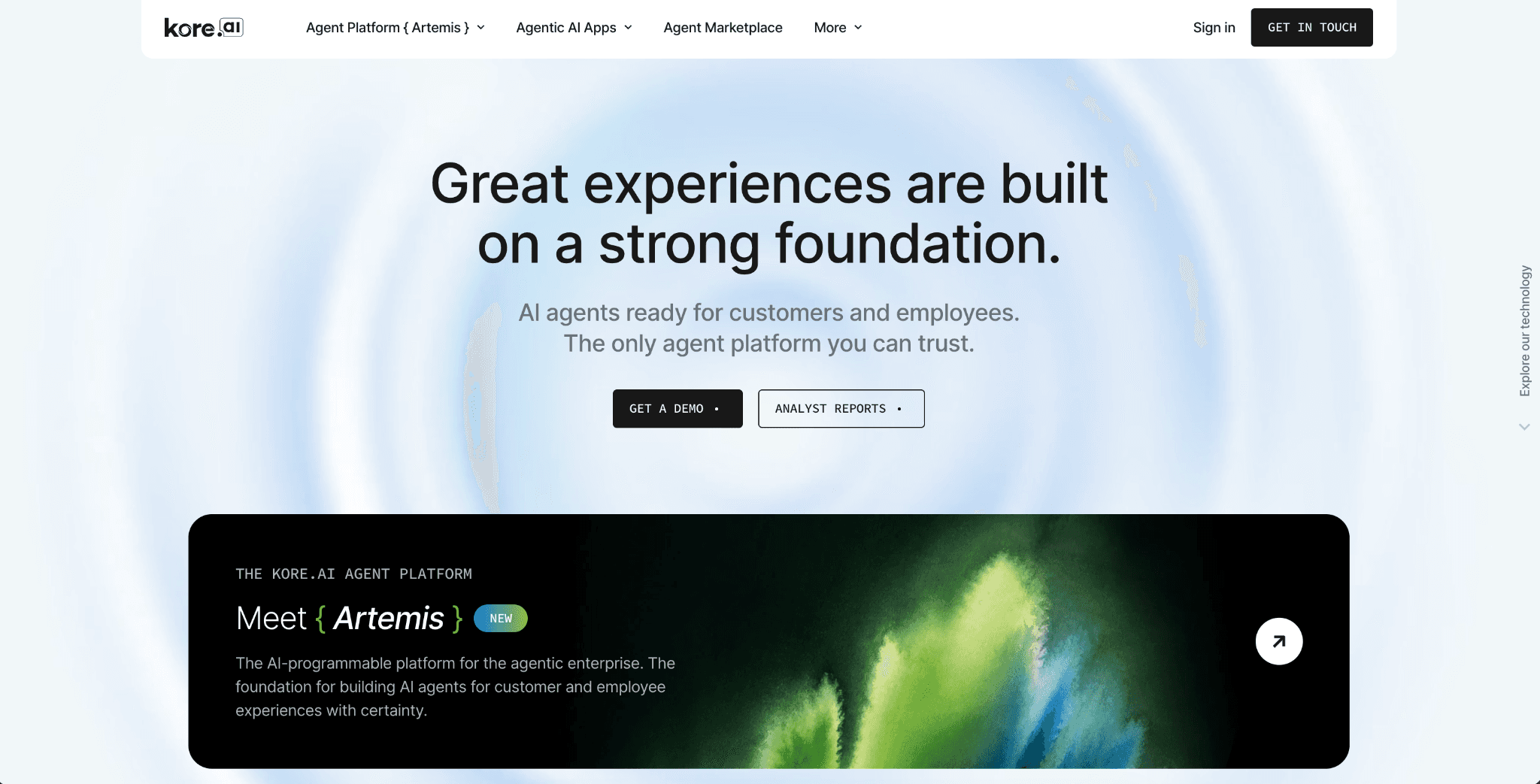
Kore.ai is a broad enterprise conversational AI platform that covers customer service automation, IT support, and employee experience workflows across voice and digital channels. Its strength is in handling complex, multi-system bot logic where conversations require lookups across multiple backend sources, conditional routing, and integration with both modern APIs and legacy systems that other platforms struggle to connect.
The platform includes a visual bot builder, pre-built industry models for banking, healthcare, retail, and telecom that reduce the time needed to train bots on domain-specific language, and an analytics dashboard showing bot performance and intent distribution. Kore.ai has a longer track record than most platforms on this list, which translates to a wider library of enterprise integration patterns and reference customers in regulated industries.
Compared to Decagon, Kore.ai offers voice channel coverage, broader industry model depth, and a more mature integration story for enterprises with complex backend environments. It does not include native quality assurance or real-time agent coaching, which places it in the same category as most alternatives: strong on conversation automation, but still requiring separate tools for contact center QA and performance management.
Key Features
Visual bot builder for designing complex conversation flows across voice, chat, WhatsApp, Teams, Slack, and email
Pre-built industry models for banking, healthcare, retail, and telecom that reduce initial training time on domain-specific vocabulary
Agent handoff with full conversation context, including intent, entities, and session data, transferred to the receiving agent
Analytics dashboard covering bot containment, intent distribution, session volume, and drop-off points
API-first integration framework connecting to Salesforce, SAP, ServiceNow, and legacy backend systems
Natural language processing across 100-plus languages with support for regional dialects
Pre-built templates for common banking, HR, and retail support use cases
Support for both cloud and on-premises deployment for teams with data sovereignty requirements
Strengths
Strongest platform on this list for complex multi-system bot workflows where conversations require lookups across several backend sources simultaneously
Pre-built industry models mean teams in banking, healthcare, and retail do not start from scratch; training time is reduced significantly
Long track record means a larger library of reference customers and integration patterns that enterprise procurement teams find reassuring
On-premises deployment option for organizations in regulated markets where all conversation data must stay within the organization’s own infrastructure
100-plus language support covers genuinely global deployments, including less common regional languages
Weaknesses
No native quality assurance or agent performance management; enterprise QA programs still require a separate tool
Platform complexity can slow initial deployment for teams without dedicated AI implementation resources on staff
Pricing is enterprise-grade with custom contracts, which slows evaluation and makes it harder for mid-market teams to compare costs quickly
Real-time agent assist during live interactions is limited; the platform is stronger on autonomous automation than on augmenting human agents mid-call
Best For
Kore.ai is best for large enterprises with dedicated AI or implementation teams that need a mature, multi-channel bot platform capable of integrating with complex backend environments including legacy systems. It works well for organizations in banking, healthcare, and retail that want pre-built industry models alongside a flexible conversation design environment.
6. Parloa
Parloa is a voice-first AI agent management platform built for large enterprises that run significant inbound call volume. Where Decagon is optimized for digital chat complexity, Parloa is optimized for telephony automation. The platform allows teams to build AI voice agents through a conversation designer that handles call routing, speech recognition, natural language understanding, and escalation to human agents, all within an integrated telephony environment.
Parloa has a documented track record in insurance, retail, and media with measurable outcomes. For Decagon users looking for voice coverage alongside their digital AI, Parloa addresses a real gap. The trade-off is that Parloa is voice-first by design: digital channel support exists but is not the platform’s primary strength. And like Decagon, Parloa does not include native quality assurance, agent coaching, or workforce performance management.
Read more about how top enterprises are using Parloa and its alternatives: Top Parloa Alternatives.
Key Features
AI voice agents built for enterprise telephony environments, handling inbound calls across complex IVR replacement scenarios
Conversation designer with drag-and-drop interface for building call flows without deep coding dependencies
Real-time translation capability allowing agents in one location to serve customers in another language during the same call
Integration with major telephony providers and CRM systems including Salesforce and SAP
Analytics covering call containment, automated resolution rates, transfer volumes, and NPS impact
Agent handoff with conversation context passed to the human agent at the point of escalation
Multi-language voice support for global contact center deployments
Compliance and audit tooling relevant to regulated enterprise environments
Strengths
Documented enterprise outcomes with named logos and specific metrics; Parloa customers publicly share measurable results, which is more than most competitors offer
Voice-first design means the telephony capabilities are genuinely mature rather than bolted on after the fact
Real-time translation capability is a standout feature for multinational contact centers that serve multilingual customer bases
Strong compliance posture relevant to insurance and financial services, where regulatory requirements on call handling are strict
Expanding North American presence after DACH success, making it increasingly relevant for global enterprise buyers
Weaknesses
Voice-first focus means digital chat capabilities are less mature than Decagon or Sierra for teams whose primary channel is chat
No native quality assurance, agent coaching, or conversation analytics beyond containment and transfer metrics
Teams that need omnichannel parity across voice and digital channels will find Parloa stronger on one side than the other
Best For
Parloa is best for large enterprises that handle high inbound call volumes and want to replace or supplement traditional IVR with natural-sounding AI voice agents. It is particularly strong for insurance, retail, and media companies in European markets, and a credible option for enterprises looking for an alternative voice platforms.
7. Fin by Intercom (now Acquired by Salesforce)
Fin is Intercom’s AI agent, designed to handle customer questions through the Intercom chat interface by drawing on a company’s help center, documentation, and connected knowledge sources. For teams already running Intercom as their primary support tool, Fin offers the fastest path to AI-assisted ticket deflection because it requires no separate contract, no new integration, and no vendor onboarding. It activates within the Intercom admin panel and starts resolving questions immediately.
Fin uses large language models to generate answers from source content rather than matching keywords to predefined scripts, which gives it more flexibility in handling varied question phrasing. It prices on a per-resolution model, which makes costs predictable. When Fin cannot answer a question, it escalates to a human agent through the Intercom inbox with full context passed along. The product has improved substantially since its launch and handles a meaningful percentage of routine support queries for many Intercom customers.
Compared to Decagon, Fin is simpler, cheaper to deploy, and entirely dependent on the Intercom ecosystem. Teams that use Zendesk, Salesforce, or any other primary support platform will not find Fin useful. And like Decagon, Fin covers digital chat only, with no voice support, no QA capabilities, and no agent performance management.
Compare Level AI and Fin capabilities directly: Level AI vs Fin.
Key Features
AI-generated answers drawn from help center articles, PDFs, and connected knowledge bases, activated within the Intercom admin panel
Per-resolution pricing model that makes cost predictable and ties spend directly to AI-driven outcomes
Automatic escalation to human agents in the Intercom inbox when Fin cannot answer a question confidently
Handoff summaries that give human agents full context on the conversation before they take over
Customizable tone and persona settings to match brand voice within the Intercom environment
Multilingual support for global customer bases
Basic analytics within the Intercom dashboard covering deflection rates, escalation topics, and resolution rates
Strengths
Zero additional integration work for existing Intercom customers; Fin activates in minutes with no engineering effort
Per-resolution pricing is easy to justify and model financially because you only pay when Fin actually resolves a conversation
Continuous improvement from Intercom’s ongoing model updates means capability improvements without customer effort
Reliable on documentation-based queries; well-organized help center content translates directly into strong Fin performance
Smooth escalation path into the Intercom inbox means agent handoffs feel seamless to the customer
Weaknesses
Entirely Intercom-dependent; teams not using Intercom as their primary support platform get no value from this product
No voice channel, no email automation, and no support for telephony-based contact center workflows
No native quality assurance, agent performance management, or coaching capabilities
Less effective on multi-step, reasoning-heavy queries where Decagon’s transactional depth is a stronger fit
Best For
Fin is best for SaaS companies that are already using Intercom and want the fastest possible path to reducing routine support ticket volume. If your team uses Intercom and your primary support channel is chat, Fin is a low-risk, low-overhead way to start with AI deflection. It is not the right choice for teams not already on Intercom or for any use case involving voice or agent performance management.
8. Cresta

Cresta is the Decagon alternative that is most directly competitive with Level AI in the enterprise contact center space. The platform combines AI virtual agents for conversation automation with real-time agent coaching that surfaces guidance to human agents during live calls, making Cresta one of the few platforms that competes on both automation and human agent enablement simultaneously. This dual focus sets it apart from most alternatives on this list that do one or the other.
Cresta has documented outcomes with enterprise contact center customers. CVS Health went from scoring 5% of calls with human QA reviewers to 100% coverage using Cresta’s AI. Snap Finance reduced average handle time by 40% and increased deflection from 6% to 33%. Propel Holdings achieved 58% call containment while cutting after-call work by half. SCAN Health Plan saw transfer rates drop dramatically after deployment. These are contact center scale results, not SaaS support team results, which positions Cresta as a credible option for buyers coming from a full contact center context.
Where Cresta differs from Level AI is in its analytics depth and the breadth of its voice-of-the-customer and QA capabilities. Cresta is strong on real-time coaching and virtual agents. Level AI goes further on automated QA coverage and customer intelligence. Teams that prioritize agent coaching and voice automation will find Cresta compelling; teams that also want deep customer analytics and comprehensive automated QA may find Level AI more complete.
See a detailed comparison of Level AI and Cresta capabilities: Level AI vs Cresta.
Key Features
AI virtual agents for voice and chat conversations, handling both inbound automation and outbound engagement
Real-time agent coaching that surfaces relevant scripts, next-best actions, and compliance guidance during live interactions
AI-powered QA that moves teams from sampling a small percentage of calls to covering a much higher proportion automatically
Conversation analytics showing performance trends, common topics, and agent behavior patterns across the team
Integration with major telephony platforms and CRM systems used in enterprise contact centers
Sales performance coaching capabilities that help teams identify winning conversation patterns and replicate them
Live call monitoring for supervisors who want real-time visibility into what is happening across the floor
Strengths
One of the few platforms that combines virtual agents with real-time human agent coaching in a single product, making it relevant for teams that want to improve both automation and human performance
Enterprise contact center credentials with documented results at CVS Health, Snap Finance, and SCAN Health Plan that are specific and verifiable
QA coverage improvements are well-documented; CVS Health’s jump from 5% to 100% coverage is a compelling benchmark
Real-time coaching during live calls is genuinely differentiated; most platforms offer post-call analysis rather than in-call guidance
Sales performance tooling makes Cresta relevant for contact centers that also handle outbound sales alongside inbound support
Weaknesses
Voice-of-the-customer analytics and customer sentiment analysis are less developed than Level AI’s dedicated intelligence layer
Automated QA breadth and configurability are more limited than platforms built with QA as a primary use case from the start
Smaller customer base than some alternatives on this list, with 13 confirmed enterprise deployments compared to Level AI’s and Sierra’s larger footprints
Platform breadth means it may not go as deep on any single capability as a specialist tool; teams with very specific QA or analytics requirements may find gaps
Best For
Cresta is best for enterprise contact centers in financial services, home security, and hospitality that want to improve both automated conversation handling and real-time human agent performance in a single platform. It is a strong fit for teams where coaching and sales performance are as important as deflection rates.
9. Bland AI
Bland AI is a developer-focused platform for building and deploying AI voice agents through an API-first approach. It provides the infrastructure for speech recognition, language model integration, text-to-speech, and call handling, so engineering teams can build custom voice AI applications without assembling those components from multiple vendors. Teams can use Bland AI’s default language models or connect their own, and can customize voice personas to fit the product they are building.
The platform supports both inbound and outbound calling, offers webhook-based event systems for building workflows around call events, and provides real-time transcription access via API. Bland AI has attracted product and engineering teams that need to build voice AI into an existing product or workflow quickly, without the overhead of enterprise contracting cycles or the constraints of a fixed product interface.
Bland AI sits at the opposite end of the spectrum from Decagon in terms of the buyer profile. Decagon is a finished product that support teams deploy to handle customer conversations. Bland AI is infrastructure that engineering teams use to build voice products. For contact center leaders who want a platform rather than a building kit, Bland AI is not the right choice. But for product teams building custom voice workflows, it is one of the fastest paths to a working voice agent.
Key Features
API-first voice agent infrastructure covering speech recognition, language model integration, and text-to-speech in a single platform
Support for custom language model connections, allowing teams to use the model that best fits their use case and cost target
Inbound and outbound calling support with integration into major telephony providers
Real-time transcription with API access so downstream applications can process call content immediately
Customizable voice personas with control over tone, pacing, and speaking style
Webhook system for triggering custom workflows based on call events such as call start, specific utterances, and call end
Basic analytics dashboard covering call volume, duration, completion rates, and transcript access
Strengths
Fastest path from idea to working voice agent for engineering teams with the technical capacity to use an API-first tool
Model flexibility means teams are not locked into a specific language model and can switch or fine-tune as requirements change
Competitive pricing makes it accessible for startups and product teams building voice AI into commercial products
No fixed product interface means teams can build exactly what their use case requires rather than working around a vendor’s assumptions
Active developer community with good documentation that accelerates time from first call to production deployment
Weaknesses
Not a contact center platform; no QA, no agent assist, no coaching, no workforce management, and no customer analytics
Requires engineering resources to build and maintain; support or operations teams without developer capacity cannot use this product independently
Analytics are minimal; teams cannot analyze conversation quality, sentiment trends, or agent performance from the platform itself
No visual interface for non-technical users; every change to conversation logic requires code or API work
Best For
Bland AI is best for product engineering teams that need to embed voice AI into a custom application or workflow and want API-level control over how the voice agent behaves. It is not suited for contact center operations teams looking for a turnkey platform with built-in management, QA, and reporting capabilities.
10. Tidio
Tidio is a live chat and AI chatbot platform designed for small and mid-market businesses that want to handle customer conversations on their website without a significant technology investment. The platform combines a live chat interface for human agents with an AI chatbot called Lyro that handles common questions automatically. Tidio is one of the most affordable options in this space, with a freemium model that allows very small teams to get started without upfront cost.
Tidio integrates with Shopify, WooCommerce, Wix, WordPress, and other small business platforms, making it particularly popular in e-commerce. Lyro, Tidio’s AI assistant, is trained on the company’s own FAQ and knowledge content and can resolve routine questions including order status, returns, and basic product inquiries without human intervention. The platform also includes email and social media inbox management alongside the chat functionality.
Tidio is not positioned against Decagon in the same market. Decagon targets SaaS and fintech teams handling complex, multi-step support conversations at scale. Tidio is built for small e-commerce businesses managing chat volume with a small support team. Teams that have grown beyond Tidio and are evaluating Decagon alternatives are likely moving up in sophistication rather than across. The reason to include it here is that some teams evaluating Decagon alternatives are looking for something simpler and less expensive, and Tidio addresses that need clearly.
Key Features
Live chat interface for human agents alongside Lyro, Tidio’s AI chatbot, in a unified inbox
Lyro AI trained on company FAQ and help center content to handle routine customer questions automatically
Integration with Shopify, WooCommerce, Wix, WordPress, and other common e-commerce and website platforms
Email and social media inbox management alongside chat in a single agent view
Canned responses and conversation templates to speed up human agent response time
Basic analytics covering conversation volume, response times, and chatbot resolution rates
Mobile app for agents who need to respond to conversations outside of a desktop environment
Freemium pricing tier that allows very small teams to start without committing to a paid plan
Strengths
The most accessible entry point on this list; free tier plus low-cost paid plans make it viable for businesses at any stage
Very fast setup; teams can have a working live chat and AI bot on their website in under an hour
Tight e-commerce integrations give Lyro access to order data, allowing it to answer order status questions without agent involvement
Unified inbox covering chat, email, and social messages reduces the number of tabs agents need to manage
No technical skills required to set up or manage; small business owners can do it themselves
Weaknesses
Not built for enterprise contact center scale; performance and feature depth drop significantly at high conversation volumes
No voice channel, no quality assurance, no agent coaching, and no workforce management capabilities
Lyro’s AI capabilities are simpler than Decagon or Sierra; it handles FAQ-style queries well but struggles with multi-step or transactional complexity
Analytics are basic; meaningful contact center reporting requires exporting data to separate tools
Best For
Tidio is best for small e-commerce businesses and startups that want to add live chat and basic AI deflection to their website quickly and affordably. It is not suitable for enterprise contact centers, regulated industries, or teams that need the kind of conversation complexity handling, QA coverage, or multi-channel support that platforms like Decagon, Level AI, or Sierra provide.
Conclusion: Why Level AI Is a Great Decagon Alternative
Decagon is a genuinely capable chat AI platform. The results its customers share on deflection rates and knowledge retrieval are real. But the teams that evaluate Decagon alternatives are almost always asking a version of the same question: what happens after the bot resolves a conversation, and what happens when it does not?
When Decagon resolves a conversation, that data lives in Decagon. It does not automatically connect to QA workflows, agent coaching programs, or customer analytics dashboards. When Decagon does not resolve a conversation and escalates to a human agent, the AI-handled portion arrives as a single block of text in Zendesk or Salesforce, making it harder to analyze what the bot did and what it missed. These are not product defects. They are architectural boundaries that reflect what Decagon was designed to do.
Level AI was designed to answer the full question. The virtual agent handles conversations. The QA layer evaluates every one of them, including the ones human agents handle after escalation. The agent assist layer gives human agents live support during those escalated conversations. The analytics layer surfaces what all of those conversations tell you about your customers, your products, and your operations. Every piece of that works from the same data set and sits in the same platform.
For a contact center that has reached the point where managing four separate tools, four data silos, and four vendor relationships is creating more friction than value, Level AI is the consolidation play. For a team that is still growing into enterprise contact center complexity, it is the platform that grows with you rather than one you outgrow.
Frequently Asked Questions
1. What is the biggest gap in Decagon that makes teams look for alternatives?
The most common gap teams cite is the absence of quality assurance and conversation analytics. Decagon handles chat automation effectively, but every interaction it resolves or escalates exists in its own data silo. Teams that want to automatically evaluate the quality of both AI-handled and human-handled conversations, track customer sentiment trends, and get operational intelligence from their full conversation data set need additional platforms to accomplish this. Level AI addresses all three alongside the virtual agent layer that Decagon provides.
2. Does Decagon support voice channels?
Decagon has added voice capabilities and continues expanding its channel coverage, but the platform's depth and primary track record are in digital chat and email. Teams that handle high inbound call volumes and need voice AI that integrates cleanly with enterprise telephony infrastructure typically find that purpose-built voice platforms like Level AI, Parloa, or Cresta are a better fit for the phone channel specifically, while Decagon remains stronger on the digital side.
3. How does Level AI differ from Decagon beyond QA?
Level AI differs from Decagon in three meaningful ways. First, it covers voice and digital channels natively rather than being digital-first with voice as a secondary addition. Second, it includes real-time agent assist that surfaces live guidance to human agents during escalated conversations, which Decagon does not. Third, it provides voice-of-the-customer analytics that identify what topics are driving contact volume, where customer sentiment is shifting, and which product or policy issues are showing up repeatedly in conversations. Taken together, Level AI answers what happens across the full interaction lifecycle, not just during the AI-handled portion.
4. Does Decagon require engineering resources?
Basic deployments can be straightforward, but integrating business systems, APIs, and custom workflows often requires engineering support.