Key Takeaways
Sierra’s outcome-based pricing becomes more expensive as your AI improves. Enterprises that scale containment rates pay more, not less.
Sierra has no native tools to QA its own virtual agent’s performance. Buyers must purchase a separate quality management platform, adding cost and vendor complexity.
Most Sierra alternatives specialize in one layer of the CX stack. Level AI is the only platform on this list that covers virtual agents, automated QA, Voice of Customer analytics, agent assist, and coaching in a single product.
Enterprises running both bot and human agents need unified analytics. Platforms that only report on bot performance create a fragmented view of the customer journey.
Implementation speed and ongoing support quality are as important as feature parity.
Introduction
Sierra has attracted significant attention from enterprise buyers evaluating AI-driven customer service automation. That momentum is real. So is the gap it leaves for enterprises that need more than a virtual agent.
Sierra focuses exclusively on autonomous agent deployment. It does not include native quality management, human agent coaching, Voice of Customer analytics, or unified oversight across bot and human interactions. Enterprises that need those capabilities must assemble them from separate vendors, which increases cost and creates blind spots across the customer journey.
This guide covers platforms that enterprise buyers should evaluate alongside or instead of Sierra. Each section includes a product overview, key features, strengths, weaknesses, and the scenarios where the platform performs best.
Why Buyers Evaluate Sierra?
Sierra’s draw is straightforward. It was built by founders with deep platform credibility, it deploys fast, and its outcome-based pricing aligns vendor cost with containment results. For a CEO focused on labor deflection, that story is compelling.
Enterprise buyers typically come to Sierra through one of three needs:
They want to deflect a high volume of routine contacts
They want a voice-capable agent that does not sound like a legacy IVR
Or they want a platform their teams can configure without writing code.
Sierra’s Agent OS handles all three reasonably well. It supports chat and voice, integrates with ERP and CRM backends, and treats agent journeys as versioned software that can be staged and rolled back. For buyers whose primary question is “how do I automate more contacts,” Sierra earns a serious evaluation.
The problem surfaces when buyers ask what happens after the bot fails. Sierra has no visibility into human agent interactions. It cannot score human conversations, identify escalation patterns, or surface the customer intelligence that informs product and operational decisions.
Enterprises running 300 or more agents cannot treat the virtual agent as an isolated system. They need a platform that connects bot performance, human performance, and customer insight in one view.
How We Compared These Tools?
Each platform was evaluated across six dimensions:
Deployment scope -- Does the platform cover voice, chat, email, and SMS, or only select channels?
QA and oversight -- Does the platform include native quality management for both bot and human agents?
Customer intelligence -- Does the platform surface root cause analysis and Voice of Customer insights beyond basic dashboards?
Agent enablement -- Does the platform include real-time agent assist, coaching, and performance management?
Pricing predictability -- Is pricing fixed and auditable, or variable and tied to resolution definitions?
Enterprise readiness -- Does the platform meet compliance requirements (GDPR, HIPAA, PCI, ISO 27001) and integrate with major CCaaS platforms?
The platforms below are ordered by overall fit for enterprise buyers evaluating Sierra.
Top Sierra Alternatives: Comparison Table
Platform | Virtual Agent | Voice Support | Native QA | Agent Assist | VoC Analytics | Pricing Model |
Level AI | Yes | Yes | Yes (bot + human) | Yes | Yes | Conversation-based |
Decagon | Yes | No | No | No | Limited | Per-resolution |
Ada | Yes | No | No | No | Limited | Platform fee |
Fin (Intercom) | Yes | No | No | No | Basic | Per-resolution |
Retell AI | Voice only | Yes | No | No | No | Per-minute |
Cognigy | Yes | Yes | Partial | No | Limited | Enterprise license |
Chatbase | Yes | No | No | No | No | Usage-based |
Kore.ai | Yes | Yes | Partial | Limited | Limited | Enterprise license |
Zendesk | Yes | Limited | Partial | Limited | Basic | Per-seat |
Detailed Platform Reviews
1. Level AI
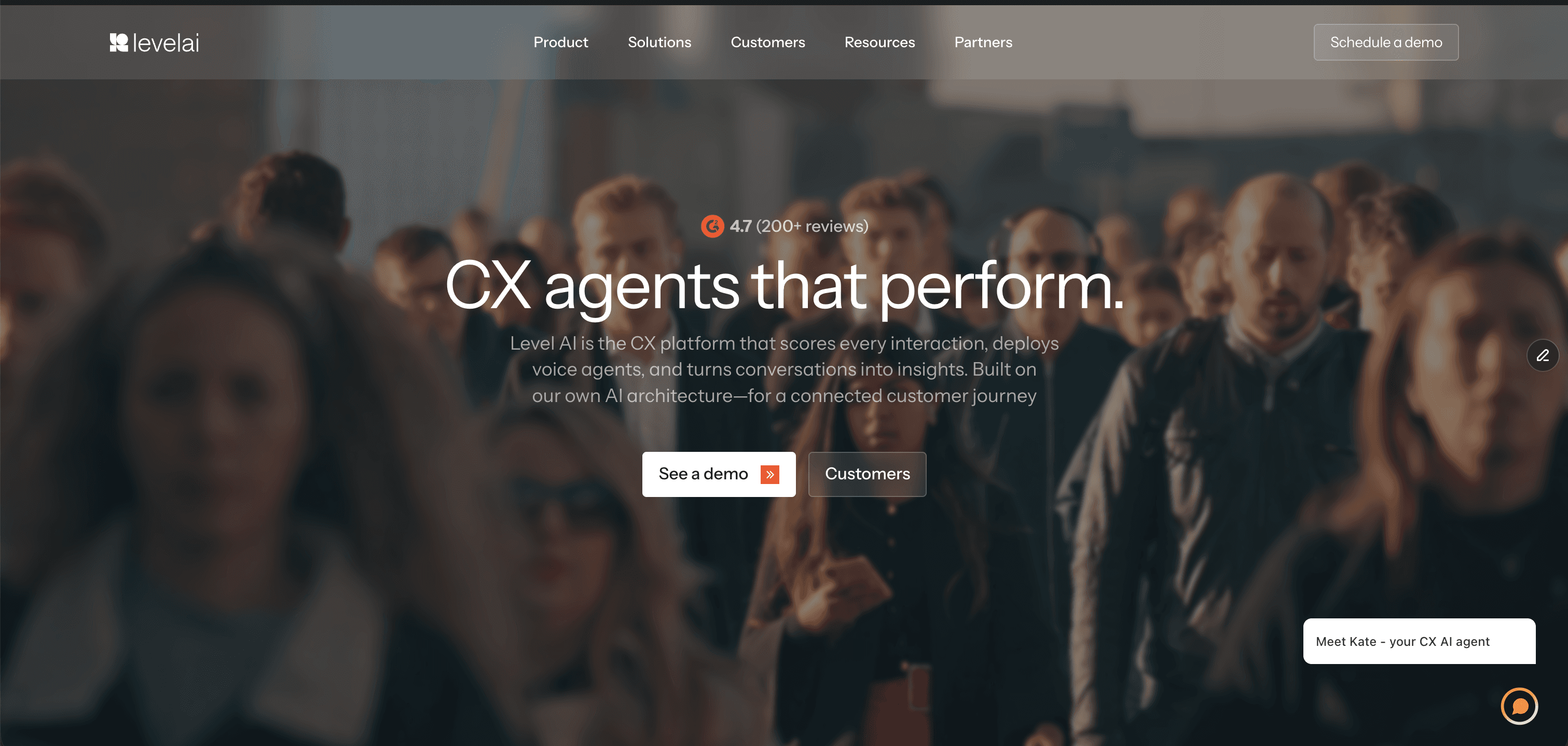
Level AI is a contact center intelligence platform that covers the full CX stack: AI virtual agents, automated quality management, Voice of Customer analytics, conversation intelligence, agent assist, and manager coaching. All capabilities run on the same underlying conversation data. QA scores, customer insights, and automation decisions share one intelligence layer rather than pulling from separate databases.
This architecture matters for enterprises evaluating Sierra. Sierra requires separate tools for human QA, bot QA, and coaching. Level AI scores both virtual agent and human agent conversations against the same rubrics, giving quality teams a single view of performance across all interaction types. The platform’s Auto-QA (QA-GPT) achieves over 90% agreement with expert human evaluators and reduces manual QA effort by up to 90%. Human reviewers complete audits 6 times faster than without the platform.
For operations leaders, Level AI’s Voice of Customer analytics analyze 100% of interactions across calls, emails, SMS, and chats. Root cause identification requires no setup. The platform detects emerging issues before they escalate and surfaces competitive and product feedback directly from customer conversations. Contact centers that previously scored 1-2% of interactions manually can move to 100% coverage without adding headcount.
Key Features
QA-GPT scores every conversation with reasoning, timestamps, and evidence-backed explanations
Voice of Customer analytics across 100% of interactions, with no survey dependency
AI Virtual Agent handles chat and voice with intent, tone, and context awareness across backend integrations
Agent Assist surfaces real-time knowledge cards, next-best-action hints, and auto-generates after-call summaries
Manager Assist provides live call monitoring, sentiment alerts, and one-click coach and whisper controls
Unified QA rubric scores both virtual agents and human agents in a single platform
Screen Recording with context-driven PCI/PII redaction
Over 70 plug-and-play connectors for CCaaS, CRM, and BI platforms
Conversation-based pricing with predictable, auditable costs
Strengths
Only platform on this list that covers virtual agents, automated QA, VoC analytics, agent assist, and coaching in one product
90% reduction in manual QA effort with over 90% agreement with human evaluators
VoC analytics identify why customers contact the center, not just what the bot resolved
Transparent, conversation-based pricing that does not increase as containment rates improve
Fully compliant with GDPR, HIPAA, PCI, and ISO 27001
Customer-driven product development with direct access to leadership
Best For
Enterprises running both bot and human agents who need quality oversight, customer intelligence, and automation in a single platform. Particularly strong for contact centers with 200+ agents, high compliance requirements, and QA teams that currently score under 10% of interactions manually..
" transform="translate(85.643 10.143)" width="23.725855670103115px"/><path d="M 71.828 0 L 0 50.702" fill="transparent" height="50.70235051546392px" id="TnJFUMH9b" stroke-dasharray="" stroke-linecap="butt" stroke-linejoin="miter" stroke-miterlimit="10" stroke-width="0.68" stroke="rgb(254, 250, 241)" transform="translate(85.508 75.029)" width="71.82828865979384px"/><path d="M 81.579 0 L 0 52.003" fill="transparent" height="52.00280412371134px" id="ccJzhVTGI" stroke-dasharray="" stroke-linecap="butt" stroke-linejoin="miter" stroke-miterlimit="10" stroke-width="0.68" stroke="rgb(254, 250, 241)" transform="translate(85.495 73.738)" width="81.57921649484533px"/><path d="M 65.653 0 L 0 32.827" fill="transparent" height="32.826556701030924px" id="X0Vp_q8HG" stroke-dasharray="" stroke-linecap="butt" stroke-linejoin="miter" stroke-miterlimit="10" stroke-width="0.68" stroke="rgb(254, 250, 241)" transform="translate(85.462 92.931)" width="65.65311340206183px"/><path d="M 88.08 14.951 L 0 0" fill="transparent" height="14.950762886597914px" id="JM_UgSiJ_" stroke-dasharray="" stroke-linecap="butt" stroke-linejoin="miter" stroke-miterlimit="10" stroke-width="0.68" stroke="rgb(254, 250, 241)" transform="translate(86.233 125.789)" width="88.07950515463914px"/><path d="M 83.204 72.803 L 0 0" fill="transparent" height="72.80313402061856px" id="KlyUUjlMK" stroke-dasharray="" stroke-linecap="butt" stroke-linejoin="miter" stroke-miterlimit="10" stroke-width="0.68" stroke="rgb(254, 250, 241)" transform="translate(85.089 125.71)" width="83.20379381443304px"/><path d="M 7.8 114.081 L 0 0" fill="transparent" height="114.08065979381445px" id="kAiUvduBR" stroke-dasharray="" stroke-linecap="butt" stroke-linejoin="miter" stroke-miterlimit="10" stroke-width="0.68" stroke="rgb(254, 250, 241)" transform="translate(85.95 125.478)" width="7.800247422680428px"/><path d="M 0 93.604 L 9.75 0" fill="transparent" height="93.60445360824741px" id="FsgTAQB0n" stroke-dasharray="" stroke-linecap="butt" stroke-linejoin="miter" stroke-miterlimit="10" stroke-width="0.68" stroke="rgb(254, 250, 241)" transform="translate(76.2 125.421)" width="9.750432989690694px"/><path d="M 0 76.379 L 76.703 0" fill="transparent" height="76.37888659793816px" id="NxOhHvPJ5" stroke-dasharray="" stroke-linecap="butt" stroke-linejoin="miter" stroke-miterlimit="10" stroke-width="0.68" stroke="rgb(254, 250, 241)" transform="translate(9.343 125.217)" width="76.7034556701031px"/><path d="M 0 26.651 L 39.002 0" fill="transparent" height="26.651381443298988px" id="QETNKJ3L6" stroke-dasharray="" stroke-linecap="butt" stroke-linejoin="miter" stroke-miterlimit="10" stroke-width="0.68" stroke="rgb(254, 250, 241)" transform="translate(47.096 125.177)" width="39.0017319587629px"/><path d="M 0 16.901 L 85.154 0" fill="transparent" height="16.900948453608265px" id="BL63wDICD" stroke-dasharray="" stroke-linecap="butt" stroke-linejoin="miter" stroke-miterlimit="10" stroke-width="0.68" stroke="rgb(254, 250, 241)" transform="translate(0.094 125.125)" width="85.15396503092786px"/><path d="M 0 0 L 78.004 17.876" fill="transparent" height="17.875793814432996px" id="PIX70Vlqf" stroke-dasharray="" stroke-linecap="butt" stroke-linejoin="miter" stroke-miterlimit="10" stroke-width="0.68" stroke="rgb(254, 250, 241)" transform="translate(8.362 107.251)" width="78.00376082474227px"/><path d="M 0 0 L 67.928 52.327" fill="transparent" height="52.32742268041238px" id="u_syqWqWD" stroke-dasharray="" stroke-linecap="butt" stroke-linejoin="miter" stroke-miterlimit="10" stroke-width="0.68" stroke="rgb(254, 250, 241)" transform="translate(17.593 72.861)" width="67.92826391752578px"/><path d="M 0 0 L 77.029 70.528" fill="transparent" height="70.52832989690722px" id="DmW_aE2A0" stroke-dasharray="" stroke-linecap="butt" stroke-linejoin="miter" stroke-miterlimit="10" stroke-width="0.68" stroke="rgb(254, 250, 241)" transform="translate(9.489 54.678)" width="77.02866804123713px"/><path d="M 0 0 L 27.301 126.431" fill="transparent" height="126.43109443298971px" id="JrLaRUubC" stroke-dasharray="" stroke-linecap="butt" stroke-linejoin="miter" stroke-miterlimit="10" stroke-width="0.68" stroke="rgb(254, 250, 241)" transform="translate(58.341 -0.071)" width="27.30111340206188px"/><path d="M 0 4.012 C 0 1.796 1.796 0 4.012 0 C 6.228 0 8.025 1.796 8.025 4.012 C 8.025 6.228 6.228 8.025 4.012 8.025 C 1.796 8.025 0 6.228 0 4.012 Z" fill="rgb(254, 80, 0)" height="8.024669690721652px" id="Nh5qrPJs_" transform="translate(81.396 121.369)" width="8.024669690721623px"/></svg>)
2. Decagon
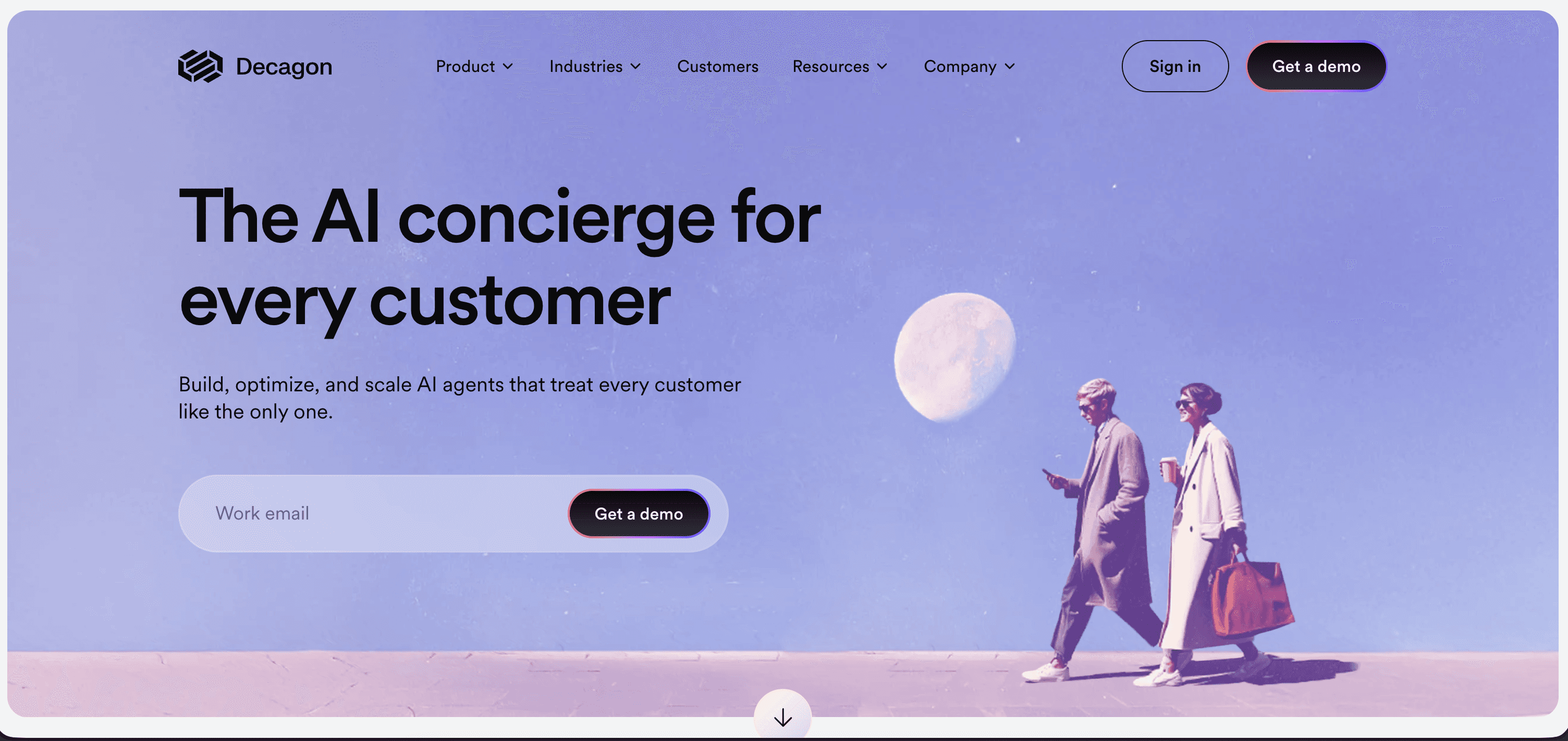
Decagon is an AI customer support agent platform built for enterprises that want autonomous issue resolution without extensive workflow configuration. The platform trains on a company’s existing support documentation, past tickets, and knowledge base to handle incoming queries across chat and email. It positions itself as a fast-to-deploy option for teams that want to deflect common support contacts without building complex conversation flows.
Decagon’s strength is the speed of initial deployment. Enterprises can connect their documentation and go live with a functioning agent in days rather than weeks. The platform handles escalation routing and can hand off to human agents with context intact. For SaaS companies with a well-documented knowledge base and a high volume of repetitive tier-1 queries, Decagon reduces response time and support cost per ticket without requiring a dedicated implementation team.
The platform does not include quality management, agent assist, or Voice of Customer analytics. It also lacks native voice capability, which limits its use for enterprises where phone support is a primary channel. Buyers who need oversight of human agent performance or operational intelligence beyond containment metrics will need additional tools.
Key Features
Autonomous resolution of tier-1 and tier-2 support queries via chat and email
Trains on knowledge base, past tickets, and documentation without manual workflow design
Escalation routing with conversation context passed to the human agent
Integrations with Zendesk, Intercom, Salesforce, and Freshdesk
Real-time analytics on deflection rate and resolution confidence
Multi-product and multi-brand support within a single deployment
Custom fallback logic for queries outside the agent’s confidence threshold
Strengths
Fast initial deployment for teams with existing documentation
Minimal configuration required to achieve functional deflection rates
Clean escalation handoff preserves conversation context for human agents
Works well for high-volume, well-documented support categories
Integrates with common helpdesk platforms without custom engineering
Weaknesses
No voice support; limited to chat and email channels
No native quality management for bot or human agents
Analytics focus on containment and deflection only; no customer insight layer
Best For
SaaS and technology companies with a well-documented knowledge base that want to automate tier-1 support queries across chat and email without building custom conversation flows.
3. Ada
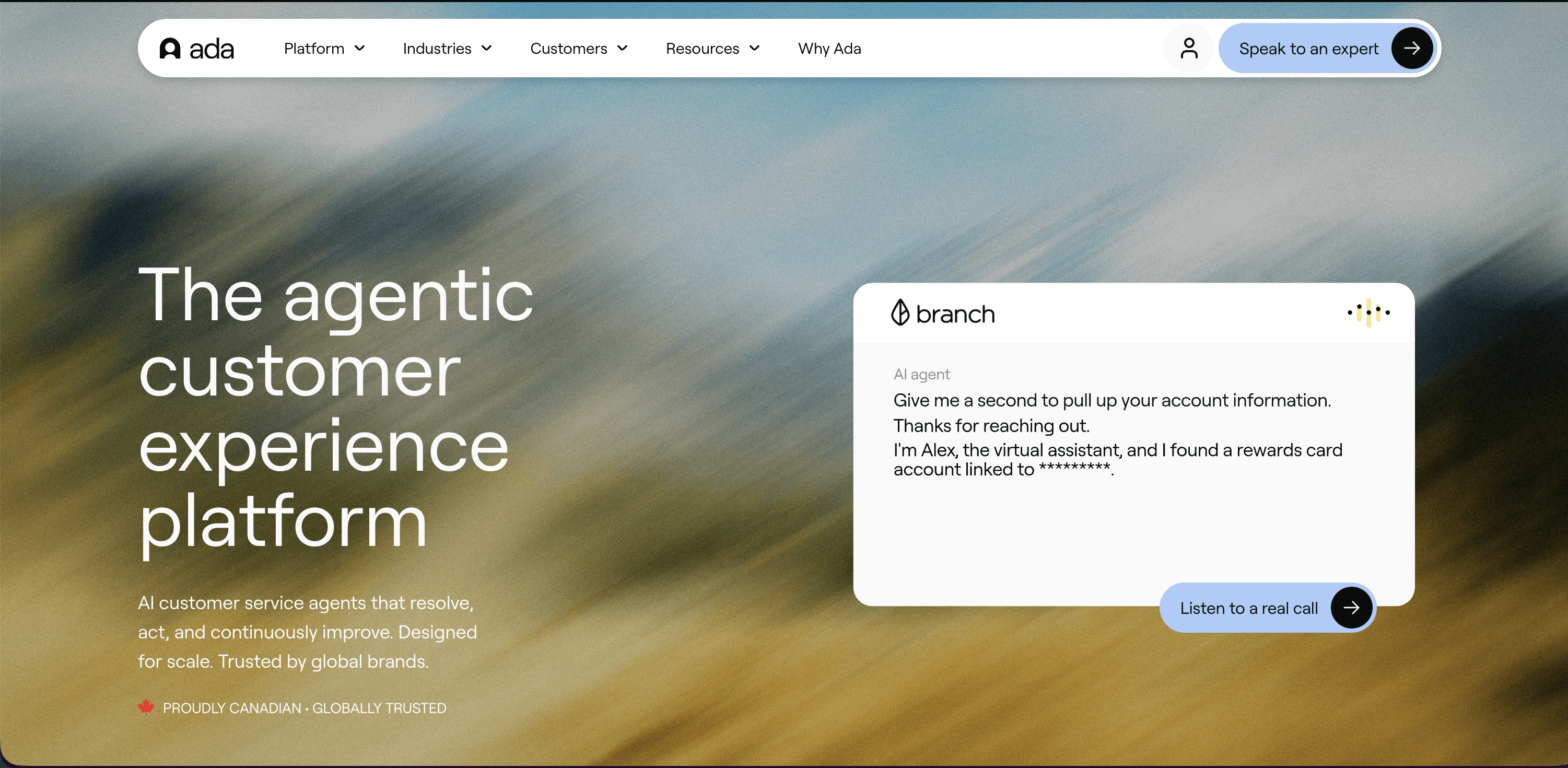
Ada is a customer service automation platform that focuses on self-service resolution across chat and messaging channels. The platform’s core capability is a no-code conversation builder that allows non-technical teams to create and iterate on customer-facing flows without engineering support. Ada has been used by enterprises in financial services, retail, and telecommunications to deflect high volumes of routine contacts.
Ada’s reasoning engine handles intent detection and routes customers to the correct path based on query type. The platform supports integrations with major CRM and backend systems, allowing the agent to perform transactions like account lookups, order status checks, and policy updates. Ada’s approach prioritizes control and consistency; teams can specify exactly how the agent should respond in given scenarios rather than relying on generative responses.
This control-first architecture is also a constraint. Ada’s responses are largely template-driven, which limits the agent’s ability to handle novel queries that fall outside predefined flows. Enterprises with complex or variable customer questions often find that containment rates plateau after initial deployment. The platform also lacks native voice, quality management, and coaching capabilities.
Key Features
No-code conversation builder with drag-and-drop flow design
Multi-language support across 50+ languages
CRM and backend integrations for transactional self-service
Intent detection with fallback and escalation routing
Real-time reporting on deflection rates, CSAT, and resolution
Pre-built industry templates for common support categories
A/B testing for conversation flows
Strengths
Non-technical teams can build and iterate on conversation flows without engineering
Strong multi-language support for global enterprises
Consistent, auditable responses with full control over agent behavior
Reliable integration with Salesforce, Zendesk, and ServiceNow
Established customer base in financial services and telecommunications
Weaknesses
Template-driven architecture limits handling of novel or complex queries
No native voice capability
No quality management, agent coaching, or VoC analytics
Best For
Enterprises in regulated industries that need strict control over automated responses, particularly where consistency and auditability matter more than generative flexibility.
4. Fin (Acquired by Salesforce)
Fin is Intercom’s AI agent, built to resolve customer support queries by reading and reasoning over a company’s help center content and internal knowledge base. It is delivered as part of the Intercom platform, which means buyers get a customer messaging system, a support ticketing layer, and an AI agent in a single subscription. Fin answers questions directly in chat, routes unresolved queries to human agents, and hands off with full conversation context.
Fin’s integration with Intercom’s existing customer data layer is its clearest advantage. Enterprises already using Intercom for support can activate Fin without a separate implementation. The platform’s resolution rate has improved substantially since its initial release, and Intercom publishes benchmark data on deflection performance across industries.
Fin is priced on a per-resolution model, which creates the same cost dynamic as Sierra: as Fin resolves more queries, the bill increases. Enterprises should model this carefully before committing at scale. Fin also lacks voice support, native quality management, and agent coaching. It works well within the Intercom ecosystem but requires additional tools for enterprises with omnichannel contact center operations.
Key Features
Resolves queries by reasoning over help center and knowledge base content
Handoff to human agents with full conversation context preserved
Integrates natively with Intercom inbox, tickets, and customer data
Supports custom answers for specific product and policy questions
Resolution rate reporting and conversation-level analytics
Multi-language support
Configurable escalation thresholds per query category
Strengths
Zero-friction activation for existing Intercom customers
Strong performance on knowledge-base-answerable queries
Clean integration with Intercom’s full customer messaging stack
Reliable context handoff reduces repeat effort for human agents
Continuous improvement tied to Intercom’s product roadmap
Weaknesses
Per-resolution pricing increases total cost as containment improves
No voice channel support
Analytics limited to bot performance; no human agent oversight or VoC layer
Best For
Mid-market and enterprise companies already using Intercom for customer support who want to add AI resolution capability without a separate vendor or implementation project.
5. Retell AI
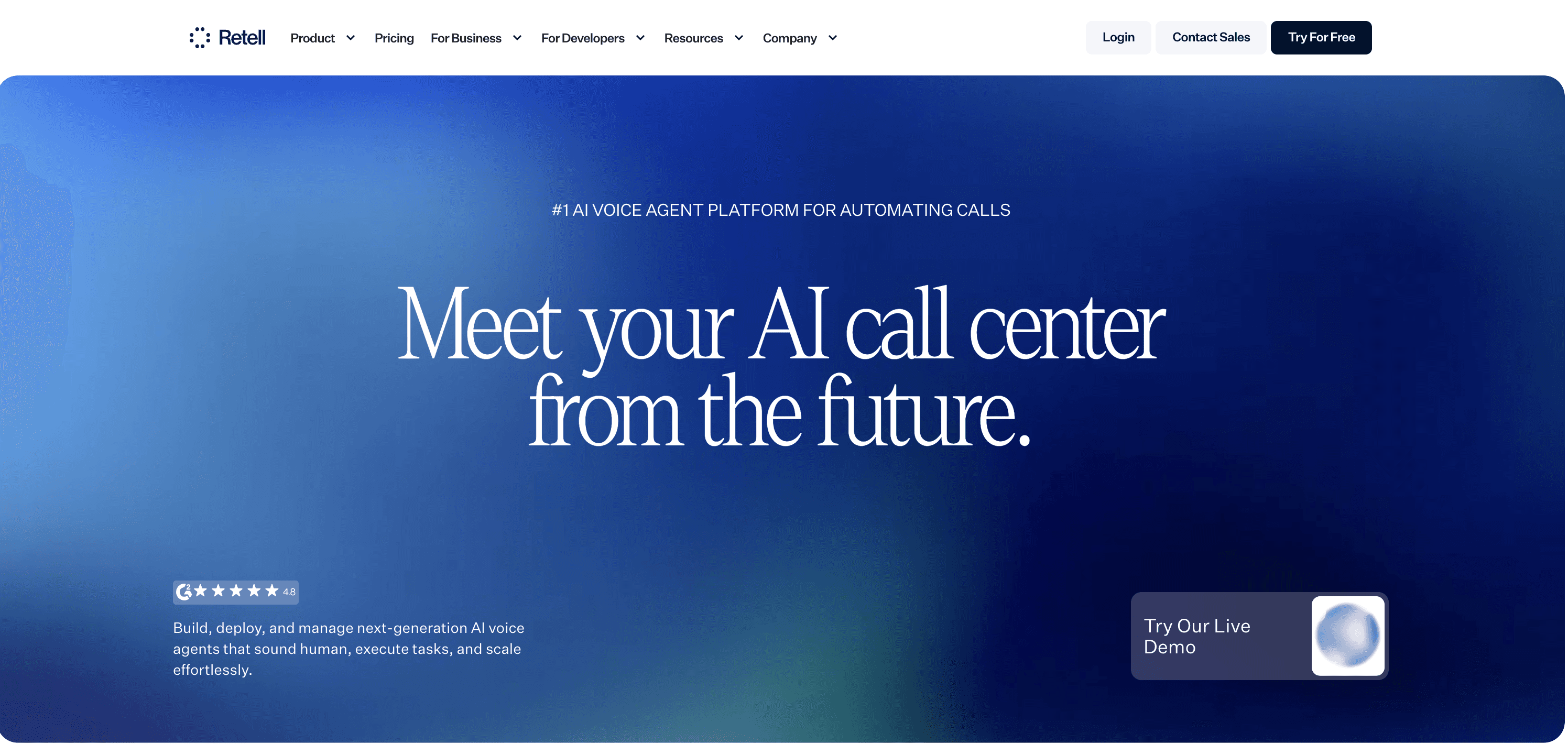
Retell AI is a voice agent platform built primarily for developers. It provides the infrastructure to build, test, and deploy conversational voice agents at scale. Teams use Retell AI to create voice bots that handle inbound and outbound calls, complete structured tasks, and integrate with backend systems via API. The platform is optimized for low-latency voice response, which is critical for call quality in customer-facing deployments.
Retell AI’s positioning is explicitly developer-first. The platform offers SDKs, a testing environment, and a deployment pipeline that engineering teams can work into existing telephony stacks. It supports multiple LLM providers, giving teams control over the model powering the voice agent. For enterprises with an engineering team that wants to build proprietary voice automation rather than buy a prebuilt flow, Retell AI offers more flexibility than turnkey platforms.
The tradeoff is that Retell AI requires engineering resources to deploy and maintain. Non-technical CX leaders cannot iterate on call flows without development support. The platform also does not include quality management, analytics, agent assist, or coaching. It covers the voice automation layer only, leaving buyers to source oversight and intelligence capabilities elsewhere.
Key Features
Low-latency voice agent infrastructure optimized for real-time conversation
Multi-LLM support (OpenAI, Anthropic, custom models)
SDK and API access for custom voice agent development
Inbound and outbound call handling with backend system integration
Conversation testing environment before production deployment
Customizable turn-taking, interruption handling, and silence detection
Webhook support for real-time event streaming
Strengths
Lowest latency voice response among developer-first platforms
Full model flexibility; teams choose and switch LLM providers
Strong developer tooling and documentation
Cost-effective at high call volumes for engineering-led teams
Active platform development with frequent capability releases
Weaknesses
Requires engineering resources for deployment and iteration
No pre-built flows, no-code interface, or guided setup
No quality management, analytics, coaching, or agent assist capabilities
Best For
Engineering teams building proprietary voice automation that need infrastructure-level control over the voice agent stack rather than a configured off-the-shelf platform.
6. Cognigy
Cognigy is an enterprise conversational AI platform with a long deployment history in large-scale, regulated environments. The platform covers voice and chat automation across multiple channels and includes a low-code flow builder that CX teams can use to design and maintain conversation journeys. Cognigy has a strong presence in telecommunications, banking, healthcare, and manufacturing industries, where compliance and complex backend integrations are non-negotiable requirements.
Cognigy’s architecture supports both generative AI responses and deterministic conversation flows within the same deployment. Teams can specify where the AI should reason freely and where it must follow a fixed path. This hybrid approach gives compliance-sensitive enterprises control over agent behavior in regulated scenarios while still benefiting from generative flexibility in unstructured queries.
Cognigy’s strengths in automation depth come with trade-offs in implementation time and cost. Enterprise deployments typically require a professional services engagement and a longer go-live timeline. The platform also lacks native quality management for human agents and does not include Voice of Customer analytics beyond basic reporting dashboards.
Key Features
Low-code flow builder for complex, multi-step conversation journeys
Hybrid generative and deterministic response control
Omnichannel deployment across voice, chat, email, and messaging apps
Agent handoff with full context transfer
Backend integration with SAP, Salesforce, ServiceNow, and custom APIs
Multi-language support across 100+ languages
Analytics on containment rate, escalation rate, and intent distribution
Strengths
Deep enterprise deployment history in regulated industries
Hybrid AI architecture balances flexibility with compliance control
Broad channel coverage, including voice telephony
Strong integration with large enterprise backend systems
Established professional services and partner network
Weaknesses
Implementation timelines are longer than turnkey alternatives
No native quality management for human agent performance
Analytics focus on bot metrics; no customer insight or VoC layer
Best For
Large enterprises in regulated industries that need a fully customizable conversational AI platform with deep backend integration and strict control over agent behavior in compliance-sensitive scenarios.
7. Chatbase
Chatbase is a knowledge-base-powered chatbot builder that allows teams to create AI support agents from uploaded documents, website content, and help center articles. The platform targets companies that want to deploy a self-service chat agent quickly without a dedicated implementation project. Chatbase is designed for speed: connect a data source, configure the agent’s persona and response style, and deploy via embed code or API.
The platform’s accessibility is its primary advantage. Non-technical teams can create a functional chat agent without writing code or working with an implementation partner. Chatbase handles training, chunking, and retrieval from the source documents, so teams do not need to manage vector databases or embedding pipelines. For small to mid-sized companies with a clear, well-documented knowledge base, Chatbase produces a deployable agent in hours.
Chatbase is built for simplicity, which limits its enterprise applicability. It does not support voice, complex multi-step workflows, backend system integrations beyond basic webhooks, or quality management. Analytics are minimal. Enterprises evaluating Sierra are unlikely to find Chatbase adequate for contact center-scale deployments, but smaller internal or departmental use cases may be a fit.
Key Features
Trains on uploaded PDFs, URLs, Google Docs, and help center content
No-code agent setup with configurable persona and response instructions
Website embed and API deployment options
Multi-language response capability
Basic conversation history and usage analytics
Lead collection and handoff to email or CRM via webhook
White-label options for agency and reseller use cases
Strengths
Fastest time-to-deploy among all platforms in this comparison
No technical expertise required to set up or iterate
Cost-effective for small to mid-sized knowledge base deployments
Easy to update; retraining on new content takes minutes
Good fit for FAQ automation and internal employee-facing use cases
Weaknesses
Not designed for enterprise contact center scale or complexity
No voice support, backend system integration, or multi-step workflow capability
No quality management, analytics depth, or human agent oversight
Best For
Small to mid-sized companies or internal teams that need a fast, low-cost way to automate FAQ and knowledge base queries in chat, without the overhead of an enterprise implementation.
8. Kore.ai
Kore.ai is an enterprise AI platform for virtual assistants that covers employee and customer-facing automation across voice, chat, and messaging channels. The platform’s XO Platform provides tools for building, training, and managing conversational AI applications at scale. Kore.ai has a broad capability set that includes intent detection, entity extraction, dialog management, and backend system integration, making it one of the more technically complete platforms in the enterprise conversational AI category.
Kore.ai’s approach is modular. Enterprises can deploy it as a customer-facing virtual assistant, an internal IT or HR helpdesk bot, or an agent co-pilot for human support teams. The platform supports deployment across Salesforce, ServiceNow, Microsoft Teams, Genesys, and other enterprise systems, which appeals to buyers who need to integrate AI into an existing technology stack rather than replace it.
sThe platform requires meaningful implementation effort. Dialog management and intent training are powerful but complex, and enterprises typically need specialized resources to build and maintain high-quality conversation flows. Analytics capabilities have improved but remain less mature than platforms purpose-built for contact center intelligence. Voice capabilities exist but have historically received less investment than chat.
Key Features
Platform for building, training, and managing conversational AI across channels
Multi-intent and multi-entity handling for complex customer queries
Pre-built domain models for banking, healthcare, retail, and IT support
Backend integration with 100+ enterprise systems via pre-built connectors
Conversation analytics with intent distribution and containment reporting
Agent escalation with context handoff to Genesys, Avaya, and other CCaaS platforms
Low-code bot builder alongside developer-facing SDK and APIs
Strengths
Broad channel coverage including voice, chat, messaging, and email
Deep backend integration library for enterprise systems
Modular architecture supports both customer-facing and employee-facing automation
Pre-built domain models reduce initial training effort in common industries
Strong API and developer tooling for custom capability development
Weaknesses
Complex to implement and maintain without specialized platform expertise
Analytics depth lags behind purpose-built contact center intelligence platforms
Limited native quality management and no VoC analytics layer
Best For
Large enterprises that need to automate across both customer support and internal IT or HR helpdesk use cases simultaneously, with a single conversational AI platform and deep integration into existing enterprise systems.
9. Zendesk
Zendesk is a customer service platform with a broad installed base in enterprise support operations. The platform includes ticketing, live chat, email, voice (via Talk), and a knowledge base, all connected in a single workspace. Zendesk added AI capabilities through its Zendesk AI suite, which includes an AI agent (formerly Answer Bot), intelligent triage, macro suggestions, and agent co-pilot features that surface relevant knowledge during live interactions.
Zendesk’s primary advantage is its position as the system of record for many enterprise support operations. Enterprises already running support on Zendesk can activate AI capabilities without switching platforms or migrating data. The AI agent draws on the existing knowledge base and ticket history to resolve customer queries. Intelligent triage routes and prioritizes incoming tickets based on intent and sentiment.
Zendesk’s AI capabilities are channel-native extensions of a ticketing system, not a purpose-built conversational AI or contact center intelligence platform. The AI agent handles deflection reasonably well for text-based channels but lacks the voice sophistication of platforms built for phone-first enterprises. Quality management requires Zendesk QA (formerly Klaus), a separate product, which adds cost. VoC analytics are limited to dashboard-level reporting without root cause intelligence.
Key Features
AI agent that resolves queries using help center content and ticket history
Intelligent triage with intent detection, sentiment scoring, and routing
Agent co-pilot with macro suggestions and knowledge surface during tickets
Omnichannel workspace connecting email, chat, voice, and messaging
Zendesk QA (add-on) for conversation quality scoring
Pre-built integrations with Salesforce, Slack, Jira, and 1,000+ apps
Workforce management and reporting dashboards
Strengths
Zero migration required for enterprises already on Zendesk
Broad channel coverage including voice via Zendesk Talk
Large integration ecosystem with over 1,000 pre-built connectors
AI capabilities activate on top of existing ticket and knowledge base data
Established enterprise security and compliance certifications
Weaknesses
AI capabilities are extensions of a ticketing platform, not a purpose-built AI product
Quality management requires a separate paid add-on
No native Voice of Customer analytics or root cause intelligence
Best For
Enterprises already running support on Zendesk that want to add AI deflection and triage without switching platforms, particularly for teams where email and chat are primary channels.
Wrapping Up: Where Level AI Fits Your Operating Model
Sierra solves one part of the enterprise CX problem: automating contact resolution through a virtual agent. It does that well in many deployments. The gap appears when enterprises ask what happens to the other 40-60% of contacts that require a human, and how they monitor the quality of every interaction across both bot and human channels.
Level AI covers both. The virtual agent and the quality management platform run on the same conversation data. QA scores for human agents and bot interactions use the same rubrics. Voice of Customer analytics surface customer intelligence from 100% of interactions, not just the ones the bot handled. Contact center leaders get one view of performance instead of assembling it from three vendors.
For contact center leaders who need to automate contacts, maintain quality across all interactions, and turn customer conversations into operational intelligence, Level AI is the platform that covers all three without assembling a stack.
Frequently Asked Questions
1. What is the biggest limitation of Sierra for enterprise contact centers?
Sierra focuses exclusively on virtual agent deployment. It has no native tools to QA its own bot's performance, no visibility into human agent interactions after escalation, and no Voice of Customer analytics. Enterprises running both bot and human agents need to purchase separate tools for quality management, coaching, and customer intelligence, which increases total cost and creates fragmented reporting.
2. How does Level AI's pricing compare to Sierra's?
Sierra uses outcome-based pricing at an estimated $0.50-$1.00 per successful resolution. As the bot's containment rate improves, the cost per period increases rather than decreasing. Level AI uses conversation-based pricing at approximately $0.10-$0.30 per conversation, with a flat platform fee. Finance teams can forecast and audit Level AI costs. Sierra's costs are variable and tied to Sierra's definition of a successful resolution.
3. Can any of these platforms replace Zendesk entirely?
No platform on this list is a full replacement for Zendesk's ticketing and support operations functionality. Several platforms, including Level AI and Cognigy, integrate with Zendesk rather than replacing it. Buyers evaluating Sierra alternatives should treat the virtual agent and contact center intelligence layer as separate from their ticketing system.
4. Which Sierra alternative is best for a company that primarily handles support over the phone?
Enterprises with high phone contact volume should evaluate Level AI, Cognigy, Kore.ai, and Retell AI. Level AI and Cognigy offer the most complete voice and quality management coverage. Retell AI offers the most control for engineering teams building proprietary voice automation. Most other platforms on this list focus on chat and email.
5. How long does it typically take to deploy Level AI compared to Sierra?
Sierra's implementation includes a University program with a steep learning curve that customers report delays time to value. Level AI's no-code agent setup allows CX leaders to configure and iterate in minutes, not weeks. Integration with major CCaaS platforms is handled through pre-built connectors. Enterprise deployments typically see initial value within weeks rather than months.