Key takeaways
Modern AI voicebots hold natural conversations, detect emotions, and respond empathetically, unlike older, scripted bots.
Voicebots are best for complex or emotional calls; chatbots work well for quick, text-based support.
The best voicebots don’t just reply; they take action, like updating records or resolving issues end-to-end.
Voicebots have come a long way from the old IVRs that made you press buttons and listen to robotic menus. Today’s bots are powered by conversational AI that allows for natural, back-and-forth conversations between people and machines.
These systems use a mix of technologies to understand and respond to spoken language:
Automatic speech recognition (ASR) turns spoken words into text, while text-to-speech converts responses back into audio.
NLP helps bots understand what the customer is saying, even when they use slang, regional accents, or emotional language.
The best voicebots detect customer sentiment and adjust their responses to keep the tone conversational, helpful, and empathetic.
But not all voicebots are up to the task:
Many struggle with complex questions or emotionally charged conversations.
Some can’t act on basic customer requests or pass along helpful context when transferring to a human agent.
Others are hard to integrate with your existing systems and cost more than they’re worth.
That’s why we built AI Virtual Agent, our next-generation voicebot platform. It delivers human-like conversations, smooth handoffs, and deep integrations right out of the box.
In this article, we’ll discuss how voicebots differ from chatbots, provide best practices for automating support, and explore these five top voicebot platforms:
AI Virtual Agent (by Level AI)
VoiceSpin
Sprinklr
Convin
Talkdesk
Voicebot vs chatbot: which should I choose?
The right choice depends on several factors, including your business goals, available budget, customer preferences, and how complex the interactions are that you plan to automate.
When to use a chatbot, voicebot, or both
If your support needs are mostly visual, text-heavy, or focused on fast answers to common questions, and you're working within a tighter budget, an AI-powered chatbot may be the better fit.
On the other hand, if your customers rely on phone support, often have more complex or emotional issues, or need a more accessible, hands-free option, a voicebot offers a more natural and responsive experience.
Use a chatbot when your customers need | Use a voicebot when your customers need | Either works for |
|---|---|---|
Quick, low-effort answers to common questions (e.g., FAQs, order tracking) | Fast, natural, and human-like help over the phone for urgent issues | 24/7 automated assistance for routine queries |
A discreet, silent way to interact (e.g., at work or in public) | A hands-free option (e.g., while driving, multitasking, or for accessibility reasons) | Multilingual support across global customer bases |
Text-based support via webchat, social media, or messaging platforms | Support over phone lines, smart speakers, or IVR systems | Appointment scheduling or account management via structured dialogue |
Rapid-fire conversations with a button or menu-based flows | Open-ended, multi-turn conversations requiring tone and context detection | Survey or feedback collection after an interaction |
Access to a low-cost, easy-to-deploy solution across multiple platforms | A more personalized, empathy-aware experience using tone and sentiment detection | Collecting lead information or routing basic support issues |
See also our guide to best chatbots for customer service.
5 best practices for automating customer service
At Level AI, we’ve seen firsthand how leading organizations roll out voicebots and chatbots, and the most successful ones tend to follow a few key practices:
1. Always provide a clear path to a human agent
One of the biggest mistakes is forcing customers into a frustrating no‑way‑out loop, where they neither get their issue resolved nor their query answered, and they can’t escalate to a human agent, either.
Your AI-powered interface and contact center automation tools (whether chatbot or voice assistant) should make it obvious how and when a customer can connect to a live representative, and pass along context like name, order number, and issue description.
2. Ensure omnichannel support
Customers expect smooth continuity whenever they switch from email to live chat, SMS, etc. Your AI system must be able to ingest and act on data from every customer touchpoint in real time, unifying the conversation history.
3. Data quality is paramount
AI systems operate on the garbage-in, garbage-out principle: their effectiveness is directly tied to the quality, accuracy, and consistency of the data you provide them, requiring a single source of truth for all customer data and knowledge base content.
4. Transparency and trust
We advise being upfront with customers when they’re interacting with an AI assistant to manage expectations and build trust. For instance, “You’re chatting with our AI assistant, who can help with most questions and connect you to a human if needed.”
5. Multilingual support
AI-powered voicebots and chatbots offer significant benefits for global businesses when they deliver support in multiple languages, increasing accessibility and ultimately reducing support costs.
See also our latest article on chatbot customer experience.
Features to look for in a customer service voicebot
Look for real intelligence, not just logic
Many traditional voicebots rely on decision trees and rigid keyword-based logic to interpret customer input across a variety of use cases. These systems follow hardcoded workflows, which means they often fall apart when a customer speaks naturally by interrupting, using varied phrasing, or going off-script.
For example, if a customer asks about a billing issue without using the word “refund,” the AI customer service agent might fail to route them appropriately.
This reliance on scripts leads to robotic, frustrating interactions that lack empathy and flexibility.
In contrast, true AI voicebots are built on vertically trained language models and powered by NLU and generative AI. These systems don’t just match keywords; they use speech analytics software to understand customer intent, adapt responses in real time, and maintain a natural, conversational tone. They can detect changes in emotion and shift their approach to deliver more empathetic, human-like support.
A modern AI voicebot should also be able to:
Understand and respond in multiple languages using its conversational intelligence software
Recognize slang, idioms, and regional phrasing
Navigate complex or ambiguous requests with context-aware intelligence
This level of real intelligence is what makes AI agents truly conversational and genuinely helpful.
AI voicebots should deliver outcomes, not just answers
Legacy bots often function like voice-based FAQ systems; they can respond to basic questions but rarely solve actual problems. In contrast, AI voicebots should be built to do things, not just say things.
A capable AI voicebot can trigger backend workflows, update records, and resolve routine and simple customer issues without needing to escalate to a human agent.
Beyond task completion, modern AI voicebots deliver a consistent, natural experience across channels, with voice being the most demanding. They scale efficiently, handling spikes in call volume or real-time user needs without compromising performance.
Importantly, advanced AI voicebots should drive measurable business outcomes. Look for clear ROI signals like:
Increased CSAT
Higher containment rates (issues resolved without escalation)
Reduced average handle time
Lower call abandonment
Ultimately, the value of an AI voicebot lies in its ability to resolve and not just respond to queries.
System integration and operational flexibility
For a voicebot to deliver real business value, it must integrate deeply with your existing systems, including CRMs, ticketing platforms, and support tools. These integrations are necessary for enabling the intelligent, agent-like behaviors discussed earlier.
Choose AI-powered platforms with robust backend integration capabilities that allow the bot to take meaningful action, like accessing a CRM to log tickets, pull up customer histories, or update records. This operational flexibility reduces manual handoffs, shortens resolution times, and ensures more fluid, personalized interactions.
Legacy systems often require significant developer involvement to set up or modify, resulting in high costs and long lead times. Instead, look for platforms that offer no-code or low-code tools so that your operations and support teams can easily build or update flows without engineering bottlenecks.
5 leading voicebots for customer service
1. Level AI virtual agent
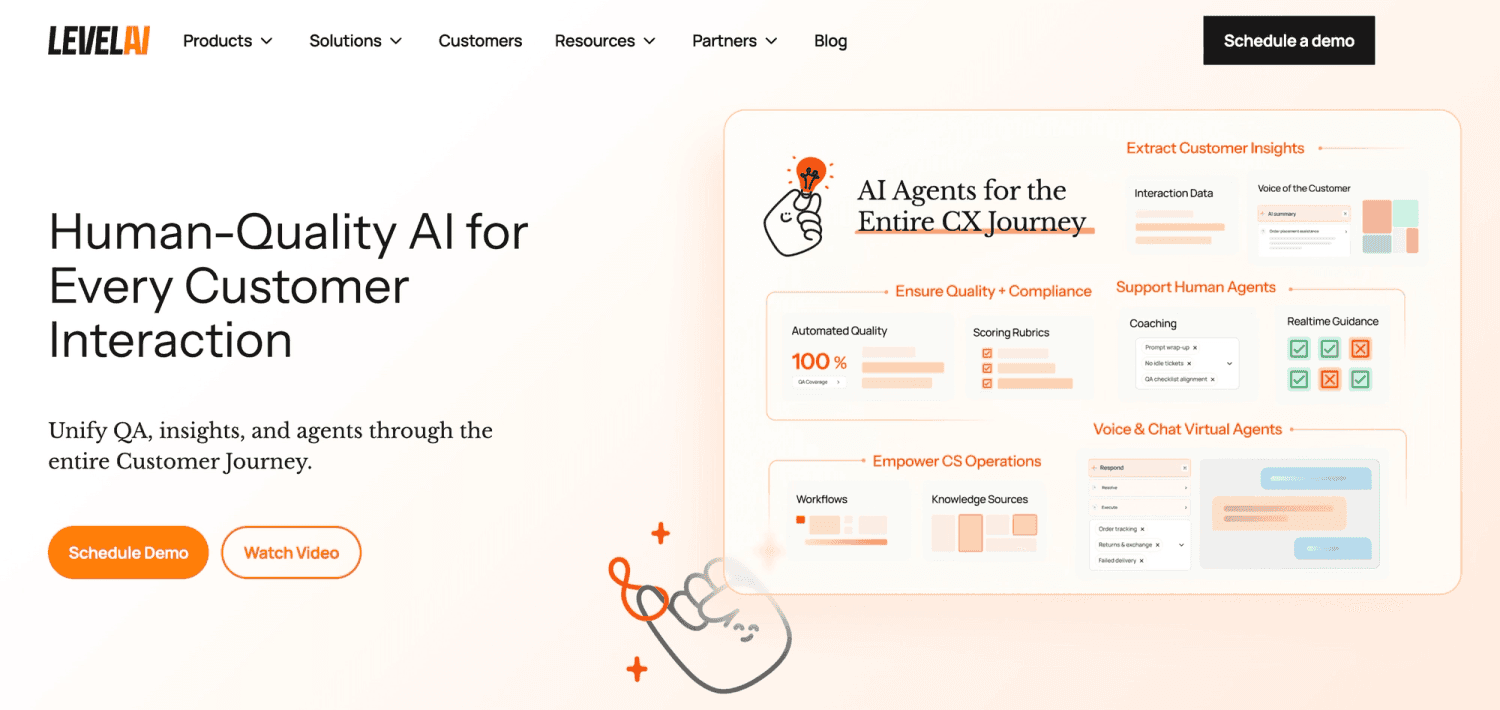
Our AI Virtual Agent is a voicebot and conversational intelligence platform built for customer service teams and designed to deliver fluid, human-like conversations across voice and text channels. It combines NLU with semantic intelligence to interpret intent, emotional tone, and context with near-human accuracy, enabling it to handle support scenarios effectively.
What sets this platform apart is its integration into Level AI’s closed-loop customer intelligence system. It monitors and evaluates 100% of customer interactions, both AI- and human-led, using AutoQA. These AI-driven evaluations track performance, surface emerging automation opportunities, and ensure the voicebot continues to learn and improve without sacrificing quality.
AI Virtual Agent is action-oriented. It can execute complex tasks, such as processing order changes, updating CRM records, or retrieving account history, thanks to robust backend integrations via APIs and pre-built connectors. It also supports multilingual conversations and meets enterprise compliance standards for customer data, including SOC 2, HIPAA, and GDPR.
Its ability to detect and respond to emotions like concern, frustration, or appreciation allows it to build rapport and offer empathetic support, making it especially effective in high-stakes or sensitive customer interactions.
To experience AI Virtual Agent firsthand, call its toll-free number: (716) 588-4326.
Below, we dive deeper into the features that make AI Virtual Agent a top choice for enterprise-grade voice automation.
Recognizes speech and intent with near-human accuracy
Legacy voicebots for customer support often fall short when conversations become emotionally charged or veer off script. While many can detect broad sentiment like positive or negative tone, they rarely respond in ways that show understanding, empathy, or the ability to de-escalate.
AI Virtual Agent takes a more advanced approach. Built on Level AI’s sentiment analysis tools, it detects the widest range of emotions of any software in its category. These include:
Anger
Annoyance
Disapproval
Disappointment
Worry
Admiration
Happiness
Gratitude
This allows Virtual Agent to engage customers in natural, emotionally aware dialogue that feels human, avoiding the robotic, scripted feel of legacy systems.
It also dynamically adapts its tone and response style in real time to match the customer’s emotional state. For instance, it knows to use calming language when a customer is angry about a billing error, or to show empathy when they’re worried about a late delivery.
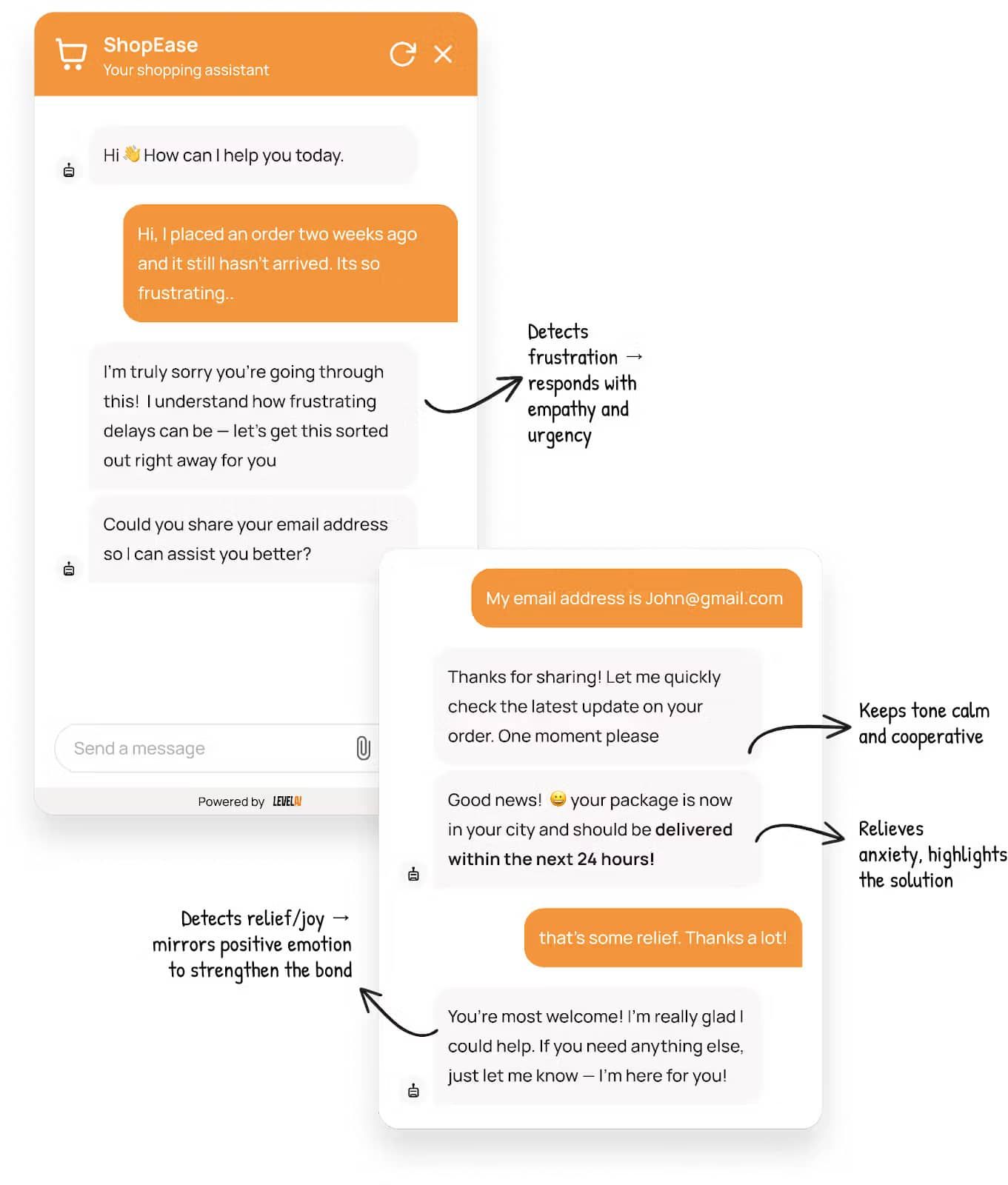
By identifying such a wide range of emotions, AI Virtual Agent avoids the simplistic binary classification of sentiment (positive or negative) used by older rule-based systems.
For example, a legacy system might misinterpret a rise in tone as simple agitation, while Virtual Agent can distinguish between a customer expressing worry and one expressing annoyance.
This focus on empathetic, human-like dialogue translates into quantifiable improvements in call center efficiency, resulting in a reported 30% higher CSAT and 50% lower abandonment rate compared to other market offerings.
Agentic AI that takes action, not just answers queries
AI Virtual Agent is built with agentic AI capabilities that go beyond conversation. It reduces customer effort by performing real support actions, not just responding to queries.
This hybrid model automates routine tasks and routes more complex issues to human agents, increasing team efficiency and improving the customer experience.
For example, if a customer asks, “I need to change the shipping address on my recent order,” AI Virtual Agent retrieves the customer’s order and account details, updates the shipping address, logs the change in the CRM, creates a support ticket, and sends a confirmation message.
It integrates easily with existing enterprise systems like CRMs (e.g., Salesforce, HubSpot), ticketing systems (e.g., Zendesk), and knowledge bases using pre-built connectors or APIs.
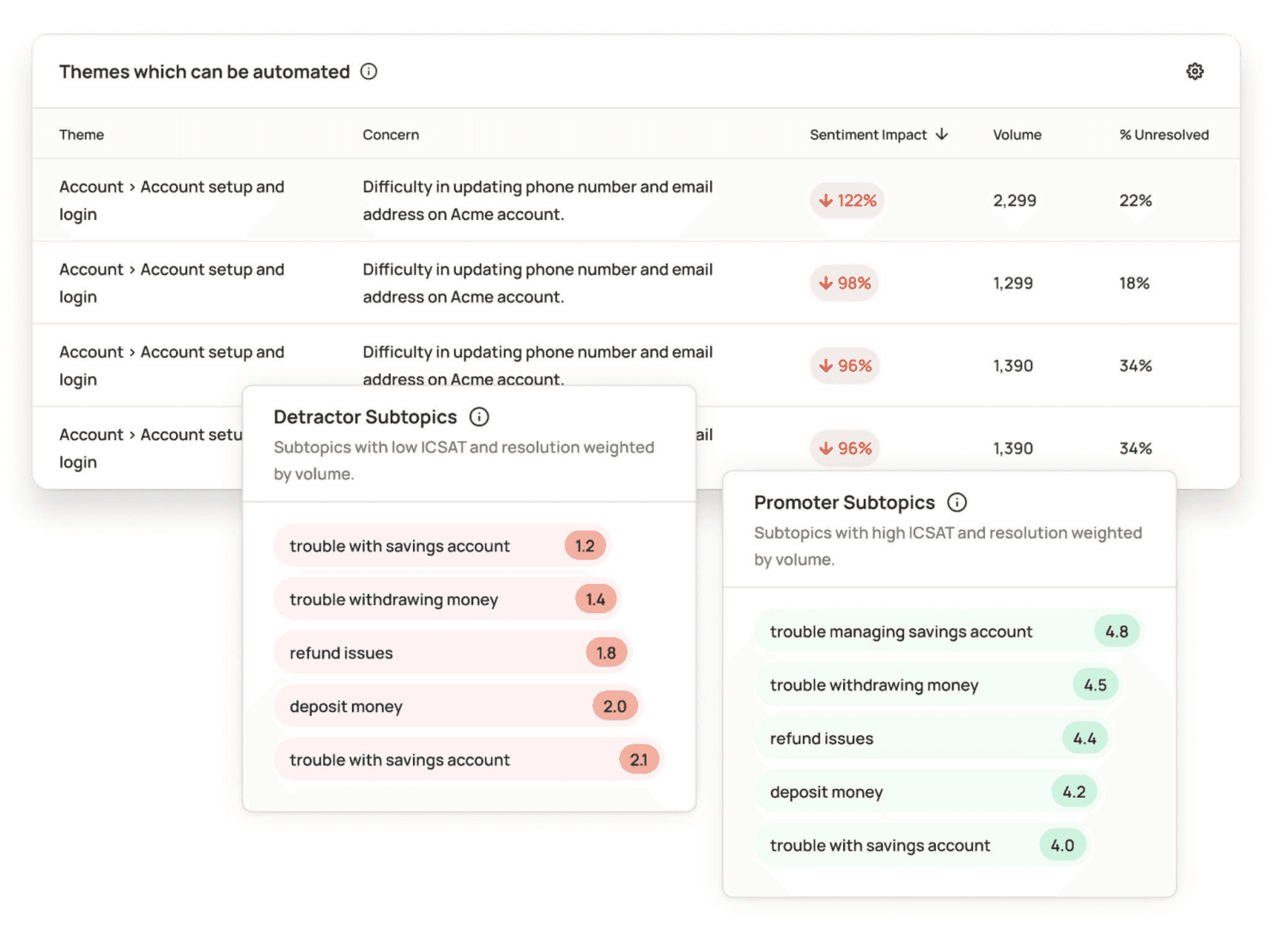
Virtual Agent’s continuous learning system identifies routine queries and tasks that recur frequently via its continuous learning system, which analyzes your past human and artificial intelligence interactions to proactively discover and map high-volume, repeatable queries that are ideal for automation.
This allows it to continually expand its automation coverage, reduce agent workload, and improve resolution rates by identifying and acting on the most common customer needs without human intervention.
AI Virtual Agent is easy and fast to set up in a contact center, requiring minimal engineering support, and can be launched in days.
It connects to your knowledge sources and external systems; teams can define “skills” for specific tasks, set triggers that activate those skills, and connect knowledge sources, such as policy documents, to improve accuracy.
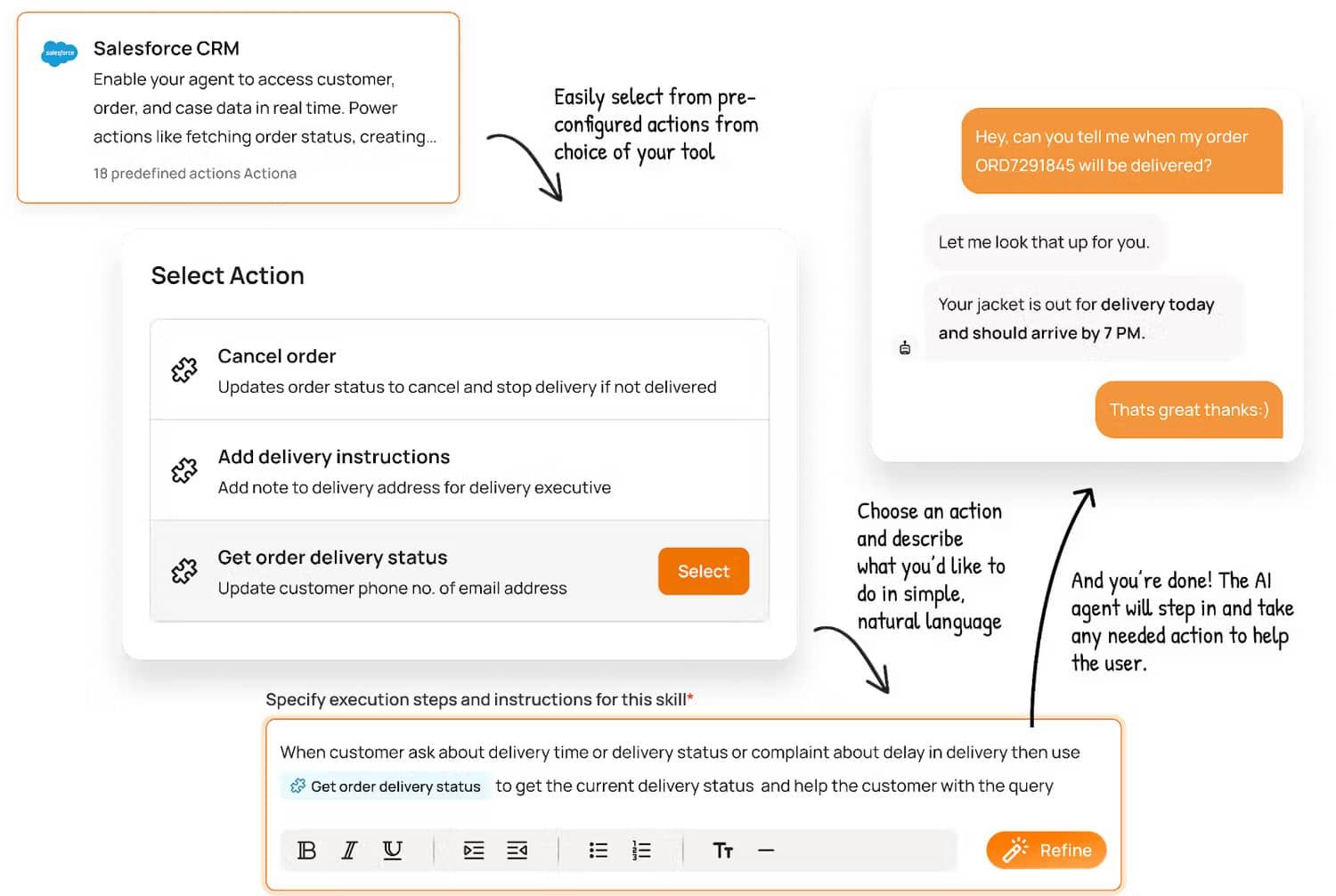
Once skills are defined, you deploy the agent in your call center by customizing branding; the system also provides an embed code (as JavaScript code snippets) for easy integration onto your website.
After it’s deployed, AI Virtual Agent begins handling live customer interactions immediately, executing defined tasks, responding to customer inquiries, and escalating complex cases to human agents.
It uses customer analytics software to obtain a comprehensive understanding of the conversation’s depth and the customer’s emotional state (e.g., when it detects a complex query at the start of the conversation), which allows it to decide when to escalate a call to a human. That’s because live agents excel in situations that require intuition, judgment, trust, and deep advisory skills, such as restructuring a loan or selecting a health insurance plan.
Virtual Agent’s advanced emotion detection also enables it to identify when a customer isn’t satisfied or is losing patience. It’s also equipped with guardrails and fallback logic, so when the bot is unable to resolve customer inquiries or if it detects errors, this information is used to trigger the escalation.
It then transfers the full conversation context to the human agent. This transfer includes the detected intent and customer sentiment, along with the entire conversation history, and summaries of the relevant part of the conversation and include that information in the transfer to the human agent.
Our Virtual Agent offers a 55% lower setup cost and maintenance compared to other bots.
Take the next step toward modern, empathetic support. Try AI Virtual Agent today with a live demo.
2. VoiceSpin
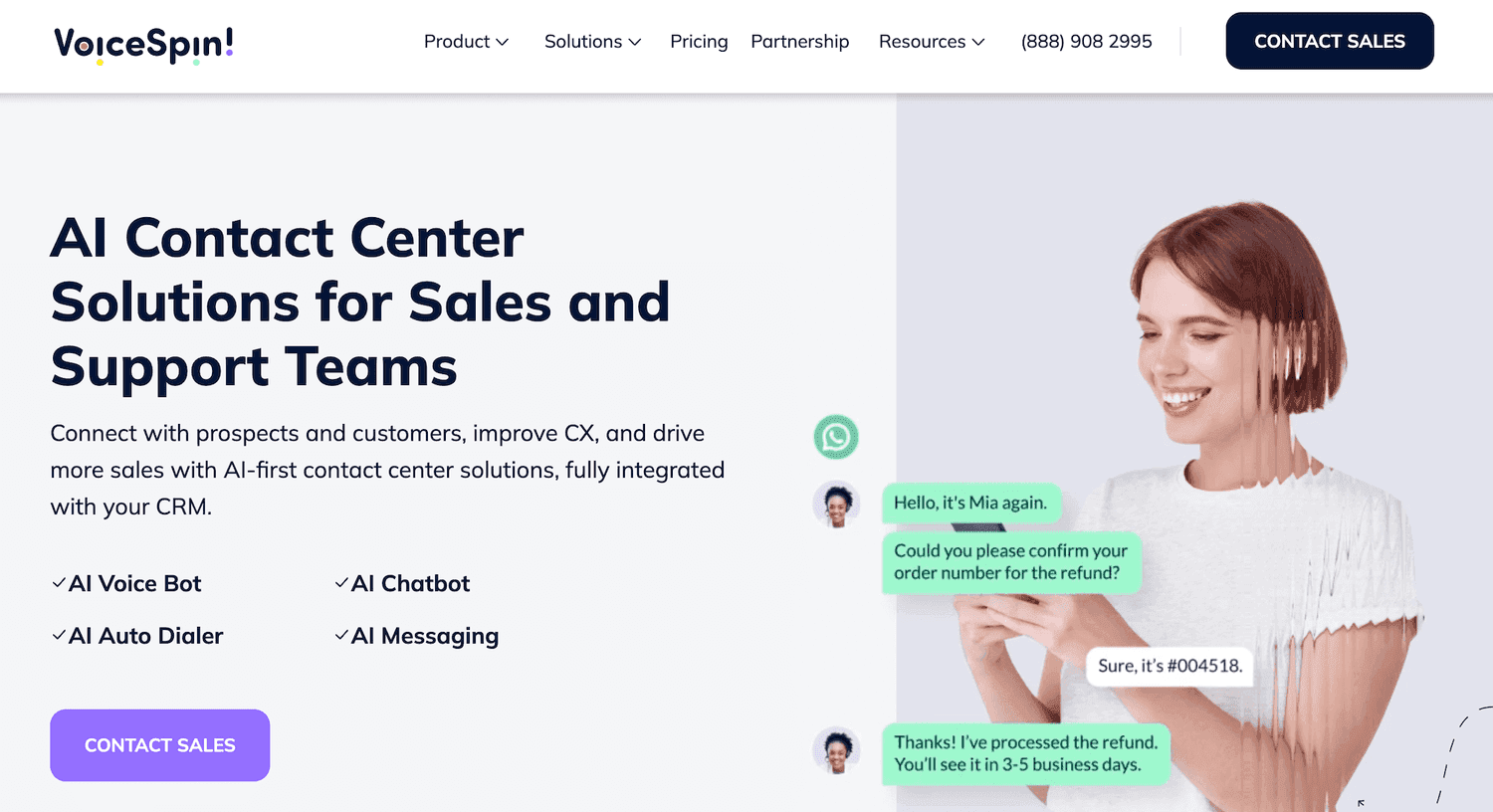
VoiceSpin handles routine inquiries 24/7 in a natural conversational style while freeing customer service teams to focus on higher-value tasks requiring human attention. VoiceSpin supports multilingual conversations, integrates with CRM and backend systems, and can transfer calls to human agents.
Key features include:
It can answer common questions and resolve basic support issues instantly, reducing hold times while improving customer satisfaction scores.
Intelligent call routing based on skills or other criteria, along with IVR to guide callers efficiently through menu options.
Call transcriptions for deeper insights, quality monitoring, performance coaching, and compliance. The AI spots keywords and provides real-time warnings to prevent issues.
Integration with common helpdesk and contact center platforms, enabling it to perform tasks such as booking appointments, capturing leads, and retrieving customer information in real time.
Pricing starts at basic customer support functionality for small call centers (five agents) at $500 per month and goes up to enterprise pricing thereafter.
3. Sprinklr
Sprinklr’s voicebot offers personalized and scalable support and is built on Sprinklr’s unified customer experience management platform. It reduces wait times, decreases operational costs, resolves common issues, and provides smooth transitions to live agents when needed to improve overall customer satisfaction.
Key features include:
Round-the-clock availability, ensuring contact center customers receive immediate assistance without waiting on hold or navigating frustrating traditional IVR systems.
Routing of calls to live agents, maintaining the context of the conversation to avoid repetition and improve resolution speed.
Customization of AI-driven voicebots via a no-code UI to reduce reliance on IT resources.
Integration across customer support channels like chat and social media and preservation of conversation history so customers don’t have to repeat information across touchpoints.
Sprinklr offers custom pricing plans only for enterprise customers.
4. Convin
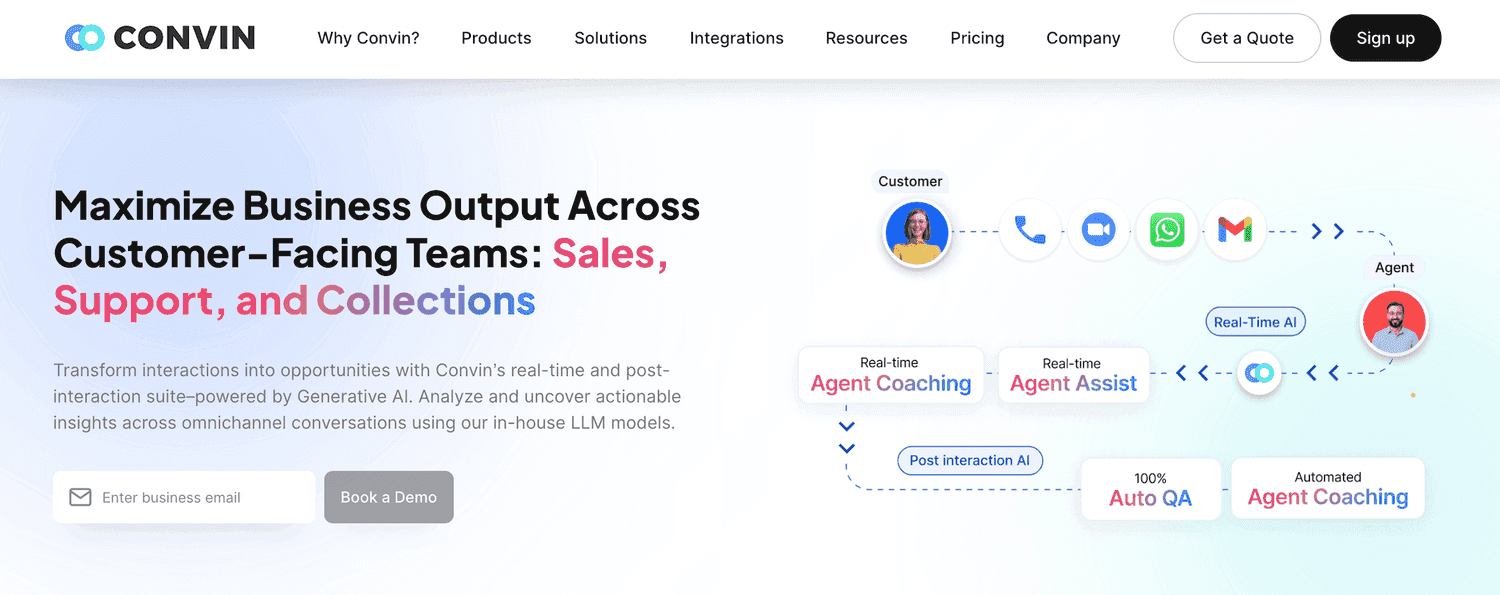
Convin uses conversational AI to automate both inbound and outbound customer interactions, scale service delivery, and improve customer satisfaction through personalized, context-aware engagement.
Key features include:
Handling of common customer support queries and use cases such as account information, product inquiries, lead qualification, FAQ resolution, and debt collection.
Replacement of traditional IVR menus with natural, free-flowing conversations, letting customers interact using natural language for more intuitive support.
Automation of routine support tasks to free human agents to focus on complex and nuanced issues.
Parallel management of calls to minimize wait times and promote consistent, real-time service.
Convin doesn’t publicly disclose pricing. Contact their team for a demo to request a custom pricing plan based on your specific needs.
5. Talkdesk
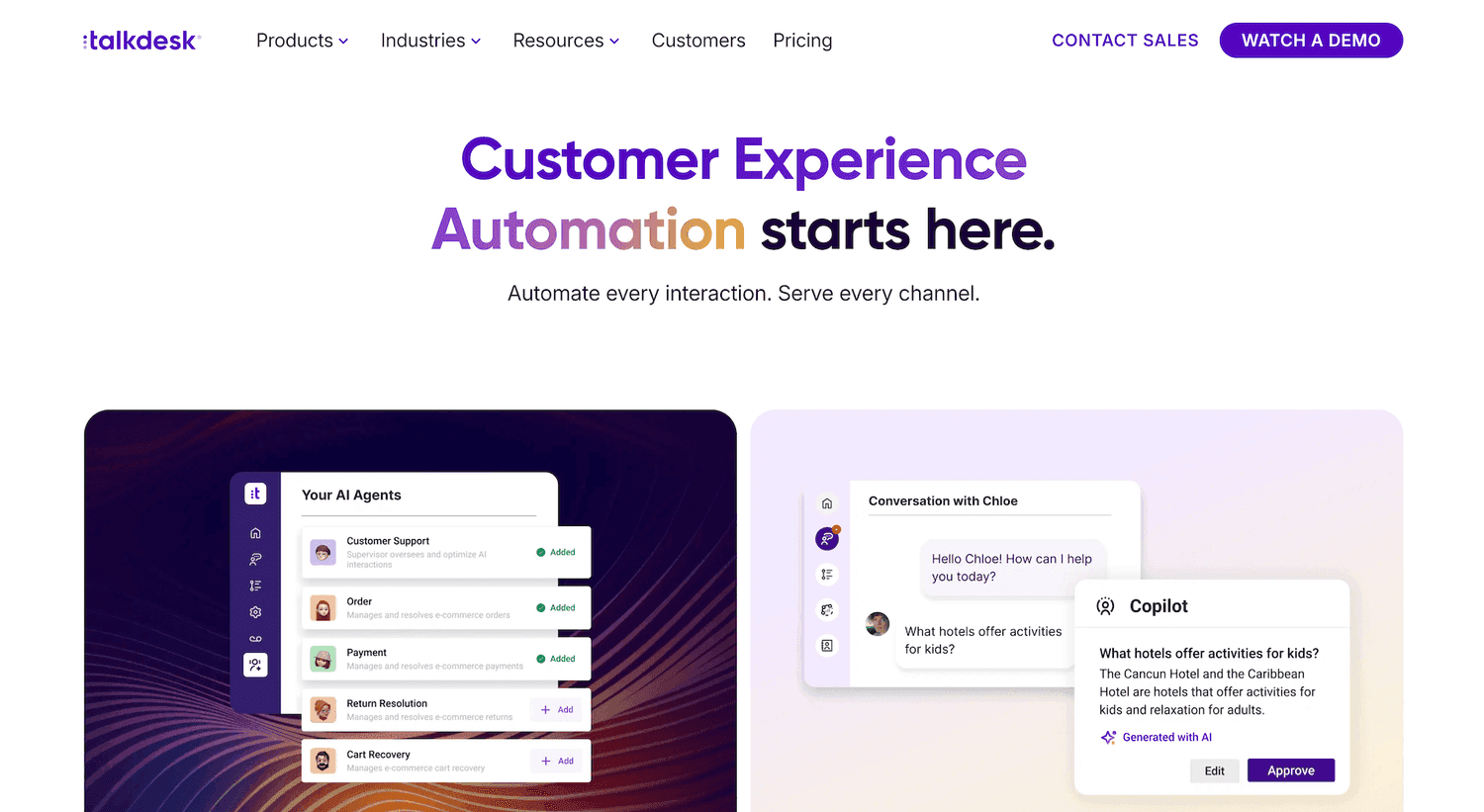
Talkdesk offers natural voice interactions that understand speech in real-time to provide 24/7 customer self-service without human intervention. It integrates with business systems like CRM and electronic health records, operates in multiple languages without translation, and requires minimal setup without complex scripting or training on intents.
Key features include:
Rapid deployment via simple natural-language prompts without the need for complex intent mapping or data science expertise.
Automated self-service that handles routine queries and use cases such as orders, returns, billing, and escalates complex cases smoothly to live human agents when needed.
Integration with CRM, EHR, and other back-end systems to retrieve relevant data and complete customer requests.
Detects sentiment, adapts voice tone to replace frustrating robotic calls with more natural-sounding conversations.
Talkdesk pricing starts at around $85 per user per month for the CX Cloud Digital Essentials plan.
Automate conversations without losing the human touch
Replace rigid IVRs with cost-effective artificial intelligence that listens, learns, and improves. AI Virtual Agent helps you turn every customer conversation into an opportunity for resolution, insight, and brand loyalty.
Level AI is used by marquee companies in a variety of different verticals such as ecommerce & retail, financial services, healthcare, printing & gifting, transportation, and tech.
Try it for yourself and book a demo to see what intelligent voice support really looks like.