8 Best AI Voice Agents for Healthcare in 2026: Use Cases & Real Examples





Key Takeaways
- AI voice agents handle routine calls without human involvement. Scheduling, refill requests, insurance verification, and post-discharge follow-up can all run at volume through automation.
- HIPAA compliance and SOC 2 Type II certification are the minimum bar for any vendor touching protected health information. Ask for audit documentation, not assertions.
- EHR integration determines whether a voice agent reduces administrative work or creates it. A system that cannot write back to scheduling platforms adds a manual step that offsets any efficiency gain.
- Context preservation on escalation matters as much as containment rate. When a transfer drops conversation history, the patient repeats themselves, and the efficiency of the automated interaction is lost.
- Training data shapes production performance. Voice agents built on real healthcare conversations handle patient language differently than systems trained on synthetic data. Ask vendors what data their models were trained on.
Introduction
Healthcare contact centers handle some of the highest-stakes calls in any industry. If patients are calling to clarify instructions or confirm appointments, they cannot afford to wait in a queue. Also, it is impractical to pull a staff member from clinical duties to handle administrative calls, this is a cost that the health system cannot ignore. AI voice agents in healthcare address both problems by handling routine inbound and outbound calls without human involvement, at any hour, and at a volume that traditional staffing cannot match.
As per this report by NLM, AI conversational tools deployed in clinical and administrative settings have shown measurable reductions in average call handling time and improved follow-through on appointment confirmations. The case for deployment is operational, not aspirational.
This guide covers what AI voice agents in healthcare actually do, the key use cases driving adoption, a list of tools currently on the market, and what to evaluate before selecting one.
What Are AI Voice Agents in Healthcare?
An AI voice agent in healthcare is a software system that conducts spoken conversations with patients or staff using natural language processing and speech recognition, without requiring a human agent on the other end of the line.
These agents handle inbound calls covering appointment scheduling, prescription refill requests, insurance verification, and post-discharge check-ins. They also initiate outbound calls for appointment reminders, care gap outreach, and chronic disease monitoring follow-ups. Most enterprise-grade deployments connect to electronic health record (EHR) systems, patient management platforms, and contact center infrastructure.
AI voice agents built on large language models handle open-ended conversation, maintain context across multiple turns, and escalate to a human agent with the full conversation history intact when the situation requires it.
What are the Use Cases for AI Voice Agents in Healthcare?
1. Appointment Scheduling and Reminders
AI voice agents handle the full scheduling workflow: checking availability, booking, rescheduling, and sending reminders. Voice-delivered automated reminders reduce no-show rates. North Kansas City Hospital reduced patient check-in time from four minutes to ten seconds after deploying AI-assisted intake workflows, and pre-registration rates rose from 40% to 80%.
2. Post-Discharge Follow-Up and Chronic Care Outreach
Hospitals face regulatory and quality penalties when discharged patients are readmitted within 30 days. AI voice agents conduct structured follow-up calls to check on symptoms, confirm medication adherence, and flag patients who need clinical review. A Voice AI platform deployed this model at a popular hospital chain where AI agents contacted over 100 patients for cancer screening follow-up, improving access to care for English-speaking and Spanish-speaking patients.
3. Insurance Verification and Prior Authorization Support
Insurance calls are high-volume, repetitive, and prone to human error. AI voice agents collect the details needed for coverage verification and flag exceptions to the appropriate staff. Billing teams see a measurable reduction in time spent on verification calls, which shortens the gap between patient intake and authorization approval.
4. Prescription Refill Requests
Refill requests are among the highest-frequency call types in outpatient and pharmacy settings. AI voice agents handle the verification steps, confirm the prescribing physician on file, and pass the confirmed request to the pharmacy system, without pulling a medical assistant or front-desk staff member into the loop.
Read: What Healthcare Contact Centers Get Wrong About Staffing
8 AI Voice Agents for Healthcare Worth Evaluating in 2026
The market includes purpose-built healthcare tools, general-purpose conversational AI platforms, and enterprise contact center platforms with healthcare modules.
1. Level AI Virtual Agent
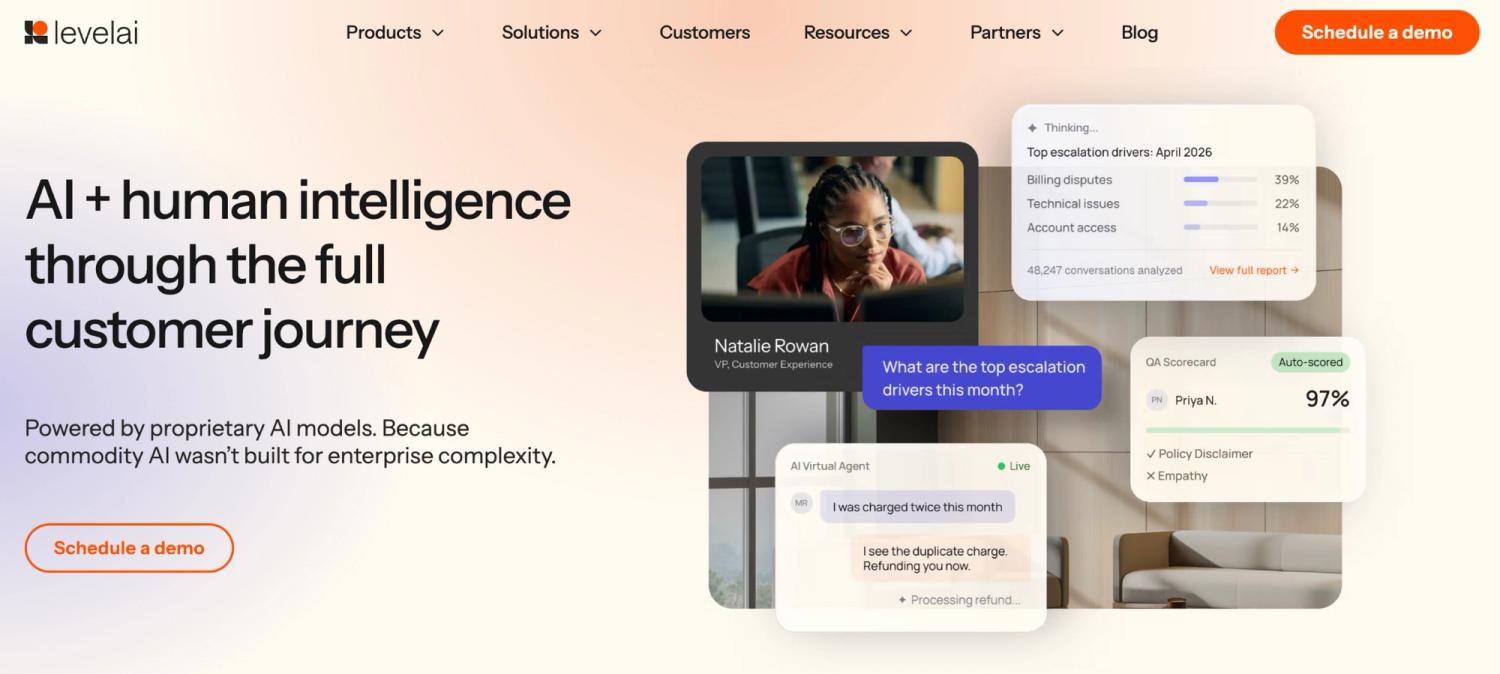
Level AI builds its AI Virtual Agent on real historical conversation data from top-performing human agents. The model learns from actual resolution patterns and inherits the judgment and tone of an organization’s best performers. This means the standards embedded in the agent come from observed human excellence in the contact center.
- Instant Path Discovery identifies which interactions to automate by analyzing existing conversation logs, so deployment decisions are grounded in what patients actually call about.
- Human-Grade Conversations delivers sub-two-second response latency through a proprietary AI stack, with emotional intelligence built into the conversation model to reduce disconnects and requests for human transfer.
- Hybrid Workflows give clinical contact centers deterministic handling for regulated or high-stakes scenarios, such as triage escalations or prior authorization requests.
- The Unified Intelligence Loop connects the virtual agent to quality assurance scoring and human performance data, so the system improves continuously from outcomes on an ongoing basis.
Level AI holds a 4.7 out of 5 rating on G2 and maintains HIPAA, SOC 2, and GDPR compliance. Customers, including Affirm, Toast, and Swiss Re, have validated the platform in regulated, high-volume environments. Healthcare organizations evaluating virtual agents will find the Level AI approach worth examining for its foundation in human performance data and its connection to quality assurance governance workflows. Learn more about the Level AI Virtual Agent.
Best for: Healthcare contact centers that want a virtual agent built on human-performance data, with built-in quality assurance governance and continuous learning.
Book a tailored demo to experience Level AI first-hand
2. Hippocratic AI
Hippocratic AI builds AI agents for non-diagnostic patient-facing communication. Its voice agents handle patient engagement calls, appointment scheduling, care gap outreach, and chronic disease check-ins. The platform is trained on clinical communication standards and holds HIPAA compliance as a foundational requirement. In January 2025, the company closed a 41 million Series B at a .64 billion valuation, giving it the runway to expand into regulated enterprise accounts.
Best for: Health systems needing compliant, patient-facing outreach at scale.
3. Cognigy
Cognigy is an enterprise conversational AI platform with a healthcare module covering voice and digital channels. Its healthcare use cases include identity verification, appointment management, insurance updates, prescription refill intake, and digital pre-registration. The platform supports over 30 channels out of the box and integrates with EHR systems. Cognigy’s deployment at Personify Health achieved a 40% containment rate, meaning four in ten inquiries were resolved without human involvement.
Best for: Organizations that need a multi-channel AI platform with voice as one component.
4. Hyro
Hyro is a healthcare-focused conversational AI company that automates patient interactions by voice, chat, and SMS. Its adaptive conversation model handles high call volumes for hospital systems, managing questions about providers, services, and appointment availability without requiring custom intent training. The platform connects to EHR and scheduling systems and handles call deflection through open-ended natural language understanding.
Best for: Hospital systems looking to reduce inbound call volume on administrative queries.
5. Suki AI
Suki AI is a voice AI tool built for clinicians. Its primary function is capturing clinical notes by voice during or after patient encounters, with integration into major EHR platforms. The product reduces the documentation burden on physicians, contributing to faster charting and lower burnout. Physicians using Suki report getting back two to three hours per day previously spent on manual charting.
Best for: Physician groups and health systems focused on reducing documentation time.
6. Nabla
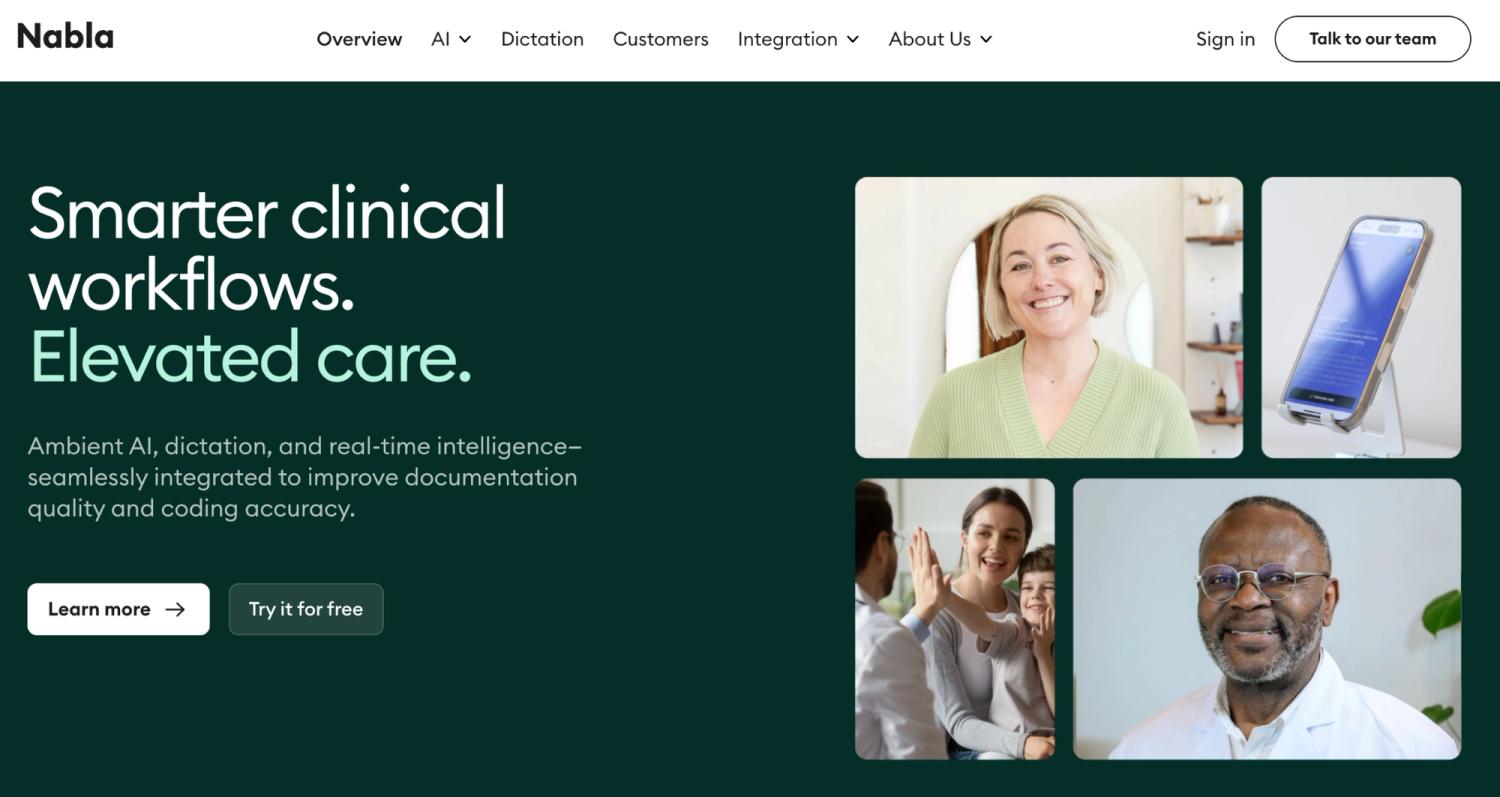
Nabla builds AI clinical co-pilots, with voice as a core input modality. Its tools cover medical note-taking, chart summarization, and ambient documentation during clinical encounters. Nabla is one of the faster-growing companies in this space in 2026, with expanding adoption in ambulatory and outpatient settings. The product handles the clinical documentation layer in a broader AI stack, while patient-facing voice agents manage inbound and outbound calls separately.
Best for: Clinicians who want AI-assisted documentation without changing how they communicate with patients.
7. Amelia (SoundHound AI)
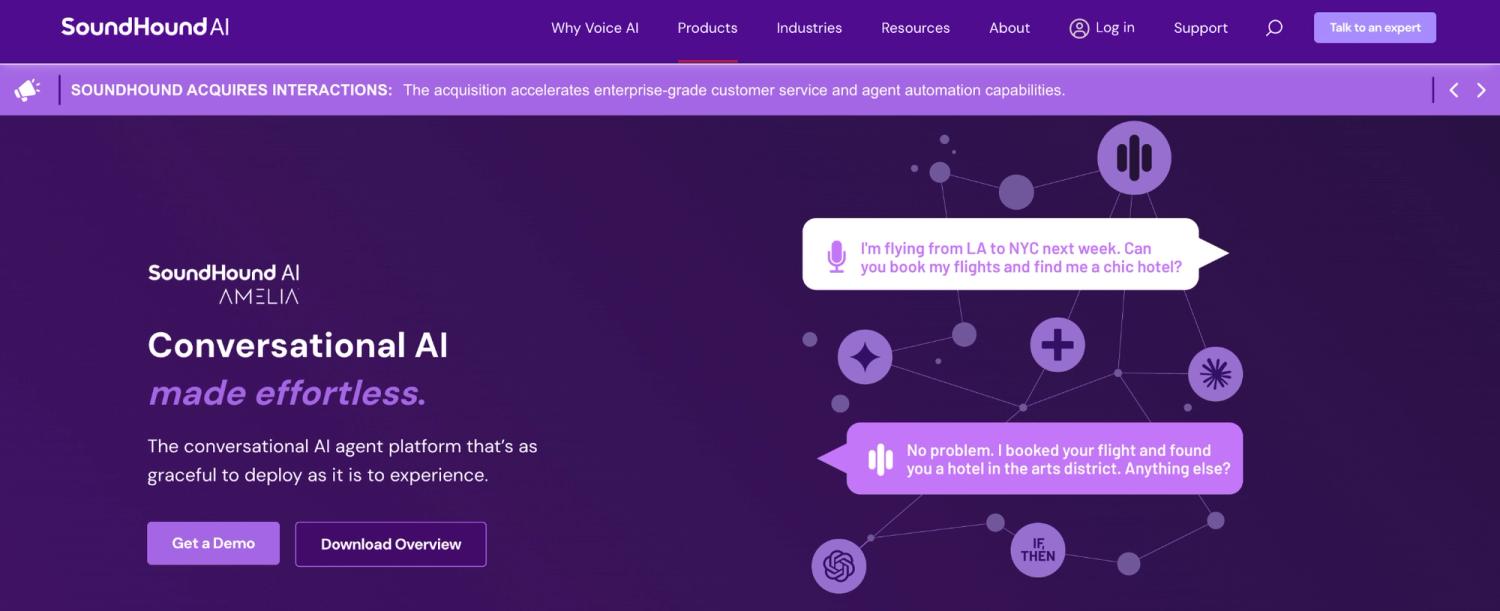
Amelia is an enterprise AI agent platform with a healthcare module for patient engagement, appointment scheduling, and care journey guidance. The platform covers both conversational AI and process automation, and its healthcare deployments extend to managing internal employee interactions, such as password resets, HR queries, and internal support workflows. At Aveanna Healthcare, Amelia handled over 560 daily employee interactions, resolving 95% through the automated channel.
Best for: Healthcare organizations with both patient-facing and internal automation needs.
8. Ada Health
Ada Health is a symptom assessment and patient triage platform that uses conversational AI to guide patients toward the appropriate care setting. Its approach combines a structured symptom-checking model with a conversational interface, allowing patients to describe their situation in natural language. Ada is widely deployed in health systems that need a scalable front door for patient navigation, particularly for after-hours or high-volume intake scenarios.
Best for: Health systems that need AI-assisted patient triage and care navigation.
What Factors to Evaluate Before Buying an AI Voice Agent for Healthcare?
1. HIPAA and compliance posture. Any vendor processing protected health information must hold end to end security, current HIPAA compliance documentation, and SOC 2 Type II certification is the baseline for enterprise security. Ask for audit reports, not assertions.
2. EHR and scheduling system integration. A voice agent that cannot write back to your EHR or scheduling platform adds administrative work. Confirm which systems the vendor integrates with natively and what is required for custom connections.
3. Escalation handling and context preservation. The handoff to a human is often the most consequential moment in a virtual agent interaction. Evaluate whether the agent passes conversation context, sentiment data, and the reason for escalation to the live agent, because systems that drop context on transfer erode the patient experience and eliminate much of the efficiency gain from automation.
4. Training data and accuracy claims. Ask vendors how their models were trained, on what data, and what ongoing retraining looks like. Systems trained on real healthcare contact center conversations behave differently in production than systems built on synthetic data or general-purpose language corpora.
5. Latency. Voice interactions are uniquely sensitive to response lag, and delays over two seconds create noticeable pauses that patients interpret as confusion or system failure. Ask for production latency benchmarks from live deployments.
6. Quality assurance and performance visibility. Deploying a virtual agent without a way to score and monitor its conversations introduces the same blind spots that make manual quality assurance in human contact centers unreliable. Look for platforms that surface quality data on every agent conversation, giving operations leaders visibility beyond volume and containment rates.
Why Level AI Is Built for Healthcare Contact Centers?
Healthcare contact centers manage clinical sensitivity, regulatory exposure, and high call volume at the same time. Level AI connects virtual agent performance to quality assurance governance, human coaching, and satisfaction scoring in a single platform.
The Virtual Agent learns from real conversations with top-performing human agents. The quality assurance module applies those same standards to 100% of conversations, automated and human. The iCSAT product generates inferred satisfaction scores for every interaction, giving operations leaders a performance signal beyond call completion rates.
See how the Level AI Virtual Agent is built.



Frequently Asked Questions
Q1. What is the purpose of an AI voice agent in healthcare?
A. An AI voice agent in healthcare is a software system that conducts spoken conversations with patients or staff using natural language processing and speech recognition. It handles calls without a human agent on the line, managing tasks like appointment scheduling, prescription refill requests, and post-discharge follow-up.
Q2. How do AI voice agents handle HIPAA compliance?
A. Enterprise-grade voice agents maintain HIPAA compliance through data encryption, access controls, and audit logging. Any vendor processing protected health information should hold current HIPAA documentation and SOC 2 Type II certification. Request audit reports directly rather than relying on vendor assertions.
Q3. Can AI voice agents integrate with EHR systems?
A.Most enterprise voice agents connect to major EHR platforms natively. The integration determines whether the agent can read patient records, write back appointment data, and trigger workflows in the scheduling system. Confirm which EHR systems a vendor supports before deployment, and ask what custom connection work is required for your infrastructure.
Q4. What happens when an AI voice agent cannot resolve a call?
A. The agent escalates to a human and passes the full conversation history, including context and the reason for transfer. Systems that drop that context on handoff force patients to repeat themselves. That friction erodes the patient experience and reduces the operational value of the automated interaction.
Q5. How long does it take to deploy an AI voice agent in a healthcare contact center?
A. Deployment timelines vary by vendor and the complexity of existing infrastructure. Platforms that identify automation candidates from existing conversation logs can shorten the scoping phase. EHR integration and compliance review add time regardless of the vendor. Most enterprise deployments take several weeks to a few months from contract to live calls.
Keep reading
View all