
Key takeaways
AI voice agents for insurance now handle policy inquiries, claims intake, status checks, renewals, and payments, freeing human agents for complex, high-stakes calls
Insurance-native platforms come with pre-built workflows for FNOL (first notice of loss) and policy servicing, while enterprise-grade platforms bring broader integrations, security, and customization
The strongest platforms combine natural conversation quality with strict authentication, compliance, and a clean handoff to human agents when a call needs one
Level AI gives insurance contact centers a way to monitor and improve every AI-led and human-led conversation from a single platform, closing the loop between automation and quality
Measuring ROI means looking beyond call deflection to agent productivity, customer experience scores, and how well the AI scales during open enrollment or catastrophe season
Introduction
AI voice agents for insurance are moving from pilot projects to core infrastructure inside enterprise contact centers. Insurance, banking, and financial services together already account for nearly a third of all voice AI adoption, the largest share of any industry, and Gartner expects conversational AI to automate roughly 1 in 10 agent interactions across contact centers in 2026, up from under 2% just a few years ago. For insurance leaders managing claims spikes, renewal season call surges, and policyholders who expect answers around the clock, the question is no longer whether to deploy AI voice agents, but which platform can handle insurance-specific workflows at enterprise scale.
This guide breaks down the 10 best AI voice agents for enterprise insurance companies in 2026, how to evaluate them, and how to deploy and monitor them once they are live.
What Are AI Voice Agents for Enterprise Insurance Companies?
AI voice agents for enterprise insurance are software programs that answer, understand, and respond to phone calls from policyholders, claimants, and prospects without a human agent on the line. They use speech recognition, natural language understanding, and generative AI to hold a real conversation, look up policy or claims information in real time, and either resolve the call or route it to the right department.
Unlike a traditional interactive voice response (IVR) system, which forces callers through rigid menus, an AI voice agent can understand open-ended questions like "Why was my claim denied?" or "Can I add a driver to my policy?" and respond in natural language. For insurance enterprises, this matters because call volume is uneven throughout the year, spiking during renewal periods, open enrollment, and after major weather events, while staffing levels stay largely fixed.
Why Large Enterprises Are Adopting AI Voice Agents for Insurance?
Insurance carriers are under pressure from three directions at once: rising call volumes, higher customer expectations, and tighter margins on service costs. AI voice agents address all three by absorbing repetitive, high-volume calls so human agents can focus on complex claims, retention conversations, and underwriting questions that genuinely need a person.
A few forces are accelerating adoption specifically in insurance contact centers:
Unpredictable demand. Catastrophic weather events, open enrollment, and renewal cycles can triple call volume in a matter of days. AI voice agents scale instantly, without hiring or overtime.
24/7 expectations. Nearly half of insurance calls come in outside standard business hours, when live agent coverage is thinnest.
Rising labor costs and attrition. Contact center attrition in insurance regularly runs 30 to 45% a year, making it expensive to keep enough trained agents on the phones.
Regulatory pressure. State insurance departments and federal regulators increasingly expect documented, consistent, and auditable customer interactions, something a well-monitored AI voice agent can support more reliably than a large, rotating agent workforce.
Competitive pressure. As more carriers roll out AI-powered self-service, policyholders increasingly expect fast, accurate answers on the first call, whether that is with a human or an AI agent.
Insurance-Native vs. Enterprise AI Voice Platforms
Not every AI voice agent is built the same way. Some vendors design specifically for insurance workflows like FNOL and policy servicing, while others are horizontal enterprise platforms that get configured for insurance through professional services or partner integrations. Both approaches can work, but they come with different trade-offs.
Insurance-native platforms | Enterprise AI voice platforms | |
|---|---|---|
Time to value | Faster, with pre-built insurance workflows | Slower, requires more configuration |
Depth of insurance use cases | Deep out of the box (FNOL, policy servicing) | Broad but needs customization |
Integration breadth | Narrower, focused on policy admin and claims systems | Wider, spans CRM, CCaaS, IVR, and data platforms |
Customization | Limited to insurance-specific templates | Highly flexible for complex, multi-line carriers |
Best fit | Mid-market or single-line carriers | Large, multi-line enterprise insurers and BPOs |
Most large enterprise insurers end up choosing a platform that sits in between: broad enough to integrate with the rest of the contact center stack, but with insurance use cases mature enough that they are not building everything from scratch.
How We Evaluated AI Voice Agents for Insurance
To build this list, we looked at each platform across seven criteria that matter most to enterprise insurance buyers:
Insurance-specific use cases, including FNOL, claims status, policy servicing, and renewals
Enterprise integrations with policy administration systems, claims platforms, CRMs, and existing contact center infrastructure
Security and authentication, including how the platform verifies caller identity and protects sensitive policyholder data
Customization, or how easily a carrier can adapt scripts, workflows, and tone to its own brand and compliance requirements
Scalability, meaning how the platform performs during renewal season, open enrollment, or a catastrophe event
Human handoff, or how smoothly a call moves from AI to a live agent with full context intact
AI agent quality and monitoring, including whether the vendor gives carriers visibility into what the AI actually said and did on every call
10 Best Enterprise AI Voice Agents for Insurance
Quick comparison
Platform | Insurance focus | Best for | Human handoff |
|---|---|---|---|
Level AI | Contact center intelligence with AI voice agents and full conversation monitoring | Enterprises that need AI agents plus quality and coaching on every call | Full context handoff with live monitoring |
Liberate | Insurance-native voice AI | Carriers wanting deep FNOL and policy servicing out of the box | Warm transfer with claims context |
Insured.io | Insurance-native voice and chat | Mid-market carriers automating policy servicing | Configurable escalation rules |
Assured | Claims-focused AI voice agent | Carriers prioritizing FNOL and claims status automation | Claims-adjuster routing |
Parloa | Enterprise conversational AI | Multi-brand, multi-language enterprise carriers | Orchestrated handoff across systems |
PolyAI | Enterprise voice AI | Large enterprises needing highly natural, low-latency voice | Real-time context transfer |
Kore.ai | Enterprise conversational AI platform | Carriers wanting a no-code platform across many use cases | Configurable via workflow builder |
Cresta | Generative AI for contact centers | Carriers focused on agent assist plus emerging AI agents | Coaching-informed handoff |
Replicant | Autonomous voice AI | Carriers automating high-volume, repetitive calls | Rule-based transfer |
Five9 | CCaaS with built-in AI agents | Carriers that want AI and contact center infrastructure in one platform | Native to the CCaaS platform |
1. Level AI
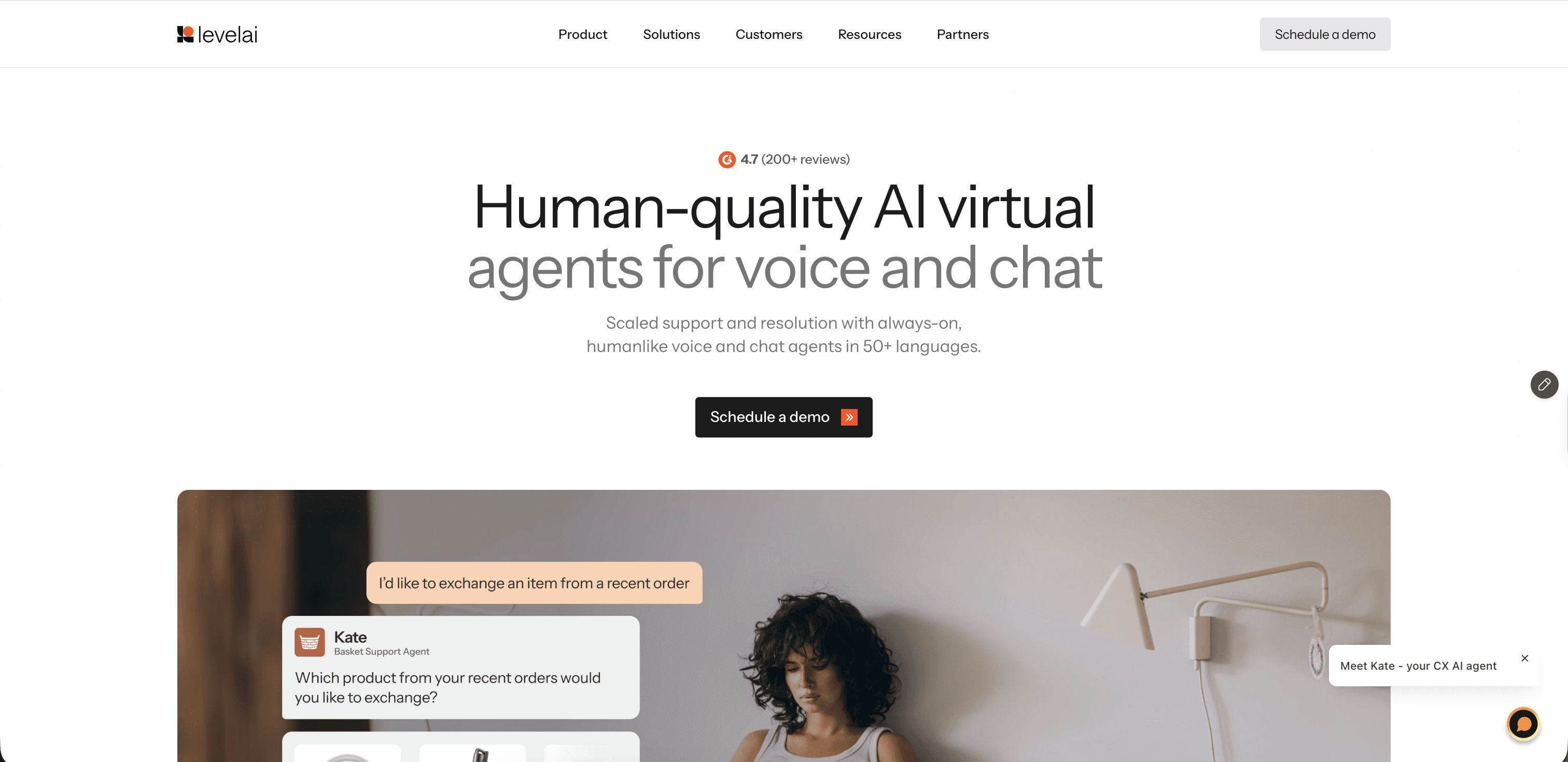
Product description: Level AI is a contact center intelligence platform that combines AI voice agents with full conversation monitoring, quality management, and agent coaching in one system. Rather than treating the AI agent as a black box, Level AI gives insurance enterprises visibility into every AI-led and human-led conversation, so carriers can see exactly what the AI said, how accurate it was, and where it needs improvement.
Insurance Use Cases: Policy inquiries, claims status updates, FNOL intake, renewal reminders, and payment support, all backed by real-time access to policy and claims data.
AI & Conversation Intelligence Capabilities: Natural language understanding tuned for insurance terminology, automated QA scoring on 100% of conversations, sentiment and intent detection, and a voice AI platform built to handle both structured and open-ended policyholder questions.
Enterprise Integrations: Connects with major policy administration systems, claims platforms, CRMs, and CCaaS providers, so the AI agent works with data insurers already have rather than requiring a separate system of record.
Security & Compliance: Enterprise-grade security controls, role-based access, and audit trails designed to meet the documentation standards insurance regulators expect.
Best For: Why Insurance Enterprises Choose Level AI: Carriers that want AI voice agents and cannot afford to lose visibility into quality once the AI takes over. One national insurance provider used Level AI to uncover customer insights and transform contact center operations, pairing automation with the kind of oversight compliance and CX leaders need to trust it.
" transform="translate(85.643 10.143)" width="23.725855670103115px"/><path d="M 71.828 0 L 0 50.702" fill="transparent" height="50.70235051546392px" id="TnJFUMH9b" stroke-dasharray="" stroke-linecap="butt" stroke-linejoin="miter" stroke-miterlimit="10" stroke-width="0.68" stroke="rgb(254, 250, 241)" transform="translate(85.508 75.029)" width="71.82828865979384px"/><path d="M 81.579 0 L 0 52.003" fill="transparent" height="52.00280412371134px" id="ccJzhVTGI" stroke-dasharray="" stroke-linecap="butt" stroke-linejoin="miter" stroke-miterlimit="10" stroke-width="0.68" stroke="rgb(254, 250, 241)" transform="translate(85.495 73.738)" width="81.57921649484533px"/><path d="M 65.653 0 L 0 32.827" fill="transparent" height="32.826556701030924px" id="X0Vp_q8HG" stroke-dasharray="" stroke-linecap="butt" stroke-linejoin="miter" stroke-miterlimit="10" stroke-width="0.68" stroke="rgb(254, 250, 241)" transform="translate(85.462 92.931)" width="65.65311340206183px"/><path d="M 88.08 14.951 L 0 0" fill="transparent" height="14.950762886597914px" id="JM_UgSiJ_" stroke-dasharray="" stroke-linecap="butt" stroke-linejoin="miter" stroke-miterlimit="10" stroke-width="0.68" stroke="rgb(254, 250, 241)" transform="translate(86.233 125.789)" width="88.07950515463914px"/><path d="M 83.204 72.803 L 0 0" fill="transparent" height="72.80313402061856px" id="KlyUUjlMK" stroke-dasharray="" stroke-linecap="butt" stroke-linejoin="miter" stroke-miterlimit="10" stroke-width="0.68" stroke="rgb(254, 250, 241)" transform="translate(85.089 125.71)" width="83.20379381443304px"/><path d="M 7.8 114.081 L 0 0" fill="transparent" height="114.08065979381445px" id="kAiUvduBR" stroke-dasharray="" stroke-linecap="butt" stroke-linejoin="miter" stroke-miterlimit="10" stroke-width="0.68" stroke="rgb(254, 250, 241)" transform="translate(85.95 125.478)" width="7.800247422680428px"/><path d="M 0 93.604 L 9.75 0" fill="transparent" height="93.60445360824741px" id="FsgTAQB0n" stroke-dasharray="" stroke-linecap="butt" stroke-linejoin="miter" stroke-miterlimit="10" stroke-width="0.68" stroke="rgb(254, 250, 241)" transform="translate(76.2 125.421)" width="9.750432989690694px"/><path d="M 0 76.379 L 76.703 0" fill="transparent" height="76.37888659793816px" id="NxOhHvPJ5" stroke-dasharray="" stroke-linecap="butt" stroke-linejoin="miter" stroke-miterlimit="10" stroke-width="0.68" stroke="rgb(254, 250, 241)" transform="translate(9.343 125.217)" width="76.7034556701031px"/><path d="M 0 26.651 L 39.002 0" fill="transparent" height="26.651381443298988px" id="QETNKJ3L6" stroke-dasharray="" stroke-linecap="butt" stroke-linejoin="miter" stroke-miterlimit="10" stroke-width="0.68" stroke="rgb(254, 250, 241)" transform="translate(47.096 125.177)" width="39.0017319587629px"/><path d="M 0 16.901 L 85.154 0" fill="transparent" height="16.900948453608265px" id="BL63wDICD" stroke-dasharray="" stroke-linecap="butt" stroke-linejoin="miter" stroke-miterlimit="10" stroke-width="0.68" stroke="rgb(254, 250, 241)" transform="translate(0.094 125.125)" width="85.15396503092786px"/><path d="M 0 0 L 78.004 17.876" fill="transparent" height="17.875793814432996px" id="PIX70Vlqf" stroke-dasharray="" stroke-linecap="butt" stroke-linejoin="miter" stroke-miterlimit="10" stroke-width="0.68" stroke="rgb(254, 250, 241)" transform="translate(8.362 107.251)" width="78.00376082474227px"/><path d="M 0 0 L 67.928 52.327" fill="transparent" height="52.32742268041238px" id="u_syqWqWD" stroke-dasharray="" stroke-linecap="butt" stroke-linejoin="miter" stroke-miterlimit="10" stroke-width="0.68" stroke="rgb(254, 250, 241)" transform="translate(17.593 72.861)" width="67.92826391752578px"/><path d="M 0 0 L 77.029 70.528" fill="transparent" height="70.52832989690722px" id="DmW_aE2A0" stroke-dasharray="" stroke-linecap="butt" stroke-linejoin="miter" stroke-miterlimit="10" stroke-width="0.68" stroke="rgb(254, 250, 241)" transform="translate(9.489 54.678)" width="77.02866804123713px"/><path d="M 0 0 L 27.301 126.431" fill="transparent" height="126.43109443298971px" id="JrLaRUubC" stroke-dasharray="" stroke-linecap="butt" stroke-linejoin="miter" stroke-miterlimit="10" stroke-width="0.68" stroke="rgb(254, 250, 241)" transform="translate(58.341 -0.071)" width="27.30111340206188px"/><path d="M 0 4.012 C 0 1.796 1.796 0 4.012 0 C 6.228 0 8.025 1.796 8.025 4.012 C 8.025 6.228 6.228 8.025 4.012 8.025 C 1.796 8.025 0 6.228 0 4.012 Z" fill="rgb(254, 80, 0)" height="8.024669690721652px" id="Nh5qrPJs_" transform="translate(81.396 121.369)" width="8.024669690721623px"/></svg>)
2. Liberate
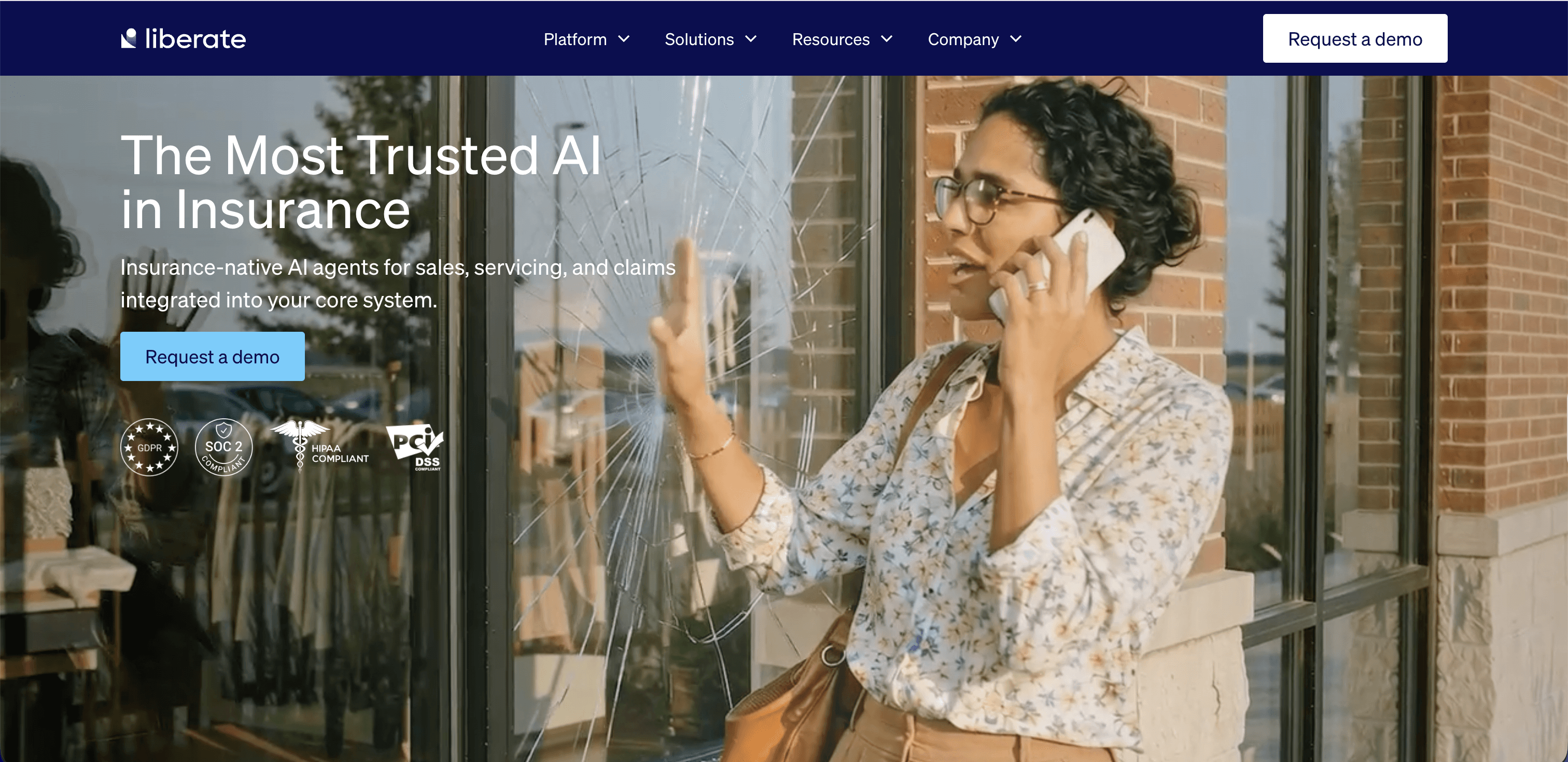
Product description: Liberate builds AI voice agents specifically for insurance carriers, with workflows designed around the way P&C and health insurers actually operate.
Insurance Use Cases: FNOL, policy servicing, billing questions, and coverage verification.
AI & Conversation Intelligence Capabilities: Insurance-tuned language models trained on carrier terminology and common policyholder questions.
Enterprise Integrations: Pre-built connectors to common policy administration and claims management systems used across P&C and health insurance.
Security & Compliance: Built with insurance data handling requirements in mind, including HIPAA considerations for health carriers.
Best For: Why Insurance Enterprises Choose This Product: Carriers that want a platform built ground-up for insurance, with less configuration needed to get FNOL and policy servicing live.
3. Insured.io
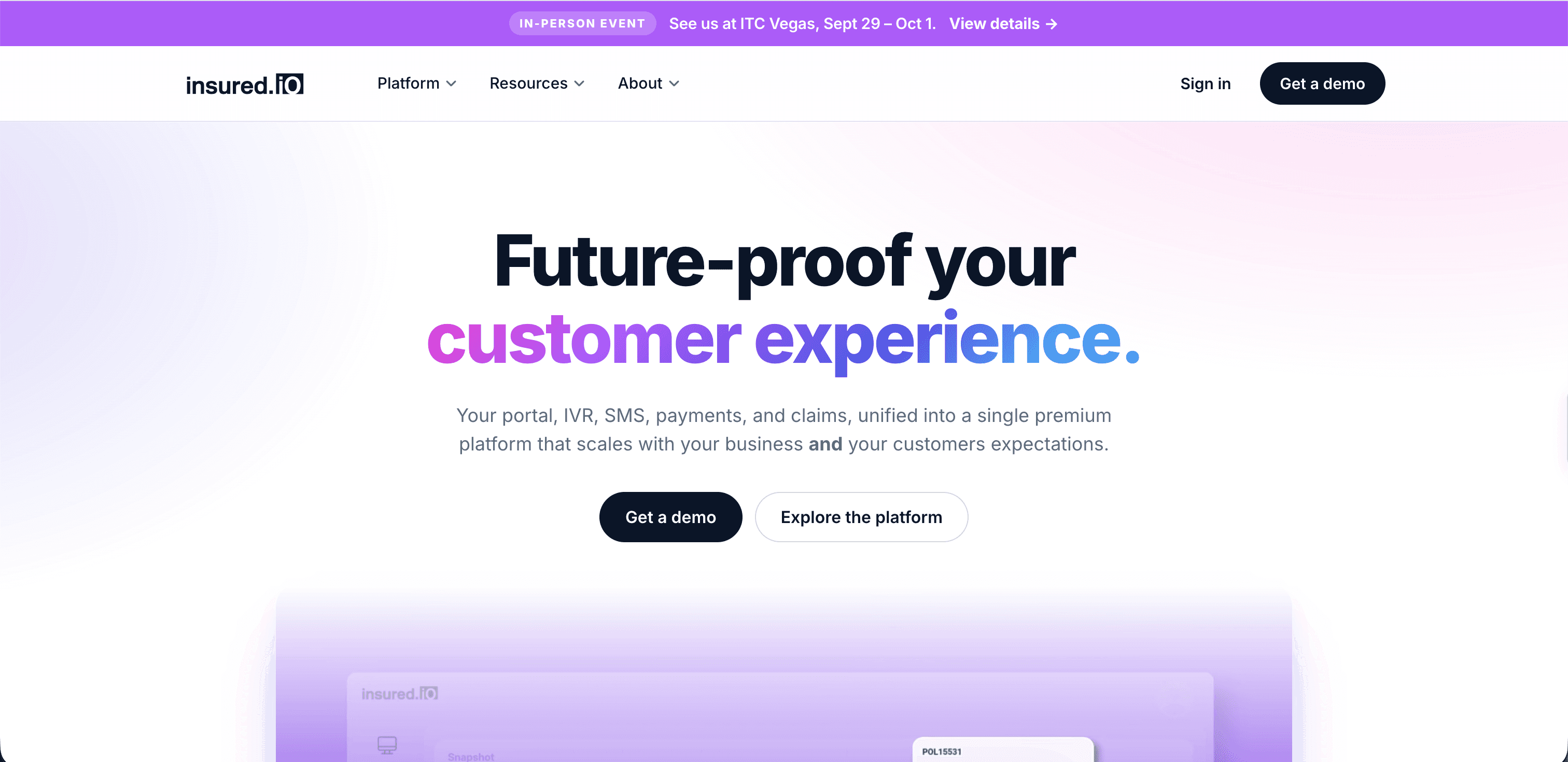
Product description: Insured.io offers AI voice and chat automation aimed at mid-market and specialty insurers looking to modernize policy servicing without a lengthy implementation.
Insurance Use Cases: Policy inquiries, endorsement requests, billing and payment support.
AI & Conversation Intelligence Capabilities: Conversational workflows built around common policyholder servicing tasks, with configurable scripts by line of business.
Enterprise Integrations: Integrates with common policy administration and payment systems used by smaller and mid-sized carriers.
Security & Compliance: Standard encryption and access controls appropriate for regulated insurance data.
Best For: Why Insurance Enterprises Choose This Product: Mid-market carriers that want to automate routine servicing calls without building a large in-house AI team.
4. Assured
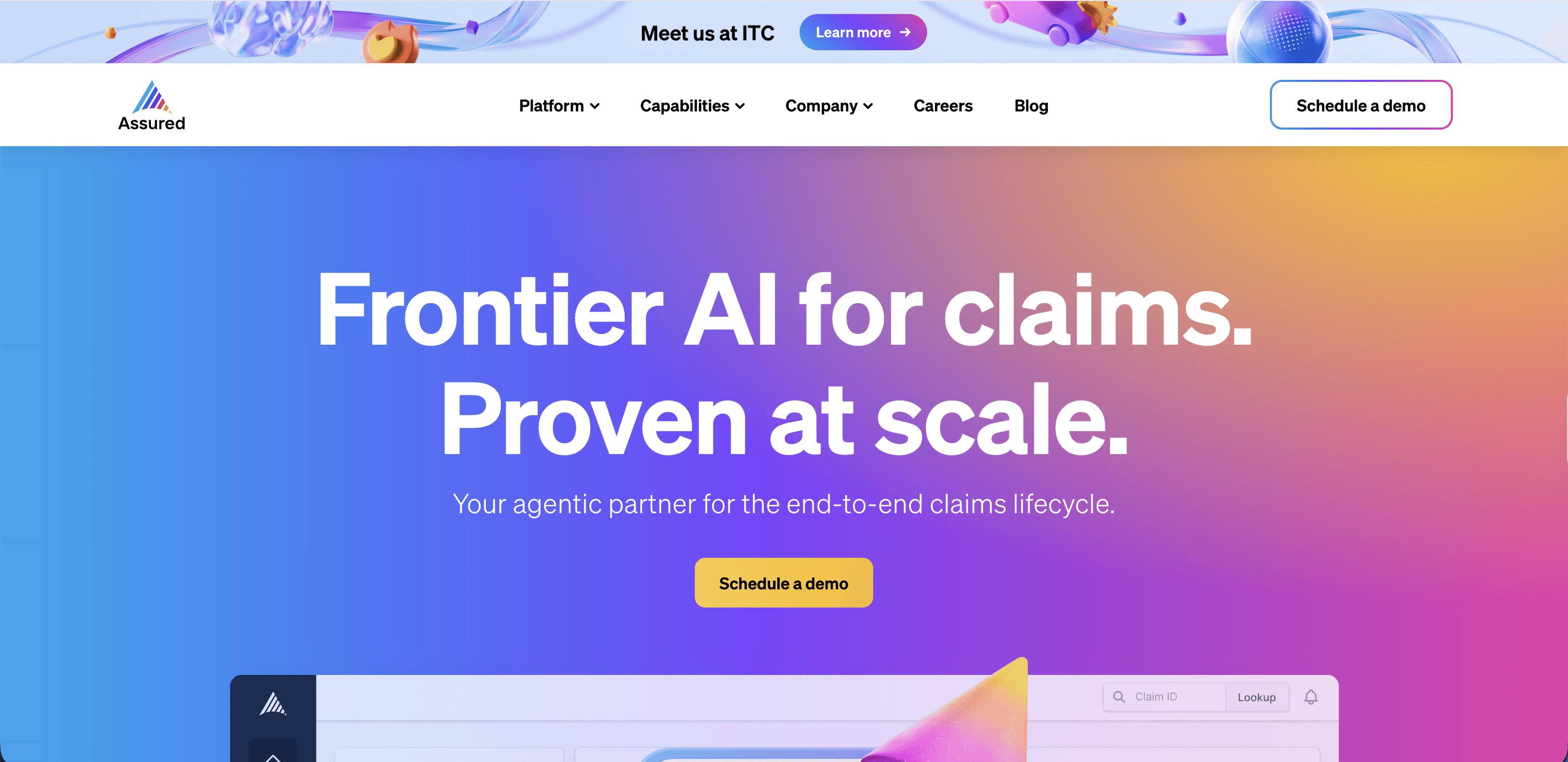
Product description: Assured focuses specifically on claims automation, with AI voice agents designed to handle the earliest and most repetitive part of the claims journey.
Insurance Use Cases: FNOL, claims status checks, and document collection.
AI & Conversation Intelligence Capabilities: Claims-specific intent recognition designed to capture accurate loss details on the first call.
Enterprise Integrations: Connects to claims management systems to push structured FNOL data directly into adjuster workflows.
Security & Compliance: Data handling built around claims-specific sensitivity, including personal injury and property loss details.
Best For: Why Insurance Enterprises Choose This Product: Carriers whose biggest bottleneck is claims intake volume, especially after weather events or other catastrophes.
5. Parloa

Product description: Parloa is an enterprise conversational AI platform used across industries, including insurance, with strong support for multi-brand and multi-language deployments.
Insurance Use Cases: Policy inquiries, renewals, and claims status, often across multiple regional brands under one carrier group.
AI & Conversation Intelligence Capabilities: Orchestration layer that can combine multiple AI models and route conversations based on intent and complexity, as covered in our breakdown of Parloa alternatives for teams comparing options.
Enterprise Integrations: Broad integration library spanning CRM, CCaaS, and data platforms.
Security & Compliance: Enterprise security certifications suited to regulated industries operating across multiple markets.
Best For: Why Insurance Enterprises Choose This Product: Large, multi-brand carrier groups that need one platform to manage AI voice agents across several markets and languages.
6. PolyAI
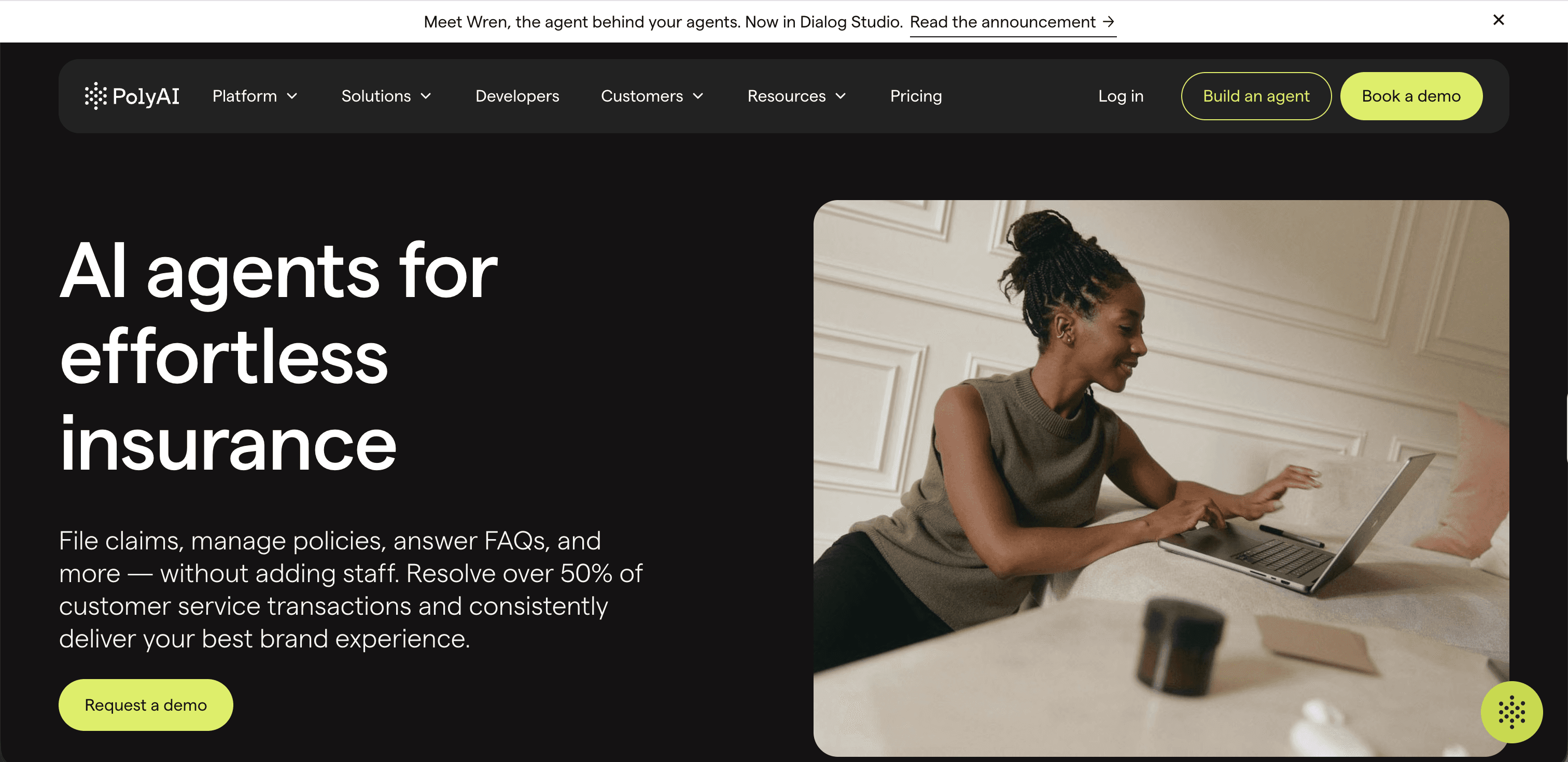
Product description: PolyAI is an enterprise voice AI platform known for natural-sounding, low-latency conversations, used by large enterprises across insurance, travel, and telecom.
Insurance Use Cases: Policy inquiries, appointment scheduling, and general customer service call deflection.
AI & Conversation Intelligence Capabilities: Focus on conversational realism and quick response times, which matters for reducing caller frustration on long or complex insurance questions.
Enterprise Integrations: Enterprise-grade integrations with CCaaS and CRM systems.
Security & Compliance: Enterprise security posture built for large, regulated customers.
Best For: Why Insurance Enterprises Choose This Product: Enterprises that prioritize a highly natural voice experience and are willing to invest in deeper customization to get there.
7. Kore.ai

Product description: Kore.ai is a broad enterprise conversational AI platform with a no-code builder, used across many industries and adapted for insurance through configuration.
Insurance Use Cases: Policy servicing, claims status, and virtual assistant deployments across voice and digital channels.
AI & Conversation Intelligence Capabilities: No-code workflow builder that lets insurance teams design and adjust conversation flows without heavy engineering support.
Enterprise Integrations: Wide integration ecosystem spanning CRM, ITSM, and contact center platforms.
Security & Compliance: Enterprise security options configurable to meet regulated industry requirements.
Best For: Why Insurance Enterprises Choose This Product: Carriers that want a flexible, horizontal platform they can extend beyond voice into chat and other digital channels.
8. Cresta
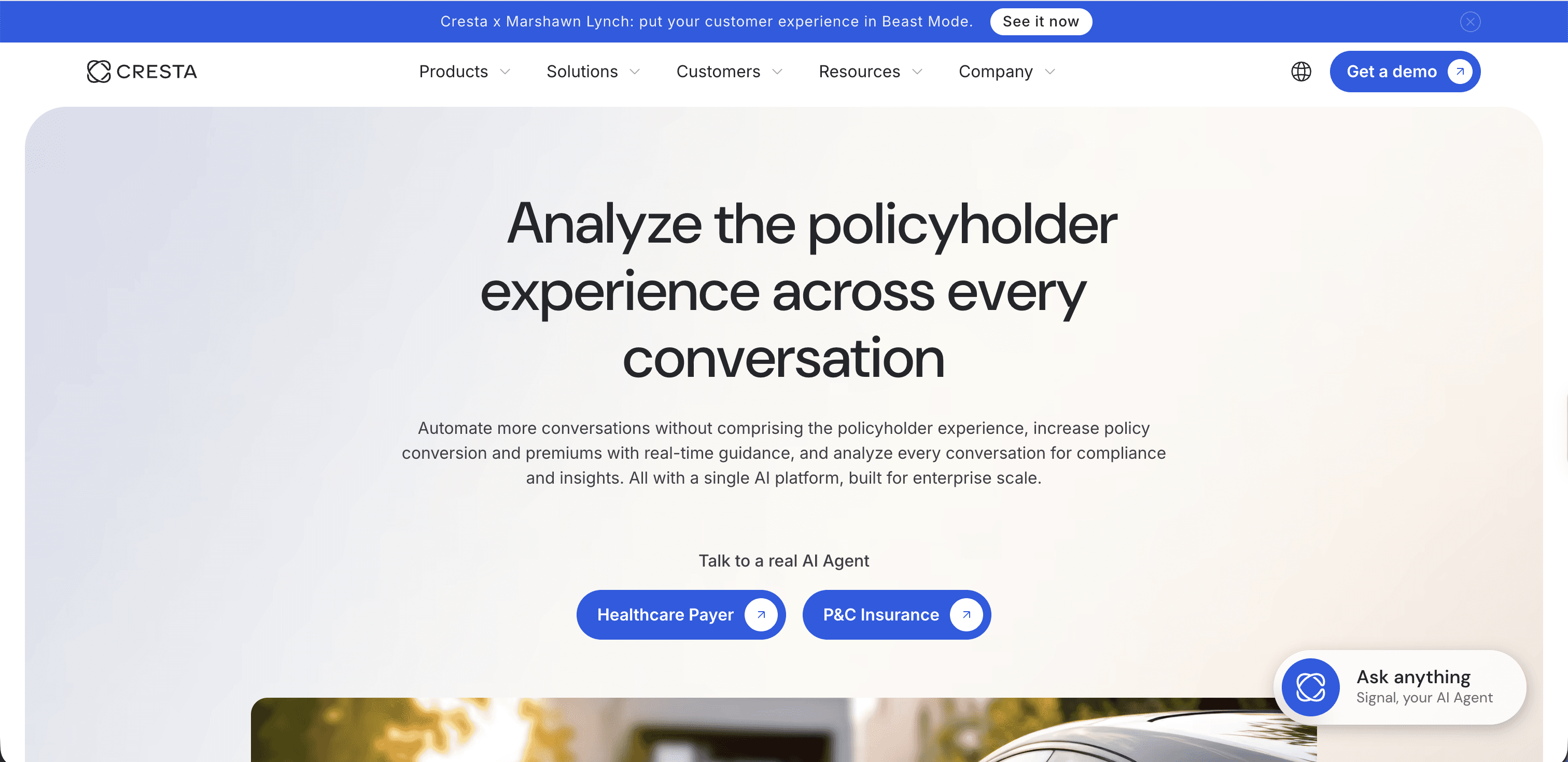
Product description: Cresta started in real-time agent assist and generative AI coaching, and has expanded into AI agents for contact centers, including insurance.
Insurance Use Cases: Agent assist for complex claims and retention calls, alongside emerging AI agent capabilities for simpler policy questions.
AI & Conversation Intelligence Capabilities: Generative AI that surfaces next-best-action guidance to human agents in real time, plus AI agent options, detailed further in our Cresta comparison.
Enterprise Integrations: Integrates with major CCaaS platforms for real-time coaching and automation.
Security & Compliance: Enterprise security controls appropriate for regulated financial and insurance customers.
Best For: Why Insurance Enterprises Choose This Product: Carriers that started with agent assist and coaching and want to extend into AI-led automation from the same vendor.
9. Replicant
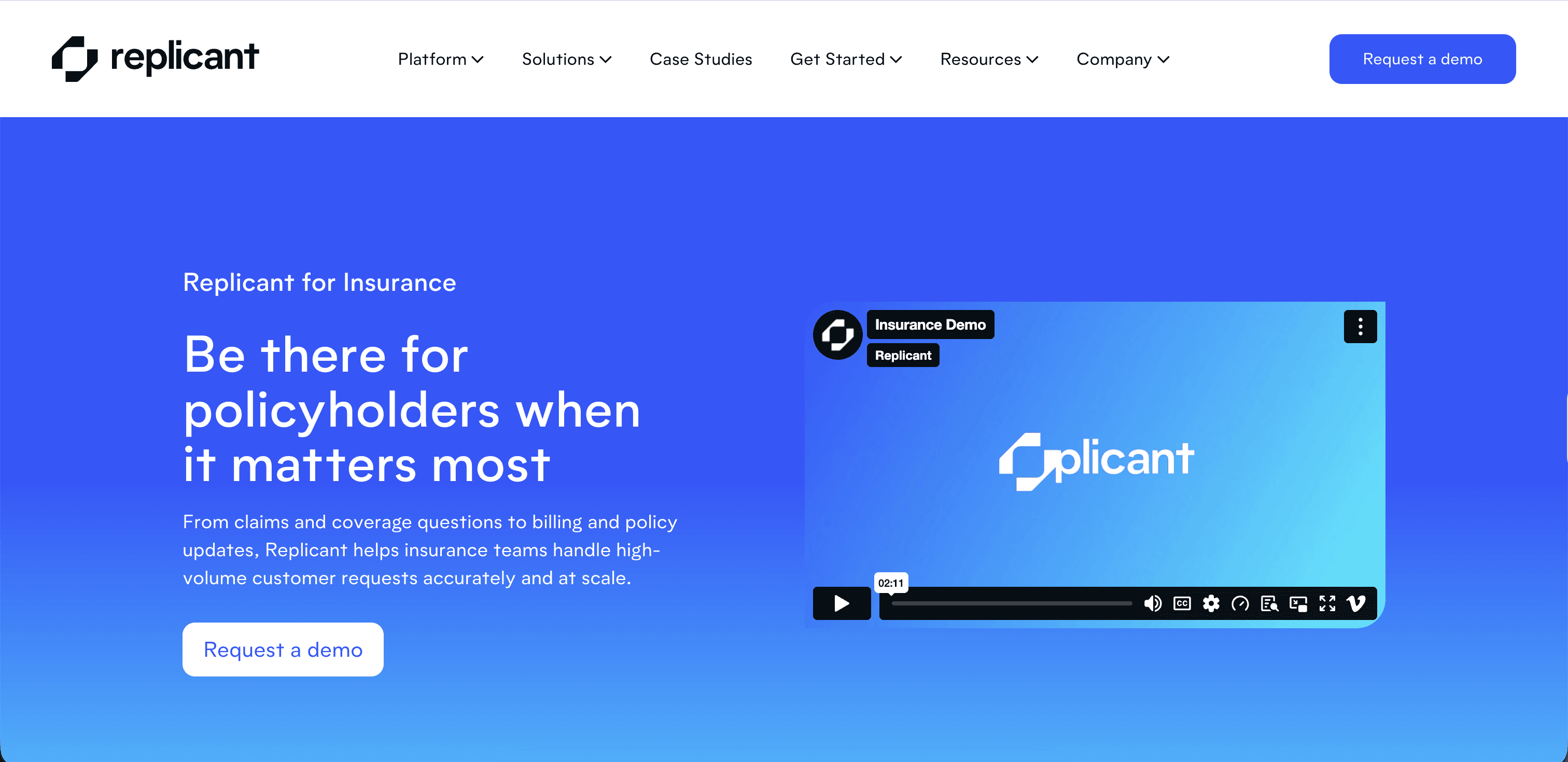
Product description: Replicant builds autonomous AI voice agents designed to fully resolve high-volume, repetitive phone calls without human involvement.
Insurance Use Cases: Policy verification, payment processing, and simple claims status inquiries.
AI & Conversation Intelligence Capabilities: Focus on fully autonomous resolution for narrowly defined, high-frequency call types.
Enterprise Integrations: Integrates with contact center and CRM platforms to pull and update account information during calls.
Security & Compliance: Enterprise security suited to financial and insurance data handling.
Best For: Why Insurance Enterprises Choose This Product: Carriers with a small number of very high-volume, repetitive call types they want to automate end to end.
10. Five9
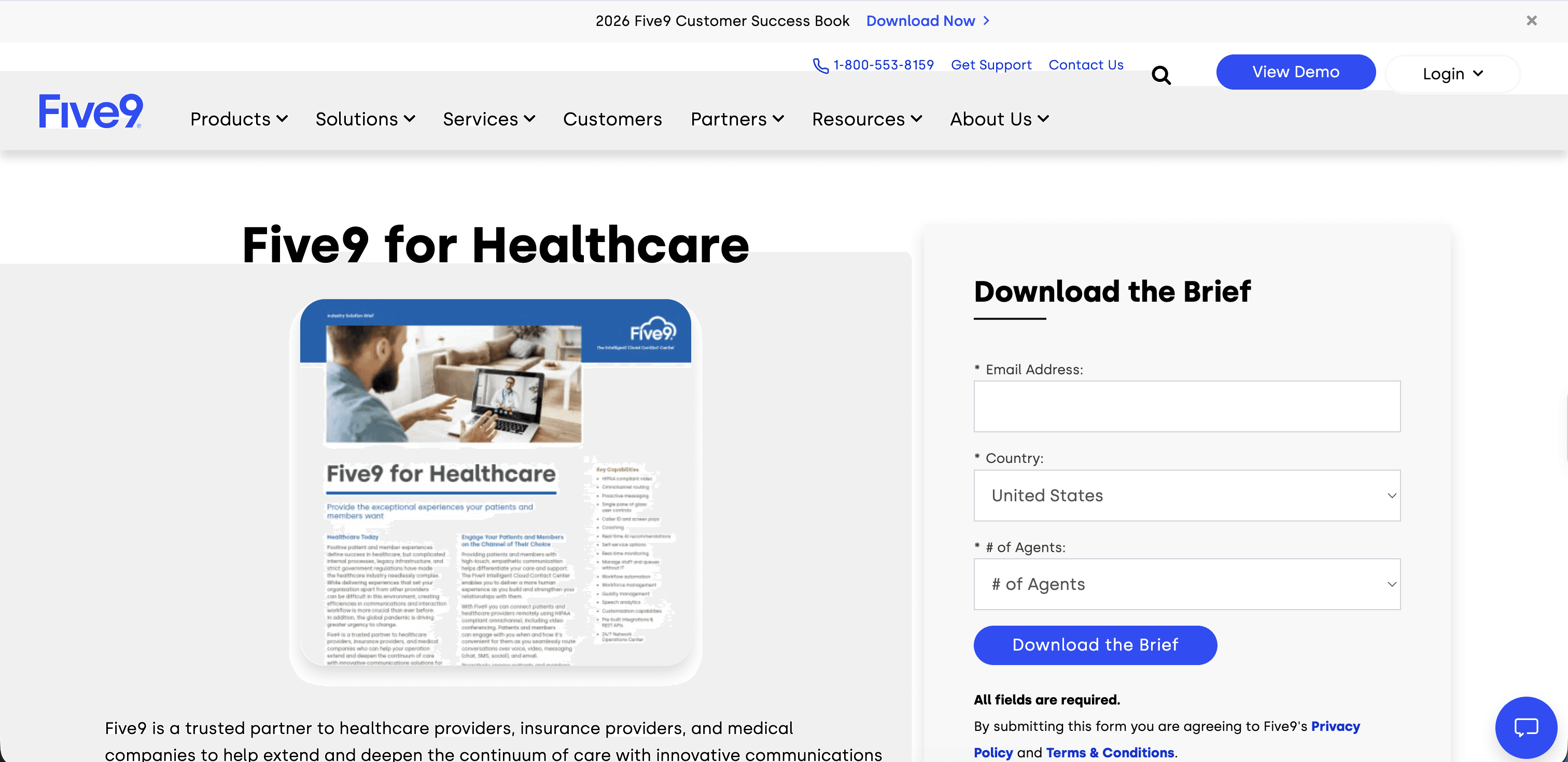
Product description: Five9 is an established contact-center-as-a-service (CCaaS) provider that has built AI virtual agent capabilities directly into its platform, giving carriers infrastructure and AI in one place.
Insurance Use Cases: IVR replacement, policy inquiries, and routing for claims and billing calls.
AI & Conversation Intelligence Capabilities: AI agents built natively on top of Five9's existing IVR and routing engine, reducing the need for a separate AI vendor.
Enterprise Integrations: Deep integration with Five9's own CCaaS stack, plus common CRM connectors.
Security & Compliance: Enterprise security and compliance certifications consistent with a long-established CCaaS provider.
Best For: Why Insurance Enterprises Choose This Product: Carriers already running Five9 as their contact center platform who want to add AI without introducing a new vendor into the stack.
AI Voice Agent Capabilities and Use Cases in Insurance
The strongest AI voice agents for insurance cover a wide range of the policyholder journey, not just one narrow task. Common use cases include:
Policy inquiries. Answering questions about coverage, deductibles, and policy documents without pulling a human agent into a routine lookup.
Insurance qualification. Screening prospects and gathering the information needed to quote a policy before handing off to a licensed agent.
Claims intake and FNOL. Capturing the first notice of loss accurately, including what happened, when, and who was involved, and detailed further in our guide to AI agent examples and use cases.
Claims status. Giving claimants real-time updates on where their claim stands without waiting on hold for an adjuster.
Policy verification and management. Confirming active coverage, updating beneficiaries, or adding a driver or dependent.
Renewals. Reminding policyholders about upcoming renewals and processing simple renewal confirmations.
Payments. Taking premium payments and answering billing questions securely over the phone.
Customer authentication. Verifying caller identity before sharing sensitive policy or claims details.
Human escalation. Recognizing when a call needs a person, such as a disputed claim or a complex underwriting question, and transferring it with full context.
How AI Voice Agents Integrate With Enterprise Insurance Systems
An AI voice agent is only as useful as the systems it can see and update. Enterprise insurance deployments typically need to connect to:
CRM systems, to pull policyholder history and update records after every call
Contact center platforms, so the AI agent works inside the same environment as human agents rather than as a disconnected add-on
IVR systems, either replacing legacy menus entirely or working alongside them during a phased rollout, a shift we cover in more detail when comparing traditional IVR vs. AI agents
Claims management systems, to log FNOL details and push status updates in real time
Policy administration systems, to verify coverage, process endorsements, and confirm renewal details accurately
Carriers that skip this integration work end up with an AI voice agent that can hold a conversation but cannot actually resolve anything, which pushes more calls back to human agents rather than fewer.
Security, Authentication, and Compliance for Insurance Voice AI
Insurance data is sensitive by nature, covering health details, financial information, and personal loss events. Before deploying an AI voice agent, enterprise insurance leaders should confirm the platform supports:
Multi-factor voice authentication that verifies a caller's identity before sharing policy or claims details
Encryption of call recordings and transcripts, both in transit and at rest
Role-based access controls so only authorized staff can review sensitive conversations
Audit trails that document what the AI said and did on every call, which matters during regulatory examinations
Compliance with relevant frameworks, including HIPAA for health-related lines and state-level insurance data protection rules
Getting authentication right is especially important for voice, since carriers cannot rely on the same visual cues used to verify identity in digital channels. Our guide to building a resilient voice authentication strategy covers this in more depth.
How to Deploy AI Voice Agents at Enterprise Scale
Rolling out AI voice agents across a large insurance enterprise works best as a phased process rather than a single big-bang launch.
Single vs. multiple virtual agents. Some carriers deploy one AI agent that handles many use cases, while others run separate agents for claims, policy servicing, and sales. Multiple agents can be easier to tune but harder to manage at scale.
Skills and workflows. Start with a small set of well-defined workflows, such as policy verification or claims status, before expanding into more complex conversations.
Knowledge base. The AI agent is only as accurate as the knowledge it draws from, so keeping policy wording, FAQs, and claims procedures current is an ongoing operational task, not a one-time setup.
VOC-driven development. Use voice of the customer data to identify which calls are frustrating policyholders today, and prioritize automating or improving those first.
Human handoff. Design escalation rules before launch, not after, so a policyholder never has to repeat information when a call moves from the agent assist tools human agents use to a live conversation.
How to Measure the ROI of AI Voice Agents
ROI for AI voice agents in insurance goes well beyond how many calls got automated. A complete view includes:
Call deflection. The percentage of calls the AI agent resolves without human involvement, tracked by use case rather than as one blended number.
Cost savings. Reduced need for seasonal hiring and overtime during renewal season or after catastrophic events.
Agent productivity. Whether human agents are spending more time on complex, high-value calls instead of routine lookups.
Customer experience. Whether satisfaction scores hold steady or improve as more calls move to AI, not just whether calls get answered faster.
Scalability. How the platform performs during volume spikes compared to the cost of scaling a human-only team for the same surge.
Carriers evaluating cost models across vendors often benefit from reviewing how contact center AI pricing models work before signing a contract, since usage-based, seat-based, and outcome-based pricing can produce very different total costs at enterprise call volumes.
How to Monitor AI Voice Agent Quality
Deploying an AI voice agent is not the finish line. Insurance enterprises need ongoing visibility into how well it performs, especially given regulatory scrutiny and the sensitivity of the data involved.
Accuracy. Is the AI agent giving policyholders correct information about coverage, claims status, and billing?
Compliance. Is the AI agent following required disclosures and documentation standards on every call?
Conversation quality. Does the AI sound natural, handle interruptions well, and avoid frustrating loops?
Downstream outcomes. Are calls the AI resolves actually staying resolved, or are policyholders calling back with the same issue?
Continuous improvement. Is the team reviewing a representative sample, or ideally 100%, of AI-led conversations to catch problems and retrain the AI over time?
This is where many carriers run into trouble. It is possible to deploy an AI voice agent without ever really knowing what it is telling policyholders. Pairing AI agents with a quality assurance layer that automatically reviews every conversation closes that gap.
The Future of AI Voice Agents in Insurance
Insurance carriers are moving toward more autonomous, agentic AI that can complete multi-step tasks rather than answering single questions in isolation, a shift already underway in autonomous AI agents in contact centers more broadly. For insurance specifically, that means AI agents that can not only answer a policy question but also initiate an endorsement, schedule an adjuster visit, and confirm the update back to the policyholder, all in one call.
Expect tighter integration between AI voice agents and claims systems, more sophisticated voice authentication to fight fraud, and growing pressure from regulators to document exactly how AI agents make decisions on customer-facing calls. Carriers that build strong monitoring and quality practices now will be better positioned to adopt these more autonomous capabilities safely.
How Level AI Helps Insurance Enterprises Monitor and Improve AI-Powered Conversations
Deploying an AI voice agent is only half the job. Insurance enterprises need to know, with certainty, what that AI agent is telling policyholders, whether it is staying compliant, and where it is falling short. Level AI gives contact center, CX, and compliance leaders a single view into every AI-led and human-led conversation, so automation and quality improve together instead of one outpacing the other.
1. What are the best AI voice agents for insurance companies?
strongest options for enterprise insurance in 2026 include Level AI, Liberate, Insured.io, Assured, Parloa, PolyAI, Kore.ai, Cresta, Replicant, and Five9. Level AI stands out for carriers that want AI voice agents paired with full visibility into conversation quality and compliance, not just automation
2. What insurance workflows can AI voice agents automate?
AI voice agents can handle policy inquiries, claims intake and FNOL, claims status updates, policy verification, renewals, payments, and customer authentication. More complex conversations, like disputed claims or underwriting exceptions, typically still route to a human agent
3. Can AI voice agents handle FNOL and claims intake?
Yes. Several platforms on this list, including Liberate and Assured, are built specifically to capture first notice of loss details accurately and push that information directly into claims management systems, speeding up the start of the claims process
4. How do AI voice agents integrate with insurance systems like CRM, IVR, and claims platforms?
Enterprise AI voice agents connect through APIs to CRM systems, contact center platforms, IVR systems, claims management systems, and policy administration systems. This lets the AI look up real policyholder data and update records during the call, rather than just answering generic questions
5. How do AI voice agents handle authentication, security, and compliance?
Most enterprise-grade platforms use multi-factor voice authentication, encrypt calls and transcripts, apply role-based access controls, and maintain audit trails for regulatory review. Level AI adds automated quality and compliance monitoring across every conversation, which helps carriers catch issues before they become regulatory findings
6. How do AI voice agents hand off complex calls to human agents?
Well-designed AI voice agents detect when a conversation needs a human, based on intent, sentiment, or explicit request, and transfer the call along with full context, including what has already been discussed, so the policyholder does not have to repeat themselves
7. How much does it cost to implement an AI voice agent for an insurance enterprise?
Pricing varies by vendor and typically follows usage-based, seat-based, or outcome-based models, with enterprise deployments often blending several. Costs depend on call volume, the number of use cases automated, and how much integration work is needed with existing policy and claims systems. Level AI works with insurance enterprises to scope pricing around actual call volume and use cases rather than a one-size-fits-all package