
Key takeaways
Traditional IVR routes calls through a fixed menu tree. AI agents hold a real conversation and complete the transaction inside the call
Sixty-one percent of customers rate IVR as a poor experience, and that gap is pushing contact centers toward conversational automation
AI agents reduce average handle time and raise first call resolution by acting on account data directly, instead of routing the caller to a queue
IVR still fits narrow, high-volume routing tasks, small operations, and required compliance disclosures
Level AI runs its virtual agent, quality assurance, and analytics on one platform, so AI agent conversations get scored with the same rubric as human agent calls
IVR and AI agents run together in production contact centers, pairing rule-based routing with agent-led resolution rather than replacing one with the other
Introduction
According to the Vonage Consumer Survey, 61% of customers say interactive voice response (IVR) systems create a poor customer experience, and 51% have abandoned a business after encountering an automated phone menu. Contact centers built their first self-service systems around fixed menus and touch-tone routing. Three decades later, many of those same systems still run the phone line, even as customer expectations moved toward instant, conversational resolution.
Traditional IVR routes calls. It does not resolve problems, and it cannot adapt when a request falls outside the menu tree. Callers now expect the same conversational AI experience they get from a banking app or a delivery service, and a fixed menu tree cannot deliver that on a phone call.
AI agents change what happens on that same phone call. A virtual agent listens to what a customer says, understands intent, checks account data, and completes the request without forcing the caller through a numbered menu. That shift moves contact centers from routing calls to resolving them on the first attempt.
This guide compares traditional IVR and AI agents across conversation design, integration, cost, and operational scale. It covers where each technology fits, how contact centers decide between them, and where AI virtual agents and legacy IVR run side by side.
What Is a Traditional IVR?
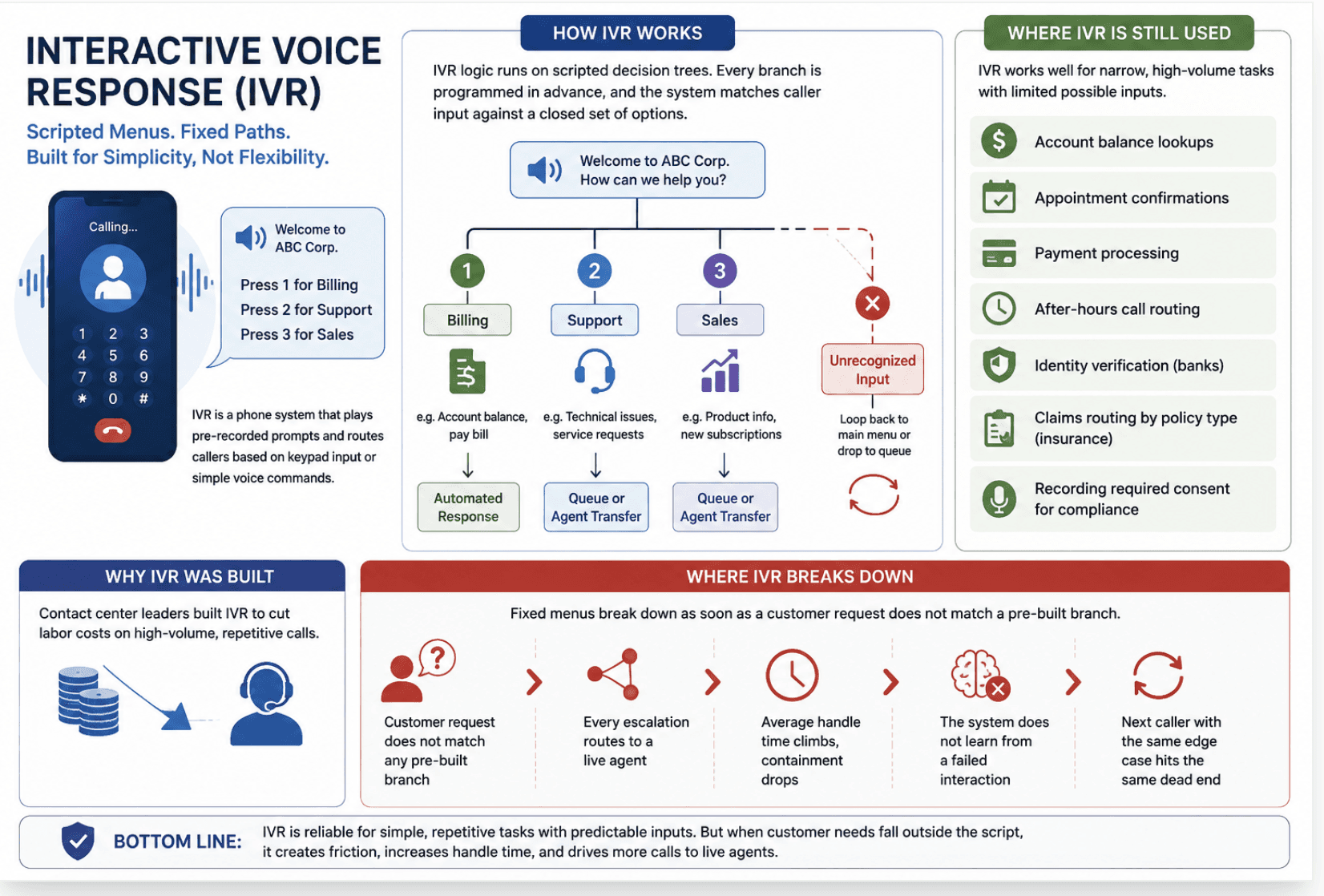
Interactive voice response is a phone system that plays pre-recorded prompts and routes callers based on keypad input or simple voice commands. A caller presses 1 for billing, 2 for support, and 3 for sales. The system sends the call down a fixed branch of a decision tree. Contact center leaders built these systems to cut labor costs on high-volume, repetitive calls.
IVR logic runs on scripted decision trees. Every branch is programmed in advance, and the system matches caller input against a closed set of options. When a caller says something the system does not recognize, the call loops back to the main menu or drops to a queue for a live agent. No natural language understanding sits behind the routing, only pattern matching against a fixed script.
Contact centers still run IVR for account balance lookups, appointment confirmations, payment processing, and after-hours call routing. Banks use it to verify identity before transferring to an agent. Insurance carriers use it to route claims calls by policy type. These are narrow, high-volume tasks with few possible customer inputs, which is where scripted trees hold up. Regulatory compliance monitoring teams also rely on IVR to record required consent language before a call proceeds.
Fixed menus break down as soon as a customer request does not match a pre-built branch. A caller with a billing question that spans two departments has no path through the tree. Every escalation routes to a live agent. Average handle time climbs, and containment drops. The system does not learn from a failed interaction, and the next caller with the same edge case hits the same dead end.
What Are AI Agents?
An AI agent is a system that holds a live conversation with a customer over voice or chat, determines intent from natural language, and completes the transaction inside connected business systems. Level AI’s virtual agent handles account changes, order status, and ticket creation without a human on the call.
Conversational IVR replaced touch-tone menus with speech prompts, but the decision logic underneath stayed the same: a caller says a word, the system matches it against a script, and routing still fails outside that script. AI agents remove the script. The system parses full sentences, tracks context across turns, and changes its next question based on what the customer just said, a distinction covered in virtual agent vs. chatbot comparisons.
Large language models generate the agent’s responses and interpret free-form requests. Automatic speech recognition converts the caller’s voice into text the model can process. Integration layers connect the agent to CRM, billing, and ticketing systems, so it can look up an order or update a record mid-call instead of only describing an answer.
AI agents authenticate a caller, pull an order history, process a return, reschedule an appointment, and escalate to a human agent with a full transcript attached. Real-world use cases span retail order management, insurance claims intake, and healthcare appointment scheduling, each running on the same conversational core.
AI Agents vs. Traditional IVR: Side-by-Side Comparison
The table below lines up traditional IVR against AI agents across the dimensions contact centers evaluate most, drawn from the criteria in a practical guide to evaluating virtual agents.
Dimension | Traditional IVR | AI Agents |
Customer interaction | Keypad input or single-word voice commands | Natural, multi-turn conversation |
Conversation flow | Fixed decision tree | Dynamic, context-driven |
Intent recognition | Keyword or DTMF matching | NLU-based intent detection |
Context retention | None across turns | Retained across the full call |
Personalization | Generic script for every caller | Responses shaped by account and history data |
Task completion | Routes to a human or a dead end | Completes the transaction directly |
Integrations | Limited, often one-way | Two-way, real-time system integration |
Human handoff | Default outcome for most calls | Exception path, with full context passed |
Scalability | Scales by adding menu branches | Scales by adding intents and integrations |
Analytics | Call counts and menu selections | Conversation-level insight and QA scoring |
Cost and maintenance | Low upfront cost, rising support cost over time | Higher setup cost, lower per-interaction cost |
How AI Agents Actually Differ From IVR
A customer calling an AI agent describes the problem in their own words: a damaged package that needs a replacement sent to a different address. The agent parses that sentence, identifies both actions, and starts the process. The same customer calling an IVR selects “returns,” then “damaged item,” then waits for an agent, because the menu structure has no branch for a combined return-and-reship request.
IVR moves a call from one queue to another. It does not check an order status, issue a refund, or update an address. AI agents complete that work during the call, which is why first-call resolution rates improve when contact centers replace routing logic with an agent who can act on the account.
Predefined rules cover the cases a team anticipated when it built the menu. Real customer requests do not stay inside those cases. AI agents decides the specific combination of intent, account state, and prior interaction, rather than matching against a static script, an approach detailed in why decision trees fail agentic AI.
Every AI agent conversation gets scored, and failure patterns from one call inform the next model update. A quality assurance layer reviews agent conversations the same way it reviews human agent calls, so the system improves from real interactions instead of a quarterly script rewrite. IVR menus stay static until someone manually edits the call flow.
Why Contact Centers Are Moving from IVR to AI Agents
Callers compare every phone call to the fastest digital experience they have had that week. A banking app that resolves a dispute in two taps sets the bar for a phone call about the same dispute. Contact center leaders report that customers expect a live agent’s judgment from an automated channel, and IVR menus do not clear that bar.
Containment measures how many calls resolve without a human agent. AI agents raise that number because they complete the request instead of parking the caller in a queue. Contact centers that track containment numbers closely find that a call marked “contained” still needs to resolve the actual problem, beyond avoiding a transfer.
Average handle time counts the minutes an agent spends on a call, including time spent re-asking questions the IVR already collected but did not pass along. AI agents pull account and order data automatically, so a human agent who picks up an escalated call starts with full context instead of asking the customer to repeat an account number.
13% decrease in average call handling time and 23% reduction in call hold time after implementing Level AI’s AI-powered Agent Assist. As Michaela Conserva, Senior Manager of Quality Assurance at ezCater, explained: “Our agents are overwhelmingly positive about Level AI… they have the answers they need instantly.”
— Michaela Conserva, Senior Manager of Quality Assurance, ezCater
First call resolution tracks whether a customer’s issue closes on the first contact. AI agents complete transactions directly, which removes the callback loop that IVR routing creates when a request needs a second department. Five practical levers for improving FCR point to the same root cause: routing without resolution capability drives repeat contacts.
IVR requires a live agent for nearly every call that involves more than a status lookup. AI agents shift that cost by resolving the transaction before a human is needed, and contact centers can model the specific savings with a cost calculator built for this comparison.
Phone lines do not close, but staffed queues do. An AI agent processes a claim, reschedules an appointment, or answers a policy question at 2 a.m. with the same conversational agent that handles the call at 2 p.m., without overtime staffing.
" transform="translate(85.643 10.143)" width="23.725855670103115px"/><path d="M 71.828 0 L 0 50.702" fill="transparent" height="50.70235051546392px" id="TnJFUMH9b" stroke-dasharray="" stroke-linecap="butt" stroke-linejoin="miter" stroke-miterlimit="10" stroke-width="0.68" stroke="rgb(254, 250, 241)" transform="translate(85.508 75.029)" width="71.82828865979384px"/><path d="M 81.579 0 L 0 52.003" fill="transparent" height="52.00280412371134px" id="ccJzhVTGI" stroke-dasharray="" stroke-linecap="butt" stroke-linejoin="miter" stroke-miterlimit="10" stroke-width="0.68" stroke="rgb(254, 250, 241)" transform="translate(85.495 73.738)" width="81.57921649484533px"/><path d="M 65.653 0 L 0 32.827" fill="transparent" height="32.826556701030924px" id="X0Vp_q8HG" stroke-dasharray="" stroke-linecap="butt" stroke-linejoin="miter" stroke-miterlimit="10" stroke-width="0.68" stroke="rgb(254, 250, 241)" transform="translate(85.462 92.931)" width="65.65311340206183px"/><path d="M 88.08 14.951 L 0 0" fill="transparent" height="14.950762886597914px" id="JM_UgSiJ_" stroke-dasharray="" stroke-linecap="butt" stroke-linejoin="miter" stroke-miterlimit="10" stroke-width="0.68" stroke="rgb(254, 250, 241)" transform="translate(86.233 125.789)" width="88.07950515463914px"/><path d="M 83.204 72.803 L 0 0" fill="transparent" height="72.80313402061856px" id="KlyUUjlMK" stroke-dasharray="" stroke-linecap="butt" stroke-linejoin="miter" stroke-miterlimit="10" stroke-width="0.68" stroke="rgb(254, 250, 241)" transform="translate(85.089 125.71)" width="83.20379381443304px"/><path d="M 7.8 114.081 L 0 0" fill="transparent" height="114.08065979381445px" id="kAiUvduBR" stroke-dasharray="" stroke-linecap="butt" stroke-linejoin="miter" stroke-miterlimit="10" stroke-width="0.68" stroke="rgb(254, 250, 241)" transform="translate(85.95 125.478)" width="7.800247422680428px"/><path d="M 0 93.604 L 9.75 0" fill="transparent" height="93.60445360824741px" id="FsgTAQB0n" stroke-dasharray="" stroke-linecap="butt" stroke-linejoin="miter" stroke-miterlimit="10" stroke-width="0.68" stroke="rgb(254, 250, 241)" transform="translate(76.2 125.421)" width="9.750432989690694px"/><path d="M 0 76.379 L 76.703 0" fill="transparent" height="76.37888659793816px" id="NxOhHvPJ5" stroke-dasharray="" stroke-linecap="butt" stroke-linejoin="miter" stroke-miterlimit="10" stroke-width="0.68" stroke="rgb(254, 250, 241)" transform="translate(9.343 125.217)" width="76.7034556701031px"/><path d="M 0 26.651 L 39.002 0" fill="transparent" height="26.651381443298988px" id="QETNKJ3L6" stroke-dasharray="" stroke-linecap="butt" stroke-linejoin="miter" stroke-miterlimit="10" stroke-width="0.68" stroke="rgb(254, 250, 241)" transform="translate(47.096 125.177)" width="39.0017319587629px"/><path d="M 0 16.901 L 85.154 0" fill="transparent" height="16.900948453608265px" id="BL63wDICD" stroke-dasharray="" stroke-linecap="butt" stroke-linejoin="miter" stroke-miterlimit="10" stroke-width="0.68" stroke="rgb(254, 250, 241)" transform="translate(0.094 125.125)" width="85.15396503092786px"/><path d="M 0 0 L 78.004 17.876" fill="transparent" height="17.875793814432996px" id="PIX70Vlqf" stroke-dasharray="" stroke-linecap="butt" stroke-linejoin="miter" stroke-miterlimit="10" stroke-width="0.68" stroke="rgb(254, 250, 241)" transform="translate(8.362 107.251)" width="78.00376082474227px"/><path d="M 0 0 L 67.928 52.327" fill="transparent" height="52.32742268041238px" id="u_syqWqWD" stroke-dasharray="" stroke-linecap="butt" stroke-linejoin="miter" stroke-miterlimit="10" stroke-width="0.68" stroke="rgb(254, 250, 241)" transform="translate(17.593 72.861)" width="67.92826391752578px"/><path d="M 0 0 L 77.029 70.528" fill="transparent" height="70.52832989690722px" id="DmW_aE2A0" stroke-dasharray="" stroke-linecap="butt" stroke-linejoin="miter" stroke-miterlimit="10" stroke-width="0.68" stroke="rgb(254, 250, 241)" transform="translate(9.489 54.678)" width="77.02866804123713px"/><path d="M 0 0 L 27.301 126.431" fill="transparent" height="126.43109443298971px" id="JrLaRUubC" stroke-dasharray="" stroke-linecap="butt" stroke-linejoin="miter" stroke-miterlimit="10" stroke-width="0.68" stroke="rgb(254, 250, 241)" transform="translate(58.341 -0.071)" width="27.30111340206188px"/><path d="M 0 4.012 C 0 1.796 1.796 0 4.012 0 C 6.228 0 8.025 1.796 8.025 4.012 C 8.025 6.228 6.228 8.025 4.012 8.025 C 1.796 8.025 0 6.228 0 4.012 Z" fill="rgb(254, 80, 0)" height="8.024669690721652px" id="Nh5qrPJs_" transform="translate(81.396 121.369)" width="8.024669690721623px"/></svg>)
When Traditional IVR Still Makes Sense?
A caller who only needs to reach the right department, with no transaction to complete, does not need a conversation. Pressing 2 for billing and reaching a billing queue is faster than talking through the same request with an agent, and simple routing is one task IVR still performs well.
A business with three call types and low volume does not need a system that learns from conversation data. A fixed menu covers store hours, appointment lines, and order status for a small, predictable operation without the integration work an AI agent requires.
IVR costs less to deploy than a conversational agent connected to CRM and billing systems. An organization that has not modeled the return on an AI deployment can run the numbers first before committing budget to a system built for volume it may not have yet.
A required disclosure, a legal consent script, or an emergency line benefits from a fixed sequence that never varies by conversation. Regulatory compliance monitoring teams often keep IVR in place for exactly this reason: predictable, auditable call flows matter more than conversational flexibility in these specific interactions.
How to Choose Between AI Agents and Traditional IVR
Contact center leaders evaluating a switch should ask what percentage of calls involve a transaction versus a simple routing decision, how often customers repeat information across the IVR and the live agent, and what integration work a conversational AI deployment requires against the existing telephony stack.
A practical decision matrix comes down to five factors:
Call volume: High-volume queues with repetitive transactions justify the integration cost of an agent capable of completing tasks directly. Low-volume lines rarely pay back that investment.
Inquiry complexity: Multi-step or account-specific requests need intent detection that a scripted menu cannot provide.
Integration needs: An agent is only as capable as the systems it connects to. Check which CRM, billing, and telephony systems a platform’s integrations cover before committing.
Budget: Weigh setup cost against the per-call savings using an ROI calculator.
Customer experience goals: A brand competing on service quality needs conversation-level resolution, not menu navigation, a priority covered in contact center leadership priorities.
Production deployments pair agent-led resolution with a short identity check, running both technologies on the same call flow. An AI agent handles the conversation and completes the transaction, and a short verification step still routes an edge case the agent flags for a human. The one AI platform architecture runs agent-led resolution and rule-based routing on the same phone line without maintaining two disconnected systems.
Why Contact Centers Choose Level AI to Power AI Agents
Level AI runs its virtual agent on the same generative AI and semantic intelligence engine that powers quality management, agent assist, and Voice of the Customer insights. Natural language understanding built on that engine reaches 2x the accuracy of legacy phrase-based systems, with zero setup required. Contact centers connect the agent to their existing CRM, billing, and ticketing systems through the platform’s integrations, so a live conversation pulls an order status or updates a record without a separate automation layer.
An AI virtual agent picks up after-hours calls, basic account inquiries, and repetitive transactions that would otherwise sit in an overnight queue. Every agent interaction is auto-evaluated for quality, which flags an incorrect or fabricated response before it becomes a pattern of repeat calls, not after a customer complaint surfaces it.
Level AI scores AI agent conversations with the same quality assurance engine that scores human agent calls, using custom scorecards built for virtual agent performance. Angela Zander, Director of Operations at Quinstreet, described the shift this way: “We’ve gone from manually scoring 1-2% of our calls to using Level AI to score 100% of our calls.” That same 100 percent coverage extends to virtual agent conversations, so a contact center compares containment and resolution quality between its AI agent and its human agents on one scorecard.
Level AI extends the same conversational core into specialized AI workers built for a specific task, such as coaching an agent or answering a policy question from a knowledge base with a cited source. AgentGPT pulls an instant answer from the knowledge base during a live call, and the generative AI behind that answer cites where the information came from, rather than presenting a response without a traceable source.
Quality management, coaching, analytics, and the virtual agent all read from the same conversation data on one platform. A supervisor reviewing a queue sees AI agent calls and human agent calls scored against the same rubric, in the same dashboard, instead of pulling virtual agent metrics from one system and human agent metrics from another.
Frequently Asked Questions
Are AI agents replacing IVR?
AI agents are replacing the routing function of traditional IVR for high-volume, transactional customer interactions. Many contact centers still use IVR for identity verification and compliance disclosures, while AI agents handle conversations, complete transactions, and escalate only when human assistance is required. Platforms like Level AI support both approaches within the same contact center workflow.
What's the difference between AI agents and conversational IVR?
Conversational IVR replaces touch-tone menus with speech recognition, but it still relies on predefined decision trees. AI agents understand natural language, retain context throughout the conversation, and complete customer requests instead of simply routing calls. This allows them to deliver a more human-like and efficient customer experience.
Can AI agents transfer customers to a human agent?
Yes. When a request requires human judgment, AI agents can seamlessly transfer the conversation to a live agent while passing along the full conversation history, customer details, and context. With Level AI, agents receive the complete interaction history, eliminating the need for customers to repeat information.
Can AI agents integrate with existing contact center software?
Yes. Modern AI agents integrate with CRM platforms, ticketing systems, telephony providers, and knowledge bases, allowing them to access customer information and complete tasks in real time. Level AI integrates with existing contact center technology, enabling organizations to add AI-powered automation without replacing their current tech stack.
Are AI agents expensive to implement?
Setup cost runs higher than a scripted IVR menu because of the integration work connecting the agent to CRM and billing systems. Contact centers model the per-interaction cost against that setup investment before committing budget.