
Key takeaways
Insurance call center software combines omnichannel routing, automated quality assurance, compliance monitoring, and AI agent assist to handle claims, sales, and support conversations across a regulated, state-by-state industry
Manual QA in most insurance contact centers covers only 2 to 5% of calls, while AI-powered platforms can score 100% of voice, chat, and email interactions for accuracy and compliance
The best insurance contact center platforms in 2026 include Level AI, NICE CXone, Genesys Cloud CX, Talkdesk, Five9, Amazon Connect, Salesforce Service Cloud, Verint, Dialpad, Nextiva, Cresta, RingCentral, and Convoso, each suited to different insurer sizes and use cases
Level AI works as an AI layer for automated QA, real-time agent assist, and compliance monitoring on top of existing CCaaS platforms like Five9, Genesys, and NICE, so insurers can add these capabilities without replacing their current telephony provider
Pricing for insurance contact center software ranges from usage-based billing (Amazon Connect) to per-agent SaaS tiers running roughly $50 to $249 per agent per month, depending on the platform and features selected
Introduction
A 2026 State of CX survey of 500 customer support agents found that 81% say most customer conversations are never reviewed (Solidroad). For an insurance contact center, that gap is not a minor operational detail. Every unreviewed call is a claims conversation that was never checked for accuracy, a sales call that was never audited for disclosure compliance, or a frustrated policyholder whose complaint never reached a supervisor.
Insurance carriers, MGAs, and BPOs handling insurance programs run some of the most regulated, highest-stakes conversations in customer service. A single missed disclosure or mishandled claims call can trigger a state compliance violation or a lost customer. This is why choosing the right insurance call center software matters more than picking any generic contact center platform. Insurers need an insurance contact center platform that can support claims intake, renewals, sales, and compliance monitoring at scale, without adding headcount every time call volume grows.
This guide breaks down the best insurance call center software options for 2026, what to look for in an insurance customer service software stack, and how AI is changing quality assurance, coaching, and compliance monitoring in insurance contact centers.
What Is Insurance Contact Center Software?
Insurance contact center software is the technology stack that insurance carriers, agencies, and BPOs use to manage phone, chat, email, and messaging interactions with policyholders and prospects. It typically combines core telephony and routing (the CCaaS layer) with quality management, analytics, and increasingly, AI layers that sit on top of that infrastructure.
For insurance specifically, this software needs to handle a few things that a generic call center software for insurance-adjacent industries does not always prioritize: claims intake and status updates, policy servicing and renewals, agent licensing and state-specific disclosure requirements, and outbound sales and retention calling. Many insurers evaluate platforms using a broader contact center software buyer's guide before narrowing down to insurance-specific capabilities like compliance monitoring and claims-specific call categorization.
Key Challenges Insurance Contact Centers Need to Solve
Challenge | Why It Matters |
|---|---|
Limited visibility into customer conversations | Insurers handle large volumes of calls, chats, and emails, making it difficult to understand what customers are experiencing across every interaction. |
Manual QA and small call samples | Traditional call center quality assurance software reviews are limited to a small percentage of interactions, leaving most conversations unchecked. |
Compliance monitoring across states and regulations | Insurance requirements vary by state, product, and line of business, making consistent compliance monitoring difficult. |
Agent coaching and performance | Agents handling complex claims and policy questions need timely, data-driven coaching rather than relying solely on periodic reviews. |
High after-call work and handle time | Manual documentation, claims processing, and policy lookups increase handle time and reduce agent capacity. |
Identifying customer trends and emerging issues | Conversation analytics can help uncover emerging complaints, policyholder confusion, and process issues before they become widespread. |
Scaling QA without increasing headcount | Call volumes can surge during renewals, catastrophic events, and open enrollment, while QA teams often lack the capacity to review the additional volume. |
Key Features to Look For In an Insurance
When evaluating an insurance contact center platform, prioritize:
Feature | What to Look For |
|---|---|
Omnichannel routing | Support for voice, chat, email, and SMS so policyholders can engage through their preferred channels. |
Automated quality assurance | AI-powered QA that can evaluate 100% of interactions against customizable scorecards. See this guide on how to choose contact center quality assurance software. |
Compliance and disclosure monitoring | Automated monitoring for required disclosures, regulatory requirements, and insurance-specific compliance risks across states and lines of business. |
Real-time agent assist | In-call guidance that surfaces relevant policy details, claims information, and next-best actions while agents are speaking with customers. |
Voice of the customer and conversation analytics | Analytics that identify why customers are contacting the insurer and uncover recurring issues across claims, sales, and support interactions. |
Agent coaching workflows | Coaching triggered by QA scores, conversation trends, and agent performance data rather than separate manual processes. |
Integrations | Connections with policy administration systems, claims platforms, CCaaS, telephony, CRM, and other existing contact center systems. |
If you are evaluating platforms for a full AI-driven overhaul rather than a point solution, this framework on how to evaluate a contact center platform for full journey AI orchestration is a useful reference before you shortlist vendors.
Best Insurance Contact Center Software: Quick Comparison
Pricing models across this category vary widely, from per-agent SaaS tiers to usage-based billing. For more on how these models differ, see this breakdown of contact center AI pricing models.
Platform | Best For | Key Features | AI Capabilities | Integrations | Pricing |
|---|---|---|---|---|---|
Level AI | Automated QA, compliance, and conversation intelligence layered on your existing contact center | AutoQA, agent assist, VoC, agent coaching, analytics | Automated QA on 100% of interactions, real-time agent assist, inferred CSAT | Five9, Genesys, NICE, Amazon Connect, and other CCaaS platforms | Custom pricing based on seats and interaction volume |
NICE CXone | Large enterprise insurers needing an all-in-one CCaaS suite | Omnichannel routing, WFM, analytics, Enlighten AI | Enlighten AI for QA, coaching, and self-service | CRMs, WFM tools, policy admin systems via APIs | $110 to $249/agent/month across suite tiers |
Genesys Cloud CX | Enterprise insurers wanting a unified cloud CX platform | Omnichannel routing, journey orchestration, WFM | Predictive routing, AI-powered self-service | Salesforce, Microsoft, custom APIs | $75 to $240/user/month across CX 1 to CX 4 tiers |
Talkdesk | Mid-market to enterprise insurers wanting industry-specific workflows | Omnichannel routing, QM, workforce engagement | Talkdesk AI Agents, AI-powered QM | Salesforce, Zendesk, Microsoft Dynamics | $85 to $165/user/month |
Five9 | Insurers running high-volume sales and outbound retention campaigns | Predictive dialer, omnichannel routing, WFM | Five9 Genius AI for agent assist and summarization | Salesforce, Zendesk, Microsoft | Starts around $119/user/month, 50-seat minimum |
Amazon Connect | Insurers with in-house engineering teams wanting a build-your-own CCaaS | Omnichannel routing, Contact Lens analytics | Amazon Connect Contact Lens, generative AI agent assist | AWS ecosystem, custom integrations | Usage-based, pay per minute and per feature |
Salesforce Service Cloud | Insurers already standardized on Salesforce CRM | Case management, omnichannel, knowledge base | Agentforce for case summarization and routing | Native Salesforce ecosystem | Roughly $25 to $500/user/month depending on edition |
Verint | Enterprise insurers needing deep workforce engagement and compliance | WFM, QM, speech and text analytics | Verint AI-powered bots and analytics | Broad CCaaS and CRM ecosystem | Custom enterprise pricing |
Dialpad | Insurers wanting a simpler, unified voice and messaging platform | Business phone, contact center, meetings | Dialpad Ai for transcription and coaching | Salesforce, HubSpot, Zendesk | Custom pricing, published tiers vary by feature set |
Nextiva | Small to mid-size insurance agencies needing unified communications | VoIP, contact center, CRM-lite tools | Nextiva AI for call summaries and sentiment | CRMs, help desk tools | Custom pricing for contact center plans |
Cresta | Insurers focused on sales and retention conversation coaching | Real-time coaching, conversation intelligence | Cresta Opera for real-time guidance and QA | Major CCaaS platforms via integration | Custom enterprise pricing |
RingCentral | Insurers needing combined UCaaS and contact center in one contract | Business phone, video, contact center | RingCX AI for summaries and sentiment | Microsoft, Google, Salesforce | Contact center plans start around $50/user/month |
Convoso | Insurance sales and lead-gen teams running high-volume outbound | Predictive dialer, lead management, compliance tools | AI-based lead scoring and answering machine detection | CRMs, lead sources, dialing compliance tools | Custom quote-based pricing |
10 Best Insurance Contact Center Software Platforms
1. Level AI
Best for: Insurers that already have a CCaaS or telephony provider in place and want an AI layer for QA, compliance, and conversation intelligence without ripping out existing infrastructure.
Key features: AutoQA that scores 100% of voice and digital interactions, real-time agent assist, voice of the customer analytics, and automated agent coaching workflows tied to QA scorecards.
Insurance-specific capabilities: Level AI has been used to uncover customer insights and streamline QA for an insurance provider, as detailed in this insurance contact center case study. Custom scorecards can be built around state-specific disclosure requirements, claims handling accuracy, and sales compliance, so nothing depends on a small manual sample.
Integrations: Works alongside Five9, Genesys, NICE, Amazon Connect, and other major CCaaS platforms rather than replacing them.
Pricing: Custom pricing based on seats, interaction volume, and modules deployed (QA, agent assist, VoC, coaching).
" transform="translate(85.643 10.143)" width="23.725855670103115px"/><path d="M 71.828 0 L 0 50.702" fill="transparent" height="50.70235051546392px" id="TnJFUMH9b" stroke-dasharray="" stroke-linecap="butt" stroke-linejoin="miter" stroke-miterlimit="10" stroke-width="0.68" stroke="rgb(254, 250, 241)" transform="translate(85.508 75.029)" width="71.82828865979384px"/><path d="M 81.579 0 L 0 52.003" fill="transparent" height="52.00280412371134px" id="ccJzhVTGI" stroke-dasharray="" stroke-linecap="butt" stroke-linejoin="miter" stroke-miterlimit="10" stroke-width="0.68" stroke="rgb(254, 250, 241)" transform="translate(85.495 73.738)" width="81.57921649484533px"/><path d="M 65.653 0 L 0 32.827" fill="transparent" height="32.826556701030924px" id="X0Vp_q8HG" stroke-dasharray="" stroke-linecap="butt" stroke-linejoin="miter" stroke-miterlimit="10" stroke-width="0.68" stroke="rgb(254, 250, 241)" transform="translate(85.462 92.931)" width="65.65311340206183px"/><path d="M 88.08 14.951 L 0 0" fill="transparent" height="14.950762886597914px" id="JM_UgSiJ_" stroke-dasharray="" stroke-linecap="butt" stroke-linejoin="miter" stroke-miterlimit="10" stroke-width="0.68" stroke="rgb(254, 250, 241)" transform="translate(86.233 125.789)" width="88.07950515463914px"/><path d="M 83.204 72.803 L 0 0" fill="transparent" height="72.80313402061856px" id="KlyUUjlMK" stroke-dasharray="" stroke-linecap="butt" stroke-linejoin="miter" stroke-miterlimit="10" stroke-width="0.68" stroke="rgb(254, 250, 241)" transform="translate(85.089 125.71)" width="83.20379381443304px"/><path d="M 7.8 114.081 L 0 0" fill="transparent" height="114.08065979381445px" id="kAiUvduBR" stroke-dasharray="" stroke-linecap="butt" stroke-linejoin="miter" stroke-miterlimit="10" stroke-width="0.68" stroke="rgb(254, 250, 241)" transform="translate(85.95 125.478)" width="7.800247422680428px"/><path d="M 0 93.604 L 9.75 0" fill="transparent" height="93.60445360824741px" id="FsgTAQB0n" stroke-dasharray="" stroke-linecap="butt" stroke-linejoin="miter" stroke-miterlimit="10" stroke-width="0.68" stroke="rgb(254, 250, 241)" transform="translate(76.2 125.421)" width="9.750432989690694px"/><path d="M 0 76.379 L 76.703 0" fill="transparent" height="76.37888659793816px" id="NxOhHvPJ5" stroke-dasharray="" stroke-linecap="butt" stroke-linejoin="miter" stroke-miterlimit="10" stroke-width="0.68" stroke="rgb(254, 250, 241)" transform="translate(9.343 125.217)" width="76.7034556701031px"/><path d="M 0 26.651 L 39.002 0" fill="transparent" height="26.651381443298988px" id="QETNKJ3L6" stroke-dasharray="" stroke-linecap="butt" stroke-linejoin="miter" stroke-miterlimit="10" stroke-width="0.68" stroke="rgb(254, 250, 241)" transform="translate(47.096 125.177)" width="39.0017319587629px"/><path d="M 0 16.901 L 85.154 0" fill="transparent" height="16.900948453608265px" id="BL63wDICD" stroke-dasharray="" stroke-linecap="butt" stroke-linejoin="miter" stroke-miterlimit="10" stroke-width="0.68" stroke="rgb(254, 250, 241)" transform="translate(0.094 125.125)" width="85.15396503092786px"/><path d="M 0 0 L 78.004 17.876" fill="transparent" height="17.875793814432996px" id="PIX70Vlqf" stroke-dasharray="" stroke-linecap="butt" stroke-linejoin="miter" stroke-miterlimit="10" stroke-width="0.68" stroke="rgb(254, 250, 241)" transform="translate(8.362 107.251)" width="78.00376082474227px"/><path d="M 0 0 L 67.928 52.327" fill="transparent" height="52.32742268041238px" id="u_syqWqWD" stroke-dasharray="" stroke-linecap="butt" stroke-linejoin="miter" stroke-miterlimit="10" stroke-width="0.68" stroke="rgb(254, 250, 241)" transform="translate(17.593 72.861)" width="67.92826391752578px"/><path d="M 0 0 L 77.029 70.528" fill="transparent" height="70.52832989690722px" id="DmW_aE2A0" stroke-dasharray="" stroke-linecap="butt" stroke-linejoin="miter" stroke-miterlimit="10" stroke-width="0.68" stroke="rgb(254, 250, 241)" transform="translate(9.489 54.678)" width="77.02866804123713px"/><path d="M 0 0 L 27.301 126.431" fill="transparent" height="126.43109443298971px" id="JrLaRUubC" stroke-dasharray="" stroke-linecap="butt" stroke-linejoin="miter" stroke-miterlimit="10" stroke-width="0.68" stroke="rgb(254, 250, 241)" transform="translate(58.341 -0.071)" width="27.30111340206188px"/><path d="M 0 4.012 C 0 1.796 1.796 0 4.012 0 C 6.228 0 8.025 1.796 8.025 4.012 C 8.025 6.228 6.228 8.025 4.012 8.025 C 1.796 8.025 0 6.228 0 4.012 Z" fill="rgb(254, 80, 0)" height="8.024669690721652px" id="Nh5qrPJs_" transform="translate(81.396 121.369)" width="8.024669690721623px"/></svg>)
2. NICE CXone
Best for: Large enterprise insurers that want a single vendor for omnichannel routing, workforce management, and analytics.
Key features: Omnichannel routing, workforce management, digital channels, and the Enlighten AI suite for quality scoring and self-service.
Insurance-specific capabilities: Enlighten AI can be configured for compliance-related scoring, though insurers often need significant configuration work to tune it to state-specific insurance requirements.
Integrations: Broad API ecosystem covering CRMs, WFM tools, and policy administration systems.
Pricing: Roughly $110 to $249 per agent per month across suite tiers, with Enlighten AI features priced as add-ons.
3. Genesys Cloud CX
Best for: Enterprise insurance carriers standardizing on a single cloud CX platform across multiple lines of business.
Key features: Omnichannel routing, journey orchestration, workforce engagement management, and predictive routing.
Insurance-specific capabilities: Journey orchestration can route policyholders based on claims status or policy type, though insurance-specific compliance monitoring typically requires a third-party layer.
Integrations: Native Salesforce and Microsoft integrations, plus an open API for custom policy admin and claims system connections. Level AI's partnership with Genesys is one option for insurers wanting to add automated QA on top of Genesys Cloud CX.
Pricing: $75 to $240 per user per month across the CX 1 through CX 4 tiers.
4. Talkdesk
Best for: Mid-market to enterprise insurers wanting pre-built industry workflows without heavy custom development.
Key features: Omnichannel routing, workforce engagement management, and Talkdesk AI Agents for automation.
Insurance-specific capabilities: Talkdesk offers industry-focused templates that can be adapted for claims intake and policy servicing workflows.
Integrations: Salesforce, Zendesk, and Microsoft Dynamics, among others.
Pricing: $85 to $165 per user per month across Digital, Voice, and Elite tiers.
5. Five9
Best for: Insurance sales and retention teams running high-volume outbound and blended campaigns.
Key features: Predictive dialer, omnichannel routing, workforce management, and Five9 Genius AI for summarization and agent assist.
Insurance-specific capabilities: Strong outbound dialing controls help sales-heavy insurance teams manage compliance around call frequency and consent, which matters for TCPA-adjacent insurance sales rules.
Integrations: Salesforce, Zendesk, Microsoft, and other major CRMs.
Pricing: Starts around $119 per user per month for the Digital plan, with a 50-seat minimum on most contracts.
6. Amazon Connect
Best for: Insurers with in-house engineering resources who want to build a highly customized contact center on AWS.
Key features: Omnichannel routing, Contact Lens for analytics and real-time transcription, and generative AI agent assist.
Insurance-specific capabilities: Because it is fully programmable, insurers can build custom claims and compliance workflows directly into the call flow, but this requires dedicated engineering effort that many insurance IT teams do not have spare capacity for.
Integrations: Deep integration with the broader AWS ecosystem, plus custom API connections to policy admin systems.
Pricing: Usage-based, billed per minute of usage and per feature consumed, rather than a flat per-agent fee.
7. Salesforce Service Cloud
Best for: Insurers already running Salesforce as their core CRM and policy servicing system.
Key features: Case management, omnichannel messaging, knowledge base, and Agentforce for AI-driven case summarization and routing.
Insurance-specific capabilities: Financial Services Cloud extensions add insurance-specific data models for policies, claims, and households, which reduces the need for custom integration work.
Integrations: Native to the Salesforce ecosystem, including Financial Services Cloud.
Pricing: Roughly $25 to $500 per user per month depending on the Service Cloud edition and add-ons selected.
8. Verint
Best for: Enterprise insurers with mature workforce engagement management programs that need deep speech and text analytics.
Key features: Workforce management, quality management, and speech and text analytics.
Insurance-specific capabilities: Verint's analytics can be configured to flag specific compliance phrases and required disclosures, though this configuration work is typically extensive. Insurers comparing options often review this list of Verint competitors or read a direct Level AI vs. Verint comparison before deciding between a legacy WEM suite and a lighter-weight AI layer.
Integrations: Broad compatibility with major CCaaS and CRM platforms.
Pricing: Custom enterprise pricing, typically negotiated based on seat count and modules.
9. Dialpad
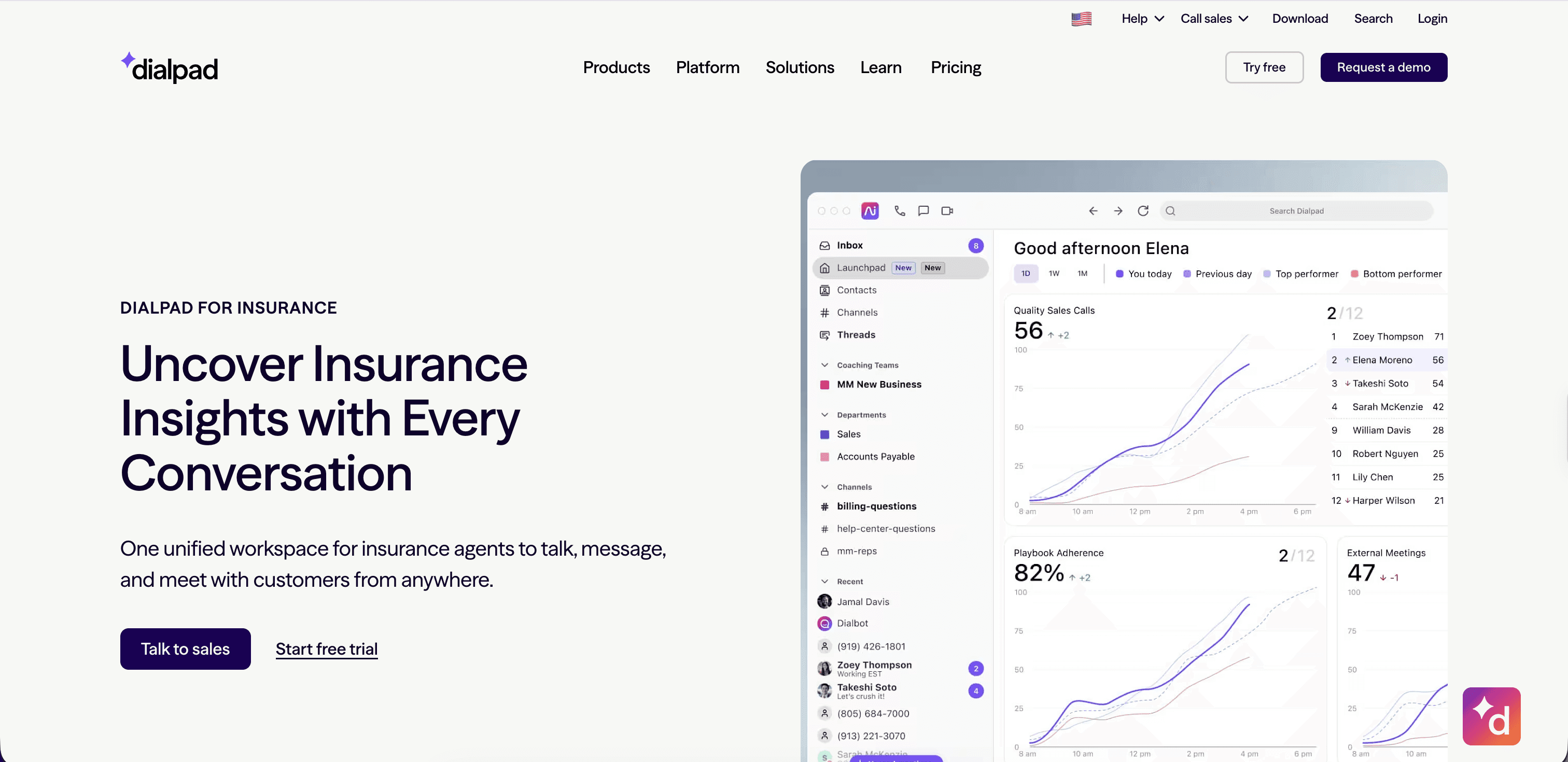
Best for: Smaller insurance agencies wanting a single, simpler platform for phone, messaging, and contact center in one login.
Key features: Unified business phone, contact center, and video meetings, plus Dialpad Ai for live transcription and coaching.
Insurance-specific capabilities: Dialpad's simplicity makes it approachable for smaller agencies, though it lacks the deep compliance and claims-specific workflow depth that larger insurers typically need.
Integrations: Salesforce, HubSpot, and Zendesk.
Pricing: Custom pricing, with published tiers varying based on the features and seat count selected.
10. Nextiva
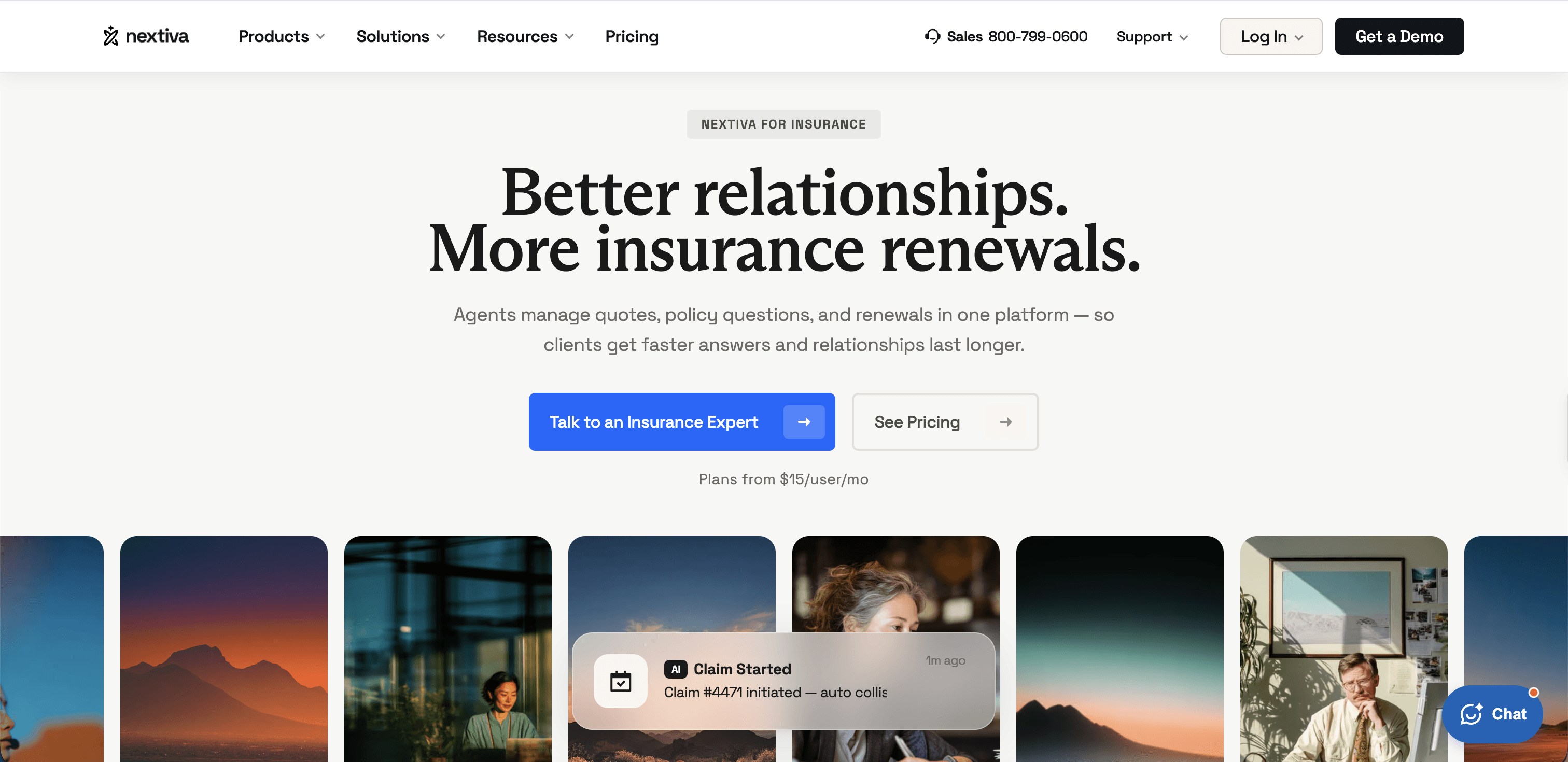
Best for: Small to mid-size insurance agencies that need unified communications with basic contact center functionality.
Key features: VoIP, contact center features, and lightweight CRM tools bundled together.
Insurance-specific capabilities: Best suited for agencies with simpler compliance needs rather than large carriers managing claims across multiple states.
Integrations: Connects with common CRMs and help desk tools.
Pricing: Contact center plans are custom-quoted separately from Nextiva's standard VoIP pricing.
11. Cresta
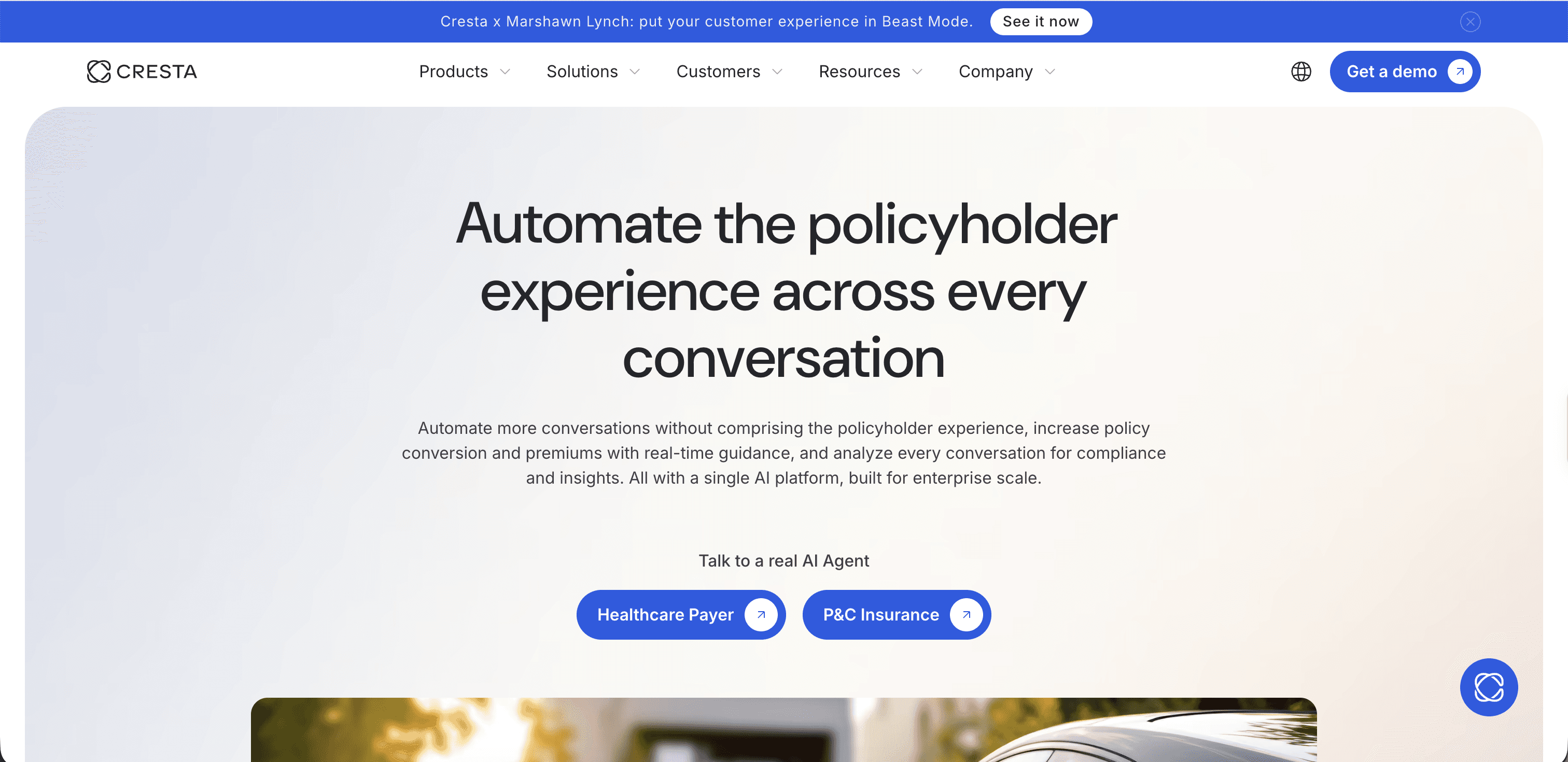
Best for: Insurance sales and retention teams that want real-time coaching layered on top of an existing dialer or CCaaS platform.
Key features: Real-time conversation guidance, coaching, and conversation intelligence through Cresta Opera.
Insurance-specific capabilities: Strong fit for outbound sales and renewal teams needing live nudges during a call, though it is more narrowly focused on sales conversations than full-spectrum claims and compliance QA. See a direct Level AI vs. Cresta comparison for a feature-by-feature breakdown.
Integrations: Layers on top of major CCaaS platforms rather than replacing them.
Pricing: Custom enterprise pricing based on seats and deployment scope.
12. RingCentral
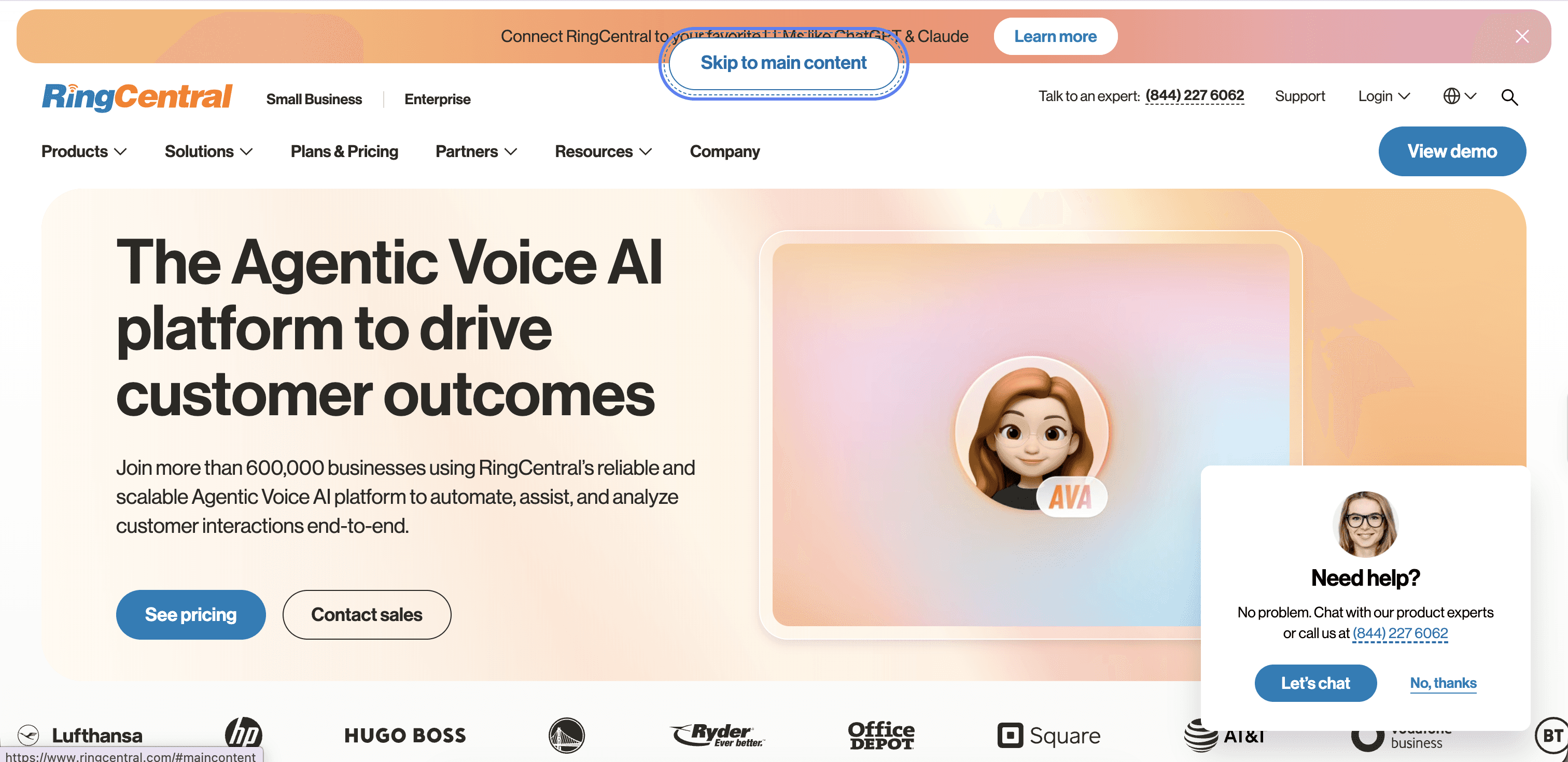
Best for: Insurers wanting combined unified communications and contact center capabilities under a single contract.
Key features: Business phone, video conferencing, and RingCX contact center with AI-generated summaries and sentiment scoring.
Insurance-specific capabilities: Works well for agencies that need phone, messaging, and basic contact center routing without deep insurance-specific configuration.
Integrations: Microsoft, Google Workspace, and Salesforce.
Pricing: Contact center plans start around $50 per user per month, with advanced tiers priced higher.
13. Convoso
Best for: Insurance sales and lead-generation teams running high-volume outbound dialing campaigns.
Key features: Predictive dialer, lead management, and built-in dialing compliance tools.
Insurance-specific capabilities: Compliance tooling for outbound calling rules is a strong fit for insurance lead-gen and sales teams that need to manage consent and call frequency carefully.
Integrations: Connects with common CRMs and third-party lead sources.
Pricing: Custom, quote-based pricing depending on seat count and dialing volume.
How AI Is Transforming Insurance Contact Centers
AI Capability | What It Does | Insurance Use Cases | Key Benefit |
|---|---|---|---|
Automated QA | Automatically scores conversations against a custom rubric. | Claims, sales, and support conversations. | Evaluates every interaction instead of manually reviewing only 2 to 5% of calls. See how automated quality assurance works. |
Real-time Agent Assistance | Surfaces relevant information and guidance while an agent is on a call. | Policy details, claims status, and next-best-action guidance. | Reduces hold times and after-call work. |
Conversation Intelligence | Categorizes customer conversations and identifies recurring patterns. | Claims delays, billing disputes, and confusion about coverage. | Helps identify customer issues before they become widespread complaints. |
Compliance Monitoring | Flags compliance-related issues across interactions. | Missing disclosures, prohibited sales language, and state-specific requirement gaps. | Enables monitoring across 100% of interactions rather than relying on a sample. |
AI-powered Self-service | Handles routine customer questions without requiring an agent. | Claims status checks and policy questions. | Frees agents to focus on more complex conversations. |
Agent Coaching | Identifies skill gaps and surfaces relevant training opportunities. | Coaching based on QA scores and individual agent performance. | Helps route the right training moments to each agent instead of waiting for an annual review. See Agent Coaching. |
AI Layer Over Existing Infrastructure | Adds AI capabilities on top of existing contact center platforms. | Five9, Genesys, NICE, and Amazon Connect. | Adds automated QA, agent assist, and voice of the customer insights without a rip-and-replace migration. |
How Insurers Use Level AI to Improve Contact Center Operations
Choosing insurance call center software in 2026 comes down to a few priorities: full visibility into every claims, sales, and support conversation, compliance monitoring that actually understands state-specific insurance requirements, and a way to scale QA and coaching without growing headcount every renewal season. Whether an insurer keeps its existing CCaaS provider or evaluates a new one, the AI layer on top of that infrastructure is often what determines whether these priorities are actually met.
Level AI gives insurance contact centers automated QA across 100% of interactions, real-time agent assist for complex claims and policy conversations, and conversation intelligence that surfaces emerging issues before they turn into complaints, all without replacing the telephony or CCaaS platform already in place.
1. How can insurance call centers automate quality assurance?
Automated QA uses AI to listen to and score every voice, chat, and email interaction against a defined scorecard, instead of relying on a manual sample of 2 to 5% of calls. This means claims accuracy, disclosure compliance, and customer tone can all be checked on 100% of interactions, and issues can be flagged the same day rather than discovered weeks later during a manual audit. Platforms built for call center quality assurance automation typically let insurers customize scorecards by line of business, so a claims call is scored differently than a sales call
2. How can insurance companies monitor compliance across customer calls?
Compliance monitoring software can automatically check every call for required disclosures, prohibited sales language, and state-specific regulatory requirements, since insurance rules vary significantly by state and line of business. Instead of a compliance team spot-checking a handful of calls, AI-based regulatory compliance monitoring can flag potential violations in near real time and route them to a supervisor for review, reducing the risk of a compliance issue going unnoticed until an audit
3. How can AI help insurance call center agents improve sales and customer service?
Real-time agent assist tools listen to a call as it happens and surface policy details, next-best-action prompts, and compliance reminders directly to the agent's screen. This is especially valuable for insurance agents handling complex, multi-product conversations where a policyholder might ask about claims status, coverage details, and renewal options in a single call. Combined with real-time agent assist capabilities, coaching tools can then use the same conversation data to identify specific skill gaps and deliver targeted coaching after the call
4. How can insurance call centers identify trends and customer concerns from conversations?
Voice of the customer and conversation analytics tools automatically categorize why customers are calling, track sentiment across interactions, and surface emerging topics before they show up as a spike in complaint volume. For insurers, this might mean spotting a sudden increase in claims delay complaints tied to a specific region or policy type well before it becomes a broader customer experience or reputational issue. Reviewing customer analytics use cases is a useful starting point for insurers building out this capability for the first time
5. How can insurance companies scale call center QA without increasing headcount?
This is the core problem that pushes many insurers, similar to challenges raised by companies like Branch Insurance, toward automated QA. Instead of hiring additional QA analysts every time call volume grows during renewal season or after a catastrophic event, AI-based QA can review 100% of interactions at the same operational cost, regardless of volume spikes. This shifts QA teams from manually sampling calls to reviewing AI-flagged exceptions and coaching agents, which scales far better than a headcount-per-call-volume model. This QA ROI research breaks down the cost comparison in more detail