

Key takeaways
MaestroQA is a solid QA tool but falls short for enterprise teams that need AI-powered auto-scoring, real-time agent assist, and voice of the customer insights in one platform.
Most MaestroQA alternatives in this list go beyond manual scorecards and offer automated QA coverage across 100% of interactions, not just sampled ones.
Level AI stands out by combining automated quality management, real-time coaching, and deep customer intelligence in a single platform built for enterprise contact centers.
Enterprises evaluating QA tools should look at integration depth, AI accuracy, coaching workflows, and total cost of ownership alongside feature lists.
The right alternative depends on your team size, channels, and whether you need QA alone or a full contact center intelligence suite.
Why Buyers Evaluate MaestroQA?
MaestroQA has been a popular choice for contact center quality assurance teams that want structured scorecards, calibration workflows, and agent feedback tools. It covers the basics well: rubric-based evaluations, coaching sessions, and reporting dashboards that QA managers can set up without heavy IT involvement.
But as enterprise contact centers grow, a few limitations start to surface. First, MaestroQA is primarily a manual or semi-automated QA tool. Teams handling thousands of calls a day still rely on reviewing a small sample of interactions, which means most conversations go unexamined. Second, the platform does not offer native real-time agent guidance, so agents get feedback after the fact rather than in the moment when it matters. Third, for enterprises that want to connect voice of the customer insights to QA scores and business outcomes, MaestroQA requires third-party integrations that add cost and complexity.
These gaps push enterprise buyers to look at alternatives that can handle scale, provide AI-driven automation, and deliver deeper intelligence across voice and digital channels. The platforms in this list represent the most credible options available today.
How We Compared These Tools
Picking the right QA platform is not just about features on a checklist. We evaluated each tool across six dimensions that matter most to enterprise contact centers:
AI automation depth: Does the tool score 100% of conversations automatically, or does it still depend on manual sampling? Enterprises dealing with thousands of daily interactions need full coverage, not spot checks.
Real-time capabilities: Can the platform surface insights and guidance to agents while a call is happening, or only after the fact? Real-time agent assist is increasingly a deciding factor for teams focused on first-call resolution.
Channel coverage: Most enterprise teams handle voice, chat, email, and messaging. We looked at whether each platform handles all of these natively or only a subset.
Coaching and performance workflows: Quality data is only useful if it drives behavior change. We assessed how each tool connects scores to coaching actions and agent development.
Enterprise integration: Does the platform connect cleanly with the CRMs, ticketing systems, and telephony platforms your team already uses?
Total cost and implementation timeline: Enterprise buyers need to factor in deployment complexity, professional services requirements, and ongoing maintenance when comparing licensing costs.
These six dimensions formed the basis for every tool in this comparison.
Top MaestroQA Alternatives: Comparison Table
Platform | Auto QA | Real-Time Assist | Voice + Digital | Coaching Workflows | Best For |
|---|---|---|---|---|---|
Level AI | Yes (100% coverage) | Yes | Yes | Yes | Full-suite AI QA and coaching |
Zendesk QA | Yes | No | Chat/Email focused | Limited | Teams already on Zendesk |
Observe.ai | Yes | Yes | Voice-first | Yes | Voice-heavy contact centers |
Playvox | Partial | No | Yes | Yes | WFM + QA combined |
Scorebuddy | Manual/Partial | No | Yes | Yes | Mid-market QA teams |
EvaluAgent | Partial | No | Yes | Yes | Gamified coaching focus |
Convin | Yes | Yes | Voice + Chat | Yes | Sales and support teams |
Balto | No | Yes (real-time only) | Voice | Limited | Real-time guidance only |
NICE | Yes | Yes | Voice + Digital | Yes | Large enterprise deployments |
Talkdesk | Partial | Yes | Voice + Digital | Yes | Talkdesk-native users |
Detailed Platform Reviews
1. Level AI
Level AI is a contact center intelligence platform built specifically for enterprise teams that need more than manual scorecards. The platform uses AI to automatically evaluate 100% of customer interactions across voice, chat, email, and messaging channels without requiring human reviewers to sample each one. Its automated quality management layer scores calls against custom rubrics, flags compliance risks, and generates coaching recommendations, all from a single interface. Beyond QA, Level AI connects interaction data to broader business signals, so contact center leaders can see not just how agents are performing but what customers are actually experiencing across every touchpoint. The platform also includes real-time agent guidance, voice of the customer analytics, and an inferred CSAT model that predicts customer satisfaction without requiring post-call surveys.
Key Features
Automated scoring of 100% of interactions across voice and digital channels
Real-time agent assist that surfaces guidance during live calls
Custom QA scorecards with AI-driven rubric enforcement
Inferred CSAT to predict customer satisfaction without survey dependency
Voice of the customer insights that connect QA data to product, operations, and CX teams
Agent coaching workflows tied directly to QA scores and performance gaps
Native integrations with Salesforce, Zendesk, ServiceNow, and major CCaaS platforms
Speech analytics with high-accuracy transcription across accents and audio conditions
Strengths
One platform covers QA, real-time assist, coaching, and customer intelligence without needing separate tools stitched together
AI accuracy is built on a semantic understanding model, not just keyword matching, which reduces false positives in scoring
100% interaction coverage means no blind spots in quality monitoring, which matters especially for regulatory compliance monitoring
Coaching workflows connect automatically to scored interactions, so managers spend time on development rather than on pulling reports
Inferred CSAT gives enterprise leaders a continuous signal on customer experience without survey fatigue
Strong track record with financial services, insurance, healthcare, and BPO use cases where compliance and accuracy are non-negotiable
Best For
Enterprise contact centers that have outgrown manual QA sampling and need a platform that combines automated scoring, real-time coaching, and customer intelligence in one system. Particularly strong for industries like financial services, healthcare, and insurance where compliance coverage and accuracy are critical.
“Level AI has fundamentally changed how we approach quality assurance. We went from reviewing 3% of interactions to having full visibility across every call. The insights we now get feed directly into agent coaching and have meaningfully improved our CSAT scores.” -- Customer Success Leader, Smartsheet (read the full story)
" transform="translate(85.643 10.143)" width="23.725855670103115px"/><path d="M 71.828 0 L 0 50.702" fill="transparent" height="50.70235051546392px" id="TnJFUMH9b" stroke-dasharray="" stroke-linecap="butt" stroke-linejoin="miter" stroke-miterlimit="10" stroke-width="0.68" stroke="rgb(254, 250, 241)" transform="translate(85.508 75.029)" width="71.82828865979384px"/><path d="M 81.579 0 L 0 52.003" fill="transparent" height="52.00280412371134px" id="ccJzhVTGI" stroke-dasharray="" stroke-linecap="butt" stroke-linejoin="miter" stroke-miterlimit="10" stroke-width="0.68" stroke="rgb(254, 250, 241)" transform="translate(85.495 73.738)" width="81.57921649484533px"/><path d="M 65.653 0 L 0 32.827" fill="transparent" height="32.826556701030924px" id="X0Vp_q8HG" stroke-dasharray="" stroke-linecap="butt" stroke-linejoin="miter" stroke-miterlimit="10" stroke-width="0.68" stroke="rgb(254, 250, 241)" transform="translate(85.462 92.931)" width="65.65311340206183px"/><path d="M 88.08 14.951 L 0 0" fill="transparent" height="14.950762886597914px" id="JM_UgSiJ_" stroke-dasharray="" stroke-linecap="butt" stroke-linejoin="miter" stroke-miterlimit="10" stroke-width="0.68" stroke="rgb(254, 250, 241)" transform="translate(86.233 125.789)" width="88.07950515463914px"/><path d="M 83.204 72.803 L 0 0" fill="transparent" height="72.80313402061856px" id="KlyUUjlMK" stroke-dasharray="" stroke-linecap="butt" stroke-linejoin="miter" stroke-miterlimit="10" stroke-width="0.68" stroke="rgb(254, 250, 241)" transform="translate(85.089 125.71)" width="83.20379381443304px"/><path d="M 7.8 114.081 L 0 0" fill="transparent" height="114.08065979381445px" id="kAiUvduBR" stroke-dasharray="" stroke-linecap="butt" stroke-linejoin="miter" stroke-miterlimit="10" stroke-width="0.68" stroke="rgb(254, 250, 241)" transform="translate(85.95 125.478)" width="7.800247422680428px"/><path d="M 0 93.604 L 9.75 0" fill="transparent" height="93.60445360824741px" id="FsgTAQB0n" stroke-dasharray="" stroke-linecap="butt" stroke-linejoin="miter" stroke-miterlimit="10" stroke-width="0.68" stroke="rgb(254, 250, 241)" transform="translate(76.2 125.421)" width="9.750432989690694px"/><path d="M 0 76.379 L 76.703 0" fill="transparent" height="76.37888659793816px" id="NxOhHvPJ5" stroke-dasharray="" stroke-linecap="butt" stroke-linejoin="miter" stroke-miterlimit="10" stroke-width="0.68" stroke="rgb(254, 250, 241)" transform="translate(9.343 125.217)" width="76.7034556701031px"/><path d="M 0 26.651 L 39.002 0" fill="transparent" height="26.651381443298988px" id="QETNKJ3L6" stroke-dasharray="" stroke-linecap="butt" stroke-linejoin="miter" stroke-miterlimit="10" stroke-width="0.68" stroke="rgb(254, 250, 241)" transform="translate(47.096 125.177)" width="39.0017319587629px"/><path d="M 0 16.901 L 85.154 0" fill="transparent" height="16.900948453608265px" id="BL63wDICD" stroke-dasharray="" stroke-linecap="butt" stroke-linejoin="miter" stroke-miterlimit="10" stroke-width="0.68" stroke="rgb(254, 250, 241)" transform="translate(0.094 125.125)" width="85.15396503092786px"/><path d="M 0 0 L 78.004 17.876" fill="transparent" height="17.875793814432996px" id="PIX70Vlqf" stroke-dasharray="" stroke-linecap="butt" stroke-linejoin="miter" stroke-miterlimit="10" stroke-width="0.68" stroke="rgb(254, 250, 241)" transform="translate(8.362 107.251)" width="78.00376082474227px"/><path d="M 0 0 L 67.928 52.327" fill="transparent" height="52.32742268041238px" id="u_syqWqWD" stroke-dasharray="" stroke-linecap="butt" stroke-linejoin="miter" stroke-miterlimit="10" stroke-width="0.68" stroke="rgb(254, 250, 241)" transform="translate(17.593 72.861)" width="67.92826391752578px"/><path d="M 0 0 L 77.029 70.528" fill="transparent" height="70.52832989690722px" id="DmW_aE2A0" stroke-dasharray="" stroke-linecap="butt" stroke-linejoin="miter" stroke-miterlimit="10" stroke-width="0.68" stroke="rgb(254, 250, 241)" transform="translate(9.489 54.678)" width="77.02866804123713px"/><path d="M 0 0 L 27.301 126.431" fill="transparent" height="126.43109443298971px" id="JrLaRUubC" stroke-dasharray="" stroke-linecap="butt" stroke-linejoin="miter" stroke-miterlimit="10" stroke-width="0.68" stroke="rgb(254, 250, 241)" transform="translate(58.341 -0.071)" width="27.30111340206188px"/><path d="M 0 4.012 C 0 1.796 1.796 0 4.012 0 C 6.228 0 8.025 1.796 8.025 4.012 C 8.025 6.228 6.228 8.025 4.012 8.025 C 1.796 8.025 0 6.228 0 4.012 Z" fill="rgb(254, 80, 0)" height="8.024669690721652px" id="Nh5qrPJs_" transform="translate(81.396 121.369)" width="8.024669690721623px"/></svg>)
2. Zendesk QA
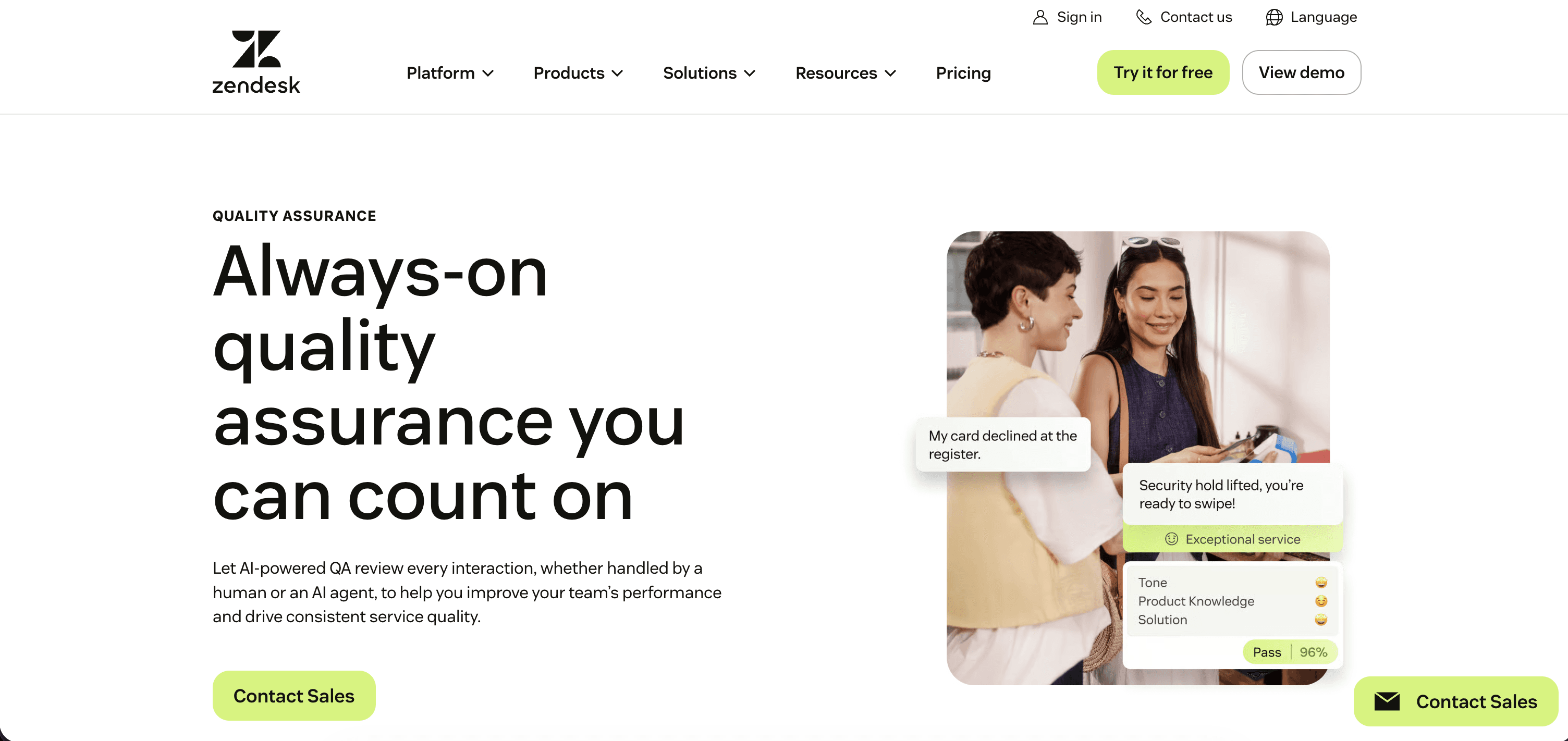
Zendesk QA, formerly known as Klaus, is a quality assurance tool that integrates deeply with the Zendesk support platform. It is designed for teams already using Zendesk as their primary ticketing and help desk system who want to add structured QA workflows without switching platforms. The tool uses AI to highlight conversations worth reviewing, auto-score interactions, and track agent performance over time. It covers chat, email, and ticket-based channels well. For teams operating a voice-heavy contact center, however, Zendesk QA has limited native voice support and relies on third-party integrations to cover phone interactions. As a call center quality assurance solution, it works best when the majority of your volume is digital.
Key Features
AI-assisted conversation highlighting to surface low-quality interactions
Auto QA scoring for chat and email interactions
Custom scorecards and rubric builder
Integration with Zendesk tickets, agents, and reporting
Calibration sessions and dispute workflows
Agent performance dashboards and coaching notes
Strengths
Seamless for teams already inside the Zendesk ecosystem
Fast setup with no new vendor relationship needed if you are already a Zendesk customer
AI highlighting reduces the manual effort of picking which conversations to review
Solid reporting for ticket-based channels
Weaknesses
Limited voice QA capability without additional integrations
Scoring AI is less sophisticated than dedicated QA platforms that handle semantic understanding
Coaching workflows are basic compared to platforms designed specifically for agent development
Best For
Support teams with high digital interaction volume that already use Zendesk and want to add QA without managing a separate platform. Not the best fit for enterprises with significant voice volume or those needing deep coaching workflows.
3. Observe.ai
Observe.ai is a conversation intelligence platform that focuses primarily on voice interactions in contact centers. It uses AI to transcribe and analyze calls, score agent performance, and surface coaching opportunities. The platform has a strong reputation in voice analytics and is one of the more mature alternatives in this space for call-heavy operations. Observe.ai also offers real-time agent guidance, which puts it in a category above basic QA-only tools. If you are looking for speech analytics for call centers with a solid QA layer on top, Observe.ai is a credible option. Enterprises running omnichannel operations with high digital volume may find its coverage less complete compared to platforms built for both voice and digital from the ground up.
Key Features
AI-powered transcription and call scoring
Automated QA across voice interactions
Real-time agent assist during calls
Custom evaluation forms and rubric builder
Agent performance analytics and coaching workflows
Integrations with major CCaaS and CRM platforms
Strengths
Strong voice transcription accuracy with broad language and accent support
Real-time guidance gives it an edge over QA-only tools
Established platform with a large enterprise customer base
Good integration coverage for telephony and CRM systems
Weaknesses
Voice-first orientation means digital channel support is less mature
The platform can feel complex to configure and calibrate initially
Some users report that the coaching tools require significant manual effort to make actionable
Best For
Voice-heavy enterprise contact centers where call quality and compliance are the primary concern, and digital channel QA is a secondary need. If you want a Level AI vs Observe.ai comparison, Level AI covers both voice and digital more evenly.
4. Playvox (By Nice)
Playvox is a workforce optimization platform that includes quality management as one of its core modules. It is positioned for contact centers that want QA, workforce management, and agent engagement in a single subscription. The QA module supports manual and AI-assisted scoring across voice and digital channels, and the platform has coaching and gamification features designed to drive agent motivation alongside performance improvement. Playvox integrates with major CRM and CCaaS platforms, which makes it a reasonable option for teams that need QA and workforce management together. For enterprises that specifically need advanced AI automation in QA, the platform’s auto-scoring capabilities are more limited compared to purpose-built AI QA tools.
You can explore how it compares in our Playvox alternatives guide.
Key Features
QA scorecards with manual and AI-assisted scoring
Workforce management and scheduling modules
Gamification and agent motivation tools
Coaching session workflows tied to QA data
Integrations with Salesforce, Zendesk, Kustomer, and Intercom
Learning management system for agent training
Strengths
Combines QA and workforce management in one platform, reducing vendor count
Gamification features help improve agent engagement alongside performance
Good integration library for common CRM and CCaaS platforms
Coaching workflows are well-structured and easy for managers to use
Weaknesses
AI auto-scoring is less advanced than dedicated AI QA platforms
Voice channel support requires additional setup compared to digital channels
Can feel like a collection of modules rather than a tightly integrated system
Best For
Contact centers that need QA and workforce management together and are willing to trade some AI automation depth for consolidated tooling. Teams that prioritize agent engagement and gamification alongside scoring will find the platform appealing.
5. Scorebuddy

Scorebuddy is a cloud-based quality management platform built for contact centers that want to move beyond spreadsheets and manual tracking without committing to a complex enterprise AI deployment. It covers scorecard creation, agent feedback workflows, calibration sessions, and reporting across voice, email, chat, and social channels. The platform is relatively straightforward to set up and use, which makes it popular with mid-market teams. Its AI capabilities have grown in recent years but remain more limited than platforms like Level AI or Observe.ai. For teams that want to understand what quality assurance means and build consistent processes before investing in full automation, Scorebuddy is a practical starting point.
Key Features
Custom scorecard builder with weighted criteria
Multi-channel support for voice, email, chat, and social
Calibration and dispute workflows
Agent feedback and acknowledgment tools
Reporting dashboards for QA managers and team leaders
Integration with telephony and CRM systems
Strengths
Easy to set up and use without heavy IT involvement
Multi-channel coverage for teams handling diverse interaction types
Calibration workflows help align QA reviewers consistently
Transparent pricing compared to enterprise-focused competitors
Weaknesses
Limited AI automation means teams still rely heavily on manual sampling
Does not offer real-time agent guidance
Not designed for enterprise-scale deployments with complex workflows
Best For
Mid-market contact centers looking to formalize QA processes with structured scorecards and feedback workflows. Teams that are not yet ready for full AI automation but want a reliable, easy-to-use quality management system.
6. EvaluAgent
EvaluAgent is a quality management platform that combines structured QA workflows with a strong focus on agent engagement and gamification. The platform covers scorecard-based evaluations, coaching sessions, learning paths, and performance tracking, with the idea that QA data should flow directly into agent development rather than sitting in a reporting dashboard. EvaluAgent has added AI capabilities over time, including some auto-scoring features, but its primary differentiation remains the gamification and engagement layer. For enterprises using agent coaching software as a central strategy for performance improvement, EvaluAgent is worth evaluating alongside more AI-heavy alternatives.
Key Features
QA scorecards with manual and assisted scoring
Gamification and leaderboard features for agent motivation
Coaching workflows and learning management integration
Agent performance tracking and trend reporting
Integrations with Zendesk, Salesforce, and telephony systems
Calibration and review dispute tools
Strengths
Gamification features meaningfully improve agent engagement with QA feedback
Strong coaching and learning integration makes development workflows cohesive
Good for organizations that want QA to drive culture change, not just compliance
Reasonably easy to set up and configure for mid-market teams
Weaknesses
AI auto-scoring capabilities are limited compared to dedicated AI QA platforms
Does not offer real-time agent assist during interactions
May feel lightweight for enterprises that need deep compliance monitoring or 100% interaction coverage
Best For
Teams where agent motivation and gamified performance improvement are as important as QA accuracy. Works well for contact centers where coaching culture is the primary goal and advanced AI automation is a secondary consideration.
7. Convin
Convin is a conversation intelligence platform that focuses on both sales and customer support contact centers. It uses AI to record, transcribe, and analyze calls and chats, score interactions against custom criteria, and generate coaching recommendations. The platform includes a real-time assistant that surfaces relevant information for agents during live calls. Convin is particularly strong for sales-focused contact centers where revenue outcomes are tied to conversation quality. For support-heavy enterprises with complex compliance requirements, the platform’s depth may be less mature than purpose-built QA tools. Teams looking for a platform that covers conversational intelligence software for both sales and support will find it worth exploring.
Key Features
AI conversation analysis across calls and chats
Auto QA scoring with custom rubric support
Real-time agent assist during live calls
Coaching recommendations tied to scored interactions
Win/loss analysis for sales-focused deployments
CRM integrations and call recording management
Strengths
Strong real-time assist capability during calls
Useful for both sales and support contact centers
Coaching recommendations are directly tied to interaction data
Good CRM integration for sales-focused workflows
Weaknesses
Less mature for enterprises with heavy compliance and regulatory monitoring needs
Digital channel coverage is less complete than voice
Smaller ecosystem and integration library compared to established players
Best For
Sales-focused contact centers and mid-market support teams that want conversation intelligence with real-time guidance. Less suited for enterprises with complex compliance workflows or high digital interaction volume.
8. Balto
Balto is different from most tools in this list because it focuses almost entirely on real-time guidance during live calls rather than post-call QA. The platform listens to conversations as they happen and surfaces prompts, objection-handling scripts, and compliance reminders to agents in real time. Balto does not offer a traditional QA scorecard system, which means it is not a direct MaestroQA replacement if your primary need is scoring and reviewing recorded interactions. However, for enterprises that want to add a real-time layer on top of an existing QA workflow, Balto can complement other tools.
You can see a detailed breakdown in our Balto alternatives comparison.
Key Features
Real-time call guidance with dynamic prompt delivery
Compliance checklists surfaced during live calls
Script adherence monitoring in real time
Call recording and basic post-call reporting
Integration with major telephony platforms
Customizable playbooks by call type or campaign
Strengths
Best-in-class real-time guidance for voice interactions
Compliance reminder delivery is effective for highly scripted call types
Fast deployment compared to full QA platforms
Useful for sales and collections teams with specific scripting needs
Weaknesses
Not a QA platform, lacks post-call scoring and review workflows
Limited digital channel support
Coaching and performance management features are minimal
Best For
Enterprises that already have a QA system and want to add real-time guidance specifically for voice calls. Not a standalone MaestroQA replacement but a useful complement for scripted call types.
9. NICE

NICE is one of the largest and most established players in the contact center technology space. Its QA and workforce optimization suite covers interaction recording, automated quality management, speech and text analytics, workforce management, and agent performance tools. NICE is built for large enterprise deployments and integrates with a wide range of CCaaS and CRM systems. The breadth of the platform is its major strength, but that breadth also comes with significant complexity in configuration, deployment timelines, and cost. For enterprises evaluating workforce optimization software at scale, NICE is one of the most complete platforms available, though it often requires dedicated IT resources and professional services to implement properly.
Key Features
Automated quality management across voice and digital channels
Speech and text analytics at enterprise scale
Workforce management and scheduling
Real-time guidance and agent desktop integration
Compliance monitoring with regulatory workflow support
Extensive integration library for enterprise systems
Strengths
Comprehensive platform covering QA, WFM, analytics, and more
Proven at the largest enterprise scales with complex multi-site operations
Strong compliance and regulatory monitoring capabilities
Large integration ecosystem with major CCaaS and CRM vendors
Weaknesses
High implementation complexity with long deployment timelines
Significant cost for licensing, professional services, and ongoing support
Platform can feel heavy and difficult to navigate for teams that only need QA
Innovation pace can be slower than newer AI-native platforms
Best For
Very large enterprise contact centers with multi-site operations that need a single vendor for QA, workforce management, and analytics. Teams prepared for a longer implementation cycle and higher total cost of ownership.
10. Talkdesk
Talkdesk is a cloud contact center platform that includes a quality management module as part of its broader CCaaS offering. Talkdesk QM provides interaction recording, AI-assisted scoring, scorecard management, and agent performance reporting. The QA tools are tightly integrated with the Talkdesk voice and digital channels, which makes configuration straightforward for teams already running on the Talkdesk platform. The quality management capabilities are solid but not as specialized as dedicated QA platforms. For enterprises on Talkdesk looking to add QA without a separate vendor, the built-in module covers the core use cases. For teams that need call center analytics software and QA together with advanced AI, a dedicated platform alongside Talkdesk may be the stronger choice.
Key Features
AI-assisted interaction scoring and auto QA
Custom scorecard creation with rubric support
Interaction recording across voice and digital channels
Agent performance dashboards and trend reporting
Coaching session workflows and feedback delivery
Native integration with Talkdesk CCaaS and third-party CRM systems
Strengths
Seamless for Talkdesk-native deployments with no additional integration work
AI scoring reduces manual QA sampling burden
Clean interface that QA managers and team leaders find easy to use
Good reporting for performance trends across teams and sites
Weaknesses
QA capabilities are more limited for enterprises not on the Talkdesk platform
Coaching and agent development features are less mature than dedicated coaching tools
AI scoring depth is below what purpose-built AI QA platforms offer
Best For
Enterprises already committed to the Talkdesk CCaaS platform that want to add quality management without introducing a separate vendor. Not the strongest choice if your contact center runs on a different telephony platform.
Conclusion: Why Level AI Is a Great MaestroQA Alternative
MaestroQA built a strong product for teams that needed to move beyond spreadsheets and manual call reviews. But the needs of enterprise contact centers have changed. Teams operating at scale need QA coverage across every interaction, not just a sampled fraction. They need real-time coaching that helps agents improve during a call, not just after it. And they need customer intelligence that connects QA data to broader business outcomes.
Level AI was built to meet exactly those needs. Its automated quality management platform scores 100% of interactions without sacrificing accuracy, its real-time assist layer supports agents in the moment, and its voice of the customer tools give CX and operations leaders the insight they need to act. Unlike platforms that piece together QA, coaching, and analytics through separate modules or integrations, Level AI delivers all of it from a single system.
Frequently Asked Questions
1. What is the biggest difference between MaestroQA and its alternatives?
MaestroQA focuses on manual and semi-automated scorecard-based QA. Most alternatives in this list have moved further toward AI-driven automation, with some like Level AI offering 100% interaction coverage across voice and digital channels. The gap is most visible in teams handling high interaction volumes where manual sampling leaves most conversations unreviewed.
2. Can I replace MaestroQA without disrupting my existing QA workflows?
Yes, in most cases. Platforms like Level AI are designed to import existing rubrics and scorecards, which means your team does not need to rebuild evaluation criteria from scratch. Most enterprise migrations involve a configuration and calibration phase, but the workflow transition is manageable with proper planning.
3. Which MaestroQA alternative is best for compliance-heavy industries?
Level AI and NICE are the strongest options for industries with strict compliance requirements like financial services, insurance, and healthcare. Both offer full interaction coverage, compliance monitoring workflows, and audit trail capabilities. Level AI is the faster deployment choice for most enterprise teams. See the regulatory compliance monitoring solution page for specifics.
4. Do these alternatives support omnichannel QA across voice, chat, and email?
Most do, though the depth varies. Level AI, NICE, and Talkdesk offer the strongest omnichannel coverage. Observe.ai is primarily voice-first. Zendesk QA is stronger on digital channels. Always verify channel support during your evaluation against your actual interaction mix.
5. How does AI-powered QA compare to manual scorecard reviews?
Automated quality management tools evaluate every interaction against your scoring rubric without human reviewers needing to listen to each call. Manual reviews are limited to what your QA team can realistically sample, typically 2 to 5 percent of interactions. AI-powered QA gives you complete coverage, consistent scoring, and faster feedback cycles for agents.