
Key takeaways
Agentic AI tools interpret customer intent, execute multi-step tasks in connected systems, and improve through continuous feedback from real interactions
Selecting a platform for enterprise contact centers requires evaluating production accuracy, QA coverage, training data quality, governance rules, and whether the system learns automatically or needs retraining
Agentic AI platforms are traditionally built as discrete function-specific agents. Level AI operates as a unified intelligence platform where every module shares the same conversation data and the same feedback loop
Introduction
Contact centers generate more interaction data than most teams can act on. Sampling 1 to 5 percent of conversations is not a reliable basis for operational decisions. The gap between what is happening in customer conversations and what leadership can see is where performance problems compound.
Agentic AI tools close that gap by interpreting customer intent, executing multi-step tasks in connected systems, and improving through continuous feedback from real interactions. McKinsey’s 2025 State of AI report found that only 23% of organizations are actively scaling agentic AI in production, while 39% remain in the experimentation phase. For contact center leaders, that gap represents both a risk and a competitive advantage.
This guide evaluates the top agentic AI tools for enterprise contact centers on the capabilities that determine production results: automation accuracy, QA coverage, live guidance depth, governance controls, and how each system learns over time.
What Are Agentic AI Tools?
Agentic AI tools are software systems that combine intent detection, multi-step planning, and direct execution within connected enterprise systems to complete tasks without requiring human sign-off at each step.
Earlier contact center automation followed predefined rules or matched keywords to trigger responses. A single customer request involving a billing dispute tied to a recent order may require pulling data from a CRM, checking a payment platform, and updating a support ticket. An agentic system handles that full chain as one continuous process.
Adoption is moving fast. Gartner projects that 33% of enterprise software applications will include agentic AI by 2028, up from less than 1% in 2024. 79% of enterprise leaders say AI agents are already being adopted at their organizations, and two-thirds of that group report measurable productivity gains. A spring 2025 study by MIT Sloan Management Review and Boston Consulting Group found 35% of organizations had already deployed AI agents, with another 44% planning to do so in the near term. IBM’s “Race for ROI” report, which surveyed 3,500 senior executives across ten countries, found 92% expect agentic AI to deliver measurable ROI within two years.
Deployment intent and production results are not the same thing. Gartner warns that over 40% of agentic AI projects will be canceled by the end of 2027 due to escalating costs, unclear business value, or inadequate risk controls. For contact center leaders, that failure rate makes platform evaluation a higher-stakes decision than it may appear at the procurement stage.
Platform | Best For | Deployment Model | Technical Lift | Post-Handoff Support | Human-Agent Knowledge Support |
Level AI | Unified QA, live guidance, virtual agent, and CSAT on one intelligence layer | Cloud, SaaS | Low | Full context: QA scores, sentiment, interaction history | Real-time knowledge, action hints, escalation signals |
Microsoft Dynamics 365 | Organizations standardized on Microsoft infrastructure | Cloud, Microsoft ecosystem | Medium | Context-dependent on CRM setup | Copilot Studio guidance; limited outside Microsoft stack |
Salesforce Agentforce | Organizations where Salesforce is the system of record | Cloud, Salesforce ecosystem | Medium | Full CRM context on handoff | AI Copilot with CRM data and suggested responses |
Cognigy | Enterprises requiring governed autonomy with internal AI ops capacity | Cloud, on-premise, hybrid | High | Full context with deterministic handling for regulated paths | Agent Copilot with real-time knowledge surfacing |
Genesys Cloud CX | Large enterprises needing unified CCaaS across voice, digital, and WFM | Cloud, SaaS | Medium | Native omnichannel context on handoff | Agent Copilot with next-best-action suggestions |
NICE CXone | Enterprises needing omnichannel routing, WFM, QA, and AI in one platform | Cloud, on-premise | Medium to High | Interaction history and sentiment available to receiving agent | Enlighten AI with real-time guidance and knowledge |
Decagon | High-volume consumer support in fintech, retail, and travel | Cloud, SaaS | Medium | Handoff to ticketing systems; no native WFM integration | Not a primary use case |
Sierra | Large consumer brands with high inbound volume and standardized case types | Cloud, SaaS | High | Full context across chat, voice, SMS, and email | Not included natively |
Cresta | Enterprises managing both human agent performance and AI automation | Cloud, SaaS | High | Supervisors can monitor and redirect AI and human agents | Real-time coaching, suggested responses, knowledge guidance |
Retell AI | Engineering-led teams building custom voice infrastructure | Cloud, API | High | Basic transfer; no native post-handoff context management | Not included |
Intercom Fin | Organizations wanting AI natively integrated with a helpdesk | Cloud, SaaS | Low | Full context passed within shared inbox on escalation | AI Copilot with reply drafts and context summaries |
Zendesk | Organizations already on Zendesk wanting AI within existing infrastructure | Cloud, SaaS | Low to Medium | Full ticket and conversation history on handoff | AI Copilot with suggested replies; QA available as add-on |
How to Evaluate Agentic AI Tools for Enterprise Contact Centers
Enterprise contact centers deploying agentic AI must cover production accuracy, governance requirements, and how the system behaves across the full range of real interactions. Consider the following.
1. QA coverage
Does the platform score 100% of interactions or rely on sampling? Platforms covering only a fraction of calls cannot provide reliable performance baselines or detect low-frequency but high-impact failure patterns. See AI agent examples and use cases for how full coverage changes what QA teams can act on.
2. Training foundation
Is the system trained on real customer conversations from the deployment environment, or on synthetic data and generic large language model (LLM) prompts? Domain-specific training directly determines how the system performs in production. Ask vendors to demonstrate accuracy on your own interaction data before contracting.
3. Governance and auditability
Can the platform explain each scoring decision? Enterprise compliance requirements in financial services, healthcare, and insurance require auditable decision logic. Platforms without this introduce procurement and legal risk.
4. The learning loop
The most durable platforms improve over time because QA outcomes, coaching data, and satisfaction signals feed back into the model automatically. That feedback mechanism is the difference between a platform that compounds performance gains and one that plateaus after initial deployment.
5. Integration depth
Can the platform read from and write to CRM, order management, ticketing, and knowledge base systems without custom engineering per connection? Systems that cannot execute in connected tools require agents to complete actions manually, which removes a core capability of agentic AI.
Top Agentic AI Tools for Enterprise Contact Centers
The following platforms represent the primary categories of agentic AI being deployed in enterprise CX environments, evaluated on operational depth rather than feature counts.
1. Level AI
Level AI is a contact center intelligence platform built on proprietary AI trained on real customer interaction data. Its agentic AI capabilities span the full contact center workflow: Agent Assist for live guidance, Virtual Agent for voice and chat automation, Auto-QA for 100% interaction scoring, and iCSAT for inferred customer satisfaction on every call.
Agent Assist interprets customer intent during live calls and surfaces relevant knowledge base content, action hints, and escalation signals. Agents do not have to search manually.
The Virtual Agent is trained on top-performer resolution patterns from real conversations rather than synthetic data, resulting in a 90% accuracy rate and sub-2-second enterprise latency.
Auto-QA covers 100% of interactions with evidence-based scoring and a reasoning trail for each score. This addresses the compliance and auditability requirements that prevent regulated enterprises from deploying AI scoring that cannot explain its decisions.
Every module, Agent Assist, Virtual Agent, Auto-QA, iCSAT, and Voice of the Customer, operates on the same conversation data, the same QA standards, and the same feedback loop. Improvements in one area compound into others.
Level AI holds GDPR, HIPAA, SOC 2, and PCI certifications.
2. Microsoft Dynamics 365 Contact Center
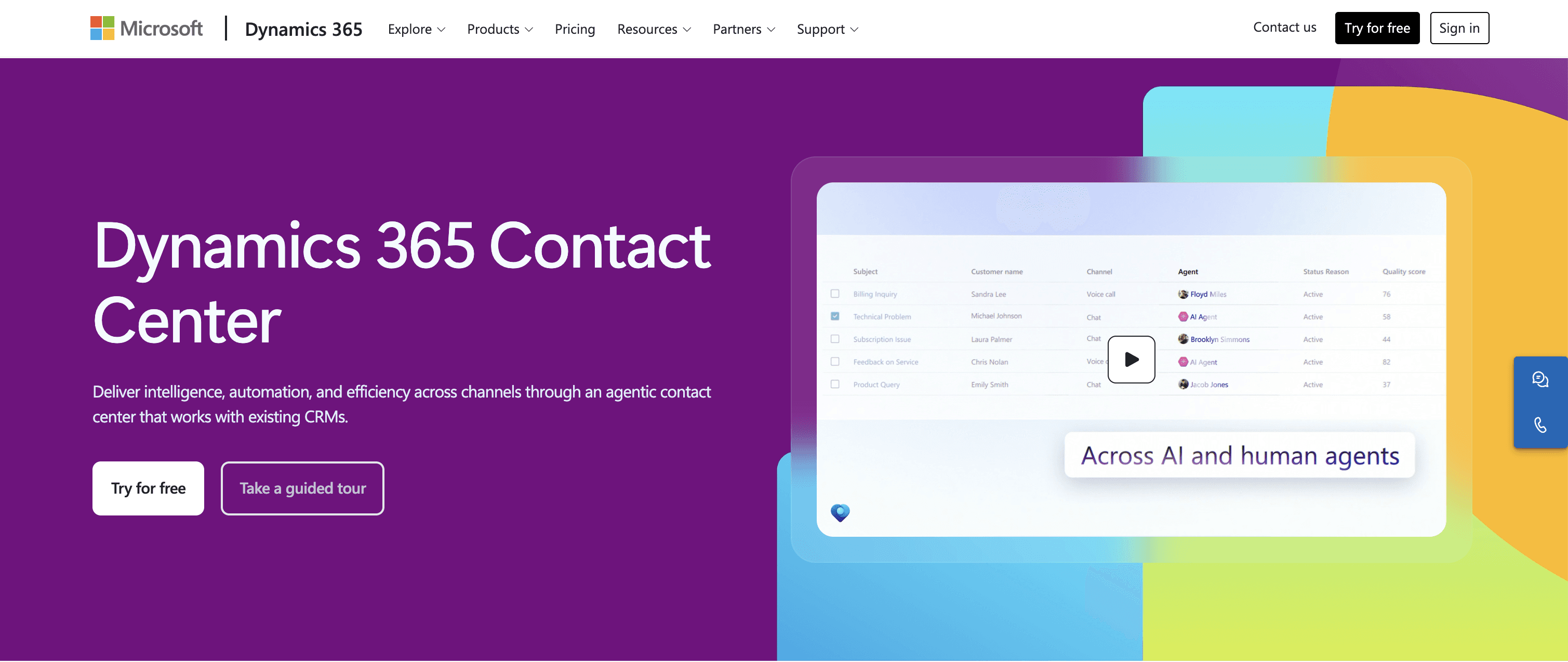
Microsoft’s contact center offering is built on Copilot Studio, with agentic capabilities connected to shared governance and data infrastructure across Microsoft’s application ecosystem.
Product Capabilities
The Customer Assist Agent handles voice and digital self-service using deterministic logic for regulated moments and generative reasoning for open-ended interactions.
The primary differentiation is Microsoft’s existing enterprise footprint. Organizations already standardized on Microsoft infrastructure can extend agentic capabilities without adding a separate vendor.
Multi-vendor CX stacks face significant configuration overhead. The platform is not purpose-built for contact center AI depth.
Autonomous multi-step resolution beyond defined workflow boundaries is still developing relative to platforms built for contact center operations.
Best For
Organizations already operating on Microsoft infrastructure that want to extend agentic capabilities without introducing a separate vendor.
Pricing
Dynamics 365 Contact Center starts at $95 per user per month for digital or voice capabilities and $110 per user per month for the full omnichannel solution.
The Customer Service Premium plan, which includes full contact center and AI capabilities, is $195 per user per month. Implementation costs typically range from $20,000 to $150,000 depending on complexity.
Microsoft is offering a 40% discount on Contact Center licenses through June 30, 2026.
3. Salesforce Agentforce Contact Center
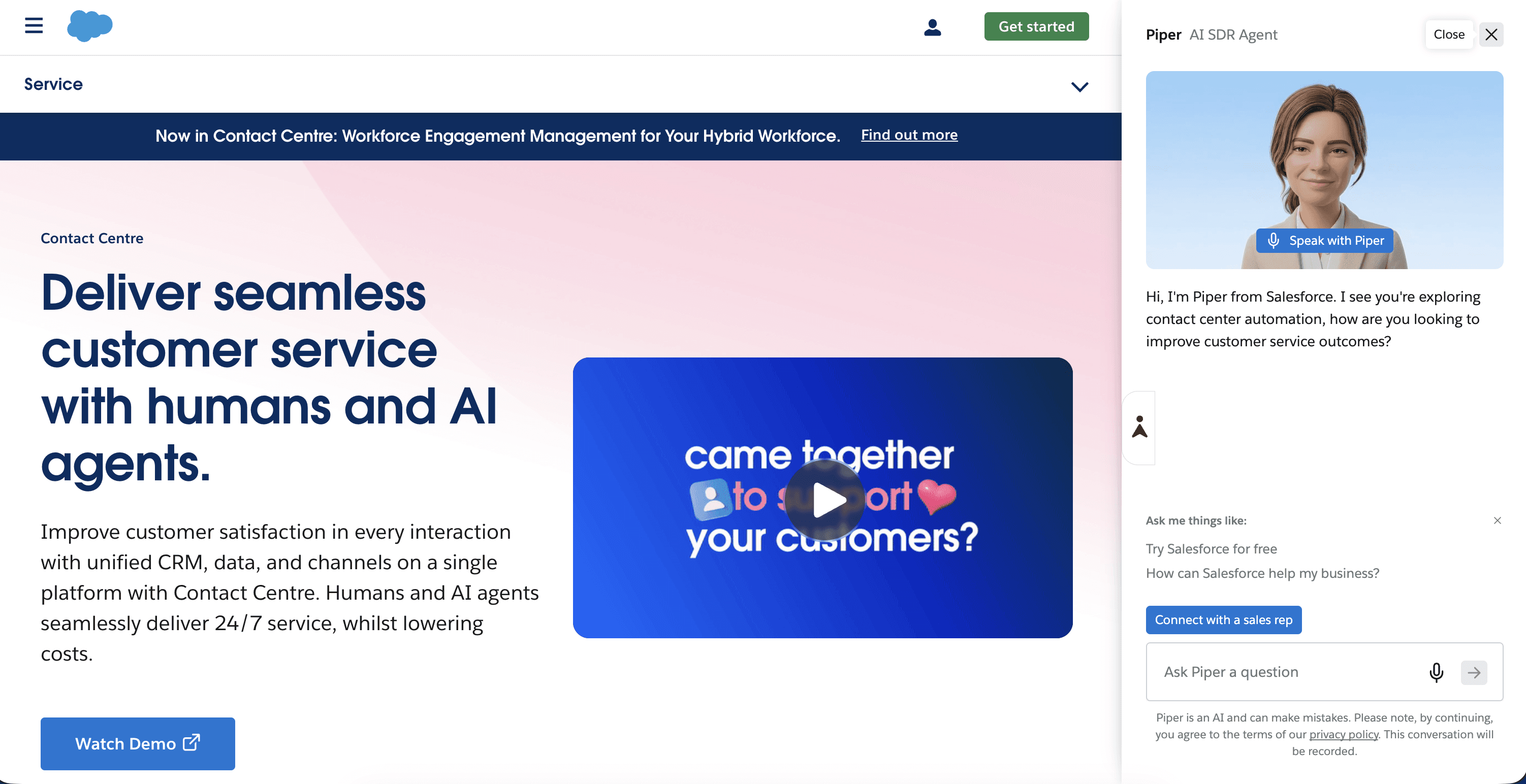
Salesforce launched Agentforce Contact Center to unify voice, digital channels, CRM data, and AI agents in a single system built around its existing customer data infrastructure.
Product Capabilities
The native CRM connection is the core differentiator. Agents can read customer history, account status, and prior interaction records without a separate integration layer.
AI agents hand off to human agents with full interaction context intact, reducing customer repetition and average handle time (AHT).
Autonomous resolution for complex multi-policy or multi-system interactions requires configuration effort beyond the default setup.
Best For
Organizations where Salesforce is the system of record.
Pricing
Agentforce currently offers three pricing models running in parallel. The original model charges $2 per conversation. Flex Credits, introduced in May 2025, charge $0.10 per discrete action, with credits available in packs of 100,000 ($500). A per-user add-on license starts at $125 per user per month for unlimited internal agent usage. First-year all-in costs for a mid-size deployment typically range from $75,000 to $200,000 including Data Cloud and implementation. All pricing requires a Salesforce sales conversation for enterprise contracts.
4. Cognigy
Cognigy is an enterprise conversational AI platform with a multi-agent orchestration architecture. It combines large language model (LLM) reasoning with enterprise knowledge, governance rules, and conversation memory for complex contact center automation.
Product Capabilities
Cognigy’s differentiation is controlled autonomy. Enterprises can define behavioral boundaries to prevent hallucination and brand risk in regulated interactions, with deterministic scenario handling for high-stakes conversation paths.
Named a Leader in the 2025 Gartner Magic Quadrant for Conversational AI.
More deployment configuration is required compared to platforms with pre-built contact center intelligence.
Best For
Organizations with internal AI operations capacity that require governed autonomy at scale.
Pricing
Cognigy does not publish pricing publicly. Based on third-party transaction data from Vendr, the average annual contract is approximately $115,000, with contracts reaching up to $350,000 depending on deployment scope. Some sources indicate enterprise contracts typically begin above $300,000 per year when voice, chat, and LLM workloads are included separately. All pricing requires a direct sales conversation.
5. Genesys and NICE CXone
Both platforms represent the established enterprise contact center AI solutions layer, with AI capabilities embedded across existing telephony, workforce engagement management (WEM), routing, and omnichannel infrastructure.
Product Capabilities
Strongest for organizations that need a single platform covering all contact center infrastructure without assembling separate vendors.
AI capabilities are embedded across the platform but were not the original product focus. Autonomous multi-step resolution beyond configured workflow boundaries requires significant additional setup.
The key evaluation question for enterprises comparing these platforms against purpose-built AI tools is whether the platform scores 100% of interactions and whether QA feedback feeds back into the model automatically or requires scheduled retraining.
Best For
Organizations that need unified contact center infrastructure from a single established vendor.
Pricing
Genesys Cloud CX uses four published tiers: CX 1 at $75 per user per month (voice only), CX 2 at $115 (voice and digital), CX 3 at $155 (adds workforce management), and CX 4 at $240 (full AI suite). A minimum monthly platform commitment of approximately $2,000 applies. Telecom is billed separately at roughly $0.009 to $0.015 per minute for inbound calls, which can add $60,000 to $100,000 annually for large operations. Advanced AI features consume AI Experience tokens, which are included in base plans with the option to purchase additional tokens.
6. Decagon
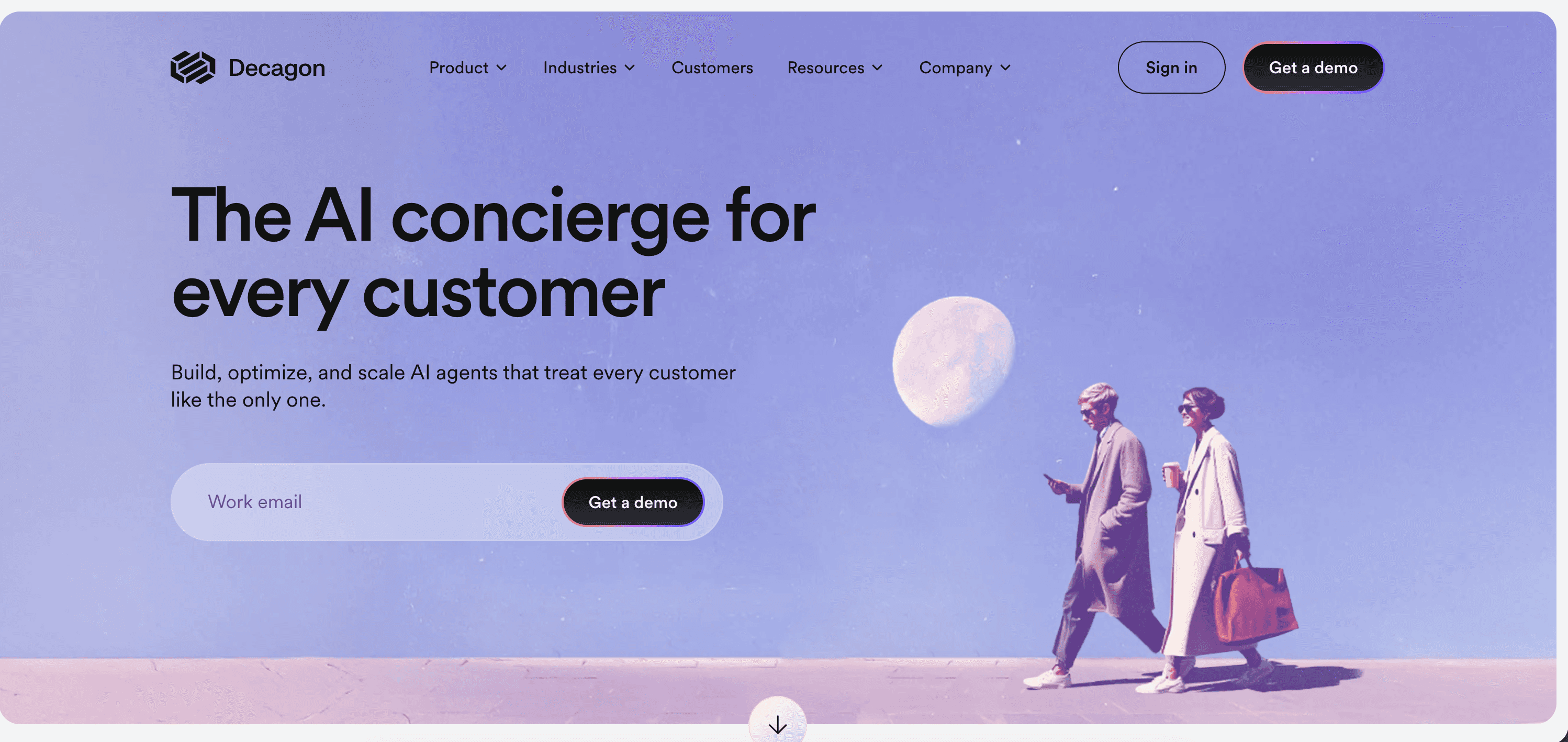
Decagon is an enterprise AI customer service platform built to automate high-volume support across chat, email, and voice. Its Agent Operating Procedures (AOPs) framework lets both technical and non-technical teams define agent behavior in natural language, while engineering teams retain code-level control over integrations and guardrails.
Product Capabilities
AOPs allow teams to define and iterate on agent workflows in natural language without requiring engineering involvement for routine changes.
Agents connect to CRM, billing, ticketing, and knowledge base systems to take real actions, including processing refunds and updating account records, not just answering questions.
The platform runs a multi-model AI stack for orchestration at scale, with full traceability for every agent decision.
Decagon reports average deflection rates nearing 70% across deployments, with some customers exceeding 80%.
Best For
Enterprise teams with high-volume, transaction-oriented support needs in consumer industries such as fintech, retail, and travel.
Pricing
Decagon uses per-conversation or per-resolution pricing. Enterprise contract values typically range from $100,000 to $580,000 annually. Pricing requires a sales conversation.
7. Sierra
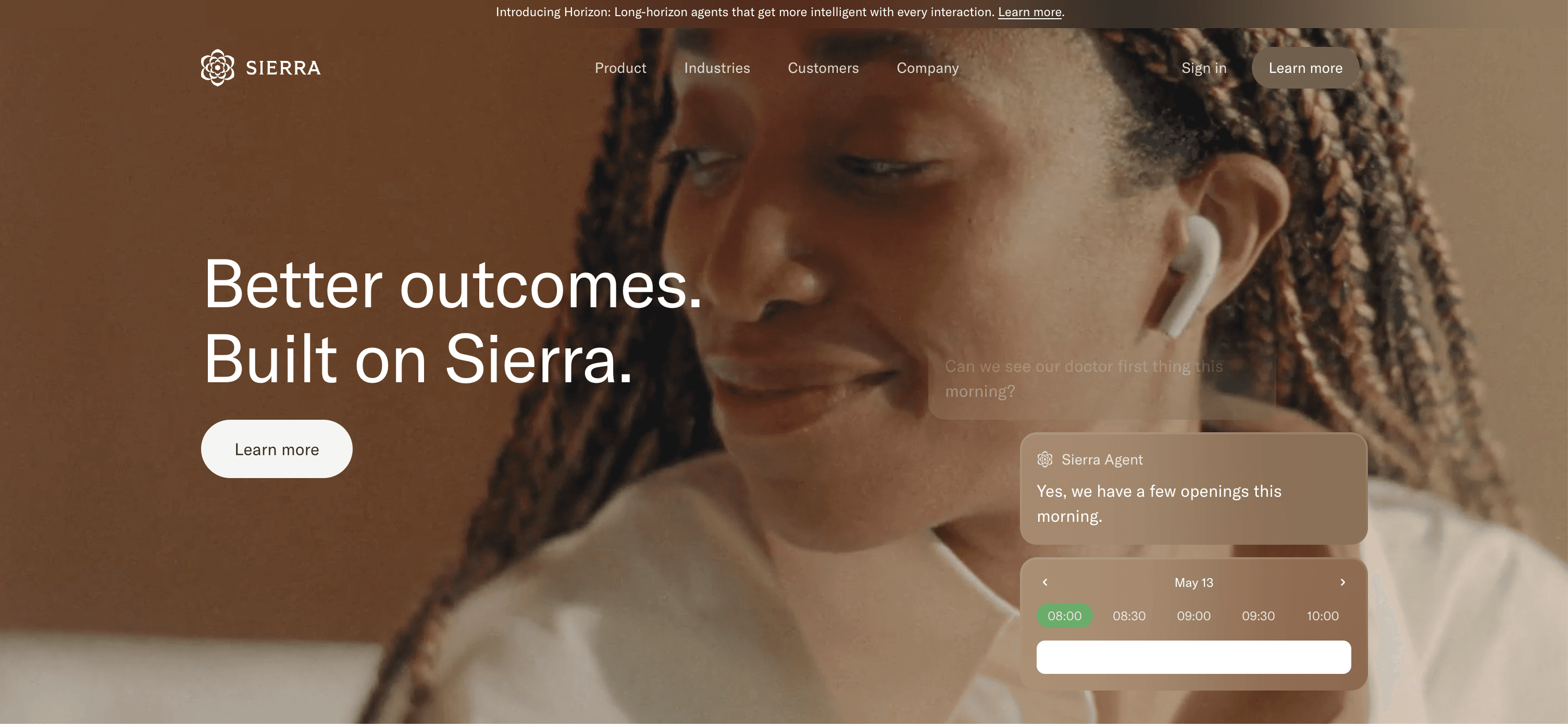
Sierra is an enterprise conversational AI platform co-founded by former Salesforce co-CEO Bret Taylor. It deploys a single AI agent across voice, chat, SMS, email, and WhatsApp, using a multi-model Constellation Architecture that coordinates specialized models rather than relying on a single large language model.
Product Capabilities
The Agent Data Platform unifies unstructured conversation data with backend systems including billing, inventory, and CRM, giving agents persistent context across interactions.
Agent Studio provides a goal-driven configuration interface for defining guardrails, escalation logic, and behavioral constraints.
Agents can switch languages mid-conversation across 34 or more supported languages.
Sierra does not natively support channel switching mid-conversation and does not handle inbound phone calls without a separate telephony system.
Best For
Large consumer-facing enterprises with high inbound volume and standardized case types that require deeply connected, action-oriented agents.
Pricing
Sierra does not publish pricing. Based on third-party analysis, annual platform costs typically start in the $150,000 to $250,000 range, with year-one all-in costs reaching $200,000 to $350,000 or more depending on integration complexity. Pricing requires a direct sales conversation.
8. Cresta
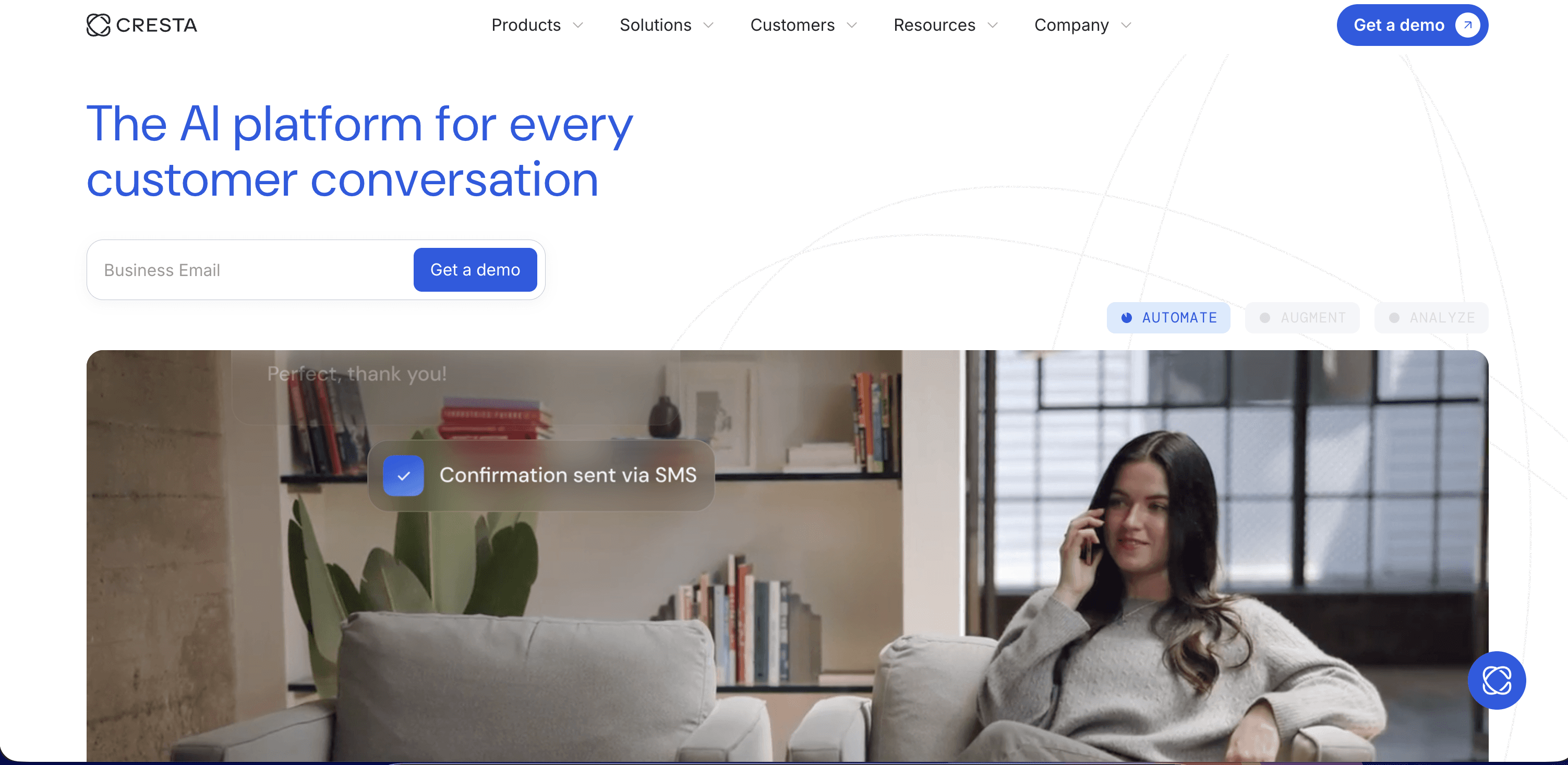
Cresta is an enterprise AI platform for contact centers focused on the human-AI hybrid workforce. Its platform spans three functions: AI Agent for automated customer conversations, Agent Assist for live human agent guidance, and Conversation Intelligence for post-interaction analysis and quality management.
Product Capabilities
Agent Assist delivers real-time coaching and guidance during live calls, with no-code tools allowing non-technical leaders to configure model behavior.
Conversation Intelligence auto-scores 100% of interactions and surfaces performance coaching recommendations without manager intervention.
Agent Operations provides a unified command hub where supervisors can monitor, pause, or redirect AI agents during live conversations.
Cresta’s models are trained on each customer’s own interaction data rather than on generic training sets.
Best For
Large enterprise contact centers that need a unified platform for both human agent performance management and automated customer interactions.
Pricing
Cresta does not publish pricing. Contracts are enterprise sales-led and multi-year. Pricing requires a direct conversation with Cresta’s sales team.
9. Retell AI
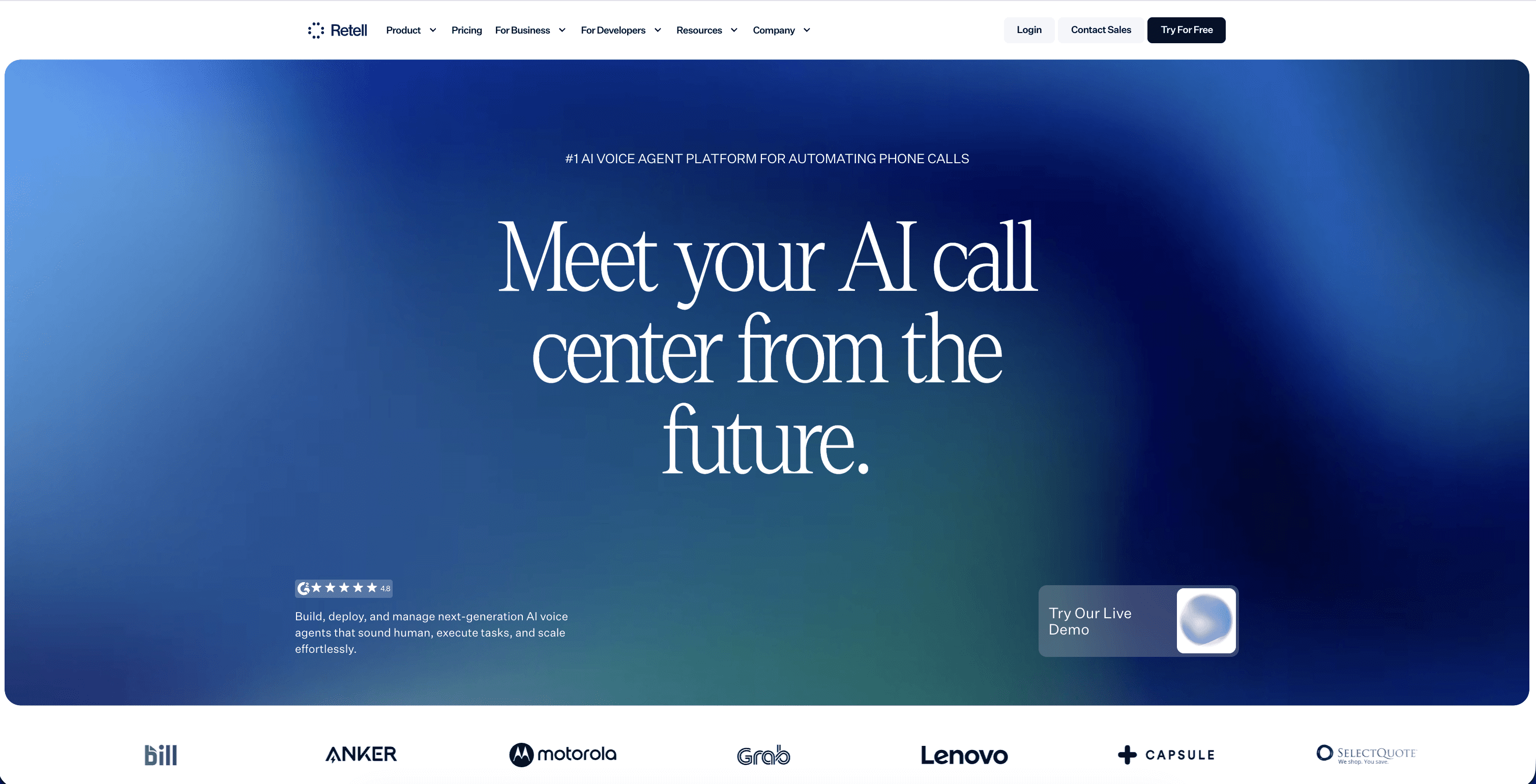
Retell AI is a developer-oriented voice AI infrastructure platform. It provides the building blocks for deploying LLM-powered voice agents, with support for custom LLM selection, bring-your-own-carrier telephony, and low-latency voice streaming via WebSocket.
Product Capabilities
Supports inbound and outbound voice across Twilio, Vonage, SIP, and Retell’s built-in carrier.
Agents are configurable with multiple LLM options including GPT-4o and Claude, with sub-500ms latency on supported configurations.
Post-call analysis includes transcripts, call summaries, and latency reporting.
The platform does not include a visual workflow builder or native role-based access controls. Meaningful production deployment requires dedicated engineering resources.
Best For
Engineering-led teams building custom voice agent infrastructure, not contact center operations teams looking for a configured solution.
Pricing
Retell uses pay-as-you-go pricing starting at $0.07 per minute for voice agents, with no platform fees. Enterprise volume pricing drops to $0.05 per minute or lower for customers spending $3,000 or more per month.
10. Intercom Fin
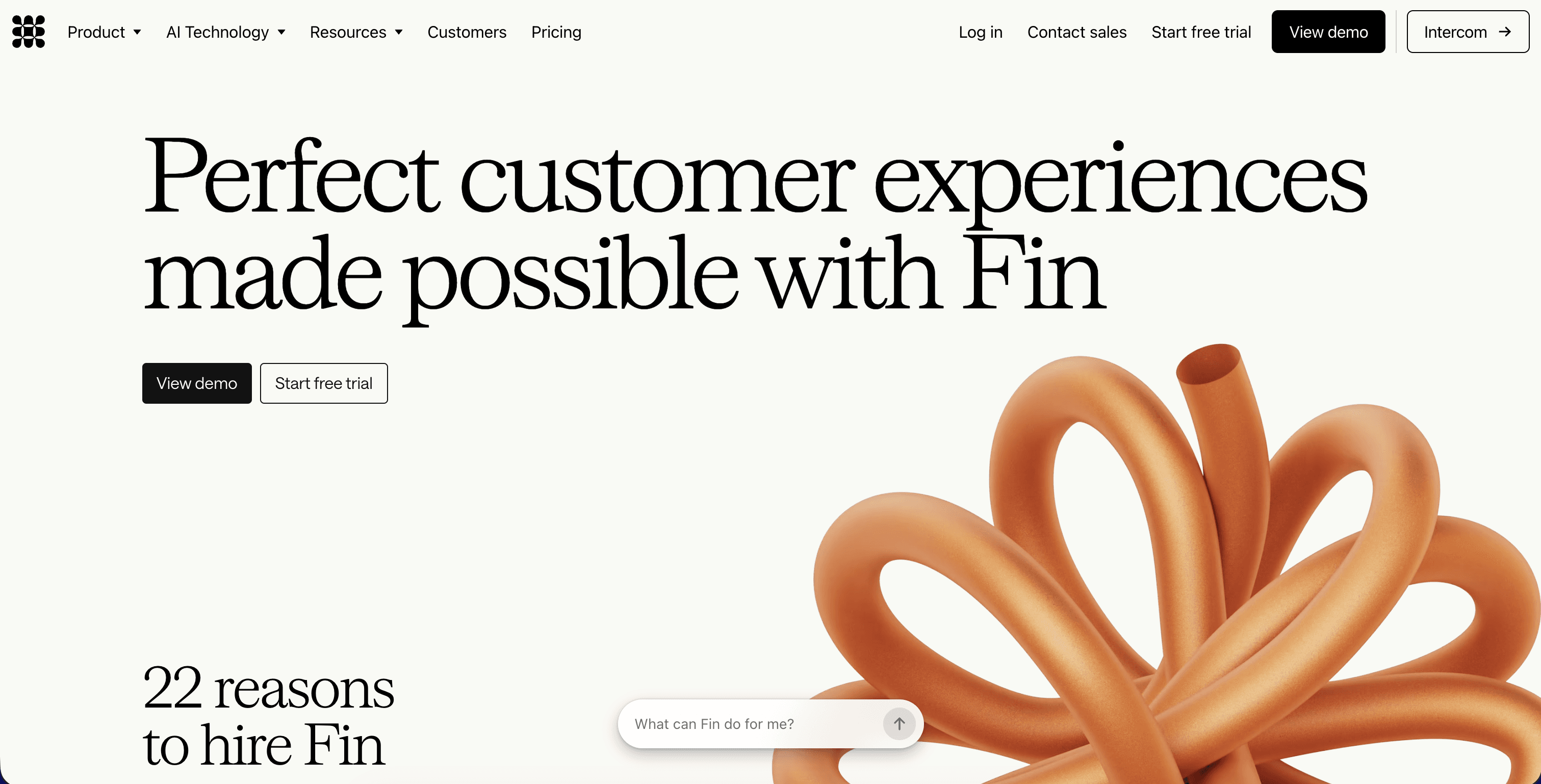
Fin is Intercom’s natively integrated AI agent. It deploys across chat, email, voice, WhatsApp, Facebook, Instagram, Zendesk, and Salesforce without requiring platform migration. Fin and Intercom’s human agent helpdesk operate on the same customer record, so every handoff carries full context.
Product Capabilities
Fin uses Intercom’s patented Fin AI Engine to understand customer questions, search across connected knowledge sources, and resolve issues or execute configured procedures.
Fin Vision and Fin Voice support image input and phone interactions at no additional per-feature charge.
Fin reports a 67% average resolution rate across more than 40 million resolved conversations as of December 2025.
For enterprises with 250,000 or more monthly conversations, Fin offers a contractual 65% resolution rate guarantee or a $1 million refund.
Best For
Organizations that want an AI agent with a natively integrated helpdesk, or those already using Zendesk, Salesforce, or Freshdesk who want to deploy Fin without migrating platforms.
Pricing
Fin is priced at $0.99 per resolved outcome with a minimum of 50 outcomes per month. Intercom helpdesk seats start at $29 per agent per month and are optional if Fin is deployed on an existing platform.
11. Zendesk
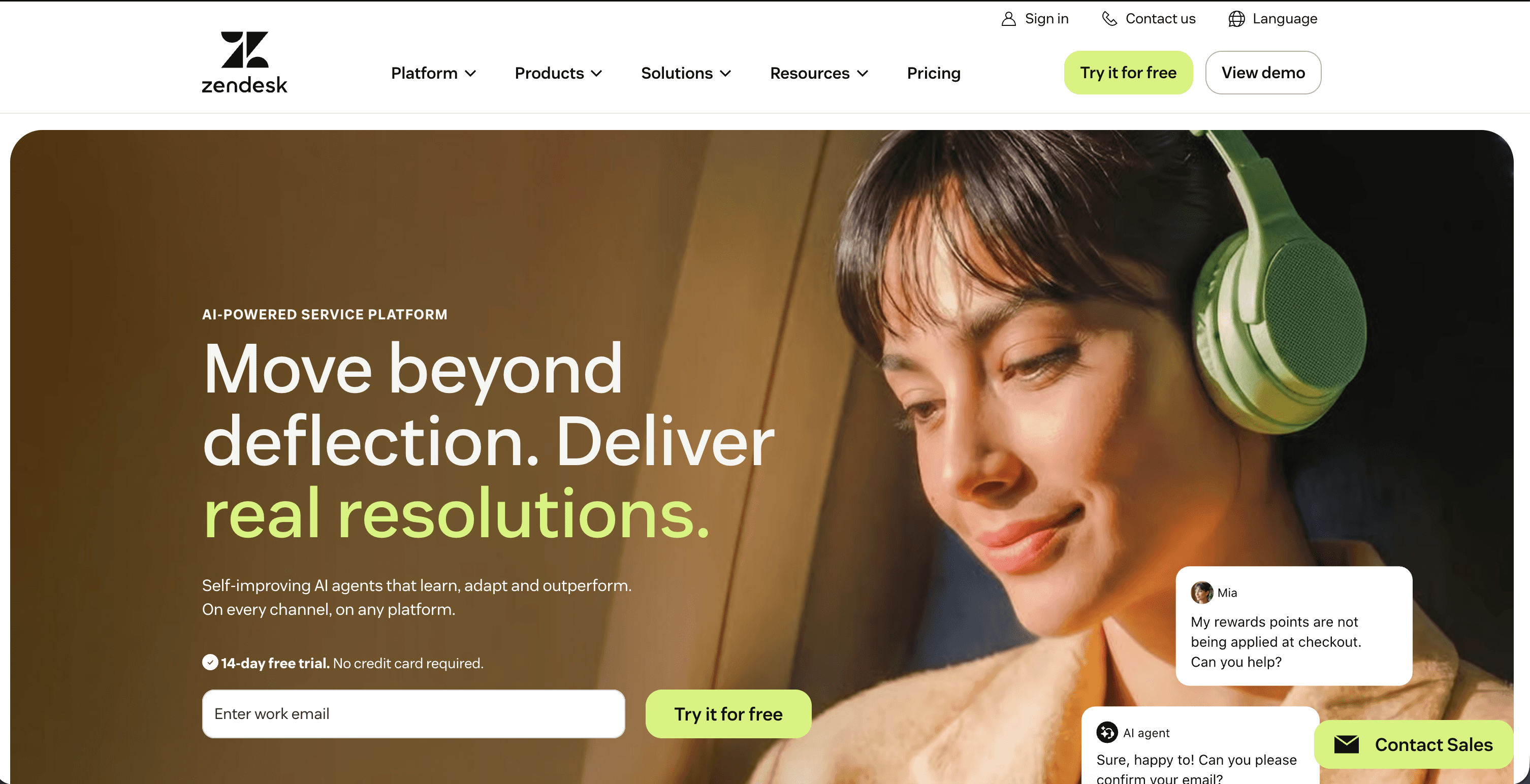
Zendesk is an omnichannel customer service platform with AI agents built into its ticketing, messaging, and help center infrastructure. Its agentic AI layer handles autonomous decision-making across customer conversations and integrates with Zendesk’s quality assurance (QA) and workforce management (WFM) tools.
Product Capabilities
AI agents resolve customer requests autonomously across email, chat, voice, and social channels, with billing based on automated resolutions rather than seat count for the AI layer.
Quality Assurance automatically scores agent and AI interactions, surfacing coaching opportunities without manual review.
The AI Copilot provides human agents with suggested replies and context summaries during live interactions.
Adding AI, QA, and WFM as separate add-ons to enterprise plans typically brings real-world per-agent costs to two to three times the advertised base rate.
Best For
Organizations already operating on Zendesk that want to add agentic AI capabilities within their existing infrastructure without introducing a separate vendor.
Pricing
Suite plans start at $55 per agent per month. The Advanced AI add-on is an additional $50 per agent per month. Automated resolutions are charged separately at $1.50 per resolution on committed volume. Enterprise pricing requires a sales conversation.
What Contact Center Leaders Should Look for When Selecting Agentic AI Tools
Platform selection is a multi-year infrastructure decision. These are the criteria that separate tools with production-grade depth from those optimized for procurement cycles.
Platform selection is a multi-year infrastructure decision. These are the criteria that separate tools with production-grade depth from those optimized for procurement cycles.
1. Deployment Risk
Gartner predicts over 40% of agentic AI projects will be abandoned by 2027. The most common failure points are unclear return on investment (ROI) frameworks, data quality gaps, and governance models that were not built before deployment. Before contracting, ask whether the vendor has documented case studies with measurable outcomes in environments similar in scale, industry, and compliance complexity to yours.
2. Vendor Architecture
Ask whether the platform’s models were trained on contact center conversation data or on general internet text. That answer determines accuracy on domain-specific language, emotion, and intent. A model tuned on generic text will perform differently on a billing dispute or a healthcare enrollment call than one trained on millions of real customer interactions in those categories.
3. Compliance Certifications
Financial services, healthcare, and insurance organizations face audit requirements that many agentic AI platforms cannot satisfy out of the box. Confirm that the platform carries the certifications your legal and security teams require before the procurement stage, not after.
4. Operating Model Fit
PwC found that fewer than half of organizations adopting AI agents are fundamentally rethinking their operating models around them. Contact centers that treat agentic AI as a feature addition rather than an architectural shift consistently underperform those that redesign workflows around the platform’s capabilities from the start.
5. Live Guidance Depth
For real-time agent assist deployments, confirm whether the platform surfaces guidance during the conversation or only after it ends. Post-call suggestions do not reduce handle time or prevent escalations.
6. Virtual Agent Resolution Depth
For virtual agent deployments, confirm whether the system resolves transactions end-to-end in connected systems or only handles informational queries. A virtual agent that cannot write to a CRM, process a payment, or update a ticket requires a human to complete the action, which eliminates the core operational benefit.
Why Level AI Is the Best Solution for Enterprise Agentic AI
Level AI is designed as a unified intelligence platform where Agent Assist, Virtual Agent, Auto-QA, iCSAT, and Voice of the Customer all run on the same conversation data, the same QA standards, and the same feedback loop. That architecture produces compounding performance gains rather than isolated improvements per module.
The Virtual Agent achieves a 90% accuracy rate with sub-2-second latency because it is trained on top-performer resolution patterns from real conversations rather than rules or simulated data. One multinational customer saved more than $30 million in under a year using Level AI. A health and wellness brand reduced call handling time by 20 to 25%.
QA scoring, agent coaching, virtual agent behavior, and customer satisfaction measurement all share the same underlying intelligence layer. A change in one part of the system informs every other part automatically. No other platform in this category operates that way. Most vendors improve individual modules in isolation; Level AI improves the entire operation each time any module learns something new.
Level AI holds GDPR, HIPAA, SOC 2, and PCI certifications, covering the compliance requirements of the industries where contact center AI carries the highest operational and regulatory stakes. See real-time agent assist and agent coaching for how the intelligence loop operates in practice.
" transform="translate(85.643 10.143)" width="23.725855670103115px"/><path d="M 71.828 0 L 0 50.702" fill="transparent" height="50.70235051546392px" id="TnJFUMH9b" stroke-dasharray="" stroke-linecap="butt" stroke-linejoin="miter" stroke-miterlimit="10" stroke-width="0.68" stroke="rgb(254, 250, 241)" transform="translate(85.508 75.029)" width="71.82828865979384px"/><path d="M 81.579 0 L 0 52.003" fill="transparent" height="52.00280412371134px" id="ccJzhVTGI" stroke-dasharray="" stroke-linecap="butt" stroke-linejoin="miter" stroke-miterlimit="10" stroke-width="0.68" stroke="rgb(254, 250, 241)" transform="translate(85.495 73.738)" width="81.57921649484533px"/><path d="M 65.653 0 L 0 32.827" fill="transparent" height="32.826556701030924px" id="X0Vp_q8HG" stroke-dasharray="" stroke-linecap="butt" stroke-linejoin="miter" stroke-miterlimit="10" stroke-width="0.68" stroke="rgb(254, 250, 241)" transform="translate(85.462 92.931)" width="65.65311340206183px"/><path d="M 88.08 14.951 L 0 0" fill="transparent" height="14.950762886597914px" id="JM_UgSiJ_" stroke-dasharray="" stroke-linecap="butt" stroke-linejoin="miter" stroke-miterlimit="10" stroke-width="0.68" stroke="rgb(254, 250, 241)" transform="translate(86.233 125.789)" width="88.07950515463914px"/><path d="M 83.204 72.803 L 0 0" fill="transparent" height="72.80313402061856px" id="KlyUUjlMK" stroke-dasharray="" stroke-linecap="butt" stroke-linejoin="miter" stroke-miterlimit="10" stroke-width="0.68" stroke="rgb(254, 250, 241)" transform="translate(85.089 125.71)" width="83.20379381443304px"/><path d="M 7.8 114.081 L 0 0" fill="transparent" height="114.08065979381445px" id="kAiUvduBR" stroke-dasharray="" stroke-linecap="butt" stroke-linejoin="miter" stroke-miterlimit="10" stroke-width="0.68" stroke="rgb(254, 250, 241)" transform="translate(85.95 125.478)" width="7.800247422680428px"/><path d="M 0 93.604 L 9.75 0" fill="transparent" height="93.60445360824741px" id="FsgTAQB0n" stroke-dasharray="" stroke-linecap="butt" stroke-linejoin="miter" stroke-miterlimit="10" stroke-width="0.68" stroke="rgb(254, 250, 241)" transform="translate(76.2 125.421)" width="9.750432989690694px"/><path d="M 0 76.379 L 76.703 0" fill="transparent" height="76.37888659793816px" id="NxOhHvPJ5" stroke-dasharray="" stroke-linecap="butt" stroke-linejoin="miter" stroke-miterlimit="10" stroke-width="0.68" stroke="rgb(254, 250, 241)" transform="translate(9.343 125.217)" width="76.7034556701031px"/><path d="M 0 26.651 L 39.002 0" fill="transparent" height="26.651381443298988px" id="QETNKJ3L6" stroke-dasharray="" stroke-linecap="butt" stroke-linejoin="miter" stroke-miterlimit="10" stroke-width="0.68" stroke="rgb(254, 250, 241)" transform="translate(47.096 125.177)" width="39.0017319587629px"/><path d="M 0 16.901 L 85.154 0" fill="transparent" height="16.900948453608265px" id="BL63wDICD" stroke-dasharray="" stroke-linecap="butt" stroke-linejoin="miter" stroke-miterlimit="10" stroke-width="0.68" stroke="rgb(254, 250, 241)" transform="translate(0.094 125.125)" width="85.15396503092786px"/><path d="M 0 0 L 78.004 17.876" fill="transparent" height="17.875793814432996px" id="PIX70Vlqf" stroke-dasharray="" stroke-linecap="butt" stroke-linejoin="miter" stroke-miterlimit="10" stroke-width="0.68" stroke="rgb(254, 250, 241)" transform="translate(8.362 107.251)" width="78.00376082474227px"/><path d="M 0 0 L 67.928 52.327" fill="transparent" height="52.32742268041238px" id="u_syqWqWD" stroke-dasharray="" stroke-linecap="butt" stroke-linejoin="miter" stroke-miterlimit="10" stroke-width="0.68" stroke="rgb(254, 250, 241)" transform="translate(17.593 72.861)" width="67.92826391752578px"/><path d="M 0 0 L 77.029 70.528" fill="transparent" height="70.52832989690722px" id="DmW_aE2A0" stroke-dasharray="" stroke-linecap="butt" stroke-linejoin="miter" stroke-miterlimit="10" stroke-width="0.68" stroke="rgb(254, 250, 241)" transform="translate(9.489 54.678)" width="77.02866804123713px"/><path d="M 0 0 L 27.301 126.431" fill="transparent" height="126.43109443298971px" id="JrLaRUubC" stroke-dasharray="" stroke-linecap="butt" stroke-linejoin="miter" stroke-miterlimit="10" stroke-width="0.68" stroke="rgb(254, 250, 241)" transform="translate(58.341 -0.071)" width="27.30111340206188px"/><path d="M 0 4.012 C 0 1.796 1.796 0 4.012 0 C 6.228 0 8.025 1.796 8.025 4.012 C 8.025 6.228 6.228 8.025 4.012 8.025 C 1.796 8.025 0 6.228 0 4.012 Z" fill="rgb(254, 80, 0)" height="8.024669690721652px" id="Nh5qrPJs_" transform="translate(81.396 121.369)" width="8.024669690721623px"/></svg>)
1. What is the difference between agentic AI and traditional contact center automation?
Traditional automation follows predefined rules or matches keywords to trigger scripted responses. Agentic AI interprets customer intent, plans multi-step actions, and executes across connected systems without requiring human sign-off at each step. A rules-based system routes a billing call to the right queue. An agentic system pulls the account record, identifies the dispute, processes the adjustment, and updates the ticket.
2. How do agentic AI tools improve contact center quality assurance coverage?
In traditional QA, teams review 1 to 5% of interactions through manual sampling. Agentic AI platforms with built-in auto-scoring cover 100% of interactions, apply consistent scoring criteria, and generate a reasoning trail for each decision. That coverage eliminates the blind spots that manual sampling produces and gives QA teams a complete, auditable performance baseline.
3. What should enterprise contact center leaders evaluate before deploying an agentic AI platform?
Training data origin, QA coverage model, compliance certifications, integration depth with existing systems, and whether the vendor has documented outcomes in environments similar to yours. Demo performance is not a reliable proxy for production accuracy.
4. How does agentic AI support human agents without replacing them?
Agentic AI handles high-volume, repeatable interactions and surfaces guidance to human agents during live conversations. Agents handle complex, sensitive, or escalated situations where judgment and empathy matter. The measurable outcome is faster resolution on routine interactions and better-informed agents on everything else.
5. What compliance and governance requirements should agentic AI tools meet in regulated industries?
At minimum: SOC 2 Type II, GDPR, HIPAA for healthcare and financial services, and PCI for payment environments. Beyond certifications, the platform must provide auditable decision logic. Regulators in financial services and healthcare require the ability to explain why a scoring or routing decision was made. Platforms that cannot produce that reasoning trail introduce procurement and legal risk regardless of their certification status.