Why AI Deployment in Healthcare Takes 6-12 Months and How to Fix It


Key Takeaways
- AI implementation in healthcare often fails because deployments are slow and over-engineered, taking 6–12 months to show results. This delays impact and makes organizations hesitant to invest in AI deployment.
- Traditional AI deployment in healthcare relies on custom integrations and assumption-based workflows, which increase complexity and extend timelines instead of delivering quick wins.
- A pilot-first AI deployment approach enables faster AI implementation in healthcare by focusing on high-volume, low-risk use cases like appointment scheduling and prescription refills, going live in weeks instead of months.
- Using HIPAA compliant AI tools from the start ensures compliance is built into the AI deployment, with features like real-time PII masking, audit logs, and secure data handling.
- Faster AI deployment with compliant systems helps healthcare organizations improve patient experience, reduce operational load, and achieve quicker ROI from AI implementation in healthcare.
Introduction
Healthcare AI projects fail on a predictable pattern: a vendor promises transformation and delivers an "almost working" prototype 12 months in. That failure pattern is why operations leaders treat "AI project" as a budget risk, not a performance lever.
The wariness is earned. Healthcare organizations cannot deploy AI that fails patients or creates HIPAA exposure. So they slow down, add review cycles, and by the time the system is live, the competitive window has shifted.
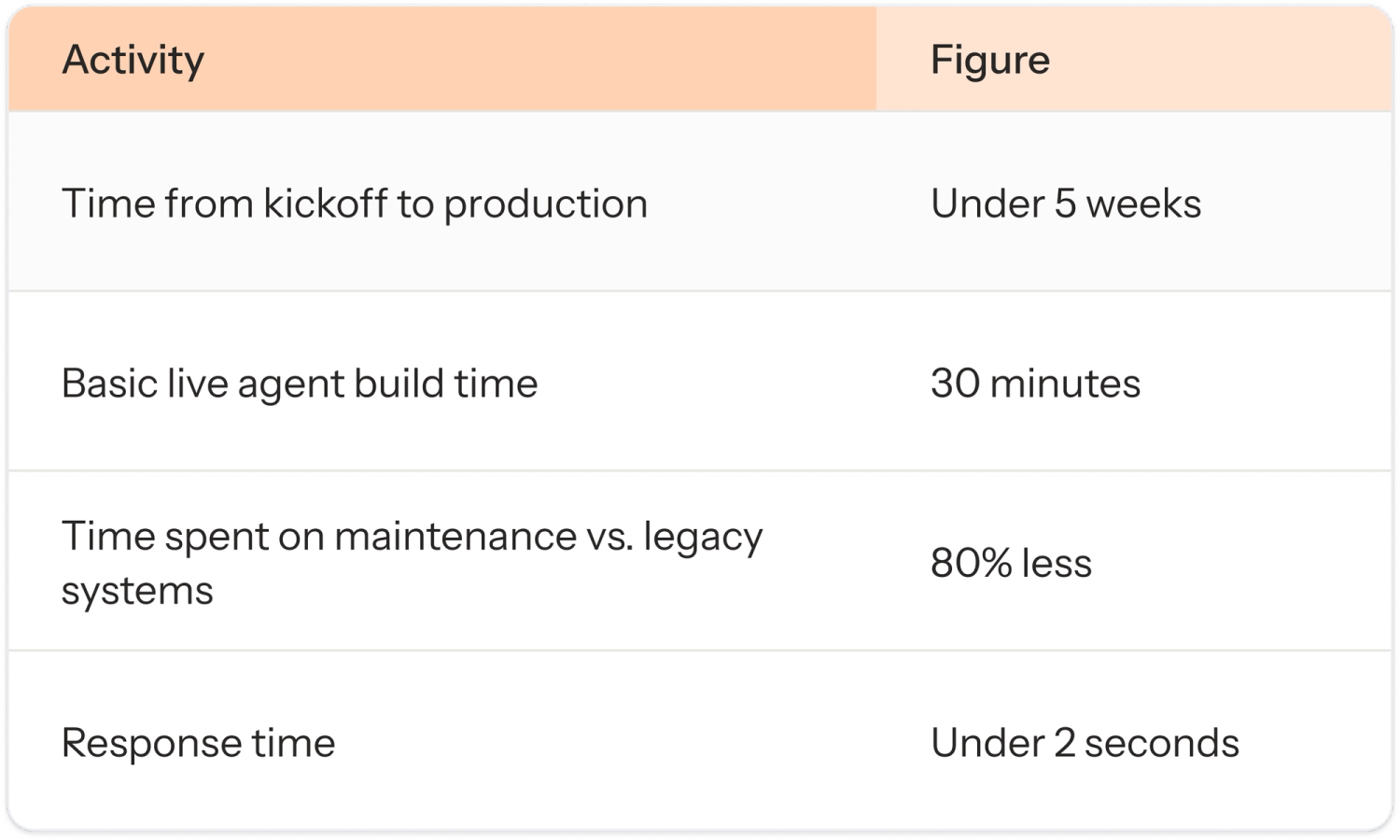
On the other hand, a pilot-first deployment model goes live in under 5 weeks with HIPAA compliance built in from day one. Speed and safety run on the same deployment path.
Why traditional AI Deployment in Healthcare Takes 6-12 Months (And What’s Changed)
The traditional healthcare AI deployment timeline comes down to two problems: custom integration build-out and workflow discovery that starts from scratch.
When a vendor builds EHR connections from zero, six months of integration work is realistic before any testing begins. When workflow mapping starts with stakeholder interviews rather than actual call data, the discovery phase expands to fill whatever time is available.
Pre-built, certified EHR and contact center integrations eliminate that 6-month build-out. Data-first workflow discovery mines 100% of existing call recordings before writing a single line of bot logic, so workflow mapping reflects actual call patterns, not stakeholder assumptions.
Both of those structural problems are solvable before day one.
What a pilot-first deployment actually looks like
A pilot-first deployment starts with the two or three highest-volume, lowest-risk use cases, validates performance with experienced staff, then expands. It does not compress a full implementation — it replaces that model.
- Weeks 1–2: Call data analysis to identify the highest-volume, lowest-risk use cases. Appointment confirmation, prescription refill intake, and after-hours triage consistently surface at the top.
- Weeks 2–3: Workflow mapping against your best-performing agents' transcripts and your EHR integration layer.
- Weeks 3–5: Pre-trained VA deployment on the mapped use cases, with full audit logging and escalation guardrails active at go-live.
- Week 5 onward: Live monitoring, QA, and expansion to additional use cases as performance is validated.
Why HIPAA Compliant AI Tools Must Be Built Into AI Deployment From Day One
The reason some healthcare AI deployments take 12 months is that compliance review happens at the end. The system is built, then it is handed to the compliance team, then it is revised, then it is reviewed again. This cycle is the primary driver of timeline overrun.
Compliance by design means the architectural decisions that satisfy your compliance team are made at the start. When your HIPAA officer asks where patient data is stored during an AI interaction, the answer is ready on day one: real-time PII masking, no PHI stored in AI model layers, full audit trail on every interaction, deterministic escalation rules for high-stakes clinical scenarios.
What full auditability means in practice: every interaction, VA and human, is captured, timestamped, and available for review. Every escalation decision is logged with the rule that triggered it. Every patient authentication step is recorded. If there is ever a compliance question about a specific interaction, the answer is in the system, searchable by any supervisor or compliance officer with appropriate access.
The Deployment Window Is Narrowing
Healthcare contact centers that deployed in the first half of this year are already reporting measurable reductions in hold times and clinical staff reallocation to higher-acuity work. Organizations still in discovery are running two to three quarters behind on both.
The pilot-first model lets operations leaders show measurable results to leadership and boards within the first billing cycle, without committing to a full platform overhaul upfront. Start with your highest-volume, clearest use case. Validate the model. Expand.
Speed to value and compliance control are both delivered from week one on the same deployment path.
See how healthcare contact centers are approaching AI deployment differently →



This is part four of The Patient-First Contact Center, a four-part series for healthcare contact center leaders navigating AI.
Part 1: What Healthcare Contact Centers Get Wrong About Staffing (And What It's Costing Them)
Part 2: The Risks of AI in Healthcare (And What Purpose-Built AI Actually Looks Like)
Part 3: Why Siloed Automation at Healthcare Contact Centers fails at Patient Care
You have covered the full framework: identifying where automation creates the most value, understanding what purpose-built healthcare AI actually requires, evaluating whether your current setup is working as a unified system, and knowing how to move from decision to deployment without a 12-month project. The next step is applying it to your own contact center.
FAQ Section
Q: How long does it take to deploy a healthcare AI virtual agent? A purpose-built healthcare virtual agent with pre-built EHR and contact center integrations can reach production in under five weeks using a pilot-first deployment model. This contrasts with traditional AI deployments in healthcare, which typically run 6 to 12 months because they require custom integration build-out and workflow discovery from scratch. The key difference is starting with data-first workflow analysis and pre-certified integrations rather than building from zero.
Q: What is a pilot-first AI deployment model in healthcare? A pilot-first deployment model means starting with two to five of the highest-volume, lowest-risk use cases, typically appointment confirmation, prescription refill intake, or after-hours triage, validating performance with experienced clinical staff, then expanding to additional use cases once accuracy is confirmed. This approach gets the VA into production quickly, generates real performance data early, and limits risk during the validation phase. It is the approach most healthcare provider organizations take when deploying VA technology for the first time.
Q: How do you ensure HIPAA compliance in a healthcare virtual agent deployment? HIPAA compliance in a healthcare VA deployment requires several specific architectural decisions: real-time PII masking so sensitive patient data is redacted during interactions, no storage of protected health information (PHI) in AI model layers, multi-factor patient identity verification before any health-related action, full audit trail on every interaction, and deterministic escalation rules for high-stakes clinical workflows. These requirements must be built into the platform architecture from the start, not added as a compliance layer after deployment. When compliance is designed in from day one, compliance review does not create timeline overrun.
Q: Why do healthcare AI deployments take so long? Traditional healthcare AI deployments take 6 to 12 months primarily for two reasons: custom EHR and telephony integration build-out, and workflow discovery that starts from stakeholder interviews rather than actual call data. Both of these add months to the timeline before any live deployment begins. Platforms with pre-built integrations for major EHR and contact center systems, combined with data-first workflow discovery that mines existing call recordings, can eliminate both sources of delay and reach production in under five weeks.
Q: What use cases should healthcare contact centers start with for AI automation? The highest-value starting use cases for healthcare contact center AI are typically appointment confirmation and rescheduling, prescription refill intake, after-hours triage, test result status inquiries, and patient identity verification and intake. These use cases account for the majority of inbound call volume at most provider organizations, require no clinical judgment to resolve, and have well-defined workflow logic that can be mapped from existing agent transcripts and deployed quickly.
Q: What is the difference between fast and compliant AI deployment in healthcare? Speed and compliance are often treated as a tradeoff in healthcare AI deployment, but they do not have to be. The tradeoff exists when compliance review happens at the end of the deployment process rather than the beginning. When HIPAA requirements, audit trail architecture, PII masking, and clinical escalation guardrails are designed into the platform from the start, the compliance review at launch is a confirmation rather than a revision cycle. This removes the primary source of timeline overrun in traditional deployments.
Keep reading
View all