
Key takeaways
The CRM platform is becoming the primary agent interface in the contact center. Metrigy projects majority adoption by 2027
CRM value in 2026 depends on connected data and usable AI, not on feature count alone
Fragmented contact center stacks prevent CRM data from reaching the teams who need to act on it
AI-generated post-call summaries are now being written directly into CRM records, eliminating manual data entry for agents
Contact centers that connect CRM data to QA, coaching, and VoC workflows have a measurable advantage over those keeping systems separate
Introduction
Call center CRM software has been positioned as a system of record for years. In 2026, that role is changing. CRM is becoming the operational center of the contact center, not just the place where customer data is stored.
Most contact centers still run on disconnected systems. The CRM holds the customer record. The contact center platform handles the interaction. The QA tool scores the call. None of them share data without friction. Agents work without full customer context. CX leaders make decisions from incomplete pictures.
CRM and contact center software are converging. Organizations that connect these systems gain a unified view of every customer relationship. They also get a data foundation that makes AI, coaching, and Voice of the Customer (VoC) programs measurably more effective.
Here are six ways call center CRM software is changing how contact centers build and manage customer relationships in 2026, with data from Metrigy, Forrester, and CX Today.
What Is Call Center CRM Software?
Call center CRM software is a customer relationship management system built or configured for contact center environments. It centralizes customer interaction history, case data, and contact records so agents can access full context during a call.
Consider the following:
A call center CRM combines the customer data layer of a standard CRM with the interaction management capabilities of a contact center platform.
Key functions include contact history, case management, call logging, agent desktop integration, and post-interaction data capture.
CRM differs from a pure contact center platform (CCaaS) in that it is the system of record for the customer relationship. CCaaS handles routing, telephony, and interaction flow.
The two systems are converging. Major CRM vendors, including Salesforce and Microsoft, now offer native contact center capabilities. CCaaS vendors are building CRM functionality.
Link naturally to Level AI’s contact center software buyer’s guide here.
Why is CRM Becoming the Primary Agent Interface?
CRM is moving from a back-office record-keeping tool to the primary environment where agents work. According to a study of 656 companies, 43.2% of contact centers currently use CRM as the primary agent interface. Metrigy projects that figure will rise to 53.4% by the end of 2027.
The shift is happening because agents handling complex calls need full relationship history, not just the current ticket. A CCaaS platform shows the interaction in progress. The CRM shows who the customer is, what they have purchased, and what has gone wrong before. Those two data sets in a single view change what an agent can do in the first 30 seconds of a call.
CRM as the primary interface also changes how contact centers think about outbound contact. Agents can act on CRM signals to reach customers before a complaint or churn indicator surfaces. Front-and-back office integration is now rated as a vital operational requirement by 58.1% of IT and CX leaders, per Metrigy. The direction of adoption data makes the trajectory clear: the contact center platform is no longer assumed to be the agent’s home screen.
AI Is Writing Call Data Directly Into CRM Records
Manual post-call data entry produces incomplete CRM records by default. After a call ends, an agent logs what they remember from the conversation. That account of events is filtered through recollection, time pressure, and whatever notes were taken mid-call. The resulting CRM record reflects an approximation of what happened.
AI-generated post-call summaries change this by writing call outcomes, action items, and resolution notes directly into the customer’s CRM record without agent involvement. The summary is drawn from the full transcript of the interaction.
This eliminates most of the after-call work time agents spend on manual logging. It also produces records that are consistent from one agent to the next and accurate at the level of the full interaction rather than an agent’s selective recollection.
The downstream benefit is a CRM that reflects 100% of interactions, not a sample. Customer success, sales, and operations teams working from that call center analytics data have a reliable record they can act on.
CRM Data Is Enabling Personalization at the Agent Level
Personalization in the contact center depends entirely on data availability. An agent can only tailor a conversation to the customer in front of them if that customer’s history, prior cases, and account status are visible before the call starts.
CRM integration surfaces this data during the call. Agents see purchase history, prior cases, sentiment signals, and account status before they say a word. That changes the opening of a conversation from a generic greeting into an informed one. According to CX Today, CRM value now depends on connected data and usable AI, not on feature count.
Connected CRM data also enables real-time agent assist software during live calls. The agent receives a prompt based on what the platform knows about this customer’s account, history, and current intent. That guidance is generated from the CRM record so it reflects the actual situation rather than an assumed one.
CRM and QA Data Are Converging
Traditional call center QA programs score interactions without connecting results back to the customer record in CRM, whereas a low QA score stays inside the QA tool.
When QA data flows into CRM, customer-level patterns become visible that no single QA score would surface on its own. A customer who has received three poorly handled interactions in 30 days is a measurable churn risk. That pattern only appears when QA output and CRM history are in the same place.
Full-coverage QA scoring applied to 100% of interactions generates far more data points per customer than sampled QA. At a 1-2% sampling rate, a customer who contacts the center six times in a quarter may have zero of those interactions scored. At 100% coverage, every one of those interactions contributes to the pattern the CRM can detect.
Interaction Data Is Flowing Beyond CRM Into Product and Operations
Contact center interactions are one of the richest sources of unfiltered customer intelligence in any organization. Product teams, marketing teams, and operations teams rarely have direct access to this data. It stays inside the contact center stack, summarized at best in monthly reports.
When call summaries, sentiment scores, and topic tags flow from the contact center into CRM, other departments can query that data directly. A product manager can see which feature complaints increased 30% over the prior week. An operations lead can identify which process changes are generating new call volume. According to Zendesk, 82% of CX leaders say promptable analytics is delivering insights in seconds, and 81% say it changes decision-making by allowing non-analysts to query data in plain language.
The value of Voice of the Customer data compounds when it reaches teams who can act on it structurally, not just teams who manage the interactions. A contact center that keeps this data inside its own reporting tools is leaving its most direct source of customer intelligence inaccessible to the people who shape products, processes, and policies.
CRM Fragmentation Is the Biggest Risk to Customer Relationship Quality
According to Puzzel, the average contact center organization manages 3.9 different contact center technologies. Only 3% operate on a single, unified platform. Each additional system in that stack is a potential point where customer data stops moving.
CRM data gating compounds this problem. When CRM vendors restrict API access or charge premium licensing for integration with adjacent systems, the contact center pays twice, once for the CRM license and once to unlock the data it already owns. Agents working from incomplete customer records make decisions based on partial context. QA teams scoring interactions without CRM history miss customer-level patterns that only become visible when both data sets are in the same place.
The risk grows with interaction volume. A contact center handling millions of interactions per year on fragmented systems accumulates inaccurate customer records, missed coaching signals, and VoC gaps at a rate that manual reconciliation will never reverse. According to CX Today, systems that share customer data consistently give agents complete pictures and give leaders records they can act on immediately.
Platforms that share context, QA standards, and customer history across voice, chat, and email resolve this at the architecture level rather than through manual data stitching after the fact.
Top 5 Call Center CRM Softwares
The platforms below represent the CRM systems most commonly integrated into enterprise contact center environments. Pricing reflects list rates as of early 2026 and applies to the service or customer-facing tier most relevant to contact center use.
1.Level
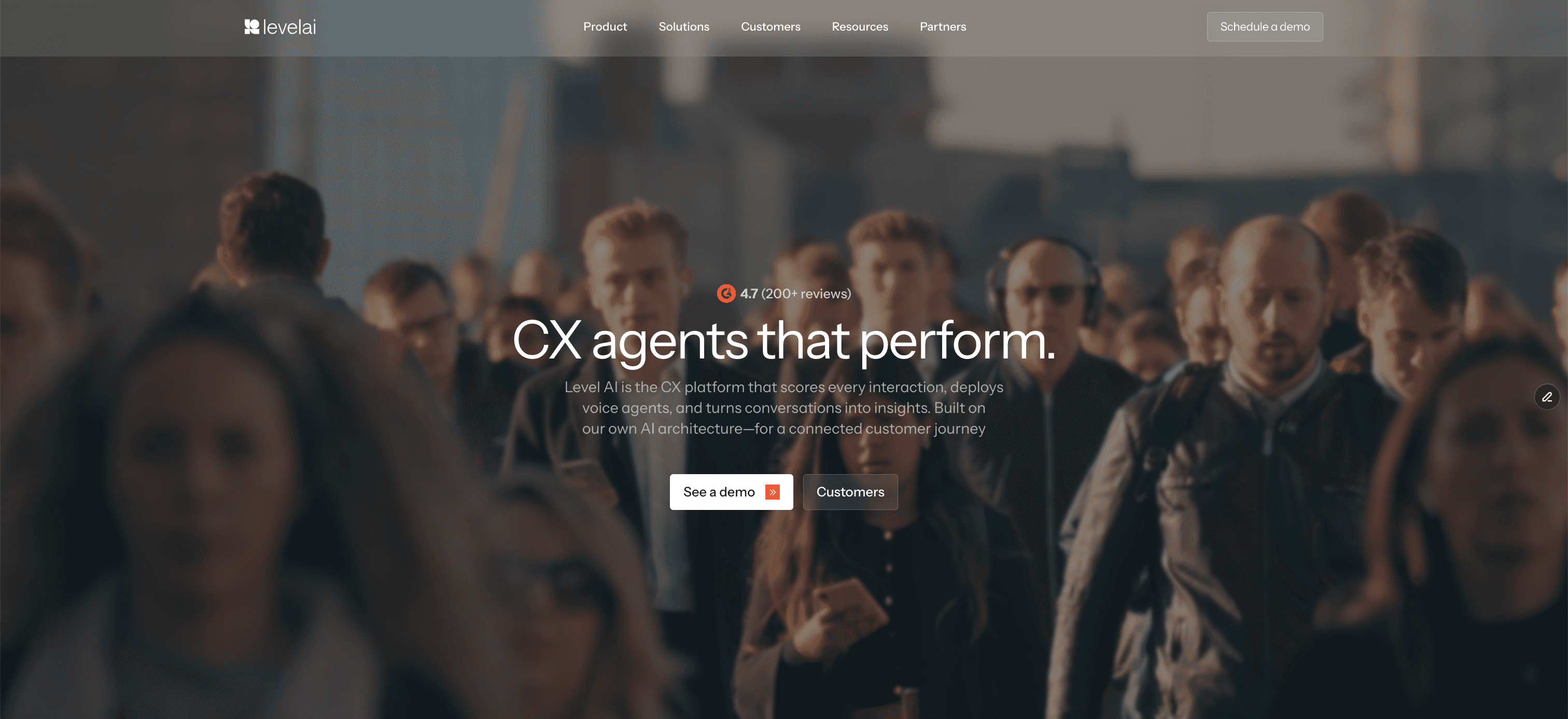
Level AI is a CX intelligence platform that layers onto your existing CRM and contact center stack rather than replacing it. Where the platforms above store the customer record, Level AI is the system that reads, scores, and acts on every conversation flowing through it. It integrates with Salesforce, Zendesk, HubSpot, Dynamics, and most major telephony and ticketing systems, then writes QA scores, post-call summaries, and sentiment data back into those records.
QA-GPT
Auto-scores close to 100% of calls, chats, and emails against your custom scorecards, returning the evidence and reasoning behind each score rather than a bare number. That replaces the 1–2% manual sampling most QA teams run today.
Real-time Agent Assist
Surfaces knowledge base articles, policy snippets, and next-best-action prompts mid-conversation, based on customer intent rather than keyword matching.
Voice of the Customer
Spots emerging friction points and trends across the full interaction set, with an AI-generated CSAT score produced for every conversation using customer effort, resolution, and sentiment signals.
In-house models
Level AI builds and controls its models rather than wrapping third-party APIs, and trains them on your business data so transcription and scoring fit your specific terminology and metrics.
Price: Custom, quoted by contact center size and scale. User-reported per-agent costs span a wide range, with integration fees per connected system. Request a demo for current pricing.
Best for: Enterprise contact centers that want full-coverage QA, real-time agent guidance, and customer insights written back into the CRM they already run.
Contract minimum: Annual, custom-scoped. Built for enterprise QA and CX operations rather than small support teams.
Learn more about Level AI
2.Salesforce Service Cloud

Salesforce Service Cloud is the market-leading CRM for enterprise customer service operations. It carries the deepest customization options and the largest third-party integration ecosystem of any platform here.
Price: $165 to $500 per user per month for Enterprise and Unlimited tiers, with a $25 Starter option. Salesforce raised most Enterprise and Unlimited prices by about 6% in late 2025.
Best for: Large enterprises that need deep customization and a mature integration marketplace.
Contract minimum: Annual billing on all paid tiers above Starter. Median contract value runs near $75,000 per year.
3.Microsoft Dynamics 365 Customer Service
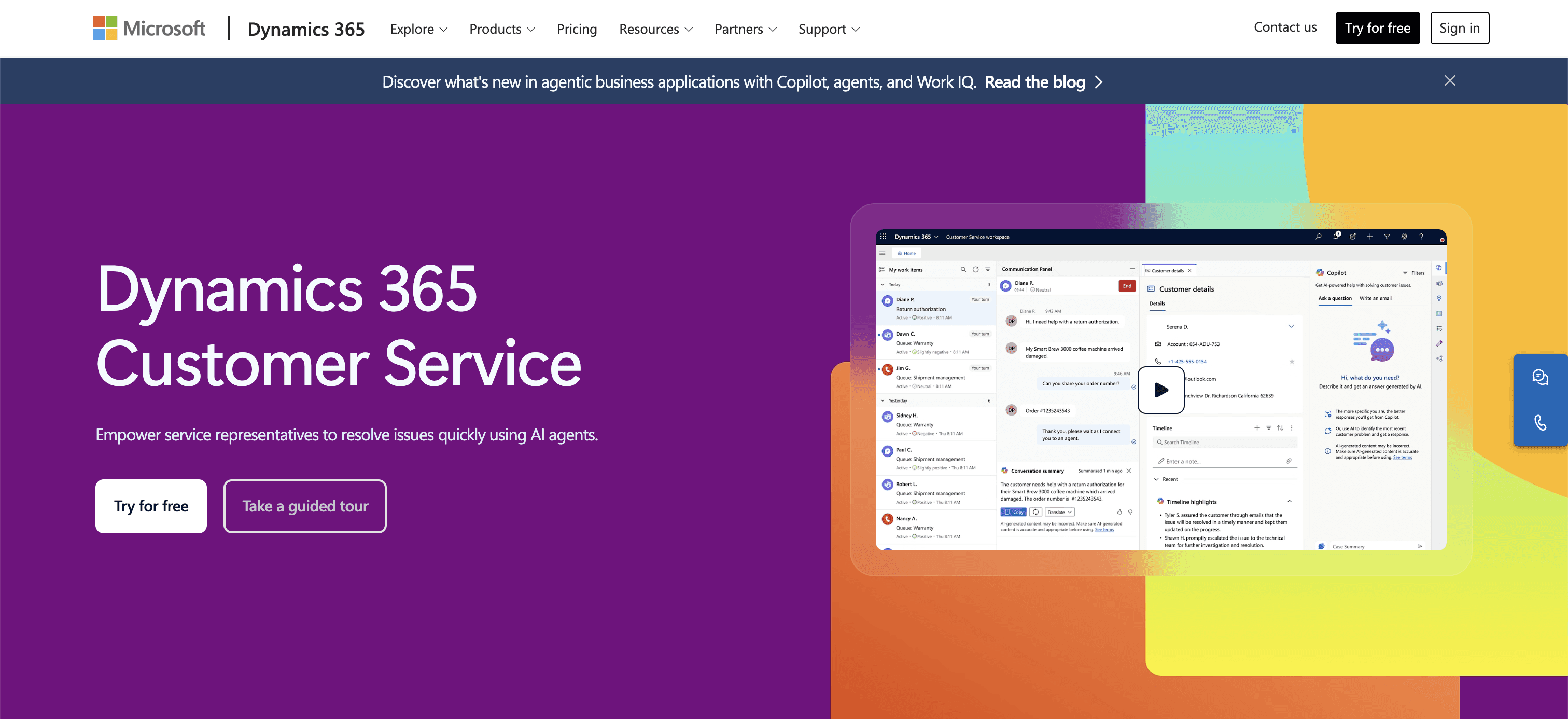
Dynamics 365 combines customer service, CRM, and analytics inside one Microsoft environment. It connects natively to Teams, Power BI, and the wider Microsoft ecosystem most enterprises already run
Price: $65 per user per month for Professional, rising to $135 for Enterprise. Copilot and Power Platform features carry separate licensing
Best for: Organizations already running Microsoft 365, Azure, or Power BI
Contract minimum: Per-user licensing, with multiple licenses sometimes required for one agent to reach features split across plans.
4.Zendesk
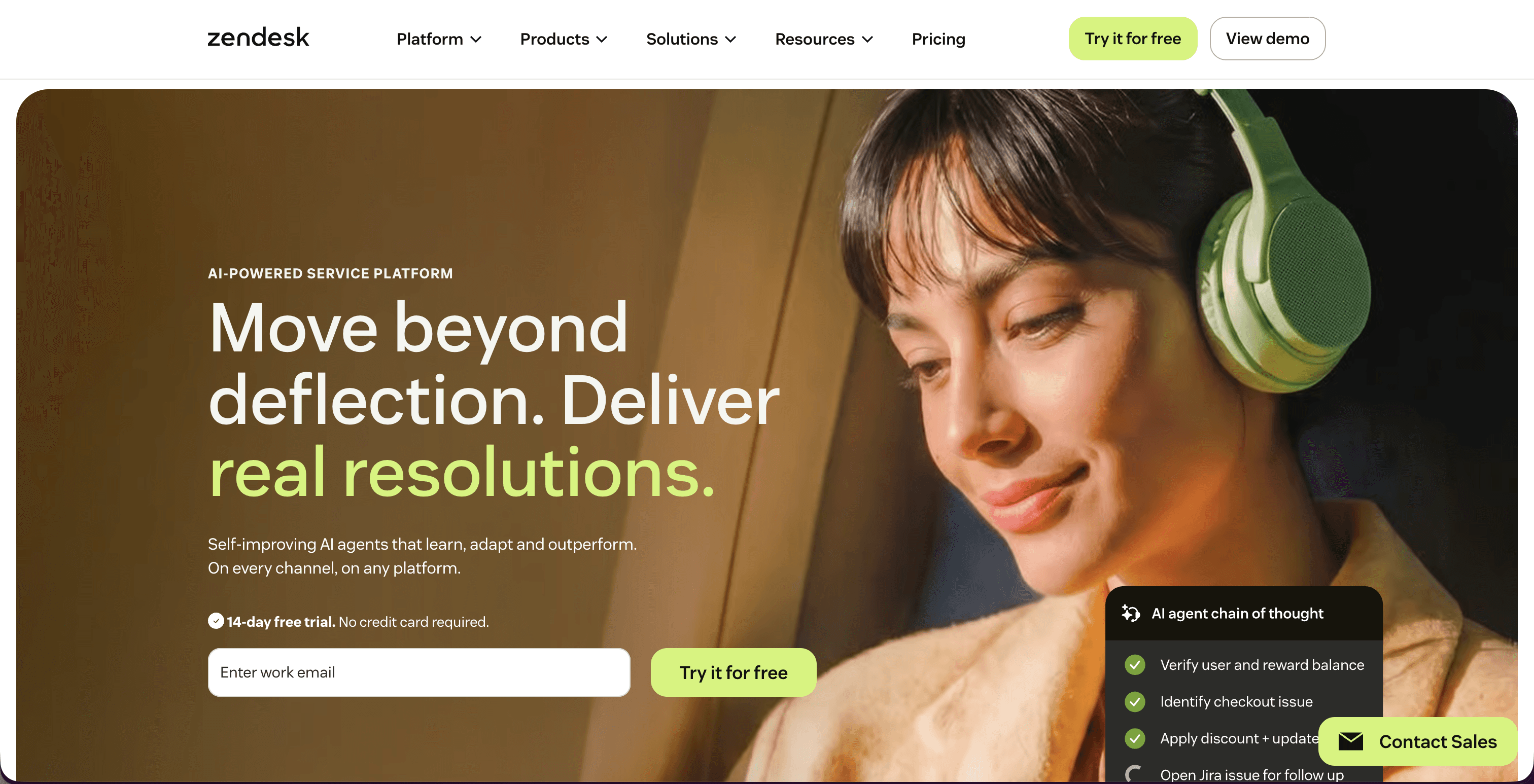
Zendesk is a support-focused help desk known for quick setup and an approachable interface. Its AI tooling is pre-trained on more than 18 billion customer service interactions.
Price: Plans start at $19 per agent per month. Suite tiers for full support operations run higher, and AI tooling is often a paid add-on
Best for: Support-led teams that want fast deployment without heavy implementation work
Contract minimum: Per-agent pricing that scales with headcount, which raises cost as support teams grow.
5.HubSpot Service Hub
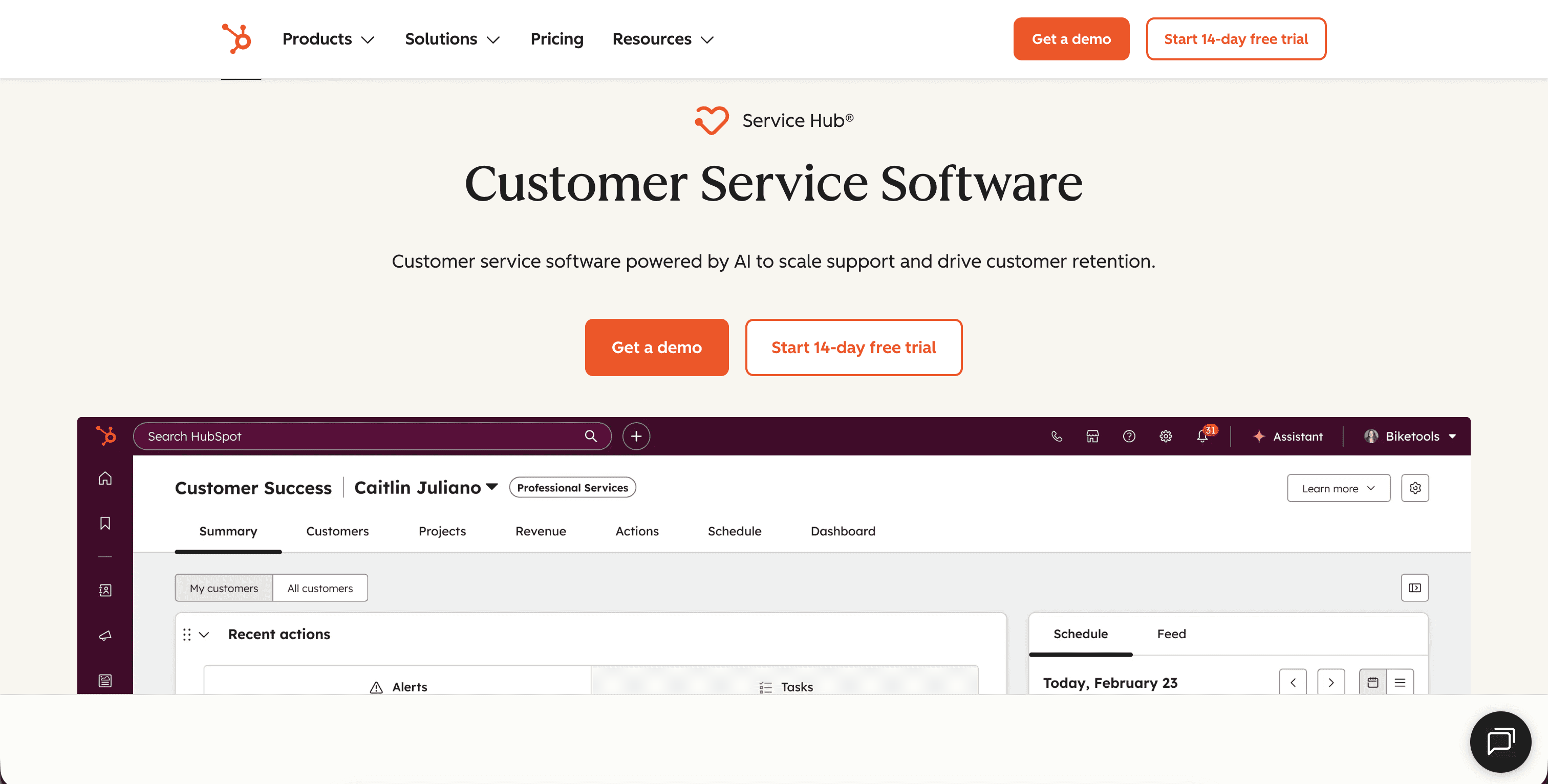
HubSpot Service Hub unifies support, sales, and marketing data on a single CRM record. Its Enterprise tier adds AI agents, SLA enforcement, and advanced ticket routing.
Price: $150 per seat per month for Enterprise, billed annually with a 10-seat minimum. Professional sits at $90 per seat.
Best for: Mid-market teams that want CRM, marketing, sales, and service on shared data.
Contract minimum: 10-seat Enterprise floor plus a one-time onboarding fee near $3,500.
6.Zoho Desk
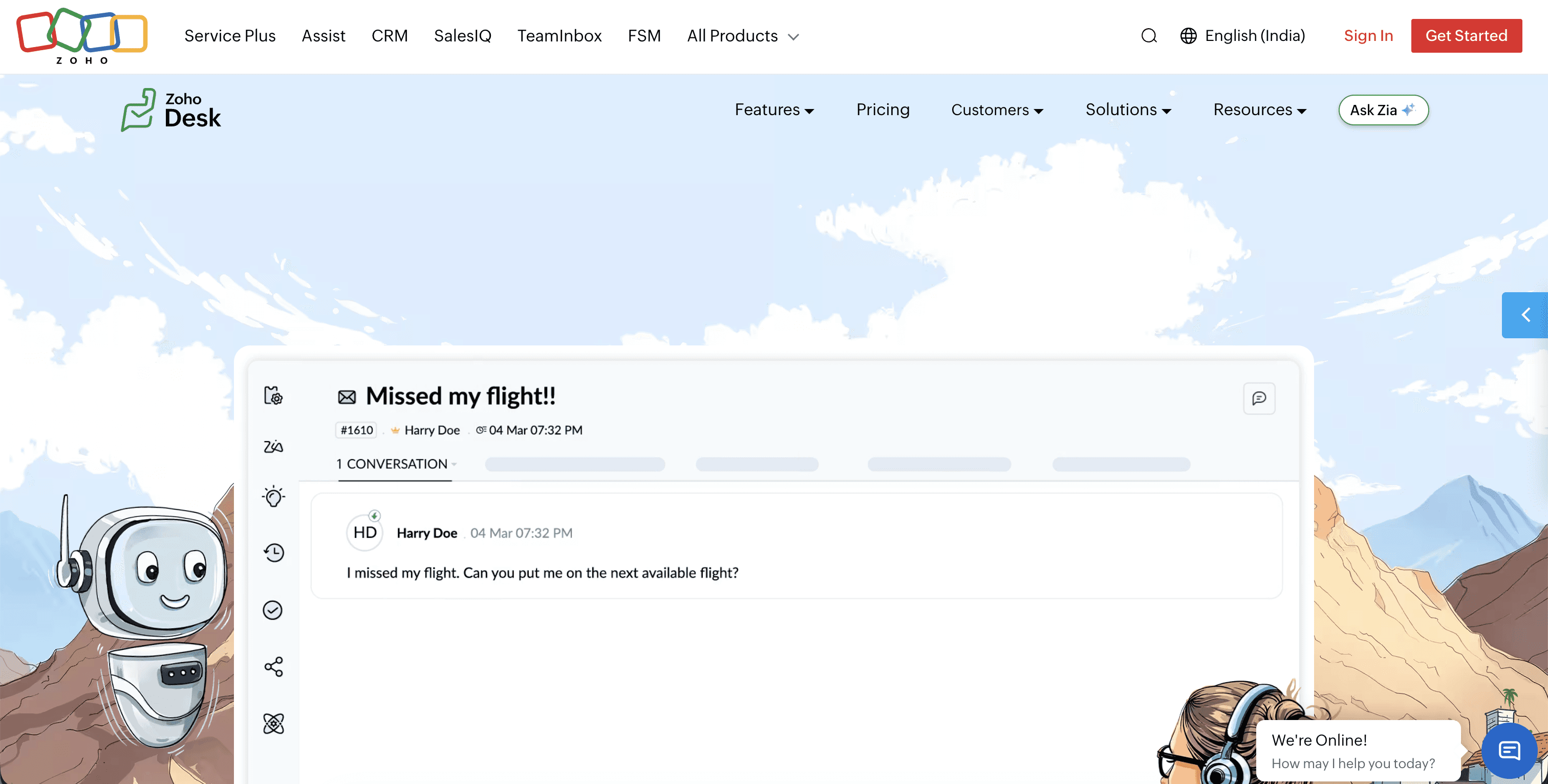
Zoho Desk delivers help desk and CRM functions at a lower price point than enterprise platforms. Its Zia assistant handles ticket sentiment analysis and predicts escalations before they happen.
Price: Enterprise runs about $50 per agent per month. Zoho CRM Plus bundles CRM, service desk, and analytics at $57 per user per month.
Best for: Budget-conscious teams already inside the Zoho ecosystem.
Contract minimum: Per-agent licensing with a free tier for up to three agents.
Why Level AI Is the Best Solution for Contact Centers Evaluating CRM Integration
The six shifts above share a common dependency: interaction data must be complete, accurate, and connected to every system that acts on it. A contact center scoring 1-2% of calls produces a CRM record that reflects 1-2% of what actually happened. Level AI scores 100% of interactions automatically, pushing QA scores, post-call summaries, and sentiment data directly into the customer record.
The accuracy behind that coverage is measurable. Level AI’s auto-QA operates at a 90% accuracy rate. Customers have moved from scoring 1-2% of calls to 100%, as the Director of Operations at QuinStreet documented directly. The iCSAT score of 4.1 generated from full-coverage data gives CX leaders a satisfaction signal drawn from every interaction, not a self-selected survey sample.
Level AI’s Query Builder connects interaction data with CRM records, ticketing systems, and external data sources in a single reporting environment. QA teams, operations leaders, and product managers query that data without depending on a separate analytics team to build the report for them. That access changes how quickly customer intelligence reaches the people who shape products, processes, and policies.
" transform="translate(85.643 10.143)" width="23.725855670103115px"/><path d="M 71.828 0 L 0 50.702" fill="transparent" height="50.70235051546392px" id="TnJFUMH9b" stroke-dasharray="" stroke-linecap="butt" stroke-linejoin="miter" stroke-miterlimit="10" stroke-width="0.68" stroke="rgb(254, 250, 241)" transform="translate(85.508 75.029)" width="71.82828865979384px"/><path d="M 81.579 0 L 0 52.003" fill="transparent" height="52.00280412371134px" id="ccJzhVTGI" stroke-dasharray="" stroke-linecap="butt" stroke-linejoin="miter" stroke-miterlimit="10" stroke-width="0.68" stroke="rgb(254, 250, 241)" transform="translate(85.495 73.738)" width="81.57921649484533px"/><path d="M 65.653 0 L 0 32.827" fill="transparent" height="32.826556701030924px" id="X0Vp_q8HG" stroke-dasharray="" stroke-linecap="butt" stroke-linejoin="miter" stroke-miterlimit="10" stroke-width="0.68" stroke="rgb(254, 250, 241)" transform="translate(85.462 92.931)" width="65.65311340206183px"/><path d="M 88.08 14.951 L 0 0" fill="transparent" height="14.950762886597914px" id="JM_UgSiJ_" stroke-dasharray="" stroke-linecap="butt" stroke-linejoin="miter" stroke-miterlimit="10" stroke-width="0.68" stroke="rgb(254, 250, 241)" transform="translate(86.233 125.789)" width="88.07950515463914px"/><path d="M 83.204 72.803 L 0 0" fill="transparent" height="72.80313402061856px" id="KlyUUjlMK" stroke-dasharray="" stroke-linecap="butt" stroke-linejoin="miter" stroke-miterlimit="10" stroke-width="0.68" stroke="rgb(254, 250, 241)" transform="translate(85.089 125.71)" width="83.20379381443304px"/><path d="M 7.8 114.081 L 0 0" fill="transparent" height="114.08065979381445px" id="kAiUvduBR" stroke-dasharray="" stroke-linecap="butt" stroke-linejoin="miter" stroke-miterlimit="10" stroke-width="0.68" stroke="rgb(254, 250, 241)" transform="translate(85.95 125.478)" width="7.800247422680428px"/><path d="M 0 93.604 L 9.75 0" fill="transparent" height="93.60445360824741px" id="FsgTAQB0n" stroke-dasharray="" stroke-linecap="butt" stroke-linejoin="miter" stroke-miterlimit="10" stroke-width="0.68" stroke="rgb(254, 250, 241)" transform="translate(76.2 125.421)" width="9.750432989690694px"/><path d="M 0 76.379 L 76.703 0" fill="transparent" height="76.37888659793816px" id="NxOhHvPJ5" stroke-dasharray="" stroke-linecap="butt" stroke-linejoin="miter" stroke-miterlimit="10" stroke-width="0.68" stroke="rgb(254, 250, 241)" transform="translate(9.343 125.217)" width="76.7034556701031px"/><path d="M 0 26.651 L 39.002 0" fill="transparent" height="26.651381443298988px" id="QETNKJ3L6" stroke-dasharray="" stroke-linecap="butt" stroke-linejoin="miter" stroke-miterlimit="10" stroke-width="0.68" stroke="rgb(254, 250, 241)" transform="translate(47.096 125.177)" width="39.0017319587629px"/><path d="M 0 16.901 L 85.154 0" fill="transparent" height="16.900948453608265px" id="BL63wDICD" stroke-dasharray="" stroke-linecap="butt" stroke-linejoin="miter" stroke-miterlimit="10" stroke-width="0.68" stroke="rgb(254, 250, 241)" transform="translate(0.094 125.125)" width="85.15396503092786px"/><path d="M 0 0 L 78.004 17.876" fill="transparent" height="17.875793814432996px" id="PIX70Vlqf" stroke-dasharray="" stroke-linecap="butt" stroke-linejoin="miter" stroke-miterlimit="10" stroke-width="0.68" stroke="rgb(254, 250, 241)" transform="translate(8.362 107.251)" width="78.00376082474227px"/><path d="M 0 0 L 67.928 52.327" fill="transparent" height="52.32742268041238px" id="u_syqWqWD" stroke-dasharray="" stroke-linecap="butt" stroke-linejoin="miter" stroke-miterlimit="10" stroke-width="0.68" stroke="rgb(254, 250, 241)" transform="translate(17.593 72.861)" width="67.92826391752578px"/><path d="M 0 0 L 77.029 70.528" fill="transparent" height="70.52832989690722px" id="DmW_aE2A0" stroke-dasharray="" stroke-linecap="butt" stroke-linejoin="miter" stroke-miterlimit="10" stroke-width="0.68" stroke="rgb(254, 250, 241)" transform="translate(9.489 54.678)" width="77.02866804123713px"/><path d="M 0 0 L 27.301 126.431" fill="transparent" height="126.43109443298971px" id="JrLaRUubC" stroke-dasharray="" stroke-linecap="butt" stroke-linejoin="miter" stroke-miterlimit="10" stroke-width="0.68" stroke="rgb(254, 250, 241)" transform="translate(58.341 -0.071)" width="27.30111340206188px"/><path d="M 0 4.012 C 0 1.796 1.796 0 4.012 0 C 6.228 0 8.025 1.796 8.025 4.012 C 8.025 6.228 6.228 8.025 4.012 8.025 C 1.796 8.025 0 6.228 0 4.012 Z" fill="rgb(254, 80, 0)" height="8.024669690721652px" id="Nh5qrPJs_" transform="translate(81.396 121.369)" width="8.024669690721623px"/></svg>)
1. What is the difference between call center CRM software and a standard contact center platform?
A contact center platform handles routing, telephony, and interaction flow. A call center CRM is the system of record for the customer relationship, storing interaction history, case data, and account details. The two are converging, but the CRM holds the longitudinal customer record that the contact center platform does not
2. How does CRM integration affect agent performance during live calls?
CRM integration surfaces purchase history, prior cases, account status, and sentiment signals at the agent desktop before the call begins. Agents open with full context rather than asking customers to re-explain their situation. That reduces handle time and changes the quality of the interaction from the first exchange
3. Which CRM platforms do most contact centers integrate with?
Salesforce and Microsoft Dynamics are the most common CRM platforms in enterprise contact center environments. ServiceNow and Zendesk are also widely used, particularly in organizations where the ticketing system and CRM functions overlap
4. How does full-coverage QA scoring connect to CRM data?
When QA scores flow into CRM records, customer-level patterns become visible. A customer with three poorly handled interactions in 30 days is a measurable churn risk. That signal only surfaces when QA output and CRM history are in the same place. Sampled QA at 1-2% coverage leaves most of that pattern invisible, and you need a contact center AI solution to get 100% coverage
5. What should contact center leaders evaluate when choosing a CRM integration?
The key evaluation criteria are data flow direction, integration depth, and API access costs. Leaders should confirm that QA scores, post-call summaries, and sentiment data are written into the CRM automatically. They should also verify that the integration does not require premium licensing to move data between systems that the organization already operates