Key takeaways
Traditional scorecards rely on limited manual reviews, making it difficult to evaluate agents consistently or capture the full customer experience.
An effective call center scorecard balances quantitative metrics with qualitative insights like empathy, problem-solving, and communication quality.
AI-powered platforms like Level AI automate scoring across all interactions, ensuring accuracy, consistency, and real-time feedback for faster agent development.
Integrated coaching features turn performance data into actionable guidance, helping agents self-improve and managers scale training across the team.
A call center agent performance scorecard is a structured tool that evaluates how effectively a call center agent resolves issues and creates positive customer experiences. Scorecards typically combine performance metrics such as average handle time (AHT), first call resolution (FCR), and customer satisfaction (CSAT) with qualitative measures like tone, empathy, professionalism, and compliance.
They’re built around internal quality standards and most are maintained in spreadsheets or dashboards. These are usually completed by evaluators who manually review a small sample of recorded calls, rating agents on how well they followed procedures and responded to customer needs.
When thoughtfully designed, scorecards give teams a consistent way to measure agent performance, spot coaching opportunities, and reinforce the skills that actually drive better outcomes.
In the sections below, we break down the core elements that define an effective call center scorecard along with best practices to help you refine your own. We also highlight five challenges that come with traditional, manually compiled scorecards, and show how systems AI addresses these.
Best practices for putting together an effective scorecard
Align KPIs with business values
The best scorecards phrase your KPIs as questions that reflect your organization’s goals, like “Was the issue resolved on the first contact?” or “Did the agent show empathy when handling the customer’s concern?” making it easier to tie performance like resolution rates back to meaningful outcomes.
This turns performance measurement for call center efficiency into a meaningful audit of business values, rather than just a technical checklist.
Balance quantitative metrics with qualitative insight
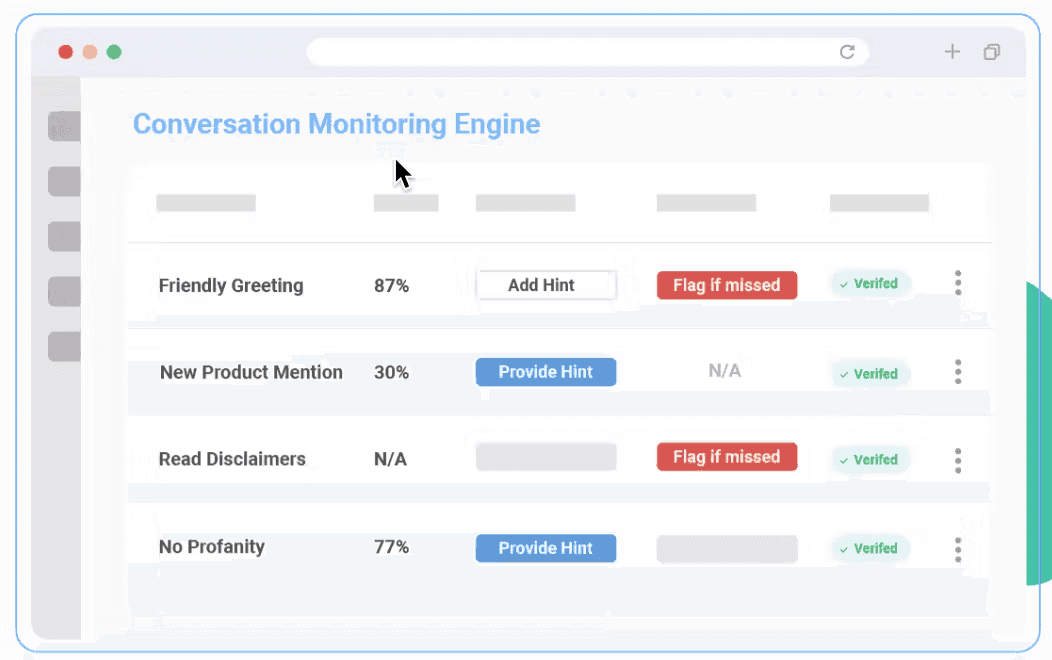
A strong call center scorecard looks at both the numbers and the human side of each interaction, measuring how efficiently contact center agents do their work and how they make customers feel. For instance, you might track how quickly a call center agent responds to incoming chats and resolves these for higher FCR, or how many issues they resolve in a day and call handling.
But just as important are communication skills like empathy, active listening, and how clearly the agent explains a solution. Did the agent stay calm with a frustrated caller? Did they use friendly, respectful language?
Measure interaction quality
Interaction quality reflects how well an agent resolved the customer’s issue and delivered a positive experience from start to finish. Scorecards should include:
Customer satisfaction (CSAT scores), sentiment, and resolution rates
Accuracy and clarity of information shared
Completion of the interaction with a clear resolution or next steps
Customer confidence in the outcome
These factors directly influence how customers perceive the service they received and if they’re leaving the interaction feeling supported.
Evaluate process adherence and compliance
Effective scorecards assess whether agents are following procedures, complying with security and regulatory requirements, and maintaining consistency. Typical criteria used to evaluate compliance include:
Adherence to call scripts or escalation protocols
Data handling and confidentiality
Compliance with data protection and privacy policies
Observance of internal protocols and steps
Capture knowledge and problem-solving ability
Customers expect more than polite conversation; they want accurate answers and solutions that work. A well-rounded call center scorecard should assess how well agents apply their knowledge and judgment to resolve customer issues efficiently.
You should measure how effectively agents:
Apply product and policy knowledge
Deliver accurate, complete answers based on the customer’s question or issue
Know when and how to escalate issues
This helps ensure agents aren’t just helpful in tone, but effective in action, resolving issues accurately and earning customer trust in the long term.
Align scorecard weighting with business goals
Not every metric matters equally. An effective call center scorecard prioritizes what’s most important by assigning the right weight to each category. For example, if issue resolution is more valuable than handle time in your business, your scoring should reflect that.
The scorecard should also be flexible enough (customizable in terms of team, channel, or campaign) to evolve alongside your goals. Regular updates help keep it aligned with changing contact center quality standards, customer expectations, and business priorities.
Support coaching and development
The best scorecards are designed to support coaching by turning data into practical guidance that agents can act on.
Use a scorecard to:
Generate clear, actionable feedback tied to real contact center interactions
Identify skill gaps and coaching opportunities
Track agent progress over time to measure growth
Reinforce positive behaviors and recognize top performers
Inform personalized development plans that support retention and advancement
This approach helps call center managers shift from checking boxes to developing people, which turns compliance-driven quality assurance into a meaningful tool for making informed decisions, meeting customer expectations, and improving communication skills.
4 agent scorecard challenges solved by AI
Below we explain how AI solves five common challenges of traditional agent performance scorecards. We illustrate these using examples from our own platform, Level AI, which brings automated call center quality assurance, coaching, and customer insight together in one place. Level AI is trusted by leading companies across diverse sectors, including ecommerce & retail, financial services, healthcare, printing & gifting, transportation, and tech.
1. Limited visibility into agent performance
QA teams that painstakingly review call recordings, chat logs, or email transcripts to manually fill out scorecards typically only get to 1–2% of these.
This leaves much of the customer journey unexamined, meaning valuable insights, emotional cues, and behavioral trends are lost. It’s not just a coverage issue but an understanding gap: even the calls that are reviewed manually can miss context, tone, or intent.
Modern AI-powered scorecards solve these challenges by automatically capturing every interaction across all channels, and by analyzing conversations not via keywords or surface-level call center performance metrics, but by using speech analytics software to deeply understand language, context, and sentiment.
Level AI combines advanced natural language understanding, semantic intelligence, and automatic speech recognition to detect customer intent and emotion across 100% of customer interactions.
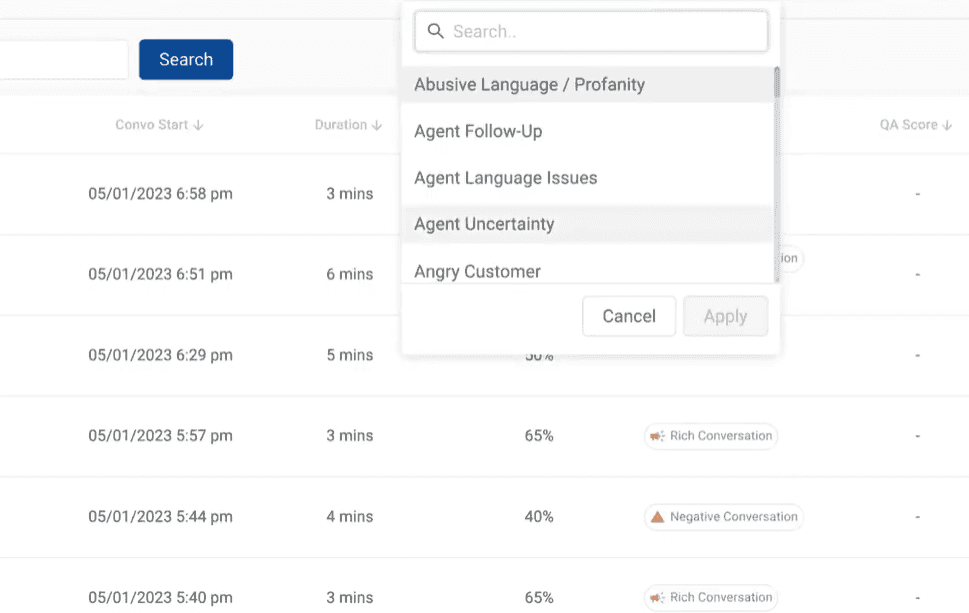
Its Scenario Engine analyzes conversations to identify the underlying purpose or goal of the customer or call center agent, classifying these intents as scenarios. So for instance, if the system detects a customer saying “I want to return the chair” or “I need to send this chair back,” it might classify these as a Price Objection scenario, understanding the underlying intent without the customer having to use certain keywords.
When its customer analytics software recognizes a given scenario in a conversation, it tags this instance using a conversation tag. Conversation tags are searchable and filterable across all recorded conversations in our platform, allowing you to find and display conversations where a given intent was expressed.
The system also detects distinct human emotions (like worry, happiness, admiration, disappointment) which allows teams to uncover the root causes of customer reactions, personalize responses, and coach agents.
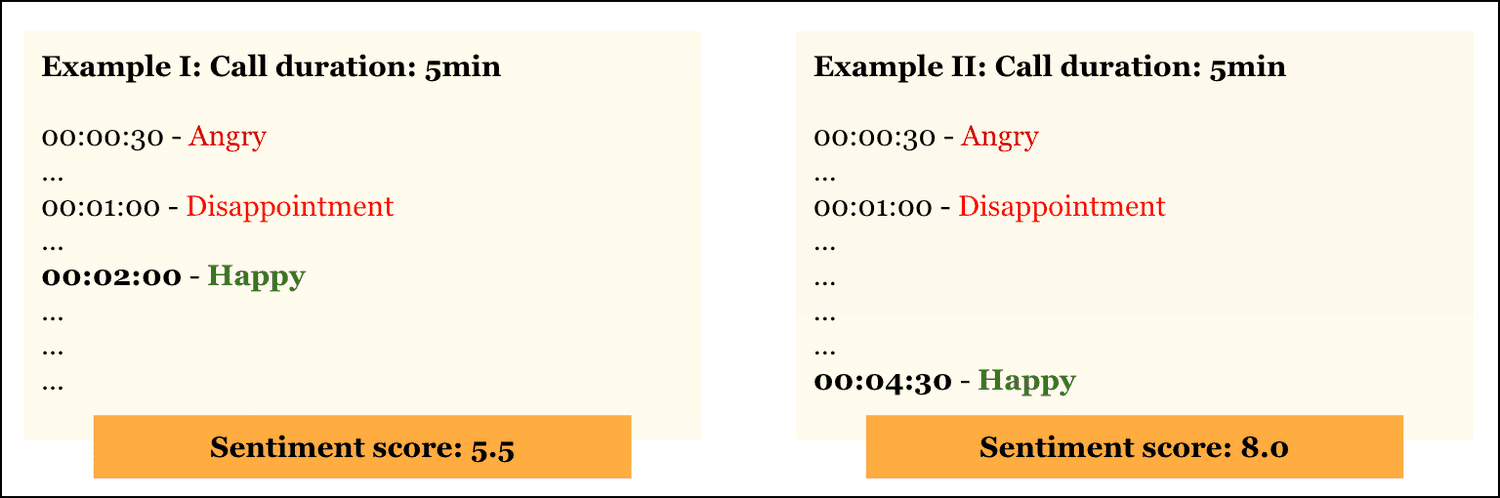
When Level AI detects an emotion, it applies a sentiment tag to the transcript, allowing users to filter conversations for a given emotion for deeper analysis. Its overall measure of how a customer feels during an interaction—Sentiment Score—runs from 0 (strongly negative) to 10 (strongly positive) and is calculated by weighting the emotions detected throughout the conversation.
Emotions occurring near, or at the end of a conversation are weighted more heavily because they tend to reflect the customer’s lasting impression and are most indicative of satisfaction or dissatisfaction with the outcome.
Accurate intent and sentiment detection supports a wide range of customer analytics use cases and enables automated agent performance scoring by identifying whether agents understood customer needs, responded appropriately to emotional cues, and delivered resolutions that align with business goals and customer expectations.
2. Subjectivity and inconsistent evaluation
Manual reviews are also prone to human bias. A QA reviewer’s mood or prior opinions about an agent can influence how they score an interaction, and even small differences in interpreting the criteria can lead to unfair or inconsistent evaluations. This makes it difficult to apply the same performance standards across the team. When reviewers grade differently, agents get uneven feedback and, eventually, trust in the QA process starts to erode.
Coaching based on just a handful of manually reviewed calls also tends to fixate on one-off mistakes instead of meaningful patterns. That can frustrate agents, who may be penalized for isolated slip-ups that don’t reflect their typical performance.
AI offers conversation analytics tools that auto-score agents by applying consistent logic and scoring rules to interactions, ensuring objectivity in performance evaluations while removing reviewer bias. The result is more transparent agent feedback that builds trust with frontline agents.
Level AI’s InstaScore evaluates agents on key criteria like greeting quality, tone, issue resolution, and adherence to process by analyzing conversations based on a set of rubrics or company policies that you define.
An InstaScore value is then assigned to each interaction and is expressed as a single percentage value.
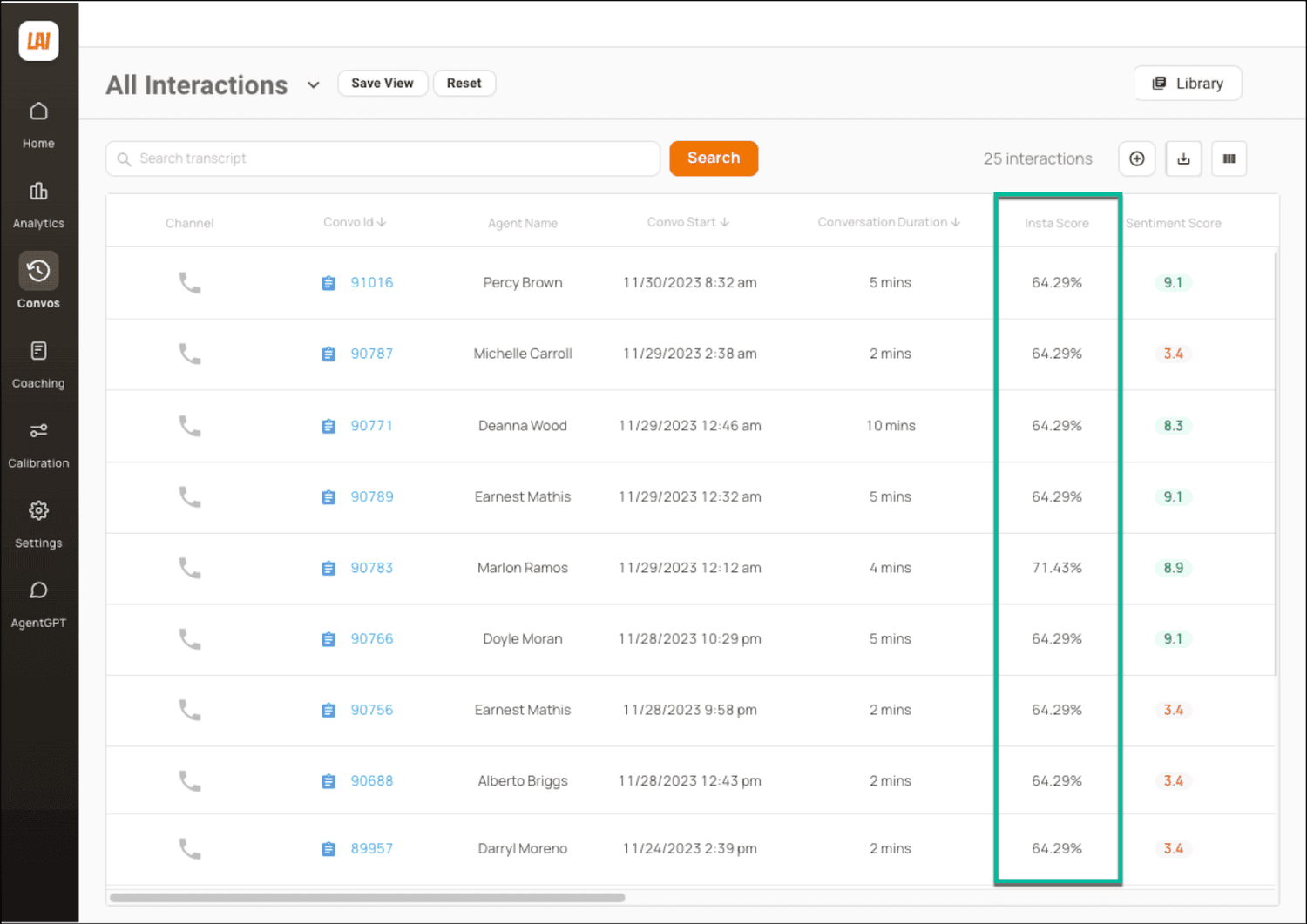
This gives contact center leaders a single view of agent performance that’s comprehensive and actionable. Because the same evaluation logic is applied consistently, results are free from variability and subjectivity.
3. Slow and inefficient quality assurance processes
Manual QA reviews are time-consuming and labor-intensive, which can delay feedback and limit the number of reviews that can be completed in a given period. Agents aren’t given the opportunity to see patterns in their own performance and self-correct themselves quickly enough, which slows down skill development and reduces the overall impact of coaching efforts.
AI-powered scorecards use call quality monitoring tools to deliver insights in real time, freeing up supervisors to focus on in-the-moment coaching rather than auditing. Instant dashboards and alerts reduce agent feedback loops from weeks to minutes.
Level AI’s Real-Time Manager Assist provides automated quality management by flagging high-risk conversations as they happen, allowing contact center supervisors to intervene immediately, deliver timely coaching, and reinforce positive behaviors in the moment for a better customer experience.
The live dashboard shows KPIs for every interaction in progress, including agent InstaScore, customer sentiment, conversion probability, call handling metrics, and a range of detected coachable insights:
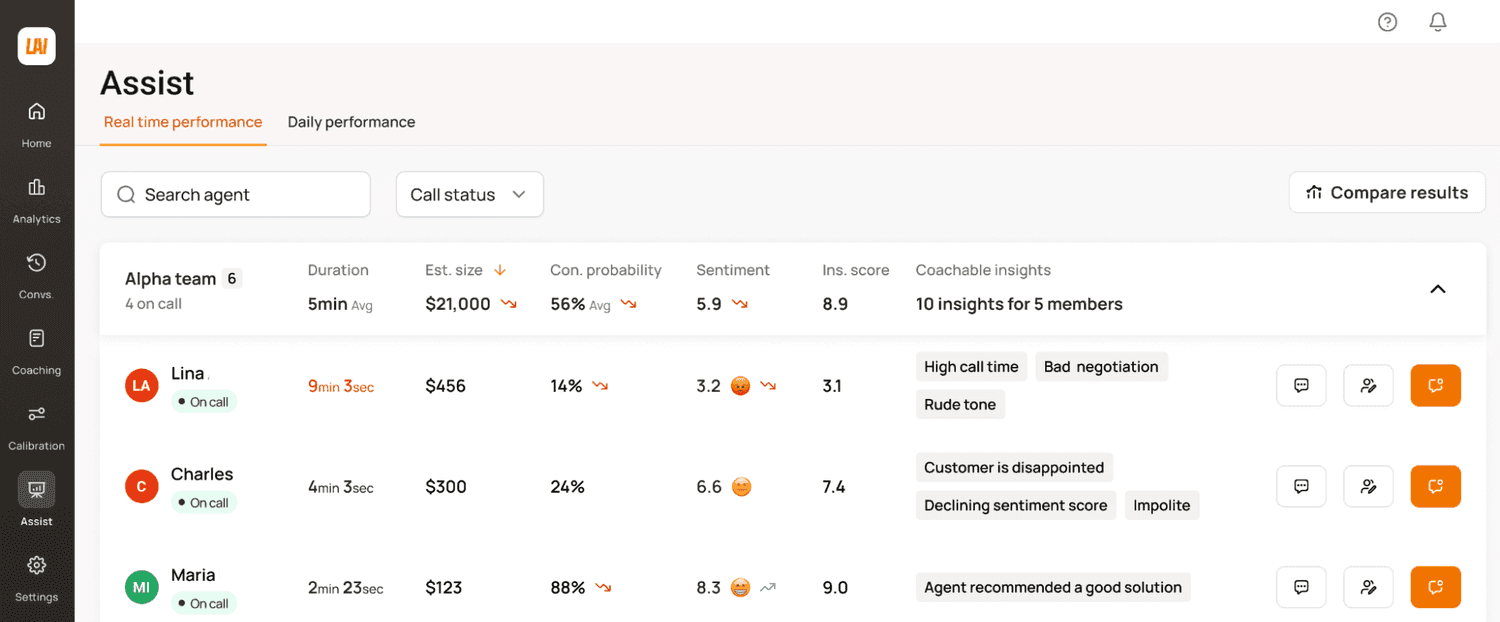
This lets managers instantly see when they need to step in—either by coaching the agent in the moment or by requesting the call be escalated to them directly.
4. Rigid systems without built-in coaching tools
Static scorecards often just show stats that are disconnected from improvement or coaching, making it hard to turn agent performance data into clear actions that help agents build skills and improve with confidence.
AI-driven agent QA platforms, on the other hand, can integrate scoring and coaching by automatically linking evaluation results to targeted agent feedback, surfacing patterns in real time, and recommending specific actions agents can take to optimize their performance.
An example of this is Level AI’s linking from scorecards and dashboards directly to its call center agent coaching features. For instance, conversation dashboards (where you can find interaction transcripts and call center performance data) all link to our coaching functionality, allowing contact center managers and coaches to directly launch a session with context in hand:
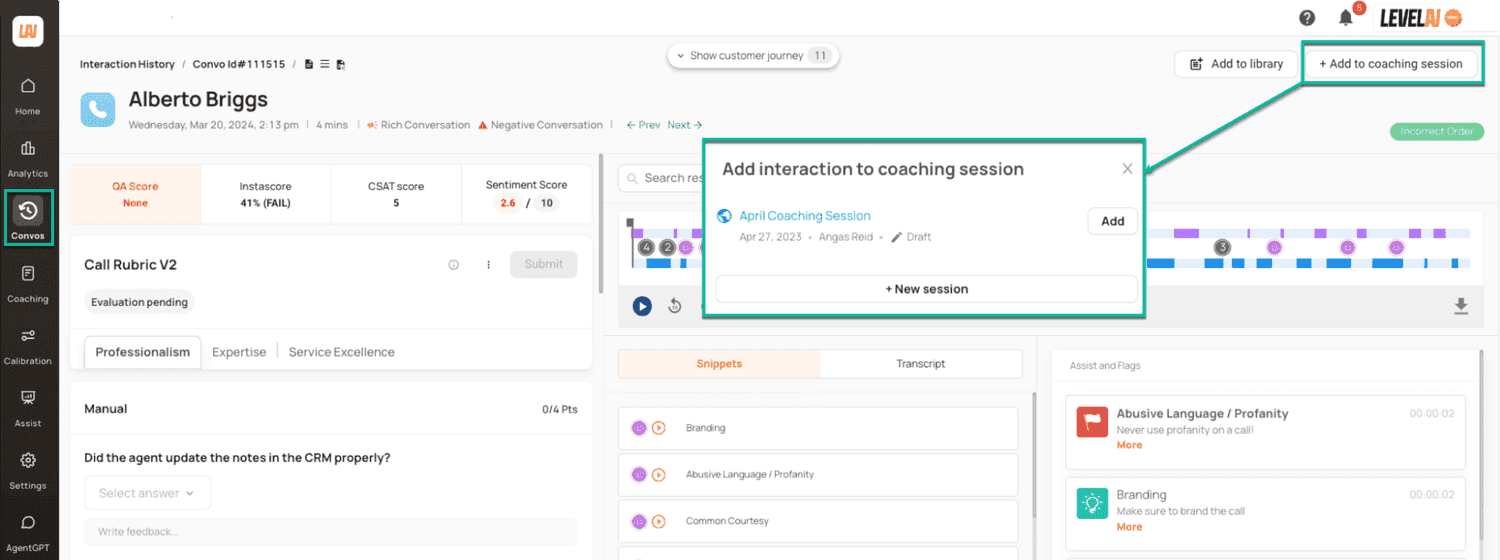
This allows managers to easily initiate call center coaching when certain issues are top of mind and makes the coaching itself targeted and actionable, so agents get timely guidance to optimize customer experience.
See the full picture of agent performance
Agents trust coaching more when it’s based on consistent, unbiased data. Level AI removes subjectivity by scoring every interaction with the same logic, giving contact center managers clarity and agents confidence in the process.
Book a free demo today to see how it helps teams improve with transparency and speed.