
Key takeaways
VoC tools help businesses uncover what customers really think and feel across every interaction, not just survey responses. They can analyze conversations, reviews, chats, emails, surveys, and social interactions at scale
The best VoC tool depends on where your customer conversations happen. Contact centers should look at conversation analytics, while marketing teams may get more value from social listening and brand monitoring
AI that understands intent beats AI that simply spots keywords. Customers rarely describe the same problem in exactly the same words. NLU based tools can identify the underlying issue without requiring teams to maintain hundreds of keyword rules
Sentiment alone isn't enough. Knowing that a customer is "negative" doesn't tell you why. Look for tools that can uncover specific emotions, topics, customer intents, and recurring pain points
The real value of VoC is turning feedback into action. The strongest platforms connect customer insights with reporting, CRM and support data, alerts, workflows, or coaching
Voice of the Customer (VoC) is the process of gathering and analyzing customers’ thoughts and feelings about your product and their interactions with your business. The right VoC tools and software make this process faster and less manual than running surveys alone.
What are VoC softwares ? (Voice of the Customer)
Traditionally, teams collected feedback through customer surveys, which come with several downsides:
Timing: Surveys are collected after the fact, so you can’t address issues before they happen.
Incomplete data: Not all customers fill out surveys, leaving gaps in your data.
Skewed responses: Usually only very happy or very unhappy customers respond, excluding the majority who feel somewhat satisfied or dissatisfied.
Bias and error: Customers may sugarcoat their experience or leave out details, producing inaccurate data.
To solve these problems, more teams now use VoC tools that automatically capture and report on data from interactions across every customer channel. This removes the need to send out surveys, and it avoids the low response rates and skewed results that come with them.
Not every VoC tool works the same way underneath, and that difference matters. Many products marketed as AI-powered VoC solutions actually run on rule-based algorithms, using basic natural language processing (NLP) and keyword matching instead of true language understanding.
A keyword-based system flags key moments, like when a customer uses a specific word to express happiness or frustration, and labels the sentiment as positive or negative. This approach has real limits:
Labeling sentiment as only positive or negative misses actual emotions, like anger, disappointment, gratitude, or admiration.
Manually entering keywords to catch every phrasing of an idea (for example, “I don’t like how this fabric feels” versus “the material isn’t comfortable”) takes significant effort.
Even with that effort, keyword systems miss intent in cases that don’t match a preset phrase, since no list can cover every way a person might say something.
Tools built on natural language understanding (NLU) work differently. They identify the underlying intent behind what a customer or agent says, rather than scanning for specific words, which lets them detect a broader range of sentiments and meanings without requiring hundreds of manually entered keyword variations.
With that distinction in mind, it helps to know what these tools actually look like across categories.
What are voice of the customer tools?
Voice of the customer tools collect and interpret customer feedback so teams can act on it without relying only on surveys. Most platforms fall into a handful of common types.
Conversation and speech analytics platforms analyze support calls, chats, and emails directly, detecting intent and sentiment as the interaction happens. Feedback management platforms centralize survey responses, reviews, and support tickets into one system so CX teams can track satisfaction trends over time. Social listening tools monitor public conversations across social media and the web, giving marketing teams visibility into brand perception outside of direct support channels. Some platforms, like journey mapping tools, focus specifically on tracking a customer’s experience across every touchpoint, from first contact through renewal.
The tools below split into these two practical use cases: platforms built for customer success and support teams, and platforms built for
VoC tools for customer success teams
Tool | Best for | Standout features | Pricing |
Level AI | Contact centers wanting survey-free VoC | NLU-powered Scenario Engine, granular sentiment detection, Sentiment Score (0-10), Real-Time Manager Assist, Query Builder reporting | Custom |
Qualtrics | Enterprise CX management | Omnichannel feedback collection, text and sentiment analysis, automated action planning workflows | Custom |
Verint | CX automation and workforce optimization | Real-time automated alerts, predictive behavior modeling, digital listening engine, custom KPI dashboards | Custom |
Gong | Revenue and sales-focused CX teams | Gong AI for interaction capture, Gong Insights paired with CRM data, Gong Engage for personalized outreach | Custom |
Medallia | Large enterprises blending surveys and signals | Text analytics with machine learning, customizable NPS tracking, real-time CES monitoring, focus group management | Custom |
Chattermill | Unifying feedback across support, reviews, and social | Deep learning sentiment and theme detection, 30+ integrations including Salesforce and Freshdesk, enterprise-grade text analytics | Custom |
Brandwatch | Large-scale consumer intelligence | 1.4+ trillion post archive, Iris generative AI assistant, 50+ live visualizations, automated reports | Custom |
Meltwater | Media intelligence and PR monitoring | Real-time analysis across 100M+ online sources, brand mention tracking, sentiment analysis | Custom |
Brand24 | Agencies and SMBs needing transparent pricing | Topic analysis, anomaly detection for mention spikes, AI-powered brand reports | $119 to $399/mo |
Talkwalker | Enterprise social listening and competitive benchmarking | Real-time multi-channel listening, visual logo and scene detection, feedback from 300+ sources | Custom |
Sprout Social | Marketing teams needing listening plus publishing | Brand mention tracking, sentiment analysis, competitive reports, AI Assist for drafting responses | From $79/seat/mo |
Top VoC softwares for customer success teams
1. Level AI

Level AI uses natural language understanding and generative AI to collect and analyze customer feedback directly from interactions, without sending a single survey. This gives teams a faster way to capture insights into customer perceptions and behavior.
Level AI’s Voice of the Customer tools let you:
Capability | What it does |
Full interaction coverage | Reviews up to 100% of customer interactions across phone, email, and chat |
Nuanced emotion detection | Identifies emotions like gratitude, disappointment, and anger, instead of a simple positive or negative label |
Beyond that quick overview, four capabilities do most of the work:
Scenario Engine: Identifies what a customer means, not just the words used, and tags the moment as a scenario, like “Connection Issues” for login trouble, using predefined categories or custom ones for your business. Each tagged moment becomes a searchable conversation tag, such as “Delivery Issues” or “Price Concerns,” and a single conversation can carry several tags.
The platform ships with predefined scenarios out of the box:

You can also define custom scenarios specific to your business:

Each tagged moment shows up as a searchable conversation tag:

Sentiment Score and tags: Scores every conversation from 0 to 10, weighting sentiment near the end of a call more heavily, and tags specific emotions like anger, disappointment, or gratitude at the moment they occur.
Sentiment Score tracks how a call trends from start to finish:

Advanced reporting with Query Builder: Combines Level AI’s tagged data with CRM, ticketing, and survey data, so teams can answer questions like which topics correlate with low satisfaction or which agent responses shift sentiment during a call.
Dashboards come ready to use out of the box:

Query Builder lets you build a custom report from scratch:

Coaching with Real-Time Manager Assist: Gives managers live call metrics, like sentiment score and likelihood to convert, plus one-click access to start a coaching session.
Coaching plans can be assigned directly to agents from the dashboard:

Real-Time Manager Assist surfaces live metrics for calls in progress:

Ready to try Level AI’s Voice of Customer tools? Book a call with our team to see how it can improve your organization’s customer satisfaction and agent performance.
Below, we cover alternative VoC tools for gathering and analyzing customer feedback.
2. Qualtrics

Qualtrics is a customer experience management platform that captures and analyzes VoC data to improve customer satisfaction and loyalty. Customers generate insights from interactions and organize them into customizable dashboards and reports. The platform excels at capturing feedback across multiple touchpoints, including surveys, social media, and customer interactions.
Feature | What it does |
Omnichannel feedback collection | Gathers insights from every customer support channel into one holistic view |
Advanced text and sentiment analysis | Analyzes open-ended responses and customer emotions automatically |
Automated action planning | Triggers workflows based on feedback to ensure timely follow-up |
Because Qualtrics is an enterprise platform, it currently offers only custom pricing plans, available upon request.
3. Verint

Verint is a CX automation platform that helps companies increase customer engagement, optimize workforce performance, and improve business processes through analytics and automation. Businesses rely on Verint to identify CX blind spots and bottlenecks in the customer journey.
Feature | What it does |
Real-time automated alerts | Triggers based on specific customer feedback, conversations, and sentiment |
Custom dashboards and reports | Visualizes business-specific metrics and KPIs |
Multi-channel feedback collection | Pulls data from surveys, social media, contact center interactions, email, and live chat |
Verint’s pricing plans are custom and available upon request.
4. Gong

Gong is a revenue intelligence platform that captures and analyzes customer interactions across channels to provide AI-driven insights for sales performance and customer engagement.
Feature | What it does |
Gong AI | Captures, transcribes, and analyzes interactions across channels |
Gong Insights | Pairs customer data with CRM metrics to gauge team performance |
Gong Engage | Uses interaction data to help teams personalize outreach and automate workflows |
Gong doesn’t disclose pricing, since each plan is tailored to the organization. Contact a sales rep for details.
5. Medallia
Medallia is an enterprise VoC platform that helps organizations build customer-centric programs through feedback management and data collection. The platform combines in-app, SMS, and traditional survey methods to capture customer expectations across every touchpoint.
Feature | What it does |
Text analytics with machine learning | Processes customer feedback at scale |
NPS tracking and segmentation | Customizable tracking tools for specific customer groups |
Real-time CES monitoring | Tracks customer retention as it happens |
Focus group management | Supports market research initiatives alongside standard feedback |
Mobile feedback apps | Collects feedback from customers on the go |
For specific pricing, organizations must contact Medallia’s sales team directly.
6. Chattermill
Chattermill is a customer feedback analytics platform that unifies data from reviews, support tickets, conversations, and social media into a single view. The platform uses deep learning AI to analyze that data at scale, and brands including Amazon, Uber, Tesco, and H&M use it to guide CX and product decisions.
Feature | What it does |
Unified feedback analytics | Combines reviews, support tickets, conversations, and social data in one platform |
Deep learning sentiment and theme detection | Surfaces recurring themes without manual tagging |
Broad integrations | Connects to Salesforce, Freshdesk, Kustomer, Intercom, and 30+ other tools |
Chattermill’s pricing depends on the data sources and feedback volume a company needs to analyze, and is available upon request
Now below are the VoC softwares for marketing teams.
7. Brandwatch

Brandwatch is a consumer intelligence platform that helps marketing teams collect and analyze conversations about their brand or product, using social listening and analytics.
Brandwatch provides:
Comprehensive data coverage: Access to 1.4+ trillion posts dating back to 2008, with 496 million new posts added daily.
Generative AI assistant: Brandwatch’s Iris finds customer conversations and turns them into readable insights.
Advanced reporting and visualization: Customizable dashboards with 50+ live visualizations and automated reports.
Brandwatch’s pricing isn’t available online. Contact its sales team for custom pricing.
8. Meltwater
Meltwater is a media intelligence and social listening platform that helps marketing teams monitor and analyze online conversations about their brand and industry.
This VoC software provides features for:
Real-time social data analysis: Processes data from 100+ million online sources, including social media, blogs, forums, and review sites.
Brand monitoring: Tracks mentions across channels and reports on conversation volume and quality.
Sentiment analysis: Flags whether brand mentions are positive, negative, or neutral.
All Meltwater packages are customized. Request a demo from its sales team for pricing.
9. Brand24

Brand24 is a social media monitoring and analytics tool that tracks brand mentions and customer sentiment across channels. It helps agencies, marketers, and PR professionals gather feedback and make data-driven decisions.
Key Brand24 features include:
Topic analysis: Identifies topics being discussed by the target audience, including sentiment, reach, and share of voice.
Anomaly detection: Flags unusual spikes or drops in mention volume so teams can respond quickly.
AI-powered brand reports: Delivers charts, metrics, trend analysis, and strategic recommendations.
Brand24 offers four pricing plans, billed annually:
Individual: $119 per month
Team: $159 per month
Pro: $239 per month
Enterprise: $399 per month
10. Talkwalker

Talkwalker is an enterprise-level social listening and analytics platform that gives marketers insight into customer conversations and brand perception, helping them track sentiment and benchmark against competitors.
The platform provides:
Real-time social listening across multiple online channels, tracking conversations as they happen.
Visual analysis capabilities that detect brand logos, scenes, and objects in shared visual content.
Advanced customer analytics that consolidates feedback from 300+ sources, including reviews, surveys, and support tickets.
Talkwalker doesn’t disclose pricing, offering only customized plans.
11. Sprout Social
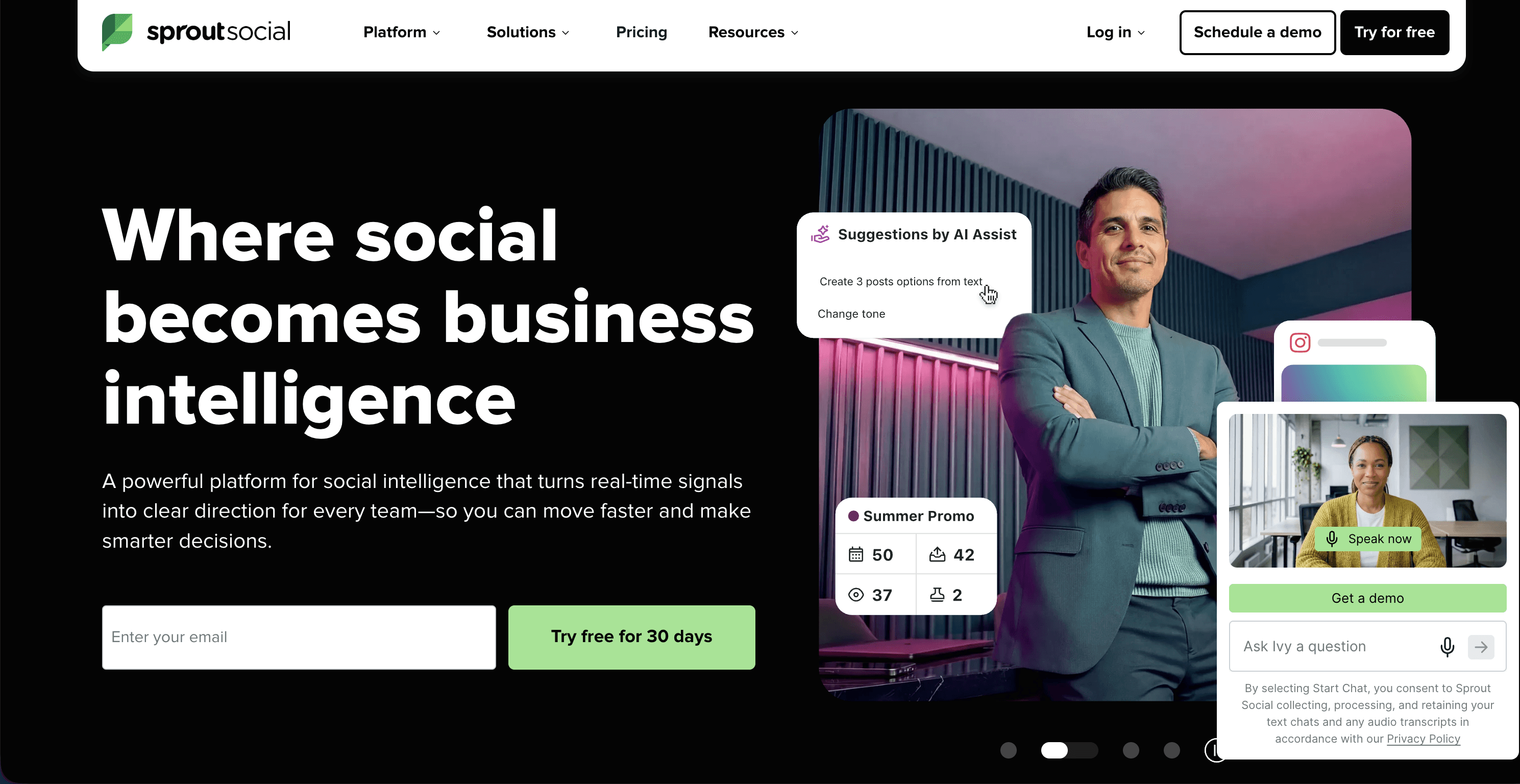
Sprout Social is a social media management platform that adds listening, sentiment analysis, and reporting on top of publishing and engagement tools, making it a common pick for marketing teams tracking Voice of the Customer software conversations at scale.
Sprout Social provides:
Social listening: Monitors brand mentions and keyword conversations across social platforms and the wider web.
Sentiment analysis: Flags positive, negative, and neutral mentions within the listening module.
Competitive reporting: Benchmarks brand performance against named competitors.
AI Assist: Helps teams draft and refine social posts and replies.
Sprout Social’s base plans start at $79 per seat per month, billed annually. Listening and premium analytics are sold as separate add-ons with custom pricing.
Conclusion: Selecting the Right VoC Tools for Your Business
Choosing the right voice of the customer tool comes down to where your feedback already lives. Contact centers get the most value from platforms like Level AI that analyze conversations directly, without surveys. Enterprise CX teams juggling surveys, reviews, and support tickets may lean toward Qualtrics, Medallia, or Chattermill. Marketing teams tracking brand perception outside of direct support channels need social listening tools like Brandwatch, Meltwater, or Sprout Social. Whichever category fits your team, prioritize platforms that detect real customer intent instead of relying on keyword matching alone.
Interested in adding Voice of the Customer tools to your process? Book a call with Level AI today to learn how we can help increase your brand’s customer satisfaction scores and call center performance.
" transform="translate(85.643 10.143)" width="23.725855670103115px"/><path d="M 71.828 0 L 0 50.702" fill="transparent" height="50.70235051546392px" id="TnJFUMH9b" stroke-dasharray="" stroke-linecap="butt" stroke-linejoin="miter" stroke-miterlimit="10" stroke-width="0.68" stroke="rgb(254, 250, 241)" transform="translate(85.508 75.029)" width="71.82828865979384px"/><path d="M 81.579 0 L 0 52.003" fill="transparent" height="52.00280412371134px" id="ccJzhVTGI" stroke-dasharray="" stroke-linecap="butt" stroke-linejoin="miter" stroke-miterlimit="10" stroke-width="0.68" stroke="rgb(254, 250, 241)" transform="translate(85.495 73.738)" width="81.57921649484533px"/><path d="M 65.653 0 L 0 32.827" fill="transparent" height="32.826556701030924px" id="X0Vp_q8HG" stroke-dasharray="" stroke-linecap="butt" stroke-linejoin="miter" stroke-miterlimit="10" stroke-width="0.68" stroke="rgb(254, 250, 241)" transform="translate(85.462 92.931)" width="65.65311340206183px"/><path d="M 88.08 14.951 L 0 0" fill="transparent" height="14.950762886597914px" id="JM_UgSiJ_" stroke-dasharray="" stroke-linecap="butt" stroke-linejoin="miter" stroke-miterlimit="10" stroke-width="0.68" stroke="rgb(254, 250, 241)" transform="translate(86.233 125.789)" width="88.07950515463914px"/><path d="M 83.204 72.803 L 0 0" fill="transparent" height="72.80313402061856px" id="KlyUUjlMK" stroke-dasharray="" stroke-linecap="butt" stroke-linejoin="miter" stroke-miterlimit="10" stroke-width="0.68" stroke="rgb(254, 250, 241)" transform="translate(85.089 125.71)" width="83.20379381443304px"/><path d="M 7.8 114.081 L 0 0" fill="transparent" height="114.08065979381445px" id="kAiUvduBR" stroke-dasharray="" stroke-linecap="butt" stroke-linejoin="miter" stroke-miterlimit="10" stroke-width="0.68" stroke="rgb(254, 250, 241)" transform="translate(85.95 125.478)" width="7.800247422680428px"/><path d="M 0 93.604 L 9.75 0" fill="transparent" height="93.60445360824741px" id="FsgTAQB0n" stroke-dasharray="" stroke-linecap="butt" stroke-linejoin="miter" stroke-miterlimit="10" stroke-width="0.68" stroke="rgb(254, 250, 241)" transform="translate(76.2 125.421)" width="9.750432989690694px"/><path d="M 0 76.379 L 76.703 0" fill="transparent" height="76.37888659793816px" id="NxOhHvPJ5" stroke-dasharray="" stroke-linecap="butt" stroke-linejoin="miter" stroke-miterlimit="10" stroke-width="0.68" stroke="rgb(254, 250, 241)" transform="translate(9.343 125.217)" width="76.7034556701031px"/><path d="M 0 26.651 L 39.002 0" fill="transparent" height="26.651381443298988px" id="QETNKJ3L6" stroke-dasharray="" stroke-linecap="butt" stroke-linejoin="miter" stroke-miterlimit="10" stroke-width="0.68" stroke="rgb(254, 250, 241)" transform="translate(47.096 125.177)" width="39.0017319587629px"/><path d="M 0 16.901 L 85.154 0" fill="transparent" height="16.900948453608265px" id="BL63wDICD" stroke-dasharray="" stroke-linecap="butt" stroke-linejoin="miter" stroke-miterlimit="10" stroke-width="0.68" stroke="rgb(254, 250, 241)" transform="translate(0.094 125.125)" width="85.15396503092786px"/><path d="M 0 0 L 78.004 17.876" fill="transparent" height="17.875793814432996px" id="PIX70Vlqf" stroke-dasharray="" stroke-linecap="butt" stroke-linejoin="miter" stroke-miterlimit="10" stroke-width="0.68" stroke="rgb(254, 250, 241)" transform="translate(8.362 107.251)" width="78.00376082474227px"/><path d="M 0 0 L 67.928 52.327" fill="transparent" height="52.32742268041238px" id="u_syqWqWD" stroke-dasharray="" stroke-linecap="butt" stroke-linejoin="miter" stroke-miterlimit="10" stroke-width="0.68" stroke="rgb(254, 250, 241)" transform="translate(17.593 72.861)" width="67.92826391752578px"/><path d="M 0 0 L 77.029 70.528" fill="transparent" height="70.52832989690722px" id="DmW_aE2A0" stroke-dasharray="" stroke-linecap="butt" stroke-linejoin="miter" stroke-miterlimit="10" stroke-width="0.68" stroke="rgb(254, 250, 241)" transform="translate(9.489 54.678)" width="77.02866804123713px"/><path d="M 0 0 L 27.301 126.431" fill="transparent" height="126.43109443298971px" id="JrLaRUubC" stroke-dasharray="" stroke-linecap="butt" stroke-linejoin="miter" stroke-miterlimit="10" stroke-width="0.68" stroke="rgb(254, 250, 241)" transform="translate(58.341 -0.071)" width="27.30111340206188px"/><path d="M 0 4.012 C 0 1.796 1.796 0 4.012 0 C 6.228 0 8.025 1.796 8.025 4.012 C 8.025 6.228 6.228 8.025 4.012 8.025 C 1.796 8.025 0 6.228 0 4.012 Z" fill="rgb(254, 80, 0)" height="8.024669690721652px" id="Nh5qrPJs_" transform="translate(81.396 121.369)" width="8.024669690721623px"/></svg>)
1. What is Voice of the Customer (VoC) software?
A. VoC software collects and analyzes customer feedback from sources like calls, chats, emails, surveys, and social media. It helps teams spot recurring issues, track sentiment, and act on customer concerns without reviewing every interaction manually.
2. What features should I look for in voice of customer software?
A. Look for omnichannel feedback collection, sentiment analysis that goes beyond positive or negative, dashboards and reporting, and integrations with your CRM or help desk. Tools that use natural language understanding, rather than keyword matching, catch customer intent more accurately.
3. What's the difference between VoC tools for customer success and VoC tools for marketing?
A. Customer success VoC tools, like Level AI, Qualtrics, and Medallia, analyze direct customer interactions, such as calls, chats, and support tickets. Marketing VoC tools, like Brandwatch and Sprout Social, focus on public conversations across social media and the web.
4. How is Level AI different from traditional VoC survey tools?
A. Level AI analyzes customer conversations directly, using natural language understanding and generative AI, instead of relying on customer surveys. This removes survey response gaps and lets teams review up to 100% of customer interactions.
5. Which VoC tool is best for enterprise contact centers?
A. Contact centers focused on call and chat volume tend to get the most value from Level AI, Verint, or Gong, since these platforms analyze conversations directly. Enterprises already running large-scale survey programs may prefer Qualtrics or Medallia instead.