
Key takeaways
Enterprises are looking beyond Replicant because they need more than voice automation. They want a platform that connects virtual agents, quality assurance, and agent coaching in one place.
Level AI stands out among Replicant alternatives because it handles both AI-powered virtual agents and the full contact center intelligence layer, including real-time coaching and automated QA.
Most Replicant alternatives specialize in either conversational automation or analytics. Very few combine both in a way that works for large enterprise teams.
Pricing, integration depth, and ease of deployment vary widely across platforms. Enterprises should evaluate based on their specific channel mix, compliance
The best alternative for your business depends on whether your priority is call deflection, agent performance, or a unified view of customer conversations across all channels.
Why Buyers Evaluate Replicant Alternatives?
Replicant built its reputation on voice automation for high-volume contact centers. It helps companies handle routine calls without a live agent. But as contact center needs grow more complex, many buyers start looking for platforms that can do more.
According to Gartner, worldwide end-user spending on conversational AI solutions within contact centers is forecast to reach nearly $2 billion, reflecting the growing enterprise investment in AI-powered customer service. As organizations invest more in these platforms, expectations have shifted beyond basic call automation. Buyers want solutions that not only automate calls but also feed insights back to human agents, flag compliance risks, and coach teams based on real conversation data.
Replicant does automation well, but it does not offer native quality assurance, real-time agent assist, or voice of the customer analytics. Enterprises that want a connected system, where virtual agents and human agents work within the same intelligence layer, often find themselves searching for something broader.
That is exactly what drives most buyers to evaluate Replicant alternatives. They are not just looking for a different voice bot. They are looking for a platform that supports their entire contact center operation..
How We Compared These Tools?
We evaluated each platform across five dimensions that matter most to enterprise buyers:
Automation depth: Can the platform handle complex, multi-turn conversations across voice and digital channels?
Integration capability: Does it connect with major CRMs, telephony providers, and workforce management tools out of the box?
Analytics and insights: Does the platform give supervisors visibility into what is happening in conversations, not just whether a call was resolved?
Agent support: Does it help live agents when the virtual agent hands off a call, or does it only handle the automated portion?
Ease of deployment and support: How long does it take to go live, and what does the vendor support model look like?
We also looked at publicly available customer reviews on G2, Capterra, and Gartner Peer Insights, as well as documented case studies from each vendor.
Top Replicant Alternatives: Comparison Table
Platform | Best For | Deployment | Integrations | Analytics | Enterprise Fit |
Level AI | Contact center intelligence | Managed | Extensive | Advanced | Excellent |
Conversational AI | Low-code | Extensive | Basic | Excellent | |
Cognigy | Voice & chat AI | Low-code | Extensive | Good | Excellent |
Retell AI | Developer voice AI | API | Good | Limited | Moderate |
Bland AI | API voice automation | API | Good | Limited | Moderate |
CloudTalk | Cloud telephony | SaaS | Good | Basic | Good |
Parloa | Enterprise automation | Low-code | Good | Good | Excellent |
Omnichannel support | Low-code | Good | Basic | Excellent | |
LivePerson | Digital CX | Managed | Extensive | Good | Excellent |
Aisera | IT service automation | Managed | Extensive | Basic | Excellent |
Top Replicant Alternatives In 2026
1. Level AI
Level AI is a contact center intelligence platform built for enterprises that need both AI-powered virtual agents and a full layer of conversation analytics, quality assurance, and real-time agent support. Unlike most Replicant alternatives that focus on one layer of the contact center, Level AI connects all of them.
The platform includes an AI virtual agent that handles inbound voice and digital interactions, a real-time agent assist layer that surfaces answers and guidance during live calls, and an automated QA engine that scores 100% of conversations without manual review. This means supervisors are not choosing between automating customer interactions or understanding them. They get both from a single platform.
Level AI is built for enterprise scale. It works across industries including financial services, healthcare, retail, and insurance. The platform integrates with major CRMs and telephony systems, making it practical for teams that already have established tech stacks. Deployment is supported by a dedicated team, and Level AI is known for treating customers as partners through the implementation process.
Paul Harraghty, VP of Global CARE, VistaPrint
VistaPrint reduced over-crediting from 20% to 8%, cut QA and coaching effort by 80%, and brought calibration variance down from over 20% to just 9%, all within the same platform.
Key Features
AI virtual agent for voice and digital channels that handles routine and complex queries
Real-time agent assist that surfaces answers, prompts, and next steps during live calls
Automated quality assurance that scores 100% of conversations without manual effort
Agent coaching tools that identify performance gaps and suggest targeted training
Voice of the customer insights that surface trends from every interaction
Inferred CSAT scoring that estimates customer satisfaction without post-call surveys
Speech analytics for identifying key moments, compliance risks, and coaching opportunities
Integrations with leading CRMs, telephony platforms, and workforce management tools
Strengths
One of the only platforms that combines virtual agents, real-time assist, and automated QA in a single system
Strong performance in regulated industries like financial services, healthcare, and insurance
100% conversation coverage through automated scoring eliminates sampling bias in quality reviews
Recognized for close customer partnerships and strong implementation support
Inferred CSAT removes the dependency on post-call surveys for measuring customer experience
Built for enterprise scale with proven deployments across large contact center teams
Best For
Level AI is best for enterprise contact centers that want to automate customer interactions and also improve agent performance and customer experience visibility from the same platform. It is a strong fit for teams in financial services, healthcare, retail, and insurance that need compliance-ready, scalable AI across voice and digital channels.
" transform="translate(85.643 10.143)" width="23.725855670103115px"/><path d="M 71.828 0 L 0 50.702" fill="transparent" height="50.70235051546392px" id="TnJFUMH9b" stroke-dasharray="" stroke-linecap="butt" stroke-linejoin="miter" stroke-miterlimit="10" stroke-width="0.68" stroke="rgb(254, 250, 241)" transform="translate(85.508 75.029)" width="71.82828865979384px"/><path d="M 81.579 0 L 0 52.003" fill="transparent" height="52.00280412371134px" id="ccJzhVTGI" stroke-dasharray="" stroke-linecap="butt" stroke-linejoin="miter" stroke-miterlimit="10" stroke-width="0.68" stroke="rgb(254, 250, 241)" transform="translate(85.495 73.738)" width="81.57921649484533px"/><path d="M 65.653 0 L 0 32.827" fill="transparent" height="32.826556701030924px" id="X0Vp_q8HG" stroke-dasharray="" stroke-linecap="butt" stroke-linejoin="miter" stroke-miterlimit="10" stroke-width="0.68" stroke="rgb(254, 250, 241)" transform="translate(85.462 92.931)" width="65.65311340206183px"/><path d="M 88.08 14.951 L 0 0" fill="transparent" height="14.950762886597914px" id="JM_UgSiJ_" stroke-dasharray="" stroke-linecap="butt" stroke-linejoin="miter" stroke-miterlimit="10" stroke-width="0.68" stroke="rgb(254, 250, 241)" transform="translate(86.233 125.789)" width="88.07950515463914px"/><path d="M 83.204 72.803 L 0 0" fill="transparent" height="72.80313402061856px" id="KlyUUjlMK" stroke-dasharray="" stroke-linecap="butt" stroke-linejoin="miter" stroke-miterlimit="10" stroke-width="0.68" stroke="rgb(254, 250, 241)" transform="translate(85.089 125.71)" width="83.20379381443304px"/><path d="M 7.8 114.081 L 0 0" fill="transparent" height="114.08065979381445px" id="kAiUvduBR" stroke-dasharray="" stroke-linecap="butt" stroke-linejoin="miter" stroke-miterlimit="10" stroke-width="0.68" stroke="rgb(254, 250, 241)" transform="translate(85.95 125.478)" width="7.800247422680428px"/><path d="M 0 93.604 L 9.75 0" fill="transparent" height="93.60445360824741px" id="FsgTAQB0n" stroke-dasharray="" stroke-linecap="butt" stroke-linejoin="miter" stroke-miterlimit="10" stroke-width="0.68" stroke="rgb(254, 250, 241)" transform="translate(76.2 125.421)" width="9.750432989690694px"/><path d="M 0 76.379 L 76.703 0" fill="transparent" height="76.37888659793816px" id="NxOhHvPJ5" stroke-dasharray="" stroke-linecap="butt" stroke-linejoin="miter" stroke-miterlimit="10" stroke-width="0.68" stroke="rgb(254, 250, 241)" transform="translate(9.343 125.217)" width="76.7034556701031px"/><path d="M 0 26.651 L 39.002 0" fill="transparent" height="26.651381443298988px" id="QETNKJ3L6" stroke-dasharray="" stroke-linecap="butt" stroke-linejoin="miter" stroke-miterlimit="10" stroke-width="0.68" stroke="rgb(254, 250, 241)" transform="translate(47.096 125.177)" width="39.0017319587629px"/><path d="M 0 16.901 L 85.154 0" fill="transparent" height="16.900948453608265px" id="BL63wDICD" stroke-dasharray="" stroke-linecap="butt" stroke-linejoin="miter" stroke-miterlimit="10" stroke-width="0.68" stroke="rgb(254, 250, 241)" transform="translate(0.094 125.125)" width="85.15396503092786px"/><path d="M 0 0 L 78.004 17.876" fill="transparent" height="17.875793814432996px" id="PIX70Vlqf" stroke-dasharray="" stroke-linecap="butt" stroke-linejoin="miter" stroke-miterlimit="10" stroke-width="0.68" stroke="rgb(254, 250, 241)" transform="translate(8.362 107.251)" width="78.00376082474227px"/><path d="M 0 0 L 67.928 52.327" fill="transparent" height="52.32742268041238px" id="u_syqWqWD" stroke-dasharray="" stroke-linecap="butt" stroke-linejoin="miter" stroke-miterlimit="10" stroke-width="0.68" stroke="rgb(254, 250, 241)" transform="translate(17.593 72.861)" width="67.92826391752578px"/><path d="M 0 0 L 77.029 70.528" fill="transparent" height="70.52832989690722px" id="DmW_aE2A0" stroke-dasharray="" stroke-linecap="butt" stroke-linejoin="miter" stroke-miterlimit="10" stroke-width="0.68" stroke="rgb(254, 250, 241)" transform="translate(9.489 54.678)" width="77.02866804123713px"/><path d="M 0 0 L 27.301 126.431" fill="transparent" height="126.43109443298971px" id="JrLaRUubC" stroke-dasharray="" stroke-linecap="butt" stroke-linejoin="miter" stroke-miterlimit="10" stroke-width="0.68" stroke="rgb(254, 250, 241)" transform="translate(58.341 -0.071)" width="27.30111340206188px"/><path d="M 0 4.012 C 0 1.796 1.796 0 4.012 0 C 6.228 0 8.025 1.796 8.025 4.012 C 8.025 6.228 6.228 8.025 4.012 8.025 C 1.796 8.025 0 6.228 0 4.012 Z" fill="rgb(254, 80, 0)" height="8.024669690721652px" id="Nh5qrPJs_" transform="translate(81.396 121.369)" width="8.024669690721623px"/></svg>)
2. Kore.ai
Kore.ai is an enterprise conversational AI platform that helps companies build, deploy, and manage virtual assistants across voice and digital channels. The platform offers a low-code environment for building complex bot flows, making it accessible to both technical teams and business users.
Kore.ai is strong on omnichannel reach. It supports deployments across web chat, email, SMS, voice, and messaging apps. Large enterprises with fragmented channel setups often find value in its ability to unify bot experiences across all of them. The platform also has tools for intent detection and natural language understanding, which help bots handle varied customer inputs without breaking down.
One area where Kore.ai differs from Replicant is its focus on enterprise IT and HR use cases in addition to customer service. This makes it a versatile choice for organizations that want to automate across multiple departments. However, teams that are specifically focused on contact center AI solutions may find the platform broader than they need.
Kore.ai does not offer deep quality assurance or real-time agent coaching natively. Teams that want those capabilities will need to integrate third-party tools or accept gaps in their contact center intelligence layer.
Key Features
Low-code bot builder for creating complex multi-turn conversational flows
Omnichannel deployment across voice, chat, email, and messaging platforms
Pre-built industry templates for banking, healthcare, retail, and telecom
Natural language understanding for handling varied user inputs
Integration with Salesforce, ServiceNow, and other enterprise systems
Agent handoff capabilities with context transfer to live agents
Analytics dashboard for tracking bot performance and containment rates
Strengths
Very broad channel coverage for enterprises with complex omnichannel environments
Strong low-code tooling lets non-developers build and modify bot flows
Good fit for enterprises that want to automate across IT, HR, and customer service
Pre-built templates reduce time to deployment for common industry use cases
Large ecosystem of integrations with enterprise software
Weaknesses
Native quality assurance and agent coaching capabilities are limited
Can feel complex to configure and maintain for smaller or less technical teams
Pricing and licensing can be difficult to predict as usage scales
Best For
Kore.ai works best for large enterprises that need to deploy conversational AI across multiple departments and channels. It is a solid choice for teams that have strong technical resources and want to build customized bot experiences at scale.
3. Cognigy
Cognigy is an enterprise conversational AI platform with a strong reputation for voice and chat automation in complex environments. It is particularly well-known in European markets but has a growing presence in North America and globally.
The platform is built around its Cognigy.AI environment, which gives developers and bot designers a visual interface for building advanced conversation flows. It supports both voice and digital channels and is known for its flexibility when it comes to integrating with enterprise telephony systems. Many large contact centers use Cognigy to replace legacy IVR systems with more intelligent, dynamic voice experiences.
Cognigy also offers a real-time agent assist layer called Cognigy Copilot. This gives live agents suggestions and information during calls, which sets it apart from simpler automation-only platforms. However, its analytics and quality assurance capabilities are not as deep as dedicated QA platforms.
For companies evaluating Replicant alternatives that focus primarily on voice automation with added agent assist, Cognigy is one of the stronger options in the market. Teams that also need robust coaching workflows or full conversation analytics will need to supplement it with additional tools.
Key Features
Visual flow builder for creating complex voice and chat conversation flows
Support for voice, web chat, SMS, email, and messaging apps
Cognigy Copilot for real-time agent assist during live interactions
Out-of-the-box integrations with Avaya, Genesys, Cisco, and other telephony platforms
Multilingual support across a wide range of languages
Pre-built connectors for Salesforce, SAP, and ServiceNow
Low-latency voice processing for natural-sounding automated calls
Strengths
Highly flexible platform for building advanced voice automation flows
Real-time agent assist through Cognigy Copilot adds value beyond pure automation
Strong integration ecosystem with enterprise telephony and CRM tools
Proven at scale for large enterprise contact centers
Multilingual support makes it useful for global operations
Weaknesses
Quality assurance and analytics capabilities are limited compared to specialized tools
Implementation can be lengthy and resource-intensive for complex deployments
May require significant developer involvement to unlock the full range of capabilities
Best For
Cognigy works best for large enterprises that need flexible, enterprise-grade voice and chat automation with added live agent support. It is particularly well-suited for organizations replacing legacy IVR systems or running contact centers across multiple regions and languages.
4. Retell AI
Retell AI is a newer voice AI platform aimed at teams that want to build and deploy voice agents quickly. It has gained attention in developer and startup circles for its fast setup, clean API, and natural-sounding voice output. Unlike enterprise platforms that require lengthy implementation projects, Retell AI is designed to get a working voice agent live in a short amount of time.
The platform allows developers to build custom voice agent workflows using its API, and it supports integrations with popular backend systems. Retell AI is often praised for the quality of its text-to-speech output, which sounds more conversational than many older systems. This makes it a good choice for teams that want AI phone calls to feel natural without heavy customization work.
However, Retell AI is not built for enterprise contact centers at scale. It lacks native tools for agent coaching, quality assurance, or conversation analytics. Teams using Retell AI in an enterprise setting will need to build or buy these capabilities separately. It is also primarily a voice-only platform, which limits its usefulness for teams with omnichannel requirements. For more context on how virtual agents differ from chatbots, see virtual agent vs chatbot.
Key Features
Developer-friendly API for building custom voice agent workflows
High-quality text-to-speech for natural-sounding automated calls
Low-latency voice processing for responsive conversations
Webhook support for connecting to external systems and databases
Prebuilt templates for common use cases like appointment scheduling and FAQ handling
Support for call recording and basic call logs
Pay-as-you-go pricing based on usage volume
Strengths
Very fast to set up and deploy compared to enterprise platforms
Strong voice quality that produces natural-sounding automated calls
Developer-friendly with clean API documentation
Affordable for low-to-mid volume use cases
Good fit for proof-of-concept projects and pilot deployments
Weaknesses
Not built for enterprise scale or complex multi-department operations
No native QA, agent coaching, or analytics tools
Limited to voice, with no native omnichannel capability
Best For
Retell AI is best for startups, small teams, or technical users who want to get a voice AI agent running quickly without a long implementation process. It is not suited for enterprise contact centers that need analytics, QA, or omnichannel automation.
5. Bland AI
Bland AI is a developer-focused voice AI platform that lets teams build AI phone agents using a simple API. Like Retell AI, it targets a technical audience that wants to create custom voice workflows without managing complex infrastructure. Bland AI is often positioned around outbound calling use cases like lead follow-up, appointment reminders, and survey collection.
The platform supports custom voice personas, meaning teams can configure the tone, pace, and style of AI-generated speech. It also supports integration with external data sources so phone agents can pull in dynamic information during a call. Bland AI processes calls at low latency, which helps conversations feel smooth rather than robotic.
From an enterprise contact center perspective, Bland AI has significant gaps. It does not offer tools for real-time agent assist, quality monitoring, or workforce analytics. It is built primarily for outbound calling automation rather than the full inbound contact center operation that tools like Replicant address. Teams looking for a platform that covers the complete contact center workflow will find Bland AI too narrow.
Key Features
Simple API for building outbound and inbound AI voice agents
Custom voice personas with adjustable tone and speaking style
Integration with external databases for dynamic call content
Call scripting tools for building conversation flows
Basic call logging and recording
Webhook support for triggering actions based on call outcomes
Pay-per-minute pricing model
Strengths
Very low barrier to entry for technical teams
Flexible for building highly customized outbound calling workflows
Good voice quality with support for custom personas
Transparent, usage-based pricing is easy to understand
Weaknesses
No QA, coaching, or analytics built in
Not designed for enterprise inbound contact center operations
Limited channel support beyond voice
Best For
Bland AI is best for product and engineering teams that want to automate outbound phone interactions like reminders, follow-ups, or data collection. It is not a good fit for enterprise contact centers with complex inbound support operations.
6. CloudTalk
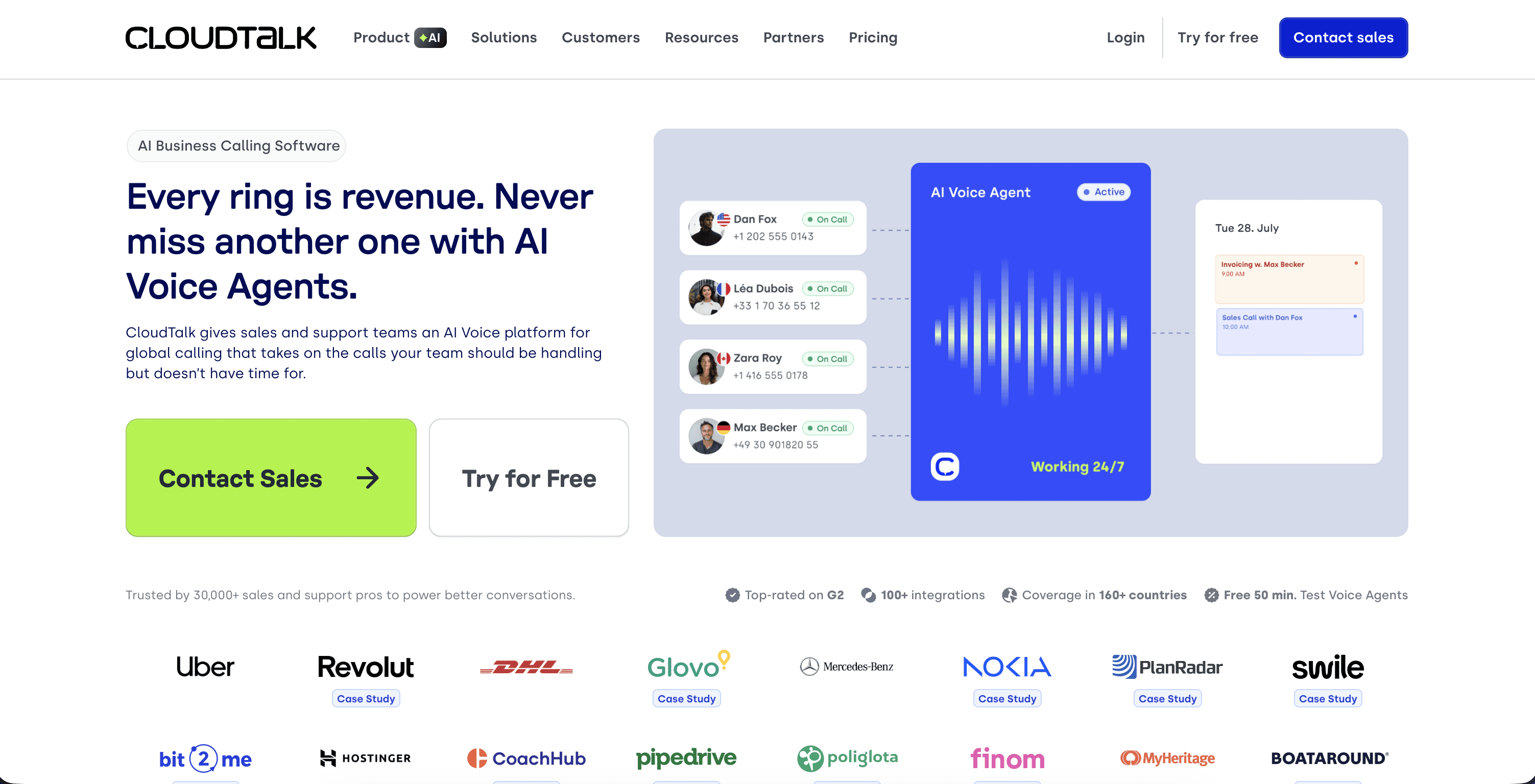
CloudTalk is a cloud-based phone system designed for sales and support teams. It offers call routing, IVR, call recording, and basic analytics as part of its core product. In recent years, CloudTalk has added AI features including call transcription, topic detection, and conversation summaries.
CloudTalk is not a virtual agent platform in the same sense as Replicant or other alternatives on this list. It does not automate conversations end-to-end without a human. Instead, it is a calling platform that adds AI features to improve the experience for live agents and managers. This makes it a useful tool for teams that want better call visibility, but not a true like-for-like replacement for Replicant’s automation capabilities.
Where CloudTalk stands out is in its ease of setup and its pricing model, which is more accessible for smaller teams. It integrates with popular CRMs like HubSpot and Pipedrive and is often used by sales teams that rely heavily on outbound calling. Teams looking for call center analytics software alongside a cloud phone system may find it a practical fit..
Key Features
Cloud calling with intelligent call routing and IVR
AI-powered call transcription and conversation summaries
Integration with HubSpot, Salesforce, Pipedrive, and other CRMs
Call recording and playback for coaching and compliance
Real-time dashboards for monitoring queue and agent performance
Power dialer for outbound sales teams
Basic sentiment detection and topic tagging
Strengths
Easy to set up with minimal technical overhead
Good integration ecosystem for sales-focused teams
Transparent per-seat pricing makes budgeting straightforward
Useful AI summaries reduce post-call wrap-up time for agents
Strong outbound calling tools for sales operations
Weaknesses
Not a true end-to-end virtual agent platform
AI capabilities are less mature compared to dedicated conversational AI tools
Limited suitability for high-volume inbound contact center operations
Best For
CloudTalk is best for small to mid-sized sales and support teams that need a cloud phone system with basic AI features. It is not a good fit for enterprises looking to automate large volumes of inbound customer interactions without live agents.
7. Parloa

Parloa is a conversational AI platform focused on automating voice and chat interactions for enterprise contact centers. It has strong roots in European markets and is known for its compliance-ready architecture, which appeals to companies operating under GDPR and other data protection regulations.
The platform supports both voice and digital channel automation and offers a visual interface for building conversation flows. Parloa has positioned itself around making bot-building accessible to business teams, not just developers. It also offers integration with major telephony providers used in European markets.
Parloa is purpose-built for contact center automation, which gives it an edge over more general conversational AI platforms. However, its coverage of the full intelligence layer, including agent coaching and automated QA, is limited compared to platforms like Level AI. Teams that want deep post-call analytics or real-time agent support will need to look at additional tools.
You can also explore top Parloa alternatives if you want more options in this space.
Key Features
Visual flow builder for voice and chat automation without heavy coding
Voice AI that integrates with Avaya, Genesys, and other telephony platforms
GDPR-compliant data handling and architecture
Multilingual support for European and global deployments
Live agent handoff with conversation context transfer
Analytics dashboard for tracking bot containment and resolution rates
Pre-built connectors for common enterprise CRMs
Strengths
Strong compliance posture for enterprises operating under GDPR
Business-friendly interface that reduces reliance on developer resources
Good telephony integration for companies using legacy contact center infrastructure
Purpose-built for contact center automation rather than general enterprise AI
Multilingual support is strong for European language requirements
Weaknesses
Less well-known in North American markets, with smaller customer base there
Native QA and agent coaching capabilities are limited
May require supplementary tools for teams needing deep conversation analytics
Best For
Parloa is best for European enterprises that need compliant, scalable voice and chat automation with a business-friendly setup process. It is a good choice for organizations on Avaya or Genesys infrastructure that want to modernize their IVR without a full platform migration.
8. Yellow.ai
Yellow.ai is a conversational AI platform focused on omnichannel automation for customer service and employee support. It covers a wide range of channels including voice, web chat, WhatsApp, email, and social messaging apps. Yellow.ai has a strong presence in the Asia-Pacific region and is growing its footprint in North America and Europe.
The platform uses a combination of generative AI and rule-based flows to handle customer queries across channels. It supports both self-service automation and live agent handoff, making it adaptable for contact centers that blend automated and human-assisted service. Yellow.ai also has a marketplace of pre-built templates for common industries and use cases, which can speed up deployment.
From an enterprise contact center perspective, Yellow.ai covers automation well, but its analytics and quality management tools are basic compared to specialized platforms. Teams that need deep voice of the customer insights or automated QA scoring will need to integrate additional tools. The platform is also noted for having a steeper learning curve for advanced customization. You can also read about Yellow AI alternatives for more context.
Key Features
Omnichannel automation across voice, chat, WhatsApp, email, and social
Generative AI capabilities for handling open-ended customer queries
Live agent handoff with full conversation history transfer
Pre-built industry templates for retail, BFSI, healthcare, and more
Multilingual support across 100-plus languages
Analytics dashboard for tracking containment, CSAT, and bot performance
Integration with Salesforce, Zendesk, and other CRMs
Strengths
Very broad channel coverage including messaging apps and social platforms
Strong multilingual support for global enterprise deployments
Generative AI integration makes bots more flexible in handling varied queries
Large template library speeds up time to deployment
Active in multiple global markets including APAC, Middle East, and Europe
Weaknesses
Quality assurance and coaching tools are basic compared to specialist platforms
Advanced customization can have a steep learning curve
Customer support quality has been reported as inconsistent in some reviews
Best For
Yellow.ai is best for mid-market and enterprise companies with omnichannel customer service needs across global markets. It is a particularly strong fit for organizations in Asia-Pacific or the Middle East that need multilingual bot automation at scale.
9. LivePerson

LivePerson is a conversational AI and digital messaging platform with a long track record in enterprise customer engagement. It originally focused on live chat before expanding into AI-driven automation. Today, LivePerson’s Conversational Cloud platform handles messaging automation across web, app, SMS, WhatsApp, and voice channels.
LivePerson is one of the more established names in the enterprise digital engagement space. Its platform supports both automated and human-assisted conversations, with tools for routing, orchestration, and analytics. The company has invested in generative AI to enhance its automation capabilities and improve the quality of bot responses.
LivePerson’s real-time agent assist capabilities give it an edge over simpler automation-only platforms. Agents can receive suggestions and AI-generated responses during conversations, which helps with speed and consistency. However, LivePerson is primarily digital-first. Teams whose primary channel is inbound voice calls may find it less suited to their needs than voice-focused platforms. For enterprises prioritizing digital messaging at scale, it is worth a close look alongside AI tools for customer service.
Key Features
Conversational AI across messaging, web chat, SMS, WhatsApp, and voice
Generative AI-powered bot responses for handling open-ended queries
Real-time agent assist for live conversation support
Conversation routing and orchestration across channels
Intent detection and analytics for understanding what customers are asking
Integration with Salesforce, Genesys, Avaya, and other enterprise platforms
Analytics dashboard for tracking automation rates and customer satisfaction
Strengths
Strong track record in large enterprise digital messaging environments
Real-time agent assist adds value beyond pure automation
Broad channel coverage including major messaging apps
Established integrations with enterprise CRM and telephony systems
Generative AI integration improves bot flexibility
Weaknesses
Less suited for voice-first or inbound call center operations
Pricing can be complex and difficult to predict as conversation volume grows
Some customers report the platform can feel heavy for teams with simpler needs
Best For
LivePerson is best for large enterprises with significant digital messaging volume across channels like web, app, and WhatsApp. It works well for companies that blend automated and human-assisted digital conversations and need real-time agent support tools built in.
10. Aisera
Aisera is an AI platform focused on automating service desk operations across IT, HR, and customer service. It uses generative AI to handle employee and customer requests through conversational interfaces, reducing the volume of tickets that require human attention.
Aisera’s approach centers on what it calls AI Service Management. The platform can connect to existing ITSM tools like ServiceNow, Jira, and Zendesk and handle routine requests through natural language conversations. Employees can ask questions, reset passwords, or request information through chat or voice without opening a ticket. This makes Aisera particularly valuable in large organizations with high volumes of repetitive internal service requests.
However, Aisera is not a traditional contact center platform. Its focus on IT and HR service automation means it lacks the kind of customer-facing voice automation, agent coaching, or quality assurance tools that enterprise contact center leaders need. Teams evaluating Replicant alternatives for customer-facing operations will likely find Aisera too narrowly focused. It is better categorized as an enterprise service automation tool than a contact center AI platform. Teams in workforce optimization should also factor this in.
Key Features
Generative AI for automating IT, HR, and customer service requests
Integration with ServiceNow, Jira, Zendesk, and other ITSM platforms
Conversational interface for employee self-service
Automated ticket resolution and routing
Voice and chat channel support
Knowledge base search integrated into conversational flows
Analytics for tracking automation rates and resolution times
Strengths
Strong at automating high-volume IT and HR service requests
Deep integration with popular ITSM platforms
Generative AI improves accuracy of responses to varied employee queries
Good fit for large enterprises with distributed workforces
Can reduce ticket volume significantly for service desk operations
Weaknesses
Not designed for customer-facing inbound contact center operations
Limited quality assurance, coaching, or CX analytics tools
Less suitable for voice-heavy contact center environments
Best For
Aisera is best for large enterprises that want to automate IT and HR service desk operations at scale. It is not a direct Replicant alternative for customer-facing contact centers but may complement a broader automation strategy for internal service teams.
Wrapping Up: Enabling Smarter, More Scalable Customer Support With Level AI
Replicant is good at one thing: automating routine inbound voice calls so live agents can focus on more complex interactions. But contact center leaders today need more than call deflection. They need to know what is happening inside every conversation, coach agents based on real data, and measure customer experience without depending on survey responses.
That is exactly what Level AI delivers. Its AI virtual agent handles inbound and outbound interactions across voice and digital channels. Its automated QA engine scores every conversation without manual sampling. Its real-time agent assist helps live agents in the moment, and its coaching tools help managers build better teams over time.
Unlike Replicant, Level AI gives you a complete picture of your contact center, from what customers are saying, to how agents are responding, to where there are gaps that need attention. And unlike platforms that specialize only in analytics or only in automation, Level AI brings both together in one place.
For enterprise contact center leaders looking for a Replicant alternative that is built for scale, works in regulated industries, and goes deeper than call automation, Level AI is one of the strongest options available today. You can explore how it compares directly on the Level AI features overview page.
Frequently Asked Questions
1. What is the main difference between Replicant and its alternatives?
Replicant is focused specifically on automating inbound voice calls. Many of its alternatives, including Level AI, go further by combining virtual agent automation with tools for agent coaching, quality assurance, and customer experience analytics. The right choice depends on whether you need automation only or a more complete contact center intelligence platform.
2. Is Level AI a good replacement for Replicant?
Yes, especially for enterprises that want more than call deflection. Level AI includes a full virtual agent for voice and digital channels, plus automated QA, real-time agent assist, and conversation analytics. This makes it a broader platform than Replicant for teams that want a single system to handle automation and contact center intelligence together.
3. Which Replicant alternative is best for small businesses?
Retell AI and Bland AI are the most accessible options for smaller teams or startups. They offer usage-based pricing and fast setup. However, they lack the enterprise-grade analytics, QA, and coaching tools that larger operations need.
Can I use a Replicant alternative alongside my existing CRM and phone system?
Most platforms on this list integrate with major CRMs like Salesforce and Zendesk and telephony providers like Genesys and Avaya. Level AI, Cognigy, and LivePerson have some of the deepest integration ecosystems. It is worth checking specific integrations for your stack before making a decision.
5.How long does it take to deploy a Replicant alternative like Level AI?
Deployment timelines vary based on the complexity of your workflows and integrations. Enterprise platforms like Level AI typically involve a structured onboarding process with vendor support. Teams that have clear use cases and well-documented processes tend to see faster time to value. Most enterprise deployments take a few weeks to a couple of months to reach full production.